Showing posts with label New Zealand. Show all posts

Wednesday, 14 October 2015

Flaunting

 
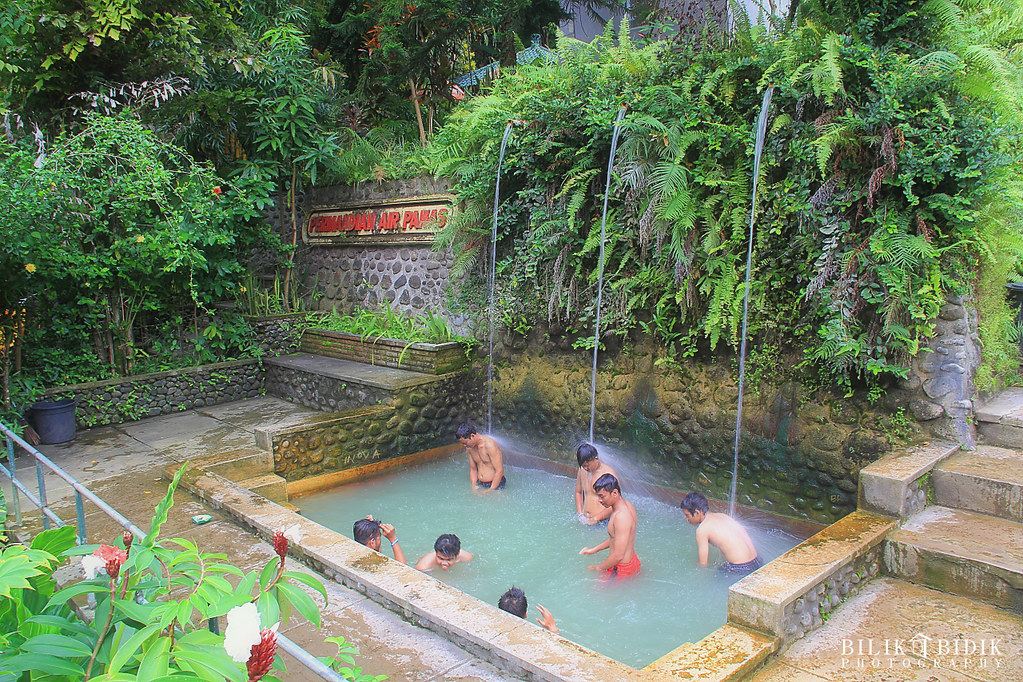
How do I start the morning in Samosir. Soaking in hot spring while enjoying a cup of hot Bandrek. [coffee] [snowflake] 
Pangururan, north Sumatra, Indonesia, source.

Solution
Regionally speaking there are not many theme's attracting attention, so let's start off this posting elsewhere on the globe.

Problems in the land of free soaking; authorities have first taken action to limit use of Umpqua hot springs (oregon, U.S.A.) after concluding that the E. Coli bacteria count was way over the limit (yuck). 
Further testing has now revealed the opposite (Oregon Live, Oct. 9):
'The Umpqua Hot Springs, about 70 miles east of Roseburg, closed to the public due to "very high" E. coli counts two weeks ago, and now forest officials say the popular springs are suffering from another possible public safety concern: bleach'.
Though the former seems to solve the latter, what is evident is the lack of management (be it government and / or volunteer). This is leading to a number of unwanted situations with health concerns being the most important. 
The bleach is also unwanted as it now affords the authorities with a real good excuse to take severe action which ultimately will mean less opportunity for soaking. 
However both situations are undesired, so in this case we just might have to have a little faith in government and hopefully the solution will only affect the less dedicated soaker ....

#nopooping #iceland  
Hrunulaug, Iceland: apparently common sense is on a wane; thus the need to heed the hordes? 
 
Also from the US, the situation surrounding the Skinnydipper hot springs is not faring well either. A latest posting on Facebook (Sep. 14):
'I started this page to save skinny dipper hot springs, we got a lot of likes (almost 10,000!) a lot of people stepped up to help and invested a lot of time and effort to "save skinny dippers" we met with the blm, spent countless hours trying to come up with solutions that remedied the concerns the blm had, remedies that could not appease them because ultimately they (the blm [= Bureau of Land Management]) wants skinny closed due to the fact there is a history of documented issues over the many years it has been open.
....
the real issue for the blm that is not being spoken about is that it is more profitable for the blm to close this beauty than to keep it open(business is business'.
So not good news

Better news from New Zealand: a geyser has sprung back to life (NZHerald, Sep. 9):
'A geyser which has been dormant for more than 35 years has caught
locals off guard after suddenly erupting'.
Though possibly they were not too surprised as the rewired geyser will hardly stand out:
'The Papakura Geyser is located at the Te Puia Te Whakarewarewa Thermal Valley in Rotorua, where there are more than 500 geothermal wonders'.
Having been there myself, there are no immediate soaking opportunities to be had nearby. 

Synchronizing
Moving on.
 
Sometimes the sprucing up of local soaks can result in something quite attractive. Dezeen magazine (May 5) reports on  a recently constructed architectural gem at Mian Yang (Sichuan). Oddly the pictures are devoid of people. Apparently it's named Well Water Resort. Cheapest rooms start at US$ 125 / night ... 

Quirky news, from Rocketnews (Oct. 7): 
'In Oita Prefecture, this means presenting their world-famous hot springs with a synchronized swimming team in what can only be known as “synchronized bathing”'.
Also published on Youtube:


Taiwan seems to frown on the attire of a Chinese soaker (Rocket News Jul. 22):
'One such visitor, reported to be a tourist from mainland China, raised a few eyebrows recently. Obviously, you can only spend so long sitting in a hot spring before you need to get out and let your body cool down again, and this man decided to spend that time browsing for souvenirs.
...
Local media has criticized the breach of etiquette, even as Taitung shopkeepers say they’ve been seeing an increasing number of tourists strolling around in public in their bathing suits after exiting the hot springs. Residents have called such conduct disgraceful. Frankly, we’re not sure which surprises us more, that the man in the video seemingly didn’t feel enough embarrassment from the stares he was getting to put on a shirt, or that he didn’t feel enough pain from pebbles in the soles of his feet to put on some shoes'.
Asia Baffled? So it seems, as reported in the Bangkok Post (Jul. 28). But the baffling this time is done by the need of young tourists to create a lasting souvenir of a visit in the region with taking a picture ... naked. Hmmm ...:
'According to Maria Lombard of Northwestern University, the need for tourists to connect with locations "in a tangible way" and the ire that it draws are not new or unique.
Ms Lombard points out that tourists have been carving initials into landmarks and historical sites for ages.
"This desire to show that "I was here" is not new; just the mode for expressing it is."
....
Local officials are also puzzled why Western tourists who flaunt their bits at revered sites in Asia refrain from doing so in their own countries in front of landmarks like St Peter's Basilica.
"They don't seem to strip off much in the Notre Dame or Hagia Sofia or any other place I can think of," said Lawrence Osborne, a bestselling author who has written extensively about the clash of culture and identity in Southeast Asia.
"Modesty and restraint are still respected virtues in the East, so stripping naked at tourist sites that are sacred or highly visible is not only taboo in these countries but a "loss-of-face" for local officials."
Others see it as a fight against conservatism ...

 
Somewhere in the Balinese mountains
Angseri hot spring, source.

Boasting
On towards more regional soaking news.
  • Indonesia
Possibly a tourist attraction in the offering according to Thinkeoenergy (Aug. 10) on Sulawesi near the town of Tomohon.
  • Malaysia
#hotspring #sohot #nature #saturday #steve #iphone6 #malaysia
Selayang hot spring, Selangor, source.
  • Philippines
Thinkgeoenergy (Sep. 8) draws attention to the Bacman geothermal power plant. Besides power generation it has a considerable environment conservation and protection project, well noted. 
From the original news source:
'Besides those we visited, the BacMan Geothermal Plant still boasts of other natural attractions that we weren’t able to check out due to time constraints. I would’ve loved to photograph the huge Golden-Crowned and Large Flying Fox bats that dot the treetops of the power plant, the Inang Maharang Mud Pool, the Naghaso Boiling Lake and the Parang Hot Spring'. 
An Experiance like no other . some peace and soul searching can be found here ! #latergram #mashtravels #chefmash #vacay #Philippines #vacay #travel #asiatrAvel #unwind #relax #greattimes #moments #airasia #manilla #hotsprings #relax #hiddengem #natural #hiddenvalley #waterfall
Hidden Valley somewhat warm springs, source.
  • Thailand
A very lengthy intro on Phra Ruang hot springs, (trip101, Sep. 9):
'Stay at Phra Ruang Hot Springs for a terrific addition to your Kamphaeng Phet [province] experience. And, if you listen to local legends, you may also take away more than you anticipated; supposedly, if you take some of the water home with you, it will bring you good fortunes and luck!'
bathing in the pai forest [herb] [leaves] #hotsprings #pai #thailand
Mae Hong Son province,  source.

Harmonious
  • Vietnam
Sometimes the description of a hot spring experience seems a bit out of here. An example of this comes from Vietnam's Yen Bai hot springs of Son Thinh and Son A. As published in Yen Bai (Oct. 6):
'In the recesses of the hot springs that Son Thinh, streams you view in Son A Tu Le and hot springs are all preferred medium.
...
At Tu Le, two hot spring baths beside cool stream and the shores are ripe rice fields. A very hot bath and a warm bath. The hot tub is more or less arbitrary per person. Whenever way down, after a day of hard work, the Thai girl to pull together down stream Tu Le, naturally shed her clothes and become the fairy between earth and sky.
At the end of the cold season: the mineral springs and wells steaming, sulfur-smelling H2S and with an average temperature of about 45 ° C, very good for health. Travelers come here also the bath, the boys are also allowed to share the bathroom, get playful harmony between nature, rest or relax in the hot water smelled of sulfur airlines between nature and details arcade arcade cold sky.
You can also dabble water, chatting with her, the girl pretty red cheeks, or the extent absolutely must keep their distance and not have bad behaviors, or they will be young men and punish law'.

Just a mud experience in Nha Trang (We live in the country, Jul. 19): 
'We opted to spend a rather luxurious day at the i-resort Nha Trang. We had a car and driver to take us round trip, and a private little villa, with our very own mud bath! The mud bath was Delicious- like chocolate soup!- and it immediately stopped all the skin irritations (I have Psoriasis) that I'd been experiencing! You actually float in the mud- but it isn't salty like the Dead Sea, and I have no idea what creates that kind of buoyancy! I loved it so much that before we left I bought two jars of the mud powder to take home- and I've been using it ever since! After our mud bath and showers, we had our massages, and enjoyed our private hot spring pools and the waterfall overlooking the mountains- the view was truly enchanting. We had lunch on the patio of our little villa, and I laid out by the pool for a bit... and all too soon it was time to leave...
Travelfish now has a section on mud baths in Nha Trang (Sep. 15). Not all is well:
'Thap Ba Hot Spring, six kilometres from downtown Nha Trang, is cheap and the most popular, which means it is usually crawling with people.
...
Baths are emptied after each round and there’s a big show to spray down the tubs, but if and how they clean the actual mud is a mystery.
....
the pools [of 100 Egg (Tram Trung)] and facilities are cleaner, tidier and better organised than Thap Ba. Our mud was pleasantly warm too, and felt velvety rather than cold and gritty like in Thap Ba'.
Treated ourselves to a mud bath because we can [pig] #danang #galina #mudbath #spa #theblondeadventure 
More mud mores catching on, now available in Danang, source

Tuesday, 14 July 2015

Stunned

Stumbled across an amazing natural hot spring in #bandung #indonesia. Had to hike up a small trail into a little rustic village to get here. #stunning #outdoors #natural #nature #landscape #hotspring #hotsprings #life #outdoors #travel #travels #water #spring

I usually start these updates with a sort of an editorial. But such was the idea for this editorial, that I will take a forthcoming full post to tackle recent developments on the subject of public access to natural soaks, public misuse and abuse and managerial measures taken as a reaction to the aforementioned.

For now, let's see what else there is to provide feedback on from the world of soaking ...

Nosy
An excerpt from an article from New Zealand (NZHerald, Apr. 21) which notices something strange:
'Last year, a writer from the Guardian newspaper asked people on Twitter for recommendations about what to do on a short visit to New Zealand. She got hundreds of responses. Broadly, they fell into two categories: those from Kiwis and those from foreigners who had visited here. And - broadly - it was the foreigners who recommended she find a thermal pool in which to soak.
Kiwis recommended vineyards, skiing, beaches, cafes in Wellington, that sort of thing. Not hot springs.
Sometimes, you miss the obvious beauty under your nose'.
On Hainan Island (China) reports have been made that a (possible forgotten) hot spring has been taken over and now functions as a bathing spot (Shanghaiist, May 14):
'The hot spring, around 500 years old, is left unmanned, and has more or less become an open-air bathing spot for people living nearby'.
It's difficult to somehow unrelate the two, is a hot spring not simultaneously a bathing spot?

A nice blog entry by onsen addict reflects on how a soak may result in cultural exchange (May 8):
'You should get naked in Japan as often as you can, not just because soaking in Japanese hot springs revitalizes your body and soul, but because Japanese onsens are places to observe and participate in cultural observation. If anybody implies that you are lazy for soaking for hours, just tell them you are doing sociological research.
...
Our conversation about Japanese hot springs continued until we all headed up the hill. Later in the parking lot way  above the hot spring, he showed us photographs that he took out from his car. We saw him and his hot-spring-addicted friends building rocky baths around natural springs in various forests. He was rightfully proud of the baths that they had constructed in remote woods. The baths were simple baths constructed from natural materials. The people I saw were members of a Japanese subculture, people who relish relaxation in natural surroundings and are willing to work hard for their sensual pleasures'.
Ever heard of the Hot Spring Traveler? She is
'A Hot Spring enthusiast on a quest to visit 365 Hot Springs. Current Tally=25'.
That's still a long way to go ...
More from Hot Spring Traveler:
'I am a water chaser. In my childhood I leaped into the waves, charged head first down slip and slides, and ran through sprinklers with my clothes on (or off). I was terrified of just about everything, but I was always chasing water. Naturally, it would make sense that I would turn this chase into a formal adventure, and so Hot Springs Traveler has been born. I am ready to chase down 365 hot springs in all their glory, from dusty desert backroads to lush northern forests.
Why hot springs? Because their surreal, secretive, calming, and wild. They feel other-worldly. You are literally bathing in waters that have traveled through the interiors of the earth'
From 7x7 (May 5) comes
'5 Best Hot Springs for Skinny Dipping in the West [of the U.S.A.]'
Heed their intro:
'It’s an age old tradition. From Japan to Iceland to the dusty backcountry of the American west, people have been soaking up the geothermal magic provided by wild hot springs since time immemorial'.
Let's hope it remains a tradition adhered to ...

So hot
The all-encompassing Huffington Post (May 6) looks into Indonesia's power questions. In particular it asks:
'Is Geothermal Power the Answer to Indonesia's Energy Demand?'
Summing up the article one could conclude the answer to be yes, if. 

There's quite a bit of geothermal power news from Indonesia.
ThinkGeoEnergy (Jul. 6) notes that Indonesia has inaugurated one geothermal project with the intention of many others all across the archipelago:
'This is clearly a step forward for geothermal and renewable power in the country, signalling a the commitment in Indonesia for geothermal development'.
Channelnews Asia (Jun. 9) also notes Indonesia's apparent ambitions:
'Indonesia aims to double its use of renewable energy in 10 years. It plans to have 30,000 megawatts of power generated from geothermal, hydro, wave and solar energy'.
Major problems lie in funding. 

Enjoying the natural Hot-springs  #hotspring#ketambe#sohot#ketambe
#sumatra #roland #ichbindra#dubischdra #kendall&kylie-collection 

In Japan, so notes ThinkGeoEnergy (Jun. 23), the debate on the merits of geothermal exploitation in their national parks continues:
'On one side, conservationists argue that directional and conventional drilling should be banned in these areas while academics and members of the geothermal industry agree that no plant should be built directly on the protected areas, but directional drilling should be allowed'.
Despite all the upbeat reactions on Indonesia's geothermal power future, all is not rosy. For instance strong local sentiment in Bali (see following) is pitted against the mights of both the national government as well as the commercial establishments. 
The Renewable Energy Magazine (Jun. 4) has a lengthy article on background of Bali's struggle:
'According to Balinese culture, mountains and forests are highly sacred because they are believed to be sources of life. As a result, environmental activists and religious members of Balism both believe that geothermal drilling in the Bedugul area would not only worsen Bail’s water crisis, but would also damage the sanctity of the area.
Though geothermal power can offer tremendous energy quantities, the governor of Bali has restated his refusal to allow the geothermal project in Bedugul in a statement from his office on May 6, 2015. He not only placed a moratorium on the construction of this location, but also reiterated the fact that this project would trespass on protected forest area in a religiously sacred area of Bali'.
To overcome opposition, the article lists a variety of approaches so as to inform and convince  those involved. Though these seem common-sense, it does miss how you can overcome environmental, spiritual and religious opposition. Relaying simple fears, fails to address these all-encompassing concerns ....
The kind of opposition that seek to win over? ThinkGeoEnergy (May 14):
'The Governor’s office said that the people of Bali would never tolerate any geothermal project that trespasses on protected forest area in a religiously sacred area of Bali. Balinese religious belief holds that the forested areas in the hills at Bedugul are home to the headwaters of Bali and must remain undisturbed'.
Ways of increasing the ability of local population to stomach geothermal power projects? Win-win solutions are just one possibility. Kenya's Kengen's Olkaria project includes a natural spa (sic). 
There's this recent visitors experience (and photo):
'On our arrival an attendant at the natural spa walked up to us and gave us a quick introduction to the site. He advised us that only those who promised to adhere to the rules of the spa would be allowed to sign in on the visitors’ book and also use the spa. We were a well mannered group and we listened to the attendant keenly as he read out the spa regulations. There was nothing he read that was out of this world, so we all signed in and off we went into the spa!'

ThinkGeoEnergy (Jul. 10) notes that now Kengen will expand their  local community initiatives to include vegetable farming in geothermal heated greenhouses.

Finally, ThinkGeoEnergy (Jun. 2) notes the fad of geothermal BBQ-ing on Lanzarote. It refers to a Daily Mail article (Jun. 1):
'Forget a portable barbecue in the park, the aptly-named El Diablo (the devil) restaurant in Lanzarote uses the 450 - 500 degrees Celsius of geothermal heat to cook the meat and fish on the menu'.
Hello
We see some inventions come by and think mûh .... 
This one could be more successful. A Hydrohammock. 
Just a waterproof hammock which you could use as a bath in far away places. Not too expensive, but if willing to have a hot bath, there's a need for a heater system. That comes at a cost of nearly a fully priced jacuzzi. The inetia (Jul. 7) thinks likewise.

A HelloKitty themed hot spring? If that's what tickles your fancy, start packing your bags.  Singapore's New Strait Times (May 24):
'Among the more than 200 onsens in Gunma Prefecture [Japan] is a Hello Kitty-themed indoor onsen (right) at the Shima Grand Hotel that opened in January.Soak up the onsen’s beauty benefits surrounded by Hello Kitty decor'.
Alas, it's a women's only onsen ...

Not all soaking is good for you. Take this article which reports on a death by soaking. Worldne.ws (Jun. 20):
'A 73-year-old woman died of heat stroke after bathing in an outdoor hot spring in Wulai, New Taipei City [Taiwan]yesterday noon, according to officials of the New Taipei City Fire Department'.
Apparently the air temperature was also above 37C.

Pictures
  • Lao
A mention of Muang La hot spring on Travelfish (Apr. 21):
'Muang La’s main attraction is the natural hot springs. Picture yourself soaking sore muscles in hot water while taking in the river scenery. The experience is tonic for both the body and soul – and it’s free. It doesn’t get much better than this'.
#hotsprings 
Lao's Bo Njai hot springs, Xieng Khouan province. Source
  • Malaysia
There was a lot to do about the deadly earthquake on Sabah earlier this June. Especially as blame seems to be heaped on lesser cultured individuals who insisted on celebrating yet again a life's achievement with a naked picca (source). That celebration could have been much worse b.t.w.
Anyway, another unknown consequence of their actions was that Poring's hot springs turned black, that's what Asiaone reports (Jun. 6):
'The water at Poring Hot Springs near Friday's 6.1 magnitude earthquake that struck at 7.17am has turned black.
Poring Hot Springs and Nature Reserve office confirmed that the water has changed colour'.
There's no info on whether or not the waters have since cleared.

How to kill off the soaking vibe? Malaysia's Borneo Post (Jun. 12) notes that officials want to promote soaking at Panchor more aggressively ..., whatever that means.
'The management board of Panchor Hot Spring should initiate a more aggressive promotion campaign to attract more locals to drop by.
Tourism Ministry permanent secretary Datu Ik Pahon Joyik said there were many ways to promote the hot spring, ...'.
Suggestions include lower entrance fee or organising a carnival. 
So much for killing the spirit ...
  • Philippines
Hot spring on a hot day! #hotspring #mambukal #NegrosOccidental #Philippines #itsmorefuninthephilippines #visitphilippines2015 #travel #friends    
  •  Thailand

Klong Thom, Krabi. From the Facebook of Kyoko Kitade source.

Floating head at Waree Raksa Hot Springs #krabi #thailand2014 #wareeraksa 


  • Timor
Venilale Baucau - Hot Spring
  • Vietnam
On allvietnam.com (Jun. 26) an outlay of Alba Thanh Tan hot spring near Hue.
'Alba Thanh Tan resort is always busy with many guests. People come here to soak in the hot springs which is full of natural minerals underground as well as under Truong Son Mountain. Needless to say, Thanh Tan hot spring resort is making the clear difference in the model of ecotourism on the central strip'.
Note that it's not so natural anymore ...

A visit to Mui Ne's new hot spring and mud center as reported by Vacationchecklist (Apr. 21):
'One important thing Avoid submerging your entire head down the mud water, a water dipper is provided for a reason. I do silly things sometimes, i mean all the time ahahaa. After I dipped my entire head down the mud water it filled my ears of course and the water didn't flow naturally. Some sand particles were trapped inside my ear, I was half deaf for the entire bath session. If I'm not wrong think were in the mud bath for 30 minutes or more than, my mum wanted to stay longer but I know it's not advisable. The staff didn't bother to check on us or maybe allowed us to take our time because we were the only customers around at that time. She came to us when she noticed we were already in the rainshower'.
#diving requires healing. Here we see 8 specimens recuperating in hot springs. #mainit #cebu #Philippines #hotsprings Mainit hot springs, malabuyoc

Tuesday, 11 February 2014

Frozen tears

Nothing else matters #indonesia #instagay #blacklesbians #hotsprings #volcanicsprings #volcano #lesbian #nothingelsematters
Toya Bunkah, Bali, Indonesia, source

Mixed
Last week saw the first in a series of interviews with hot spring enthusiasts, the culmination of quite some research and effort. I intend to publish the next interview in 2 months time, but let's just see what the future will bring.

One aspect brought forward in the interview was the hot spring / wellness use of natural waters. Charles Davidson of Peninsula Hot Springs explained nicely the difference for his company, but my attention was drawn to an article from the New Zealand Herald (Dec. 17), concerning the intentions to build an additional "hot pool" complex in Queenstown on the South Island; roughly $20 million should be involved ...:
'The complex would include about 12 large public hot pools, four smaller private pools, changing facilities, a health spa, reception and retail building, and a cafe/restaurant area. At peak capacity, it could cater for an estimated 300,000 to 350,000 customers a year'.
No mention where the waters come from? Are they natural?

Outside of New Zealand there is little understanding of what makes a hot pool.
With an abundance of hot springs readily available in New Zealand, one would find it strange that tourists flock to a number of businesses offering hot pools (and not natural hot springs). But the problem is that geothermal bathing is more attune to the central part of the North Island, whereas those hot springs of the South Island are mostly very remote and therefore (thankfully) devoid of development. 
But the South Island is a lot cooler (thus the need for warmth?) and attracts a fair share of foreign tourists who need to be able to spend a dollar or two. 
With the idea of replicating natural hot springs in a business concept conveniently located for tourists, some entrepreneurs have been introducing the concept of hot pools. And these seem very much to be taking off.  

The existing hot pools of Queenstown are (if one looks at the amount of instagram photo's, see below) a resounding success.

#Onsenhotpools #Southisland source

Named officially Queenstown onsen hot pools, the use of the private pools are priced at $NZ 80 (65 $US) for 2 adults for one hour. The source of their waters:
'Our pools are filled with a mixture of mountain spring water, rain water, and lake water'.  
Sort of natural.

Other hot pools on the South Island are Omarama hot tubs (private pools, 2 adults, 1,5 hours, $NZ 80) where the water is from
'fresh mountain water'. 
Then there are the Glacier hot springs. 
'The Glacier Hot Pools are fed by the waters of Kā Roimata o Hinehukatere [Franz Josef Glacier!], the frozen tears of Hinehukatere for her lost love'. 
NZ$25 p.p. for public pools, $NZ 85 for 2 adults 45 minutes in a private pool. The Tekapo springs have no private pools and are priced at NZ$20 p.p., water from
'alpine springs'.
So while certainly a good experience (see reviews all over the net), waters are not always naturally occurring; heat itself does wonders but natural hot springs have more direct benefits.
Another surprise is the cost, which lies way above what one would pay in say Europe for a visit to an upmarket wellness concept, especially when private pools are all that are on offer (hardly available in Europe).

Fishy
Continuing on the trend-setting agenda. The other week while watching tv, I came across a mention of seaweed baths. A bit of internet searching and you'll arrive at this apparent Irish tradition. From the Voya seaweed internet site:
'The therapeutic properties of wild seaweed have long been known along the Irish coast. At the beginning of the 20th century there were an estimated 300 seaweed bath houses in Ireland and nine in the small town of Strandhill alone.
Here was the challenge, to revive the Irish tradition of Seaweed Baths in his home town of Strandhill – a challenge which was achieved by Neil and his Family in 1996. The VOYA Seaweed Baths in now one of only a few in the country.
Since reopening, the VOYA Seaweed baths in Strandhill have been enticing customers from all over the world. Attracting 40,000 visitors every year to the beautiful surroundings of Strandhill, they have become one of Sligo's most popular landmarks'.
Treatment consists mostly of a steambath followed by taking a hot bath with seaweed in it. Simple. 

Hope
Think Geoenergy tends to think big business. So it's surprising they notice a news article, originally from NHK (Jan. 24) concerning a small scale geothermal plant in Fukushima, Japan:
'The project plans to utilize water and steam from hot springs to generate power. The water – so the expectation – will be sufficiently hot to be reused for the hot spring bath operations and therefore address the fear of many that geothermal power projects could dry up hot springs.
The managers hope to generate about 2.8 million kWh of electricity, sufficient power to supply around 500 households. They hope to generate about $980,000 per year in electricity sales starting in July 2015.
...
There is the general hope that projects like this will bring visitors back to the region, showing that hot springs can generate clean power and help revive the community.  Overall, the project has attracted some great interest'.
In the meantime, construction has started on a mid-scale thermal power project which would be the first such a large facility in 15 years. Mainichi (Feb. 5) notes further more:
'The development of geothermal power generation often comes in conflict with the interests of local residents, who are worried about a possible reduction in the amount of hot spring water as a result of such construction. Chuo Electric Power Co. overcame such a hurdle by building a geothermal plant not as large as ones developed by major power companies and by sharing profits with Waita-kai [local company owned and operated by residents]'. 
It seems quite straight forward, to consult and get locals to cooperate in whatever geothermal project you have lined up. But with this years New Year news, geothermal trends are spelt out for the coming year (Think Geoenergy, Dec. 27):
'...
4. Public engagement
The industry will now wake up and accept that there needs to be more public engagement for geothermal development and activities in general. Not only PR work, not only pure marketing, but real engagement of stakeholders in communities and regions to educate what geothermal has to offer, but also to accept as criticism'.
So it's quite new, to consult with locals ...
Singing from the same music sheet, a geothermal project at Sorsogon, Philippines wants to meet and discuss opposition to it's proposed geothermal plant there (Think Geoenergy, Dec. 30). Opposition includes:
'... environmental impacts such as land subsidence, dehydration of ricefields and springs that provide the area with tourism and the effects of the geothermal plant’s chemical discharge to the health of host communities'.
Pulang Bato, a hot spring on Negros, Philippines (source).

Recently we discussed the implications of the typhoon on the Philippines geothermal power abilty. Apparently everything has been repaired and all damage has disappeared. One way to cope with the lack of cash in-flow due to the disaapearance of power output has meant that Energy Development Corporation (EDC) has had to teighten it's belt (Think Geoenergy, Dec. 17):
'Hence, the traditional Christmas parties were scrapped and replaced by simple get-together; office supplies have been drastically reduced to the barest minimum; their outreach projects for their host communities have been suspended or scaled down and even snacks during company meetings have been discouraged'.
All to ensure that the shareholders won't have to fork the bill? 

Think Geoenergy (Dec. 18) would also like to fix Indonesia's problems. With geothermal power generartion. In the highly appreciable article they give the floor to Hezy Ram of Ram Energy International. Government investment is distorting the market in Indonesia and thus the investment of private funds. Red tape leads to frustatration and under-the-table payments. And finally the lack of clarity and consistency.
It also touches briefly on the subject of land-ownership. With heavy government involvement, private land-holders are not necesarily paticipating in the projects and are too often sidelined.

So involve locals is the new way ahead? Let's hope.

Tops
The Guardian (Jan. 7) got their New Year ('Forget freezing New Year dips and enjoy a blissfully warm soak instead at one of these natural pools, creeks and beaches') off with a list of the world's free hot springs. Listed are Tavertine (USA), Saturnia (cheating, there's an entrance fee ..., Italy), Reykjadalur (Iceland), Halfway and Lussier (Canada) and Hot Water Beach (New Zealand). There aren't many free hot springs in Southeast Asia, then again most entrance fees are nominal  with some very remote hot springs, which are mostly used by locals still devoid of pricing.

Nominal fee for Pong Duet hot springs, Thailand (source) required, though one can also soak for free in a nearby stream. But as most hot springs in Thailand are located within a national park, entering the park does require a fee ....

Aol Travel (Dec. 9) has a quirkier listing, the 
'Top 9 Places to Enjoy the Snow While Barely Clothed -- or Even Naked'. 
Why only 9? Could they not find 10? Did one turn out totally wrong?
Whatever the reasoning, the only way to enjoy as said are in 9 different hot springs, mostly US based, but also includes the 
'Anywhere, Iceland'
section. 
No Asian mentions, let alone Southeast Asian. The former I understand, but Japanese hot springs, naked and snow seems very normal ...

Or Korea. Korea Times (Dec. 19) lists it's nations best five hot springs.

The best hot spring of China? Xiamen has been awarded the best Hot Spring Tourism Destination in China award (source):
'Xiamen won the title of Best Hot Spring Tourism Destination in China on the first China Hot Spring Summit Forum which was held in Xiamen’s Tong’an District on 22nd December. Xiamen Trithorn Hotspring Resort, a well-known hot spring resort in Xiamen’s Tong’an district, was also awarded the “Best Hot Spring Boutique Hotel”.
Regional updates: obscure
Shocking the locals at #angseri #hotspring #tabanan #bali #indonesia #crazy #russians

There's suspiciously little info from the region itself, with few exceptions.
  • Singapore
Singapore's only urban hot spring, Sembawang, draws yet again another news article (The Republican, Dec. 13). Not really sure why the need for the article, there is no news in it:
'Once attracting 1,000 visitors during its peak on the weekends, the Sembawang Hot Springs has since dwindled into obscurity. However, there are still patrons who continue to visit because they believe the natural hot water that comes out of the spring has healing properties'.
  • Vietnam
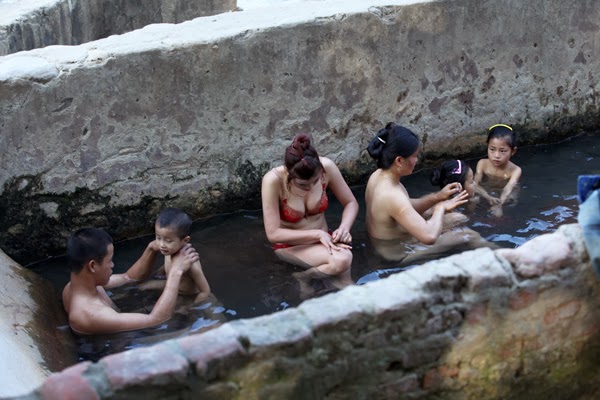
From northwest Vietnam I came across this recent photo reportage which records tastefully how locals use their hot spring for bathing. Location is attributed to Tú Lệ commune, Yên Bái Province


Glory
Further afield there is this strange piece of news from Japan (Japancrush, 23 Jan.):
'A well-known onsen village in Kansai is now being sued [for nearly $US 20,000!] by a woman and her mother thanks to a faulty bamboo curtain that meant that for a period of 30 minutes, the women were visible to those in the corridor, in all their naked glory'. 
Is this a sign of the times for Japan, where it seems naked and mixed-sex bathing is on the wane? Are Victorian times ahead of Japan? 
Despite this being an accident and the women having not noticed any lookers they had the following: 
'Following the incident, the women claim they had stomach pains and insomnia, and were diagnosed with anxiety disorder at the hospital. The women’s legal representatives stated that “It equates to considerable mental anguish for a single woman to have her naked body exposed while she bathes”'. 
Reality check.

Globatimes.cn hits another trend, Asian bathing houses. It provides an overview of Shanghai's most popular Japanese, Korean and local-style bathhouses.

More New Years news (Dec. 24) from Taiwan: ideal time to go for a soak. It's a very extensive article with ever

I don't like calling it a trend, but upmarket hot springs are all the rage in China. Near Kunming, Travel Asia reports (Dec. 5) that Dusit will manage a new luxury hot spring resort as of 2016 ...

The Sydney Morning Herald (Dec. 9) has an article on a number of onsen, Japan, doesn't seem to be going anywhere.

Tuesday, 9 July 2013

Impact

'Water spring bath
Hot water spring at Banjar, Buleleng, Bali'
From the flickr site of I Putu Budi Astawa

To follow
Does anybody recognize that the social side of internet is dumbing down? With the advent of broadband and higher speeds, there's been a shift from text based write ups to mass photo ops.

In this case, do you notice that after all these years there are still only just 8 followers on this blog? that's not much ... The Tumblr site Soaking Spirit on some days welcomes 8 new followers!
I do get it. On Tumblr a follower is just a single click away, whereas if you become a follower on blogger there are a few steps to go through. 
But I simply believe that the intellectual stimulance blog entries offer, simply can't stand up to the instant (in your face) photo visualisation. And yes in some cases one pic can beat many a lengthy blog. But a blog offers more ...

Anyway this leads me to Pininterest. I don't understand Pininterest. I have put up a board of Thai hot springs, but nothing seems to happen. I follow a couple of boards, but again nada: no updates. Doesn't look like anything will happen here ... Can someone explain to me what the existence of Pinterest is meant to be?

And what is happening at Flickr? Are they really trying to drive away their customers? And their visitors?

Hmmm. 

Light headed
The Global Times, China not so long ago warns potential soakers for health concerns (January 20):
'However, even though the hot springs are reputed to have beneficial effects, doctors say the hot springs are not some supernatural elixir and that there are many risks involved in overdoing it, from light-headedness to infertility.

Even for young and healthy people, hot springs have risks that often are not posted.
...
"In Japan, bathing in the hot springs is a very popular and enjoyable thing. But in Japan, the hot springs are a more natural resource. It's underground water with a lot of minerals, such as sulfite," he [Yan Hongbiao, a doctor at the Fuwai Cardiovascular Hospital] said.
In China, there are many fake hot springs and the quality cannot be ensured, he said'.  
Infertility is a remote possibility apparently.

'People soak in the hotspring in Xingtai, north China's Hebei Province, Dec. 13, 2012. 
Local people went to hotspring during snowy days'. 

The ultimate list? Lonely Planet's 1000 ultimate sights of this planet. Under the heading best baths are a few hot springs (Beppu, Dogo (Japan), Hot water beach (New Zealand (been there)), Szechenyi Baths (Hungary) and Blue Lagoon (Iceland)).
These are their ten choices for Best Natural Springs: (1) Rift Valley, Ethiopia; (2) Oymyakon, Siberia, Russia; (3) Deception Island, Antarctica; (4) Waimangu Volcanic Valley, Rotorua, NZ; (5) Grand Prismatic Spring, Yellowstone National Park, USA; (6) Jigokudani Monkey Park, Yamanouchi, Japan; (7) Troll & Jotun Hot Springs, Svalbard, Norway; (8) Pamukkale Terraces, Turkey; (9) Landmannalaugar, Iceland; (10) Blood Pond Hot Spring, Beppu, Japan.
Most hot springs I presume ...

Lonely Planet has another list, this time of Europe's best hot springs (May 17). A couple from Iceland, likewise for Austria, Italy and Hungary. Language barriers mean the need to include the sole Anglo-Saxon soak, aptly named Bath. How they compile this list seems to be besides the point. Who cares, as long as you have a press release every day ...

Nudity is common in northeast Asia hot springs. Equally common are the western (or better said conservative) reactions. Example from Soul to Seoul (11 June) visiting a local Jimbilang (hot spring bath) near Seoraksan National Park:
'People, the scene facing my small tribe when we opened the change room doors will never leave me. I had entered some alternate reality where I was taking part in a Cleopatra-esque era movie Korean style. There were more than ten big (think typical Aussie backyard pool big) rectangle baths spread out before us. There were hot baths, hotter baths and even hotter baths to choose from (temperature readings at the top told you what to expect) along with a walking bath, a mud bath, a cold bath and the outside bath (where, as we discovered, there was no where to hide thanks to the water clarity). Along one side of the enormous cavern were rows and rows of mirrored benches where groups of women sat on small stools facing the mirrors and vigorously scrubbed each other using special gloves and brushes. All totally naked. Despite all the activity - women walking from bath to bath, from bath to scrubbing area and back to bath - there was an unbelievable sense of calm that exuded from all. One might even say it was somewhat liberating and strangely comforting all at once. I would like to report that I soon got used to being this naked but I did not. Oh no, not at all'. 
She didn't relax ...
  
The way ahead? Ciater hot spring , Java, Indonesia. From the instagram page of sayisayyie

Yet again New Zealand leads the way in the wackier (literally) side of soaking. First there is the story of a 9 year old volcano hunter. Or should it be a hot spring hunter and volcano vollower ... (NZ Herald, July 7). 
Then from the same source (July 3) the curious story of a hot spring hoist:
'As the man left the hot pools he was hit over the head.
Some of the couple's belongings were then stolen from their van and their keys were tossed into the hot pools.
After the group left, the pair were able to retrieve their keys and drove to Rotorua Hospital.
The woman was not harmed but the man needed stitches to a cut to his head'.
Poetry from from the region
  • Indonesia
Meanwhile in Bali, Indonesia. Geothermal projects are off the drawing map (Thinkgeoenergy, June 19):
'Pastika [Govenor of the province] said there are still other green sources such as water, solar energy and waves that could be exploited for it. “It may be more expensive but it also has a price,” he said.
The governor said the main reason for his decision is that because mountains, forests, beaches, lakes and estuaries are holy areas'.
Soakers can continue to enjoy Angseri hot spring, Bali, Indonesia. At least for the time-being? From the instagram page of lealbeny
More bad news for Indonesian geothermal powerfans. On Sumatra there is local opposition to a geothermal project, according to thinkgeoenergy (June 6):
'“The villagers, mainly members of the Rajabasa traditional clan residing on the slope of Mount Rajabasa, staged a peaceful rally at Sukaraja dock in Jeti village, Rajabasa, on Wednesday, demanding that PT Supreme Energy cease its exploration.
Beside being detrimental to the environment, the villagers said the geothermal exploration would also damage the social structure of the South Lampung traditional community, especially those living around Mount Rajabasa'.
On Java, near Sumedang, another geothermal project (100+ $US million) is running into problems due to land acquisition (thinkgeoenergy, June 6). Or not?
'“The land acquisition process is hampered due to public concerns about the impact of environmental pollution resulted from the geothermal project,” he [PT Wika Jabar Power Engineering Director Uum Komarudin] said'.
Is a pattern evolving?

 Hot spring near Bogor, Java, Indonesia. From the instagram site of audreytanzil

Indonesia in the meantime is raising feed-in prices for geothermal electricity. The smaller the geothermal plant, the higher the price (Source: thinkgeoenergy, June 12). So maybe they could buy a few wavering villagers ...
  • Malaysia
Banjaran hot springs, Malaysia is very ... umm chic. The yumlist BLOG has a report (June 13). How to describe? Well, the author goes over the edge and picks up on many a detail:
'Earthy hues, natural stone, wood, glass and tropical furnishings transit the outdoor environment to the in. Abundant use of vegetation and running water bring the revitalizing characteristics of nature to the living space, creating both a calming and rejuvenating setting.
The glass windows and doors of the bathroom look over the villa’s most prized feature – an outdoor sunken Jacuzzi with a direct hook-up to the geothermal hot springs. Star filled skies can only be made better with a skinny dip in the bubbling bath allowing the healing properties of the water to do its magic'. 
Note that this all comes with a price ...
  • Philippines
More on the proposed hot spring / geothermal plant on Mindoro island, the Philippines (Southern Luzon Inquirer, June 19):
'The potential is endless!  Power firm Constellation Energy Corp. (CEC) will develop lakeshore areas near its 20-MW geothermal power project into a hot spring and wellness center to showcase the healthy mix of green energy and green tourism in this province'. 
Well, that would be a first for the region. In general there is a disregard for soakers vis-a-vis the techno superiority of geothermal projects. 
Note the Dutch connection ....!
The News of Iceland (July 1) picks up on the Dutch connection (IF Technology) as well (leads to credibility?), as it of course does on the Icelandic comparison.

From the instagram site of buddz_06 Hibok-Hibok hot spring, Camiguin, Philippines:
'The perfect way to cap off the day!. Sarap..emojiemoji Goodnight!'
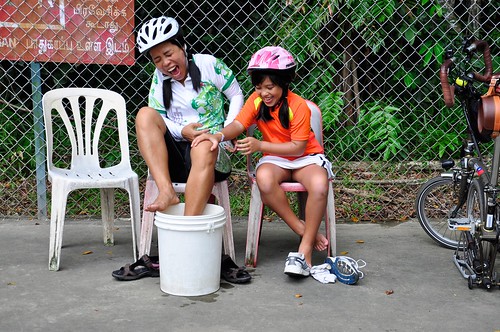
By the way, Philippines, already one of the global leaders in geothermal energy hopes to up the output by another 75% in the coming 15 years. According to the Manila Standard (July 3).
  • Singapore
'Yikes hot'
Sembawang hot spring, Singapore. From the blog of smallwheelsbigsmile (June 16).
  • Vietnam
Top 5 most famous hot springs of Vietnam by tripatini (June 25):
1. Kim Boi ('Being immersed in a large mineral water deposit of Kim Boi stream is also not unmemorable for every visitor'.)
2.Bang ('Bang Spring is attractive with its fanciful, poetic scenery'.)
3. Kenh Ga
4. Tay Vienh
5. Dam Rong
No mention of Nha Trang?

Bicol hot spring. From the instagram site of carmelajacinto
Related Posts with Thumbnails
Copyright 2009 © Soaking in Southeast Asia. All rights reserved.
No reproduction or republication without written permission.