Monday, 11 May 2009

Spa-ing and Soaking: Same-Same but Different?

One could state that soaking is an increasingly popular past time, not only here in Southeast Asia, but worldwide. But to be able to state this, one would need to know how many soaks there are and the number of visitors, i.e. back it up with some data. Which are not available.
But leaf through any travel related print and, sure, there will be an increasing amount of articles and more advertising on ... spa's. But is going to the spa, the same as taking a soak?

Soaks and soaks of sorts
Soaks, as I understand them, are soaks in natural waters. They become soaks as the waters are usually warm or hot. Looking for where these natural waters occur in the heated substance, one is looking for hot springs. So soaks are in their majority hot springs.
I say in majority, as here in Southeast Asia, we experience a prolonged period of hot weather. So hot, that shallow bodies of water warm up and could be considered as soaks. As could be the sea, which surprisingly sometimes fails to cool the swimmer.
During the heat, cooling down is often a better option and it's no secret that I enjoy waterfalls as much as or just as much as hot springs. One factor in their favour, is that there are many more waterfalls. Possibly because of their numbers, unnatural enhancements are less obvious to come across upon. And here in Southeast Asia if there's no road, no car park, no amount of food stalls, it can't be worth it ... But for me (and my family) that's just the attraction. What better way to unwind, cooling off naturally, in a natural environment, 'au naturel'?


April this year, Yak Loam Lake Ratanakiri province, Cambodia: the 'coolest' soak.

Define spa!
But I'm digressing. So are spa's not the same as soaks? The word spa, you'd be surprised to know, is actually a shorter version of the Russian word '
spasibo'. Which was the word Peter the Great used in 1717 when offered water, as he was sojourning nearby the town now known as Spa located in the Wallonian Ardennes.

Why they changed the name of the town remains a mystery, considering it had been used as a soaking site from the 14th century onwards. Anyway, such was the significance of this happening, that today the global relaxation industry is greatly dominated by the word. Though the word spa is largely eponymous with any place having a natural water source that is believed to possess special health-giving properties, in practice spa seems to have more in common with other wider themes such as health tourism or wellness rather than soaking itself. Massages, wraps, facials are all standard ingredients one can expect at a spa. What's more they have little or no relation to the existence of natural springs, be they warm or cold. And their health claims seem mostly unfounded. Spa's are nearly all located in or near urban areas where they can provide a 'retreat' from the outside world and/or on beaches where tourists may well be tempted off the beach to a, as naturally possible, property to indulge.

Exclusive
What all spa's have in common though is an emphasis on a different distinctness with a hope for attracting the well-heeled. The more exclusive the better. Especially here in Southeast Asia, spa's aim for the upper class.
AsiaSpa puts it like this:
'Targeted at wealthy professional women aged between 30 and 50, AsiaSpa invites its readers to step outside their everyday urban environment and escape to a tranquil world where body and mind are refreshed'.
Though I might have a weakness for the mag, for instance it includes issues such as this month (May 2009) a special: 'The Family Issue'. With articles such as 'how to... be a super parent' and 'yoga for fertility'! However it's commercial emphasis and pretension to highlight the distinct rather than the true natural , certainly doesn't endear itself.

This penchant for exclusiveness is in contrast to say northern Europe where thermal bathing is open to all. But class associations are made between town's. i.e. Harrington for the lower class, Royal Spa Leamington for the upper class. This is also evident in other European nations. Places such as Evian or Baden-Baden are known as places where the upper class hang out, so to say.
In Holland (and Germany) though, spa's as such are scarce and sauna's are there to give what is essentially is a spa experience, though with the emphasis on taking a sauna, with the possibility of other upgrades (wraps, massages) or extensions (sunbed). Significantly these are less distinctive for upper / lower class. And they emphasize social contact.

One could compare this culture very much akin to that of onsen and sento in Japan. Though a soak may be great, a soak with great (new) friends is even better.


This all seems quite in contrast to spa's, where relaxation is the mantra such that tranquility becomes all enveloping (see above quote). And to muffle away the odd a-natural sound here and there, they offer background sounds, a fast flowing stream, gentle waves, rustling leaves, etc.. Believing that socializing is again against human nature, rooms are parted and separated.
The most exclusive massage I had here in Phnom Penh was a joint massage, the joint being a door between the massage rooms which was opened, rather than a room where at least both of us would lie. Possibly by de-socializing the experience it becomes more exclusive: "Oh ,I had a plunge pool all to myself". And how long did it take to get bored?


So ..., not the same?
No, I believe. A spa for me, is there for the convenience of a cheap massage. In contrast seeking a soak is an undertaking, getting out, an expedition, a voyage of discovery, a search for the holy grail and a possible reward at the end. But, all -in-all a lot of fun and interest.

I mean, in Southeast Asia what makes some of the most exclusive spa's differ from each other?
Take Tamarind Springs on Thailand's isle of Samui. It goes all out to tempt the tourist off the beach and it certainly looks great.


Hmm, would you pay to experience this? Nature is a plenty in Thailand.
'Tamarind Springs Forest Spa, Samui is inspired by its superb location – its lush coconut groves gently sloping into a valley of huge granite boulders bordering the island’s jungly interior. Built out of love and respect for this unique landscape, every effort was made to fluidly integrate this Samui spa into the existing indigenous surroundings.
...

The magical forest surroundings will help you to completely unwind.
The Forest. At The Forest guests enjoy drifting between the fragrant herbal steam cave and cold water rock pools, snacks and refreshments in the tea sala, before their massage treatments in open air pavilions.'
Is this much more different than a soak? Possibly, because the customer is king, hygiene is high, quality is good. But most Thai soaks offer a massage and the waters are more inclined to have therapeutic qualities. Then again at Tamarind Springs you do get disposable underwear!

Over at Losari (Central Java) it's more of the same (massage), though they have a hamam and not a steam room. It claims:
'An oasis for tranquility and renewal'
Maybe?

Anantara at the so-called Golden Triangle:
'Whether you choose an exotic fruit peel or a signature four-hand massage, Anantara's spa therapists will tailor every treatment to ensure your relaxation. From the moment you step into the spa's three-storey mountainside reception room, you'll feel infused with a sense of calm'.

Anantara Spa: Enticing? What happened to the view?
But again a number of massages to choose from, possibly an extensive choice, just to make it exclusive. But nothing more than a typical hot spring, other than exclusiveness with a price to fit.

Again they are different but also similar. Soaks, now those are different! They are naturally tranquil. No need to blend in some background muzak. Now let's hope the developers don't impose themselves and make spa's out of those great soaks!

Thursday, 30 April 2009

Update for April 2009

As usual there is hardly any news to comment on. Then again if you mention hot springs in your national budget, as Thailand is doing, then this is important! Then again, it's only a mention.

Furthermore a news story from the Philippines:
'The Department of Tourism (DOT) has plans to develop the Mt. Kanlaon as Philippines’ newest eco-tourism site'.
Newest eco-tourism site? Probably what they mean is the newest developed eco-tourism site. Is that not a contradiction? Unfortunately the report does not mention what is planned. The relevance:
'The volcano has three hot springs on its slopes: Mambucal Hot Springs on the northwest, Bucalan Hot Spring, Bungol Hot Spring'.
Blog reports then. More soaks added to the lists. A consistent theme in many of the highlighted are comments on the clothing etiquette.

Malaysia
  • Naturally, Poring is mentioned oft in blogs on Malaysia. Experiences are far short of what is expected, as Diane points out:
    'It is poky little bath tubs that you stand in, and wait forever to the water to fill. For some reason taking a bath in public rather than chillin in a natural rock pool was not appealing to me. It was also holiday season so it was full of school kids running around'.
  • Jasin hot springs? A not yet included hot springs in Malacca state. Why not? Because!
    'This hot springs is also known as Taman Rekreasi Air Panas Jasin was built on the historic site of Natural Hot Springs Pool which was first opened on May 1884'.
    Woops! Does not look too bad. More info
    here as well. Is this not Gadek hot springs?
  • More question marks: Lubuk Timah, found here. Question mark no more.
  • Not more misses! After so much research I thought I had almost all Malaysian hot springs covered. It's not a volcanic actively country, so there can't be that many. But yet again. This time it's Ulu Legong in Kedah state. For a report visit this blog posting by Ed and Cher:
    'The place is actually opened 24 hours. Now, have you ever heard of a recreation park most visited after midnight??? Well this is just the place. There were tons and tons of people here hanging around the pool, swimming, camping and just lepaking around'.
    Lepaking? Gathering, researching and / or hanging out are the quick interpretations. Learning more every day. Any roads the site has many photo's and even a video.
    And believe it or not, but there's another blog from the same place. From aeiween with photo's and a short comment:
    'Because after i tried it my whole body's skin really feel soft and smooth! HoHo~ :)'.
  • Another disappointed soaker? Jelajah xplorer visited Kerling hot springs. Besides a number of good photo's, he has the briefest of comments on the soaks themselves:
    'The place is not well manage and the so called hot spring does not fit the profile of a hot spring'.
  • Jabing Aura though was not so disappointed with Annah Rais hot springs in Sarawak:
    'The place, to our surprise was well kept and clean. The unpolluted mountain air felt so refreshing, the stream water beside the hot spring was really cool, calm and welcoming.
    A caption to one of his photo's:
    'A view of the Hot Spring. Look at the clear water!!!'
Vietnam
  • What is with mud and Vietnam? Binh Chau have the mud bath. Alia in Korea describes a day at Binh Chau.
    "Our tour guide drove us over, but didn't mention that the hot springs was a bathing suit-necessary activity".
    ...
    An employee put a few bags of prepackaged mud and some scented oil in a bucket, and we just had to rub it on our skin and wait a little while for it to dry, while walking around outside'.
    She obviously had a good time, but was surprised by this:
    'was reminded how modest Americans are when some woman (I think most of the other foreign tourists that day were German) came into the bathroom and got naked to change without bothering to go into a stall. There was even a window in the restroom door, but she obviously wasn't concerned. It's funny to get little peeks of how other people and other cultures operate'.
    Hilarious?
  • National hot spot with mud are the Thap Ba springs near Nha Trang:
    'We had a mud bath in these mud pits, then layed in hot mineral water, and swam in mineral waterfalls. The water was very hot, but after your skin felt so good. It was really fun to splash around in the mud, and swim in the pools. The whole process was very unique including high pressure jets to wash all the mud off'.
    Such was
    Traveling Tami's experience.
  • In the town of Tu Le, Yen Bai province, things are less upmarket:
    'Thai ethnic people in the town bath in natural hot springs. In the afternoon, normally from 5pm, they come to the hot water pool next to the Nam Cuom spring, taking off their clothes and enjoying the hot water and natural surroundings'.
    Another miss on the list! [and now corrected]

  • More from northern Vietnam. While trekking in and around Sapa, NMCutler visited an unnamed hot spring:
    'The hot spring, unfortunately, was disappointing in scope but very, very nice at the same time'.
    ?
Singapore
  • Singapore, having only two hot springs, one of which is off-limits, means the other, Sembawang, gets blogged quite often. See here a good (photo) report by ygblog4. He reminiscences a past visit:
    'what we saw were some kampong houses around a stream and some puddles. quite a number of kampong folks were around the spring, some washing their clothes and some cooking their eggs, like what we did today'.
    He also sheds some light (and a photo) on the area before authorities sanitized the soak:
    'the place is open from 7.00 a.m. to 7.00 p.m. every day. the scene today is a far cry from what we witnessed in 2006 when the place was packed throughout the day, regardless of weekday or weekend. before they cemented the place and put all those retrictions in place, you could cycle or even drive and park right next to the hot spring'.
    That's progress. But considering the reports from sites in neighbouring Malaysia, it's either a privatized money maker or a dump (or both).
Thailand
  • More strange customs concerning clothing and soaking. This unnamed blog entry from Pai:
    'And we went to Pai Hot spring. It’s a wonderful natural hot spring and it is a major public service for thai and foriegners for a bath or a long soak (with clothes on) :). It’s Thailand so customs in hot spring is quite different than somewhere else. Local people who bathe in this hot springs always keep themselves covered with clothes or thai skirt (a simple skirt somewhat like a tube skirt / sarong). If you want to do local thai spa, just only bring one blanket and sit next to the pool! It works!! The Others hot pools can make an boiled eggs, the temperature is about 80 celcious!!'
Philippines
  • Maquinit hot springs on Palawan. Zoechairein reports:
    'The hot water came from a spring in the mountain and it’s naturally hot and salty! The discoverer of this hot spring initiated to create a pool that will gather the hot water at the foot of the mountain'.
  • Though I have some of my own tough experiences finding hot springs, finding Baslay hot springs on Negros proved nearly insurmountable for Stupidlyperfect [what's in a name?]:
    The ride did not go smoothly and safe as what I’ve expected. While we were on our way up on the super rocky and bumpy road under the pouring rain, the habal-habal [moto-taxi] slid for two times.
    ...
    After the two slight accidents, we decided to walk the remaining part of the road leading to the entrance of the hot springs. And the walk was not a joke. I am already running out of breath in trekking the right-angled rocky road as the raindrops mixed my sweat.
    ...
    After the descending and ascending walk on the 400 concrete steps to the hot springs, we finally reached the spot.
    ...
    As soon as I dipped myself on the pool, I realized that it is not bad after all'.
    Who said soaking was no fun? Another hot springs to list.
    And would believe it, there's another blogger who made it there! Optimistic Dora describes her travels in getting to Baslay hot springs.
    'It is almost 10kms from the proper Dauin. It may sound just a short distance, but 3kms of this is what you need to walk to reach the spring, because of a bumpy road. The motorcycle cannot anymore resist to the roads, so we need to walk.
    ...
    Finally, we find it. But the misery of walking did not end there. We need to pass the thousand steps of their developed ladder in going down to the hot spring and the river near to it'.
    And oddly she ends her story such:
    'Until now, the clothes I wore in bathing in the spring still smells sulfur and that would remind me of Baslay hot spring'.
  • Asin hot springs, an easier find, a more pleasant experience?
    'It was a crowded Sunday so I got bummed out because the all the pools seem congested'.
    Courtesy of My shoeboxjournals.
  • Mateo hot springs:
    'The Mateo Hot Springs resort turned out to be a dump. The room cost 1000 pesos for a very basic room with its own bathroom. No facilities open for even a cup of coffee. So we were tired after a very long day and no food or drink with us. Got frustrated with the owner that she wouldn't even make us a drink. The hot springs were open and so we went for a relaxing soak to ease away the stresses of the day'.
    Jeff Brad's world travels.

Monday, 30 March 2009

Updates for March 2009

News on Southeast Asian hot springs is sparse. One possible exception is a report in the travel section of the Bangkok Post. Despite all the travel writings currently focusing on home tourism, one of the Posts reporters has had a probably all-expenses paid trip to Japan and reports on the attractions.
On the 5
th of March a photo report on Sendai was published. A caption to an innocent picture reads:
‘There are numerous areas boasting onsen (hot springs) in the Tohoku region. Many onsen bathhouses have both indoor and outdoor pools. In the latter, you can also relish the beautiful scenery as well as fresh cool air while relaxing in the warm mineral rich water. One inhibition for most Thai and even some Westerners, is the going naked part. But once you overcome it, the rest is easy and enjoyable. Keep in mind that you can use a little tower to cover your private part when out of the water. Sure enough the Japanese themselves do so too’.
Well, if this inhibition was so easy to conquer, why isn’t it practiced in Thailand proper?
More southeast Asia focused, an article from Vietnam. On so-called health tourism. Though in reality there's no news, just a report that if one wants to wallow around in mud, Thap Ba, near Nga Trang, South Vietnam is the place to go.
And what is a first hand experience like? From Kate's blog:
'We spent the afternoon at a hot springs resort about 10 minutes outside of town. There was a 7 step regiment for optimal health benefits from this mud bath/mineral soak wonderland. We were ushered into a tub with a Vietnamese couple which was full of cool liquid mud the consistency of a chocolate shake. A somewhat awkward 15 minute soak in this small muddy bathtub with another couple involved all of us pouring pails of mud over our arms, chests, and backs. Most local people were in shorts and tank tops and we quickly figured out why. The mud got well trapped in our suits, especially between the layers of the lining and the outside, and made us both a muddy, saggy, bloated mess! In this goopy state, we were instructed to sit in the sun for 10 minutes before rinsing. The ground and rocks were so hot from the super-charged sun we were forced to hop from foot to foot to not burn our feet. Quite a sight. After a thorough mineral shower rinse, we were hustled into a 3 foot wide channel of rocks which sprayed water at you from all sides - imagine car wash meets leaky dam. After the pressure wash, we were pointed towards larger mineral hot tubs to soak with more strangers. After that, on to the big, but still hot, soaking pool. Keep in mind that it's a good 85-90 degrees out so at this point, we were not only pretty pruney but quite thoroughly cooked. We cut short our 7 steps to mineral-induced health and headed home feeling silky smooth with just a few pockets of mud in our ears.'
More blog reports:
Malaysia
Yet again quite a few postings, but somehow most seem disappointed ....
  • Poring:
    ‘It was a good thing that the pool of springs closed at a much later time, 7.30PM. The hot springs were set up like a huge public bathing area, Japanese style. Some pools fit more than 6 people, while some were built for just one person to submerge into. The smell of sulfur was strong, and the water was extremely hot, but it was so inviting after hiking unexpectedly in the jungle. After the first dip, you could just laze in the water forever'.
  • Sungai Klah. Huge amount of photo's here. And here. And here.
  • Some shots of Bentong hot springs by Budleee Rants. His rant: '
    ... it was a hot spring pool. An abandoned and unkempt one that is. The facilities are nice, but there was no one to maintain it. As a result, the place was unkempt and the pool was full of algae and other free living parasites'.
  • Kerling hot springs. eXtreMesh has visited these springs:
    'Place was well maintained and the river was clean and cool to dip into. Well when it comes to the hot spring, there is nothing much to be expressed about. The hot spring is a pool with not very hot water, i managed to get in the water and even dance, but did not feel the heat that much. I also noticed that the pool was not that clean and rather slippery to stand in it'.
    Recommendable? Author comments:
    'Even i was disappointed with the place as i reached there'.
Philippines
  • Camaguin, ardent or not?
    'After the falls, we went to one of the island's hot springs. And man, that truly was a heavenly experience. As I settled my ass and the rest of my body in the lovely 40°C water (that's 104°F to you Americans) I swear it felt almost like having an orgasm. Sweeet! I could hardly keep from moaning because it felt so damn good. I credit the hot springs for the lack of muscle soreness the next day. Sitting there, watching the mist rising from the water and being immersed in wet warmth was simply spectacular'.
    Would anyone be surprised that this was posted by I Am Woman, See Me blog?
Thailand
  • A short impression by Phil and Julia of Pai hot springs:
    'Stepping in the water meant feet and ankles turned instantly lobster red.I couldn’t get more than my bum in the water and even that was a bit of a mission.'
  • Thaisticky rice has another short impression of the nearby Pong Duet hot spring:
    'At the bathing area they had a couple of nice looking hot spring swimming pools as well as private cabins or if you preferred you could just dangle your feet in the natural hot spring stream. As it was just after mid day and the day was already a scorcher the last thing I felt like doing was jumping in an even hotter bath of water so I gave the bathing a miss ...'.
    The soak season in Indochina has passed apparently. So much for health reasons for soaking!
  • Andy is still at it, this time from south Thailand, Ranong:
    'They [the hot springs] were really nice, and free because they are government owned. It was all paved and tile but the pools were good temperatures (controlled by valves) and there were a lot of locals there. Some locals told me stories of how the spring water had saved peoples lives. I don't know if I believe the stories but I do believe hot springs in general have good health benefits. The girl at my guest house said I shouldn't walk at night to the springs because its a little out of town and its dangerous, but I did stay until past dark. So I figured I'd test my luck, but I met some nice thai people before I left and they gave me a ride back to the guest house. It didn't seem dangerous but I guess in a boarder town there is more danger than in other parts of thailand'.
Indonesia
  • Blogs are an easy way of getting information out there without all the hassles of signing up, etc., etc. So easy, that commercial companies in Indonesia use them to plug their tour programmes. But sometimes they are not as appealing as the author may well think! On Banyuwedang hot springs, Bali:
    'Flights Banyuwedang from the hot springs that appear on the beach.... Because the uterus sulfur high enough, hot water is widely held even up to the island this summer because the water can cure some diseases, especially skin disease. ... here is hot water that contains sulfur which is located along the coastal region is supported with a rare population so quiet atmosphere can be created.'
    (?)
  • Tangkahan in northern Sumatra (Aceh) is an area of wilderness and is managed as an ecotourism site. Some of the attractions are hot springs. This extensive report of the area mentions 2 hot springs.
Others
On Thaivisa forum: Umphang (or as this site refers to Mae Klong) ‘
The hot spring itself is amazingly not ruined. Thais have a nasty habit of concreting, paving, and tiling over hot springs, removing all sense of any natural aesthetic and completely defeating the purpose of the hot spring (they call it "progress" and "development;" you might as well soak in a tub with a hot water heater). This hot spring is just a natural pool with a rock/dirt floor located a few meters from the river. So you can soak hot and then go jump in the cold! There is even a small tributary hot spring just at the river's edge where you can lay in both hot and cold simultaneously!’

Wednesday, 11 March 2009

Art and hot springs

Ando Hiroshige's: View from 7 hot springs at Hakone

Well, that's an exceptional topic I hear you say. It's not really a topic at all, there's not much linkage between the two, certainly not here in Southeast Asia. Some hot springs though are adorned with temple structures and / or carvings, but it's much more culture rather than art.

I started thinking of this subject when I came across a number of beautiful photo's by Hillary Atiyeh which she made at Breitenbush hot springs, Oregon, U.S.A.. She describes herself as
"Photographer of nature, wildlife, travel, adventure, aerial, underwater, photojournalism, environmental and social advocacy and fine art prints".
The various combo's of photo's ("Work in progress **Hot Springs**") probably fall in the underwater bracket, but nature, adventure, travel could also apply.

I personally think they are very attractive and original, though then again water and people are quite common themes in art. So I thought that this must be recurring theme. However the subject seems quite unresearched.

Some of the examples found:
  • Frommers explains to us that soaking in hot springs there is an art in it self!
    'Nowhere is the experience of taking a bath so celebrated, ritualized and revered as in the cities and regional areas of Japan'.
    Especially when it comes to etiquette, a fact that us most westerners take for granted in everyday life. Even for Southeast Asians the rules may prove challenging, witness (or not yet as is the case!) the Bangkok Post advice dispensed in a blog entry end of this month. Then again some parts of the art are self-evident:
    'clean yourself before soaking!'
  • More on the same art:
    'Bathing in Japan really is something of an art, or has at least been elevated to the status of it. This brings us to the first and most important rule of bathing in Japan: no suds in the tub — ever'.
    Again not really art, but the blog (antipixel.com) does contain some nice black and white photo's.
  • Another art form is the Japanese art of manga, alas here it's mostly female oriented, the hot springs providing an opportunity to undress the subject.
    'Obligatory Onsen (hot springs) Story': I usually call this the 'Obligitory Onsen Episode' because in anime there is almost ALWAYS an episode where the main characters head for a hot springs. But now I am noticing that this happens in shoujo manga a whole lot too. It usually happens in the form of a school trip, and involves the main hero and heroine of the story encountering each other unexpectedly in the bath, and having a few nice minutes of romantic/sexual tension ^_^;
    At least, they're sort of decent [1]
  • Again Japan, but not so hot springs, but nonetheless with some fringe connections. Paintings on sento (public bathing places) walls:
    'A vivid blue paint fills the huge wall of the Sento, the public bath house, and in no time, bold brush strokes with great momentum create an image of Mount Fuji and crashing waves… As a long-standing tradition, Japanese Sento users have enjoyed many of these panoramic views on the walls of their beloved hazy bath houses which are an integral part of Japanese life'.
There are quite a few artists impressions of hot springs:
  • Jimn Hill:
Is this art? [2]
  • Beitou hot springs (Taiwan) has a museum, no less. Though this is more culture than art.
    'This museum is housed in public hot spring bath built during the Japanese colonial era. his is a good spot to learn about Beitou's rich hot spring culture and history'.
  • More culture? Huaqing, China:
    'Ranked among the Hundred Famous Gardens in China, it also has the status as a National Cultural Relic Protection Unit and a National Key Scenic Area.'
    Again more history. With some architecture.
  • An "Art" Spa hotel in Jilan, Taiwan. It has nothing to do with art though!
  • Radium hot springs, U.S.A., has an art show, but little connection between art and hot springs other than the physical location.
  • Literature?
  • Probably the most intriguing is the inovel by Steve Zio aptly titled Hot springs.
    'Hot springs are about indulging the senses and living in the moment. They’re about finding a deeper connection through warmth and relaxation. This connection differs from person to person, of course, and the Hot Springs website aspires to be whatever you want it to be. Whether you’re a reader of the book, have an interest in the Hot Springs art, music, and multimedia experience, or if you’re more inclined to pool your talents (by sending your own art, music, photos, links) with other online contributors on the Hot Spring theme, then please just dive right in.

    We’re made mostly of water, our lives our fluid, and we came from the seas. Through Hot Springs and hot springs, we can explore this liquid matrix and delve as deep as we want to go. And the best thing about plunging into.'
Keep soaking!:

This piece, detailing conversation from a recent trip to Cougar, has just been completed for the great French anthology, Stereoscomic. By Kalah Allen.

Update [June 2012]

'Where the the hot water comes from and where the water gets hot'.
Henry Yuen:
'"Hot tub all to ourselves"
11 x 14 inch Silkscreened Print
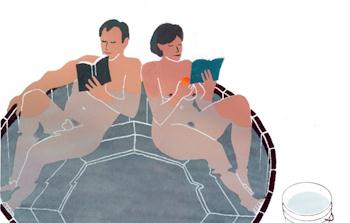
If you can get to Bagby Hot springs early, you may get the tub all to yourself. Then you can stretch out and catch up on a good book'.

Sunday, 1 March 2009

Excuse me! Do you mind?

One of the most talked about issues in soaking and taking to the hot springs is when to decide whether the soak is full and how to respect each others private sphere.

Having lived in Nepal and keeping abreast of what's (or better said not) happening I came across this recent photo from Kantipur publications, I'd like to share with you. It shows a hot spring near the town of Beni in Central Nepal, though not the Tatopani located on the round the Annapurna trail.


People submerge themselves into the Tatopani Pokhari (hot water pond) in Myagdi district. There is a belief that taking dip into the pond help one to get rid of several diseases. Photo taken by G. Khadka, 2009-02-13


I've visited this place myself, it's just a couple of hours walk west of the town along the river, nothing too strenuous. Back then (96/97?) it was already quite touristy, but only locals and nowhere as busy as above!

However it was great water, not too hot, nor cold and located directly next to the river. The village around had a couple of simple guesthouses to stay. As you can see, there a number of bathing fashions, from fully clothed to near nothing (in the back). What I remember was that most bathed in their underwear, which might not be so hygienic. Funny thing was that many people carried a slate rock around, twice / three times as large as their hand and when standing up to retreat from the soak the rock was held to cover possible butt cracks and /or more showing up. Quite weird I thought.


Nepal has got quite a few hot springs and is well worth a trip to discover. Besides this one I've been to the more Tatopani north of Beni, Tatopani on boarder at the main road to China and one directly north of Kathmandu, west of Langtang valley (Chilime).

There are more, from what I know in Darchula, Surkhet, near above photo's hot springs but another days walk to the west, Manang and probably more to the east.

In relation to the above, I found this blog entry on hot springs in Taiwan: Rules of Chinese traditional hot spring baths. It's quite interesting, especially if you note the lack of rules in Southeast Asia. Now where does the line lie between rules and none at all?
  1. Don't wear clothes
    'Requiring every person to soak only in their birthday suits seems to be a sanitary issue'.
  2. Clean up
    'Every person must wash before hitting the bath'.
  3. Don't confuse the buckets
  4. Don't move
    'Once in the bath, patrons are not to move at all. I ran my hands over my legs to try and alleviate the feeling of conflagration. Surprise: I got yelled at'.
  5. End it after 20 minutes.
Juliane then ends the post on a upbeat:
'Soaking privately in a modern hotel room will never compare to my first experience with the ahmas. Although I have to admit, it is nice not to get yelled at while naked'.
!!!!!!

Related Posts with Thumbnails
Copyright 2009 © Soaking in Southeast Asia. All rights reserved.
No reproduction or republication without written permission.