Saturday, 5 July 2014

Morning!

Just a couple of photo's from the region: Indonesia, the Philippines, Thailand and Malaysia. Enjoy!

'#hotsprings #lombok #naturlombok #rinjani'
'Banaue, Luzon, Philippines'
A less warm spring with Thai script. My guess is Pai, but Pai's hot spring is usually too busy for a rustic soak ..., but it has to be. From rebeccalewisjones
'Casual naked natural bath emoji #hotsprings #takemeback'
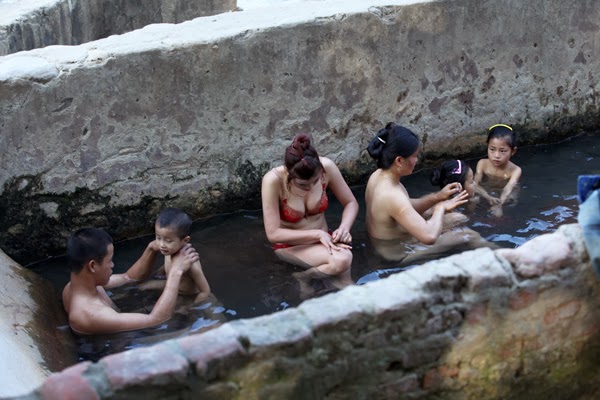
'Morning you uollss...pagi2 ibu n papa ajak datang sini #kolam #airpanas #selayang abaikan mereka2 yang seksi tu..haha'

Tuesday, 27 May 2014

Born Again?

This time around the updates on what's new and trendy focuses on the usual topics which seem to have evolved to be the core of these updates: local and regional news, geothermal power news, the significance of natural hot spring bathing in general and some wackier bits here and there.

Concerning the Soaking in Southeast Asia blog family, especially the European version has seen many new entries, while the Tumblr blog is going from strength to strength. 

Over here this blog saw the second interview with those passionate about  soaking, these interviews are really demanding. I'm researching now on interested persons from North America and Europe.

Sari Ater hot spring, Java by Yulia Purwanti 

[ ... ]
From the  Global Spa & Wellness Summit there was this article in Travel&Leisure Asia (May 14).
'At the Global Spa & Wellness Summit, held in India, his holiness, Tenzin Gyatso, the 14th Dalai Lama, spoke about the impact of the multi-billion dollar industry on modern day wellbeing.
His holiness kicked off the talk by whispering to his translator, "What does it mean, spa?"—a tongue-in-cheek start to his headlining role at a summit dedicated to exactly that. After a few chuckles from the crowd, he continued to explain that while the world of spas is relatively new to him, wellness is a concept he knows plenty about, setting the tone for the many parallels drawn throughout his speech.
"A happy mind, a peaceful mind, is the key factor for a healthy body," the Dalai Lama said, advocating relaxation through mental detox. "Medical scientists are actually telling me hatred, anger, fear—these emotions are eating our immune systems. Relaxing does not mean just on a yoga mat, lie down full of anger, full of fear. Relaxation means the mind is calm."
The Dalai Lama personally finds soaking in hot springs quite enjoyable. Hot springs cleanse, detox and heal the body, the mind and the psyche through minerals, tranquility and nature'.
In the transcript the Dalai Lama actually says:
'HIS HOLINESS THE DALAI LAMA: In Tibet, I never use, you see, because the hot springs...
[laughter]
HIS HOLINESS THE DALAI LAMA: But in India, in Kullu, I used to visit there. I don't know how much sort of medical sort'.
Unfortunately the original article from Travel&Leisure comes up with 3 choices of hot springs / spa's which I doubt the Dalai Lama has visited. Though the person he is he will certianly give them his blessing.

The 2014 summit is in Morocco's Marrakesh. Again there is some relevance for soaking enthusiasts. Notably Charles Davidson has put a programme together to visit Morocco's hot springs post summit.

Other hallroom meetings, f.i. from the Perfect Sweat Summit by saunatimes (Mar 14):
'Presenters kept it short, packed with information and personal sentiments.  It became clear early on that the kinship of the group is making for strong, long lasting relationships that are going to be building blocks for advancing sweat practices today. ”The burgeoning wellness movement is returning to its roots, as the millennia-old sweat trend reheats up.”'
In another more recent blog entry saunatimes expands further on what was discussed.

Sneak Peeks
Something different? An onsen shinkansen (high speed train)?
'A new shinkansen named Toreiyu, with coach cars featuring big bath tubs (for foot bathing), facing the car windows, will be launched this coming June. Today I’ll give you a sneak peek at this latest bullet train'. Source
Or a beer bath? The Mailonline (Mar. 14, 2014) :
'A brewery in a castle is offering punters the chance to bathe in warm beer in their underground vaults.
At Schloss Starkenberger in Austria, seven 13-foot long pools are open for visitors to immerse themselves in warm beer.
Deep in the 700-year-old castle's cellar, artist Wernfried Poschusta modified the old fermentation rooms to hold 84,000 litres in the spa-like baths'.
Apparently not the only one diving into this trend. Beer baths have been all the rage in Czech as well. Read this personal account. 

Fancy a bath? This is in Singha Tatopani, Beni district, Nepal. From their website. 

Rarity
Onsen addict laments the cultural flux which means onsen bathing naturally is slowly disappearing:
'Getting back to the topic of differences in the acceptance of nudity in public hot springs: Social mores have gone through many transformations at various times. Mixed-sex bathing in the nude was common in different periods of Japanese history. It is fairly rare nowadays, though. Most hot springs have separate areas for men and women. Those hot springs that still allow men and women to mingle freely tend to be outdoor ones in remote locations, such as Tsubame Onsen.
Even with this separation of the sexes, there is now a substantial number of young Japanese who feel uncomfortable bathing naked with other people. Not too far ago in the past, the Japanese idea of a vacation meant going to a Japanese ryokan with a gorgeous hot spring in an onsen region. Nowadays, a vacation often means going abroad. Also, tiny nuclear families are the norm. The average fertility rate in 2014 for Japanese women is 1.4. Many children in the new millennium bathe alone, which is very different from the experience of previous generations. I have met a few college students who have told me that they do not enjoy bathing nude in hot springs. I have read reports of young parents insisting that their children wear swimsuits when the children go on school trips and stay in hotels with hot springs.
For now, such shyness is still a rarity. We are all born with bodies that we should not be ashamed of. Let's enjoy ourselves while behaving respectfully and tactfully with our family members, neighbors, and strangers in and around hot springs and sentos'. 
On the same subject anything notti in a recent blog entry explores the same:
'Mixed-sex communal bathing has been a common practice in Japan since hundreds of years back. However due to modernisation and western influence, “Konyokuburo” (mixed-gender public onsens) are now becoming increasing rare as Japanese social mindset changes'. 
His explanations are that the youth are more uptight while the social framework in which mixed-bathing was possible (and regulated through convension) is unravelling.

Target
Japan's first geothermal plant will start up according to Japan's Daily Press (March 17): 
'As Japan continues to look for viable alternatives to its mothballed nuclear reactors, Chuo Electric Power Co. is set to open Japan’s first new geothermal power project in 15 years'.
And though this might be the way forward, it seems that smaller installations are the next thing in Japan. Bloomberg reports (May 21):
'IHI Corp. (7013), a maker of everything from aircraft jet engines to gas turbines, expects the market for small-scale geothermal projects to take off in Japan as the country seeks cleaner sources of energy.
The Tokyo-based company has developed a 20-kilowatt generator capable of turning hot water into electricity that can be set up in as little as half a day, said Tomohiko Yamaguchi, an IHI official in charge of marketing the product.
“The government may want to push large-scale geothermal projects, but big ones are having a hard time,” Yamaguchi said in an interview on May 20. “Small ones are easier to set up. They are faster to expand.”
Smaller geothermal plants may prove popular in Japan because their scale makes them more manageable for operators, offering a quicker way to build out the island nation’s rich sources of heat below the earth’s surface.
The market to utilize heat from hot springs “is becoming active, helped by the government’s focus on clean energy,” Yamaguchi said.
Since IHI’s “Heat Recovery” generation device went on sale in August, the company has received orders for more than 10 units for hot springs and industrial sites, Yamaguchi said.
IHI was developing the system initially targeting waste water from factories, according to the official. Once the device was ready, half of all inquiries were related to hot springs.
“We realized the use at hot springs has potential,” Yamaguchi said'.
Makban geothermal plant (Luzon) has an extensive piping system which runs through the local community. Thinkgeoenergy (March 23) believes this warrants a flickr photo set.

Paying Homage 
  • China
China hopes to see stars being handed out to respective hot springs, starting with Chongqing. So reports (Mar. 26) Chongqingreports (!):
'Guided by Chongqing Tourist Administration and relevant associations, Chongqing hot spring tourism industry is considering industrial standards and will be the first to kick off the star level evaluation work in China, according to the Second China Spa Tourist Expo'.
The Sheraton in Huzhou has opened up it's Mystic Spa and Hot Spring village. There's surprisingly little information on what claims to be the largest natural hot spring resort in China. Simplyfabulicious adds (April 22):
'You will need time to really soak in this place – pun fully intended – with its 101 hot spring pools, 39 private guest villas, 8 spa chalets for private treatments, 21 treatment rooms and a health food restaurant spread across 20,000 sqm. Massive. All this is located adjacent to the hotel which links directly to the spa’s private changing rooms via a discreet underground passage. Like the sound of it yet?
The main section of the spa village is the glass dome pool complex with 26 hot spring pools of varying sizes and privacy, overlooking the Resort’s private lake. Cascading waterfalls, flora and fauna and steamy surrounds give it a tropical jungle feel. Further away from the main pool are smaller hot spring pools dotted along different levels, accessed via winding pathways. Look out for the decadent red wine spa pool where you get to soak in gallons of red wine – for its antioxidant properties. (I won’t drink it if I were you, though.)'
China mentions that the next hot spring capital is to be Xiamen, according to whatsonXiamen (March 7). 
'Starting last year, Xiamen has been striving to build its high-end hot spring resorts integrating the functions of leisure, recreation and physiotherapy by upgrading its major popular hot spring resorts including Riyuegu Hot Spring Resort and Trithorn Hot Spring Resort'. Hot springs are expected to be another claim to fame for Xiamen, and are sure to drive a new round of growth for the city's tourism industry, according to an industry spokesperson'.
Thinkgeoenergy adds 
'Cities with geothermal hot springs install geothermal bath facilities and are becoming more and more proud of it. So it is not surprising that efforts to become “China’s Hot Springs Capital” is an important element in branding cities to attract visitors.
...
While the focus seems to be mostly on tourism and a drive to grow it, geothermal heating for the inhabitants might also be an option going forward, particularly as the spa tourism is seasonal with peaks and lows throughout the year'.
  • Indonesia
The Sydney Morning Herald (March 1) claims Ubud, Bali is the world's spa capital. Though not necessarily fed by hot springs, the Ubud spa's do all they can to replicate the experience. 
The article itself features on what could a sumuun of indulgence the COMO Shambala Estate. It's website advertise it's waters: 
'For our hydrotherapy in Bali, we use water from The Source, the sacred spring on the Estate revered by locals for its healing properties. This feeds the heated Vitality Pool, the chlorine-free, mineral rich and alkaline water making for a deeply therapeutic experience ...'.
Well the following from Flores would also do ...

'Natural hotpool in the ricefields of #Moni 40degrees! Haven't developed any weird tropical diseases yet... :) #nature #hotpool #hotspring #Flores #Indonesia #travel'
  • Malaysia
The Malaysian Times reports (Feb. 14):
'The Tawau Hot Spring Park is fast becoming one of Sabah’s tourist attractions.
...
Rekobumi Sdn Bhd, the company that recognised the potential of the hot springs and the importance of preserving it, has been maintaining and upgrading the hot springs since three years ago.
It turned the segregated pools of hot water into a pleasantly landscaped park that could help lure more visitors.
The company director Datuk Soon Ten Fook told Bernama that the efforts to develop the hot spring park and its surroundings was in line with the current needs.
“There is still a lot of work that needs to be done to make the park a competitive tourist destination that fulfilled tourist needs while focusing on the safety aspects,” he said. Among the future plans for the park is to incorporate a mini zoo that features exotic animals'. 
Hmmm ...
#nature #trees #forest #hotspring #annahrais #scenery #green
Annah Rais hot spring, Sarawak, Malaysia (source)

Another hot spring seeing more visitors is that of Panchor, Sarawak. The Borneo Post (April 11):
'Natural Resources and Environment Deputy Minister Datuk Sri Dr James Dawos said about 2,500 people visited the hot spring every month last year and the number could be more now.
He said the Panchor Hot Spring, which was upgraded by the Tourism Ministry last year at a cost of about RM500,000, is currently managed by the village security and development committee.
“I was told by the committee chairman last year that they can easily collect RM10,000 in entrance fee a month, which means about 2,500 people visited the hot spring a month. Now, the number of visitors going there could be more as electricity has been connected to the facilities'.
  • Philippines
Looneyplanet visits Baslay hot spring on Negros (Mar. 30):
'... there's an abandoned hot spring resort with water temperature rising between 38 to 40 degrees. Some locals have no idea where it is. The signage doesn't help either (what is left of it from the national highway is just the metal frame). The way is rough and dusty with patches of concrete road in between. Getting there is already half of the adventure.
After wading through the lukewarm river, the abandoned facilities beckon. The moss has thickened and rust seems to take over.
I was here a year ago. Nothing has changed. Still abandoned. No other people in sight.
Pay homage to nature! #skinnydipping'.
Ferdz Decena visits the Palan-ah waterfalls and the adjacent hot spring near Tulgao village, Northern Luzon. looks like an idyllic place.

'One day i woke and realized that i deserved better! #hotspring #water #volcano #thereismorefuninthephilippines #philippines #photo_of_the_day #igers_ph #igers_sg #instagood #instamood'

The Business Monitor (Feb. 23) mentions that fish-farming may profit from geothermal power generation:
'AQUACULTURE farms in Mindoro will be able to grow tons of triple high-quality tilapia, sea bass and shrimps per year, in a nutrient-rich, controlled temperature using water from geothermal power plants'.
The idea is to use the geothermal waste water to warm fish ponds with some water to be used as source water. 

A nice blog entry by Jeffer on a hot spring worth visiting, Aatungan - Tinglayan, Kalinga, Luzon. Easily to combine with a waterfall visit.
  • Singapore
Another photo blog on Sembawang, this time by Sakuraharuka. He comes prepared, complete with ph testing kit. 
'The hot spring water is slightly alkaline {due to the presence of minerals} and its sulphide content is three times that of tap water'.
  • Vietnam
Some hope for the anti-developers. Vietnam News (May 5) reports:
'Deputy Prime Minister Hoang Trung Hai has ordered the People's Committee of northern Phu Tho Province to stop construction of an ecotourism site that brings hot mineral water for tourists'.
It was of course a Vietnamese style eco-tourism site.
'The ecotourism site, which is located near the Thanh Thuy Hot Spring, was a key project to encourage the growth of the tourism sector in the province. Last month, it ended its first period of construction with an investment of VND450 billion (US$21.4 million). Further, the project is likely to receive an additional capital investment of VND200 billion ($9.5 million) to continue its second period of construction.
...
Currently, nine enterprises have leased land to exploit the hot mineral water for their tourism services, within an area of 218 hectares.
Also, hundreds of households in the province have used the hot water for their daily use and businesses.
However, few have received licences to take advantage of the hot water source.
An inspection of the department last month showed that among seven enterprises that are operating their tourism services in the province, only one received permission from the Ministry of Natural Resources and Environment'.
And then finally a little exposed part of the soaking world. Abu Dhabi's The National has a small photo expose on hot springs in Yemen:

'The Damt thermal bath is famous for the healing effects of its hot spring water'.

Saturday, 10 May 2014

Expansion

Onsen soaking
Miho Tabuchi is a well-known name within the the global soaking culture. At home (Japan) she is known for a Japanese language onsen review site as well as a publicist of articles on onsen. The English language part of the world will be familiar with her onsensoaker blog.

Laying claim to being a global expert, at the time of this publication, Miho has visited 215 hot springs in 28 countries excluding Japan (and counting China and Taiwan separately). If including Japan, the number of soaking sites visited rises to 1,500 hot springs in 29 countries, a very impressive count indeed.

Miho at Jinata Onsen, Shikinejima (Shikine Island), Tokyo 

Gifted
Miho, what would be your favourite hot springs and why? 
"Let me answer my favourites this way:
My favourite hot springs area is Beppu, Oita prefecture, Japan. Beppu is a rather big area and actually consists of eight hot springs: Beppu, Kannawa, Myoban, Shibaseki, Kankaiji, Kamegawa, Horita and Hamawaki. There are various soaking spots in Beppu, especially many public baths. 
Outside of Japan I liked the hot springs of Iceland, Indonesia and Taiwan. Iceland and Indonesia are geothermally active. Taiwan is geothermally not so active, but this mountainous country has many unspoiled wild hot springs and Japanese style public baths. 
I prefer though the wild hot springs and public baths as I can feel hot springs are gift of mother natures while soaking in wild ones".
Mugen-no-sato, Horita Onsen, Beppu Onsenkyo, Beppu City

Trendy
In your blogs we see you are concerned with onsen closing. 
Do you have figures to illustrate this?
"The latest statistics from Japan's Ministry of the Environment (March 2013)  show that the number of the day-visit onsen (commercially run onsen without accommodation) was 7,771 which had increased by 54 from a year before. However the number of ryokan (onsen with accomodation) were 13,521: a decrease of 200.
Additionally, according to the first issue of the Onsen Hihyo, the number of konyoku decreased from more than 1,200 in 1993 to less than 700 in 2013".
Can you describe the reasons behind these trends? 
"I think the main reasons for the number of ryokans to decrease are a lack of successors and changes in our lifestyle. When the Japanese economy was booming, visiting big onsen hotels as part of a tour group was popular. Many larger hotels counted on these groups. But after our so-called economic bubble burst, the number of these tour groups decreased sharply. However, many hotels had invested in expanding their capacity and couldn’t avoid bankruptcy.
Small-scale ryokans and hotels also suffer from the economic down turn and the lack of successors. Very often ryokan owners’ children tend to prefer working in larger cities such as Tokyo or Osaka, rather than taking over the family business.
More recently, new building standards have been introduced to prevent damage by earthquakes. Since, some ryokans and hotels have had to close their business as they couldn’t afford to renovate their buildings in accordance with the new standards.
Revitalization / regeneration business is booming. Specialized companies acquire bankrupt hotels and ryokans, and turn them into economical hotels and ryokans. They omit service as much as possible to offer cheap accommodation prices. For example, they serve buffet dinner and breakfast. If you stay in traditional Japanese style ryokans, they will serve your meals dish by dish in your room".
As we have noticed, you have been to many hot springs outside of Japan. 
What are your ideas about the development of wild and / or rural hot springs into resorts?
"For Japanese, onsen means bath / soaking place. Outside of Japan, hot springs are for swimming / for leisure / for drinking / to cure disease / forcooking and so on. I always enjoy finding these different kinds of use. However, I don’t like resort type hot springs myself.
Resort hot springs are rapidly increasing in China and Southeast Asia. They are though nice places to visit and watch other visitors".
Resources I have the impression that taking an onsen bath in Japan is very important aspect of life. 
To what degree are the surroundings (natural / non-natural / enhancements), price, catering and the ability to stay overnight important aspects in selecting where to take an onsen?
"It’s very important to me personally, but generally speaking, I think we Japanese love taking bath. It’s usually humid in Japan and I take a bath every day. And if it’s an onsen bath, the better. I prefer natural onsen bath, but if impossible, circulated onsen water bath is fine to me. Sometimes after visiting a wild onsen, I have to drop in to another onsen to wash off mud and other dirt. 

I don’t limit myself as to how much I spend when visiting an onsen, if a reliable friend had made recommendations, then I will visit there. But my favourites are small, old, family-run ryokans and usually they offer rooms with meals costing 15,000-20,000 yen (150-200 $US) or less per person. Once I stayed at a ryokan costing just 3500 yen (35$) with dinner and breakfast! 

Gorgeous places are usually rather new ones. However it’s difficult to find naturally gushing hot springs at these places. Many of these are obtain their hot springs from deep bored wells. Of course there are always some exceptions".
 
A look inside the latest issue of Onsen Hihyo magazine. 
And the article on Singa Tatopani, Baglung district, Nepal written by Miho.
   
You recently authored an article in the Japanese publication Onsen Hihyo (Hot Spring Critique). 
How important are these sorts of publications in Japan?
"Though it might seem in book stores in Japan that there are many onsen publications, they are mostly not of much significance. Many of these publications carry articles on onsen which have been sponsored. They look like an usual article, but onsen owners pay for favourable reviews. I know the writers and editors of these publications get their information from websites, blogs and social media, but magazines and guidebooks are resourceful for those who recently got interested in onsen, I guess.
The Onsen Hihyo is an exception to the above, as it has no sponsored articles or advertorials.

Otherwise, good information is available through internet rather than magazines and / or guidebooks".
Li-song Hot Spring , southeastern Taiwan

Enthused
Is there an aspect of hot springs bathing which you would like to highlight?
"My most memorable hot spring experience is a recent visit to Li-song hot springs in Taiwan. Maybe because I came back just a few weeks ago and my memory is still vivid. The hot spring itself was amazing and support from the Taiwanese was impressive. 
Let me explain about Li-song hot spring a bit more. When I first saw a photo of Li-song in an in-flight magazine 8 years ago, it caught my breath: I couldn't imagine that such a beautiful hot spring was there in a neighbouring country. 
But I can't understand Chinese and without any friends there to help me, visiting Li-song was just a distant dream. Since then, I have visited Taiwan 7 times, learnt how to travel and one by one made some friends.
When I visited An-tong Hot Springs in October 2013, the general manager there told me, if I wanted to visit Li-song so much, he could come with me next time. He kept his promise, even asked the #1 specialist of wild hot springs in Taiwan to come with us and the specialist came out of kindness.
The trail was so steep, I had to cling to a rope, and crossed the river twice, with short swims in cold water, but it was rewarding. I'd never been to such a beautiful wild hot springs before. I'm so happy and looking for next main target".
 
"What I like to do is to make people of other countries get interested in onsen and want to come to Japan. 
I've been to more than 70 countries in the world. People are generally nice to me wherever I go. So I want to welcome people to Japan in turn. And I believe onsen is worth visiting while travelling in Japan, I want to provide useful information.

I also want to make Japanese people more interested in hot springs in other countries. 
It might sound strange, but Japanese onsen enthusiasts tend to look down on hot springs in other countries even though they don't know any. They say "Hey, they take hot spring bath in swim suites, right? That's a swimming pool, not a hot spring at all". I want to change this by explaining to them there are so many attractive hot springs in the world. 

Finally I would like to build a network of hot springs enthusiasts like myself.
To visit hot springs in the world, I need up-to-date information from other hot spring enthusiasts.
I think I'm doing well, gradually expanding my network".
Thank you Miho for your effort in giving an insight into how you experience wild soaks from the Japanese perspective. 
It's also very interesting reading about the trends affecting hot spring soaking in Japan. 
Good luck in your future endeavours to highlight global soaking!

Notes
All photo's are used courtesy of Miho Tabuchi.

For more info on Jinata onsen, see the onsensoaker report. 
Concerning Mugen-no-sato, onsenaddict has a blog entry.
Singa Tatopani has it's own Facebook pag.
Li-song hot springs is featured at Lonely Planet ("most beautiful natural hot spring in Taiwan").

Japanese soaking vernacular:
Konyoku (混浴): Mixed baths 
Onsen (温泉): Japanese for hot spring 
Ryokan (旅館) : Traditional Japanese style inn


Tuesday, 11 February 2014

Frozen tears

Nothing else matters #indonesia #instagay #blacklesbians #hotsprings #volcanicsprings #volcano #lesbian #nothingelsematters
Toya Bunkah, Bali, Indonesia, source

Mixed
Last week saw the first in a series of interviews with hot spring enthusiasts, the culmination of quite some research and effort. I intend to publish the next interview in 2 months time, but let's just see what the future will bring.

One aspect brought forward in the interview was the hot spring / wellness use of natural waters. Charles Davidson of Peninsula Hot Springs explained nicely the difference for his company, but my attention was drawn to an article from the New Zealand Herald (Dec. 17), concerning the intentions to build an additional "hot pool" complex in Queenstown on the South Island; roughly $20 million should be involved ...:
'The complex would include about 12 large public hot pools, four smaller private pools, changing facilities, a health spa, reception and retail building, and a cafe/restaurant area. At peak capacity, it could cater for an estimated 300,000 to 350,000 customers a year'.
No mention where the waters come from? Are they natural?

Outside of New Zealand there is little understanding of what makes a hot pool.
With an abundance of hot springs readily available in New Zealand, one would find it strange that tourists flock to a number of businesses offering hot pools (and not natural hot springs). But the problem is that geothermal bathing is more attune to the central part of the North Island, whereas those hot springs of the South Island are mostly very remote and therefore (thankfully) devoid of development. 
But the South Island is a lot cooler (thus the need for warmth?) and attracts a fair share of foreign tourists who need to be able to spend a dollar or two. 
With the idea of replicating natural hot springs in a business concept conveniently located for tourists, some entrepreneurs have been introducing the concept of hot pools. And these seem very much to be taking off.  

The existing hot pools of Queenstown are (if one looks at the amount of instagram photo's, see below) a resounding success.

#Onsenhotpools #Southisland source

Named officially Queenstown onsen hot pools, the use of the private pools are priced at $NZ 80 (65 $US) for 2 adults for one hour. The source of their waters:
'Our pools are filled with a mixture of mountain spring water, rain water, and lake water'.  
Sort of natural.

Other hot pools on the South Island are Omarama hot tubs (private pools, 2 adults, 1,5 hours, $NZ 80) where the water is from
'fresh mountain water'. 
Then there are the Glacier hot springs. 
'The Glacier Hot Pools are fed by the waters of Kā Roimata o Hinehukatere [Franz Josef Glacier!], the frozen tears of Hinehukatere for her lost love'. 
NZ$25 p.p. for public pools, $NZ 85 for 2 adults 45 minutes in a private pool. The Tekapo springs have no private pools and are priced at NZ$20 p.p., water from
'alpine springs'.
So while certainly a good experience (see reviews all over the net), waters are not always naturally occurring; heat itself does wonders but natural hot springs have more direct benefits.
Another surprise is the cost, which lies way above what one would pay in say Europe for a visit to an upmarket wellness concept, especially when private pools are all that are on offer (hardly available in Europe).

Fishy
Continuing on the trend-setting agenda. The other week while watching tv, I came across a mention of seaweed baths. A bit of internet searching and you'll arrive at this apparent Irish tradition. From the Voya seaweed internet site:
'The therapeutic properties of wild seaweed have long been known along the Irish coast. At the beginning of the 20th century there were an estimated 300 seaweed bath houses in Ireland and nine in the small town of Strandhill alone.
Here was the challenge, to revive the Irish tradition of Seaweed Baths in his home town of Strandhill – a challenge which was achieved by Neil and his Family in 1996. The VOYA Seaweed Baths in now one of only a few in the country.
Since reopening, the VOYA Seaweed baths in Strandhill have been enticing customers from all over the world. Attracting 40,000 visitors every year to the beautiful surroundings of Strandhill, they have become one of Sligo's most popular landmarks'.
Treatment consists mostly of a steambath followed by taking a hot bath with seaweed in it. Simple. 

Hope
Think Geoenergy tends to think big business. So it's surprising they notice a news article, originally from NHK (Jan. 24) concerning a small scale geothermal plant in Fukushima, Japan:
'The project plans to utilize water and steam from hot springs to generate power. The water – so the expectation – will be sufficiently hot to be reused for the hot spring bath operations and therefore address the fear of many that geothermal power projects could dry up hot springs.
The managers hope to generate about 2.8 million kWh of electricity, sufficient power to supply around 500 households. They hope to generate about $980,000 per year in electricity sales starting in July 2015.
...
There is the general hope that projects like this will bring visitors back to the region, showing that hot springs can generate clean power and help revive the community.  Overall, the project has attracted some great interest'.
In the meantime, construction has started on a mid-scale thermal power project which would be the first such a large facility in 15 years. Mainichi (Feb. 5) notes further more:
'The development of geothermal power generation often comes in conflict with the interests of local residents, who are worried about a possible reduction in the amount of hot spring water as a result of such construction. Chuo Electric Power Co. overcame such a hurdle by building a geothermal plant not as large as ones developed by major power companies and by sharing profits with Waita-kai [local company owned and operated by residents]'. 
It seems quite straight forward, to consult and get locals to cooperate in whatever geothermal project you have lined up. But with this years New Year news, geothermal trends are spelt out for the coming year (Think Geoenergy, Dec. 27):
'...
4. Public engagement
The industry will now wake up and accept that there needs to be more public engagement for geothermal development and activities in general. Not only PR work, not only pure marketing, but real engagement of stakeholders in communities and regions to educate what geothermal has to offer, but also to accept as criticism'.
So it's quite new, to consult with locals ...
Singing from the same music sheet, a geothermal project at Sorsogon, Philippines wants to meet and discuss opposition to it's proposed geothermal plant there (Think Geoenergy, Dec. 30). Opposition includes:
'... environmental impacts such as land subsidence, dehydration of ricefields and springs that provide the area with tourism and the effects of the geothermal plant’s chemical discharge to the health of host communities'.
Pulang Bato, a hot spring on Negros, Philippines (source).

Recently we discussed the implications of the typhoon on the Philippines geothermal power abilty. Apparently everything has been repaired and all damage has disappeared. One way to cope with the lack of cash in-flow due to the disaapearance of power output has meant that Energy Development Corporation (EDC) has had to teighten it's belt (Think Geoenergy, Dec. 17):
'Hence, the traditional Christmas parties were scrapped and replaced by simple get-together; office supplies have been drastically reduced to the barest minimum; their outreach projects for their host communities have been suspended or scaled down and even snacks during company meetings have been discouraged'.
All to ensure that the shareholders won't have to fork the bill? 

Think Geoenergy (Dec. 18) would also like to fix Indonesia's problems. With geothermal power generartion. In the highly appreciable article they give the floor to Hezy Ram of Ram Energy International. Government investment is distorting the market in Indonesia and thus the investment of private funds. Red tape leads to frustatration and under-the-table payments. And finally the lack of clarity and consistency.
It also touches briefly on the subject of land-ownership. With heavy government involvement, private land-holders are not necesarily paticipating in the projects and are too often sidelined.

So involve locals is the new way ahead? Let's hope.

Tops
The Guardian (Jan. 7) got their New Year ('Forget freezing New Year dips and enjoy a blissfully warm soak instead at one of these natural pools, creeks and beaches') off with a list of the world's free hot springs. Listed are Tavertine (USA), Saturnia (cheating, there's an entrance fee ..., Italy), Reykjadalur (Iceland), Halfway and Lussier (Canada) and Hot Water Beach (New Zealand). There aren't many free hot springs in Southeast Asia, then again most entrance fees are nominal  with some very remote hot springs, which are mostly used by locals still devoid of pricing.

Nominal fee for Pong Duet hot springs, Thailand (source) required, though one can also soak for free in a nearby stream. But as most hot springs in Thailand are located within a national park, entering the park does require a fee ....

Aol Travel (Dec. 9) has a quirkier listing, the 
'Top 9 Places to Enjoy the Snow While Barely Clothed -- or Even Naked'. 
Why only 9? Could they not find 10? Did one turn out totally wrong?
Whatever the reasoning, the only way to enjoy as said are in 9 different hot springs, mostly US based, but also includes the 
'Anywhere, Iceland'
section. 
No Asian mentions, let alone Southeast Asian. The former I understand, but Japanese hot springs, naked and snow seems very normal ...

Or Korea. Korea Times (Dec. 19) lists it's nations best five hot springs.

The best hot spring of China? Xiamen has been awarded the best Hot Spring Tourism Destination in China award (source):
'Xiamen won the title of Best Hot Spring Tourism Destination in China on the first China Hot Spring Summit Forum which was held in Xiamen’s Tong’an District on 22nd December. Xiamen Trithorn Hotspring Resort, a well-known hot spring resort in Xiamen’s Tong’an district, was also awarded the “Best Hot Spring Boutique Hotel”.
Regional updates: obscure
Shocking the locals at #angseri #hotspring #tabanan #bali #indonesia #crazy #russians

There's suspiciously little info from the region itself, with few exceptions.
  • Singapore
Singapore's only urban hot spring, Sembawang, draws yet again another news article (The Republican, Dec. 13). Not really sure why the need for the article, there is no news in it:
'Once attracting 1,000 visitors during its peak on the weekends, the Sembawang Hot Springs has since dwindled into obscurity. However, there are still patrons who continue to visit because they believe the natural hot water that comes out of the spring has healing properties'.
  • Vietnam
From northwest Vietnam I came across this recent photo reportage which records tastefully how locals use their hot spring for bathing. Location is attributed to Tú Lệ commune, Yên Bái Province


Glory
Further afield there is this strange piece of news from Japan (Japancrush, 23 Jan.):
'A well-known onsen village in Kansai is now being sued [for nearly $US 20,000!] by a woman and her mother thanks to a faulty bamboo curtain that meant that for a period of 30 minutes, the women were visible to those in the corridor, in all their naked glory'. 
Is this a sign of the times for Japan, where it seems naked and mixed-sex bathing is on the wane? Are Victorian times ahead of Japan? 
Despite this being an accident and the women having not noticed any lookers they had the following: 
'Following the incident, the women claim they had stomach pains and insomnia, and were diagnosed with anxiety disorder at the hospital. The women’s legal representatives stated that “It equates to considerable mental anguish for a single woman to have her naked body exposed while she bathes”'. 
Reality check.

Globatimes.cn hits another trend, Asian bathing houses. It provides an overview of Shanghai's most popular Japanese, Korean and local-style bathhouses.

More New Years news (Dec. 24) from Taiwan: ideal time to go for a soak. It's a very extensive article with ever

I don't like calling it a trend, but upmarket hot springs are all the rage in China. Near Kunming, Travel Asia reports (Dec. 5) that Dusit will manage a new luxury hot spring resort as of 2016 ...

The Sydney Morning Herald (Dec. 9) has an article on a number of onsen, Japan, doesn't seem to be going anywhere.
Related Posts with Thumbnails
Copyright 2009 © Soaking in Southeast Asia. All rights reserved.
No reproduction or republication without written permission.