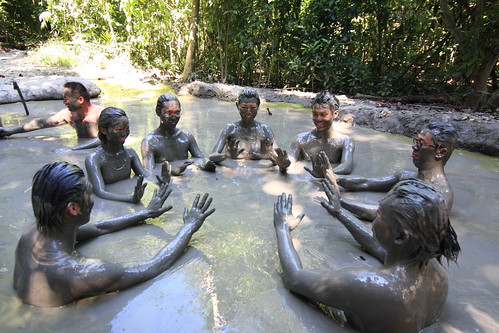
Showing posts with label mineral bath. Show all posts

Sunday, 26 July 2015

Reclaim

Yes, I'll admit. 

This website as well as others I maintain are directly stimulating soaking in our earth's natural and naturally heated waters: there's little on earth that beats having an impromptu warm bath in natural water in the midst of nature.

But times being as they are, the few yet to be remodeled and commercialised hot springs are increasingly being threatened by the ever increasing swaths of tourists, who are seeking their fair share of bliss. 
At the same time we see that managing what's left of the planet's bounty is becoming more and more of a challenge, one we might be losing. 
Sadly, with more use, comes more abuse: contamination of the pure waters, filth surrounding the baths, erosion of the natural environment, non-social soaking behaviour, etc., etc.

So it comes as no surprise that in the past few months, in various countries around the globe, an assortment of users / governing organsations, owners and managers have seen fit to seek to change the way we might be able to enjoy soaking.

Fight
Exhibit A is the hot spring named Skinnydipper located in the state of Idaho, U.S.A. 

The abuse of the site has the managing organisation (Bureau of Land Management) putting forward  a proposal so as to eliminate soaking for once and always. KVTB (May 5):
'... dealing with litter, feces, drug use and break-ins in the area'.
Luckily at the last hour, users have organised themselves and hope to reach agreement enabling future use. Hopefully.
Idahostatesman (May 12):
'Nothing’s official yet. Tate Fischer, who manages the BLM office for most of southern Idaho, said he’s meeting with the agency’s upper-level management this week to discuss a compromise between users of the popular hot springs and the federal government'.

Read more here: http://www.idahostatesman.com/2015/05/12/3798444_aficionados-of-skinny-dipper-hot.html?rh=1#storylink=cpy
More info on the user cause here, a facebook site currently notching up nearly 9000 likes. Their latest message:
'To give everyone an update on where we are at right now:
The Department of Interior denied our petition for stay. What this means is that the closure order is in place and going forward. The BLM will need to follow their process for closure and we hope that before they take any action, our appeal will be granted.
So right now, cross your fingers and toes. We are still in this fight!'
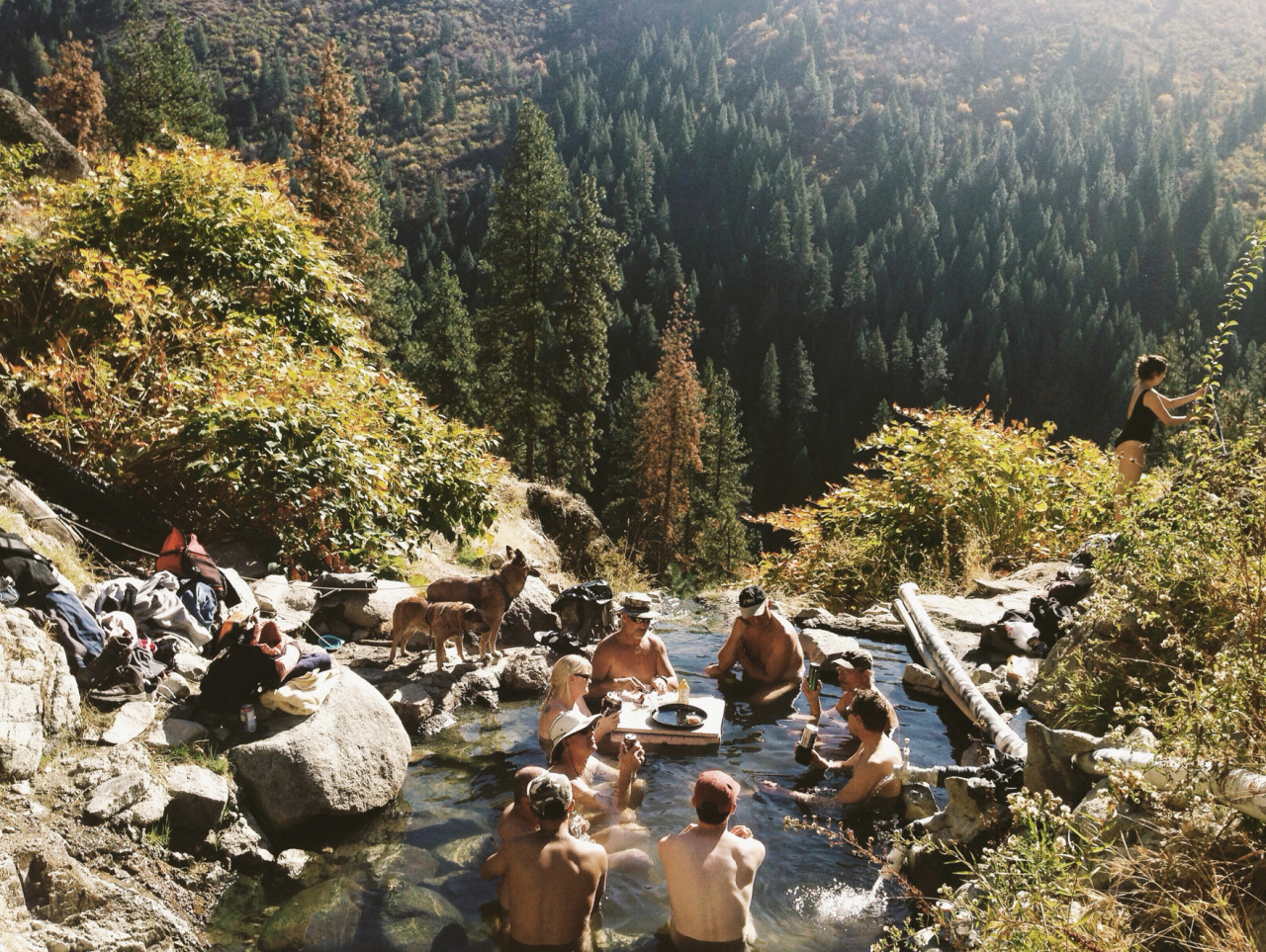
we hiked to a hot spring along the side of a mountain. the folk who maintain this hot spring just so happened to be having a sunday bbq. naked. so. that happened. when in idaho?
(Source: caseykaui)

Beauty
In a recent European Natural Soaking Society blog post there's more on the problems of Hrunalaug hot spring, one of Iceland's most iconic hot springs. 
The limited soaking site is unable to cope with the influx of the Iceland tourism boom and the owner has headaches enough without these.

The Grapevine.is (Jul.  5):
'The Hrunalaug hot spring has undergone so much damage from the sheer numbers of visitors it has received that the owners have considered bulldozing it over.
Helena Ei­ríks­dótt­ir, the daughter of the owner of the famed Hrunalaug hot spring, told MBL that her family simply cannot keep up with the number of visitors the spring receives. The spring is not just experiencing regular wear and tear, either; vandalism has also started to be a problem. People have also started camping on the site, despite numerous signs asking them not to'.
The Hrunalaug pool lies in the outskirts of the village Flúðir (Fludir), just over an hour's drive from Reykjavík. The pool combines beautiful nature with an ancient structure. The pool is located in a beautiful green gully, where the natural geothermal water collects into the pool.  The pool is actually split into two pools and the water streams out from the first pool in a little trickle of a river through an old turf-hut. There it collects again into another deeper but smaller pool at the front end of the hut. The hut is old and weary but can be used as changing facilities for guests who visit the pool. The hut has concrete walls and concrete floors, but the roof is made from corrugated iron and turf. Inside the cottage you will find a bench were you can put your clothes. The facility is primitive and raw but very interesting.
source tripcreator

As users are mostly tourists there's little scope for a user group being established to assist in management. With tourists outnumbering locals by far, I can't see locals taking the initiative and for tourist companies to practically assist there's too much scope for free riding from non-participation.
Thus the future use for soakers lies in the hands of the owners and their willingness to put up with antics and numbers. 
Icelandic law decrees unfettered access to nature and natural resources, destruction of the source is the only way owners can restrict access. 
Dilemma.
 
Elsewhere from the same blog we saw both an interview as well as a soaking review of terme Il Bullicame near the  town of Viterbo, Lazio (Italy). 

Here users are facing a doubled edged sword. 

On the one hand how to manage use, while at the same time lamenting the commercial exploitation of the source itself as waters are syphoned off to a neighbouring establishment. 

It's a much wider problem as legislation and governance seem to contradict itself resulting in a free-for-all; thus meaning commercial strength is the winner.

The fight itself is already protracted and it's yet to see what, if anything can emerge. Other than a Pyhrric victory ... 

A call to reclaim the hot spring at a recent protest
Tuscia Times (Jul. 25, 2015)

Cover up
Then closer to Southeast Asia, we were told the story of the Fudo no Yu onsen (Japan) where due to remoteness (and thus lax governance) abuse of the hot spring could take place. Here plays social change a large part as well. 
Tokioreporter (Jun. 2):
'Following a number of complaints regarding illicit behavior, the Shiobara Hot Springs Tourism Association announced on Monday on its Web site that one resort in Nasushiobara City has shut its doors
...
With an entry fee of 200 yen that was paid on an honor system, Fudo no Yu generally operated without managerial supervision.
Other reports concerned theft. 
Very Asian, the closing of the onsen was meant to avoid bad publicity ...

Safe to say the onsen has since reopened (see excerpt below) however with increased management it also saw the need to force a change in age old bathing habits; is this the future face of soaking in Japan?
Tokioreporter (Jul. 6):
'On August 1, the mixed-bathing Fudo no Yu onsen, located in Nasushiobara City, will begin accepting bathers during the day on weekends and holidays.
...
came to an agreement under two stipulations: A manager will be on hand to monitor the bathers, who will be required to cover their bodies with towels'.
Sacrilege? It beats me how forcing bathers to cover up will lead to positive changes. Certainly only the posting of a manager would be sufficient ...

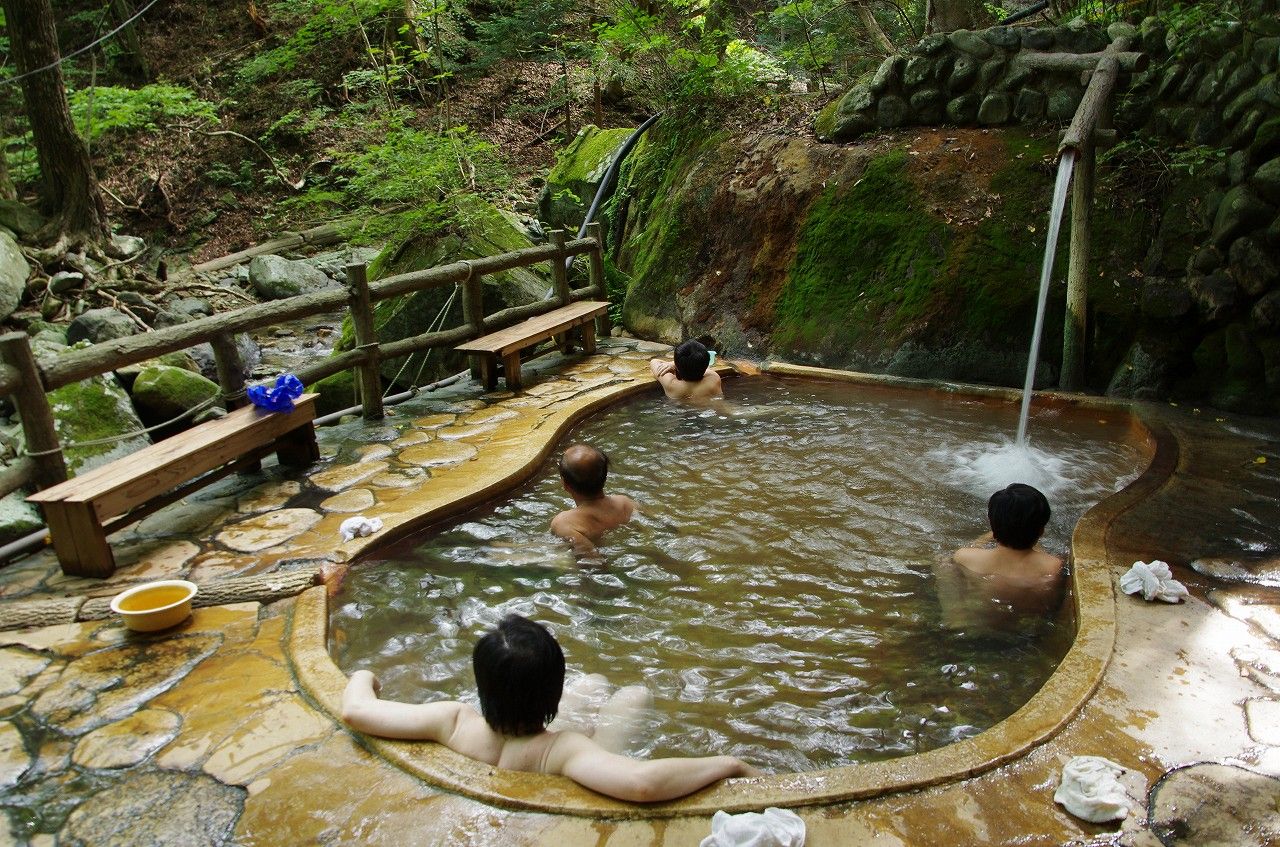
Fudo no yu onsen, source

Vocal
What's required is a need to know how managing naturally natural resources can be successful. Without caving into commercial interests. And with public interest at heart.

Are there any examples of such? 

It can't be overstated that public interests require public (read government) commitment. 
However, nowadays public entities worldwide are chronically underfunded to such an extent that they are increasingly getting caught in upholding the interests of the establishment. 
And if the public's interest require funding, the public's interest will stand little chance.

So it's up to us to bring about change. 
Each soak requires tailor made solutions, there are no blueprints. 
But what we share is a common, is an interest to safeguard the few unique publicly accessible natural soaking sites. 

At the very least our voices need to be heard!

Sunday, 14 October 2012

Sulfur, Siam & self-indulgence

Not much self generated news this time, so let's go to the regional soakers press:
The Jakarta Post (12 Oct) has a feature article of the hot springs at the foot of Gunung Sibayak on Sumatra (Indonesia), previously highlighted on this site. The village of Semangat Gunung counts 9 commercial soaking sites and according to the article can 
'remove dandruff'. 
Also noteworthy: 
'Sulfur powder is obtained by sieving sulfur water after being laid exposed for one night. It is sold at the price of Rp10,000 (US$1.04) for three packs. Many tourists buy the powder. Sugiran, a tourist from Medan, was one of the visitors buying the powder. He said he had taken a sulfurous bath for the first time and was interested in applying the powder to heal his skin disorder. “The rash on my body will hopefully be cured by this powder,” added Sugiran while soaking in a pool'.
Bathing in Borneo
 The local Post reports (9 Sept): 
'The hot spring at Kpg Panchor Dayak along Kuching [Malaysia]- Serian road recorded 15,076 visitors in the first eight months of this year'.
That's 60 a day for recently improved springs. 
'The Mambong MP [Deputy Tourism Minister Datuk Dr James Dawos] advised the village chief to request for parking space from the local council and electricity to be connected to the area. He said his ministry was willing to help'.
Hmmm, lets not hope it's a road to ruin. 

A very neutral review of Southeast Asia's most popular hot spring, Poring, with the addition of this: 
'If you are shy to bath in public, you can pay a little more for the private room located in the cabin behind the hot spring. Each room can accommodate two people. Remember to bring your swimsuit as you are not allowed to get naked in public in a Muslim country...'. 
?

Thai Tales
Travel Thailand has an entry on Thasatorn hot spring, Suratthani, Thailand. Some nice pictures, other not much to add to the Soaking in Siam blog entry. Travel Thailand does have an entry on the hot spring of Samet, Chaiya, Suratthani: 
'At Tambon Samet in Amphoe Chaiya, Surat Thani Province. away from Amphoe Chaiya about 4 kilometers hot springs is holy water. consists of two small caves and two natural hot spring'. 
Again. nice photo's.

Sai Ngam hot spring, Pai, Mae Hong Son province, Thailand. 
Photo found on picasa site of Ka zu. Apparently this hot spring is a tourist destination waiting to be discovered with a few tourist bungalows present.


By the way, Soaking on Siam has once more an overview of press clippings on the newly opened Yunomori onsen, a natural hot spring bath house in the center of Bangkok. Most comment on how outlandish the Japanese bathing culture is towards the conservative Thai society (as well as that towards the anglo-saxon reporters backgrounds), though they note that many Thai join in. All glowing repotrys (not only literally ...). 
I have two questions, one about the source of the water and the need to keep the water sanitary. And the other weather this may prove to be a new trend in Siam soaking, set to be replicated by the copycats (I WISH)?

Meanwhile in the Phillippines, an individual is doing just that ... 
'It was deserted but not closed. I was the only guest that day. Perfect for skinny dipping which I did!' 
Looneyplanet visited the hot spring of Baslay on Negros. And enjoyed it, despite the absence of crowds. Or because there were none ...

Otherwise
An interesting side theme. Ahave, an Israeli cosmetics company has been accused of war crimes by mining Palestian-owned resources: mud. The company response: no comment. Report by Sydney Morning Herald (4 Sept. 2012). More info on the controversy on Wikipedia.

Geothermal news: this time it is the New York Times (Oct 1) which picks up on the discussion in Japan on whether or not to promote geothermal energy generation.
'Then came the Fukushima disaster.
In March, the government lifted its decades-old ban to allow geothermal projects in five new potential sites in national parks and monuments to go ahead, under strict oversight.
Tightly regulated or not, that decision has inevitably caused tension between conflicting local business interests, environmentalists and geothermal energy developers. In Yuzawa City, for example, existing and prospective geothermal power generation facilities typically are close to the hot spring resorts.
...
Mr. Sakaguchi, the researcher at the industrial science and technology institute, said he understood the concerns of Oyasu’s onsen innkeepers.
In two known cases outside Japan, geothermal power developments have caused hot springs to dry up, he noted. One such case was recorded in the 1970s in Steamboat Springs, Nevada, he said.
Still, “a clear case of geothermal development causing a hot spring to dry up has not occurred in Japan,” Mr. Sakaguchi added. “The technology to pick up underground movements and simulation technology has really improved in the last two decades, so the risk is much lower.”
It typically can take 20 years to develop a geothermal plant, if only because it takes time to earn the trust and cooperation of local people, Mr. Sakaguchi said'.
Elsewhere a review of Japan and renewables mentions this: 
'Even geothermal, touted as a vital energy investment in Japan given the country’s abundant hot springs, is facing a battle with local resorts – the Kusatsu Hot Spring Resort association, on Kyushu island, announced opposition to developing the clean energy for fear that the precious mineral hot springs would decrease in supply'.
Meanwhile other nations are less restricted by the soaking set. Vietnam announces a project to come online at the end of this year.


'Thai Drama,
Chiang mai
San Kamphaeng Hot Spring
Thailand

NEX 3 , SIGMA 30 , MEIKE box (water/dust/sand proof )'
Found on flickr, posted by setsunalee

Saturday, 16 April 2011

Update Mid April 2011

In reality there's little to mention over the past 3 months, despite it being the best time of the year for soaking in Southeast Asia. Now the heat is on us and we can sit at home and soak in our own sweat.

This blog has been busy, adding entries on Lao and Vietnam as well as an extensive standard setting entry on global mud baths and another entry on the most popular soaks this side of the globe. Next month will see a few more entries in Soaking in Siam.

Though not exclusively Southeast Asian I would like to draw your attention to the following. The first is an entry on japansugoi, it focuses on hot springs on tv:
'Fuji TV’s popular onsen ジテレビの温泉番組 show is called “Lets go to the Onsen or Onsen ni Ikou!”. That program was so successful they decided to make an upgraded version called ” Let’s go to the onsen more! or Motto Onsen ni Ikou!” もっと温泉に行こう'!'
There's a long way to go for Southeast Asian soaks ...

Other big news from Germany's Focus magazine on New Zealands Hot Water Beach. A good write up (if you can read German)

From the blogosphere, a description of Ban Nam Ou, Lao on travelfish:
'Everything is shabby and funky but also crazy and cool'.

'Native laotians bathing in the hot springs south of Luang Prabang
I saw this incredible view out of the bus window, near Nan Keng on the highway between Vientiane ad Luang Prabang. (Geotagged picture, thats how I know), people bathing in steamy water - but my camera was tucked away and I didn't have time to catch it. Then 10 seconds later he bus stopped to let out someone who had to pee :) I grabbed my camera and ran back 200 meters and catched this picture, it was one of the rare minutes it didn't rain on the whole (11 hour!) bus trip back to Vientiane'.
Photo of Ban Nam Ou by Sunday Laks

Wednesday, 6 April 2011

Southeast Asia's Top 10 2011

More than one and a half years have past since a collated data on the internet savviness of Southeast Asian hot springs and present to you in a top 10. Back then Soaking in Southeast Asia wrote:
'Though arrived at through repeatable measurement, it has to be acknowledged that there is considerable bias in the results.
  • English is the main language in some countries and counts especially for Malaysia and Philippines.
  • Income and thus internet use once again counts in favour of Malaysia.
  • Names for hot springs are sometimes fluid, especially in Thai, where one can have many different versions for the same hot spring. In Vietnam and the Philippines this is less the case.
  • Due to changes in ownership, hot springs change name which does not favour a large number of hits. See for instance Toya Bungkah, which was previously known as Kintamani, a much more often used name. And would have made the top 10.
  • Internet is disproportionally skewed towards English. Vietnam sees relatively more non-English speaking tourists.
  • Some hot springs carry easy names referring to larger places, such as Fang or regions. Banjar for instance, would have been third instead of fifth if Lovina (the name for the region) would have been used'.
Much of the above is still very much true.

Used were searches on google, bing (new), flickr, tripadvisor's Asian forum and google blog (new).

So again caution when interpreting the following top 10 as of April 5 2011:

1. (1) Poring, Malaysia

2. (4) Fang, Thailand

3. (3) Ardent, Philippines

4. (5) Banjar, Indonesia

5. (-) Asin, Philippines
6. (2) Sungai Klah, Malaysia
(7) Thap Ba, Vietnam

8. (-) Kham, Lao

9. (10) Tambun, Malaysia

10. (-) Pedas, Malaysia
(-) Binh Chau, Vietnam

Sungai Klah drops, possibly an anonomy. Purely on Flickr, the number of Sungai Klah photo's has doubled, though ranking stayed the same. With tripadvisor many of the other hot springs scored better.

Muang Kham in Lao is a newcomer as is Asin (Philippines), no idea why they have become so much more popular. Maquinit (Philippines) dropped away altogether, would now be twelfth.


Country wise, Indonesia seems less popular.


It's surprising how in just one and a half years much more info has come online. Fang for instance has received more than 150 times more links. Sankampaeng (Thailand) has seen the number of links on Flickr increase 5 fold.


Do note that this says nothing of the quality of the soaks nor over the degree of greatness of each soak. It might just be the opposite ....


By the looks of it, Fang hot spring is getting hotter! Photo by Hannah Says Hi:
'Fang Hot Springs This water is SO HOT. A geyser shoots every 20 minutes. Family fun!'

Monday, 4 April 2011

The rein of confusion

Duc My 
Confusion reins concerning the hot spring of Duc My. Duc My is a village located along Vietnam’s Highway 26 which connects Vietnam's Khanh Hoa town of Ninh Hoa with Buon Ma Thuot (Dak Lak provincial capital), close to the Cambodian border. However my driver speeds through Duc My, a village located on the banks of a nice river, just before the road leaves the lowland for the foothills covered by extensive sugarcane and cassava fields. It is 9 km after Duc My village that there is a turn-off to the left down a 100m wide dirt 'avenue' before we halt in front of a house. An attentive man sells an entrance ticket (5,000 VND, about US$ 0,25) and explains to proceed to behind the house. A short way after the house one comes across two shallow ponds. Around the ponds are a number of shaded picnic tables. Just upstream of the ponds is a 3m high, 10m wide piece of rock which emits both water and steam. The host who had accompanied me illustrates nature’s oddities by simply announcing that the water is 70-72 degrees. That’s Celsius. The water body (see photo below) is a man-made 1 m wide basin halfway up the rock, roughly 3m long. There’s another basin, same size, equally hot. One can scramble over the rock, there are quite a few holes from which hot water streams. It all doesn’t look soakable: the ponds are too shallow and look very muddy, the basins are for boiling eggs or such. Vietnamese guests seem to have found the only way to use the water: adding it to their noodle lunch. I scramble around and must conclude that, no there is no way to soak. 

Clear 
I return to the house and try with help of my driver and the host's son try to clarify one or two things. For one, I always said I wanted to go to Duc My hot spring and my driver went straight to this place (without any need to seek questions), so this must be it. However at the spring site itself, they refer to this place as Truong Xûan (Suan). Then there is this reference to a hot spring, about 5 km past Duc My called Ong Me with some descriptions which remind me of Truong Xûan, though it distinctly says it is not Truong Xûan:
'Beside Truong Sinh [or Xûan?] Hot Spring that is very well-known, tourists coming to Ninh Hoa District, Khanh Hoa Province recently rumoured about a new hot spring which has a very peculiar name of Ong Me'.
The description though is not of Truong Xûan. The attendee and taxi driver have not heard of Ong Me, which if closeby seems a bit odd. Is it thus another hot spring? Or not? Then again this reference of Duc My hot spring has another description of it’s location,
'close to National Highway 1'.
Which it is not.
But the other two sentences would not conflict with what I experienced. And a reference to Truong Xuan hot stream:
‘located in Ninh Tay Village’.
Which according to my sources is correct. But surprisingly it also adds that
‘the precious natural mineral water is processed into beverages’.
Which I observed no proof of.
Why can't life be more simple? Hope Mr Rakuda of his hot spring journal fame, has visited what he also calls Duc My and the photo's posted are very similar to what I experienced. Translation of the text does not add much to the above other than that back then (2005) he did bathe in the lower pond ... (I believe). I've been able to find an experience from 1995 though other than hot nothing new (or old). Odd as it seems, but there is a project underway to build Truong Xûan Hot Spring Heath-Spa Resort which the name would imply would be at exactly the same place. The first reference I found dates to 2003, but clearly nothing has come about. Even though a real estate agent is trying to sell something under this name in 2004. More importantly Wellness Vietnam
('Consulting is dedicated to the design and implementation of client-centric, cost-effective spa and wellness solutions')
now lists the project as going to be completed this summer as well as a project nearby in Ba Ho (which when visited was well under way). The above link to Wellness Vietnam though is to a cached page, it's up to date page has no reference to either projects ....

'Hot springs, near Nha Trang. Khiet showed us some very natural hot springs tucked in the foothills on the way to Nha Trang. It was beautiful to see springs kept so naturally'.
Funny that, natural cemented wall. Photo by
lafeola

Elsewhere
Khanh Hoa province through Thap Ba hot spring Center has become a major destination for hot spring lovers. That said until recently Soaking in Southeast Asia had listed a number of other soaks, such as the already blogged Tubong and this entrance's Duc My. We will have to contend that until further proof Ong Me is another hot spring in this province.
But there are possibly more hot springs. Danh Thanh is often used in texts on Vietnam's potential for geothermal electricity as well as in mineral water sales.
Then there is this link that names Danh Thanh as well as another hot spring:
'By 2003, Khanh Hoa has registered 10 hot springs with average reserve of more than four litres per spring every second. The province’s famous hot springs are Danh Thanh and Suoi Dau'.
Ten? Suoi Dau? Suoi Dau is more better known in the province for being an industrial zone as well as the place where a former colonial Alexander died (source):
'The grave of Doctor Alexandre Yersin is located on top of a nameless hill at the Suoi Dau area in Dien Khanh district'.
My hunch is that they only mean spring rather than hot. But then 10 springs are not much ...

Getting there
: From Nha Trang head north to the town of Ninh Hoa and take the main road out to Buon Ma Thuot, After passing Duc My village (about 5 km) it’s about another 11km on the left side of the road.
 
Soaking experience: Too hot. 
Overall impression: Due to the lack of soaking possibilities, not really worth a visit unless passing through.

Monday, 28 March 2011

Mud on our mind

Tiermas, Navarra, Spain: natural geothermal spring and mud bath: better than a soak? By Patrick_22_b:
'Tiermas Stuwmeer met zwavelbronnen bij ruïnes van oud dorpje'
Popular
Hot on the heels of Soaking in Southeast Asia's blog on Thap Ba hot spring (Nha Trang, Vietnam) I got to wondering what would the basis of this hot spring's success. Some suggestions in that blog were:
  • ease of access,
  • high degree of visits by tourists and
  • many potential domestic visitors.
But these do not seem to be the key.

Elsewhere Soaking in Southeast Asia read that the rate of foreign visitors versus nationals was like 40:60, a fact which in itself is not so surprising. However on most visits to hot springs in Southeast Asia, I was the only foreigner. So why so many foreigners?

The only reason why, could be due to the difference in tourists nationalities (many Russians) and/or the potential to take a mud bath.
Yes, mud. Essential to the Thap Ba experience is a mud bath. While in Nha Trang, tourists will go out of their way to take a mud bath, a highlight of their holidays.

Now, as slopping around in slurry is such a draw, why aren't mud baths more commonplace?

Research
Soaking in Southeast Asia put this thought into some research:
  • Mud is healthy
Yes, besides vitamins and organics, mud is essentially a lot of minerals packed together. And we know that these minerals are an essential part of hot spring soaking. And bathing in hot mineral water can assist disease treatment, as well as have marked health benefits when used long term.

World's most used online reference manual, Wikipedia, hardly expands on this theme which seems a bit strange. 'Therapeutic' is one suggestion, another points to 'relieving of arthritis'. Others inputs include 'healing properties' and 'skin revitalization'.

A better source of reference is the medindia.net entry on mud baths (under the alternative medicine chapter):
'Mud bath is a detox therapy, which has become extremely popular around the globe. Until rather recently, many European practitioners promoted mud baths as a treatment for arthritis. This back to the basics, relatively simplest of alternative therapies, tends to help relax muscles, soothe aches, improve blood circulation and smoothen the skin. With today's emerging trends mud baths are often recommended to help reduce stress and leave us feel rejuvenated at the end of the session.
...
Taking a hot bath or sauna promotes sweating that flushes the toxins away from the body. Mud baths draw out the toxins and impurities from the body, exfoliating and nourishing the skin'.
Despite this
'Deep relaxation is the primary and most-proven reason to take a hot mineral mud bath. The warm, soft mixture cocoons and buoys up the body and sucks the stress out. There’s no pressure anywhere on the body. The heat of the mud (usually over 100 degrees Fahrenheit) makes you perspire and cleans the pores. The treatment consists of 10-15 minutes of immersion, which improves the complexion, removes toxins, and soothes and relieves joint and muscle pain' (source).
Ooh, that sounds great.

'Analysis of Mud'
From Hell's gate, Wai-ora, Rotorua, New Zealand. Source

Another good source of info is the about.com page on (mud) spa's in Calistoga, California, U.S.A.. Historically it mentions that Cleopatra was one of the first users of (in her case) Dead Sea mud which appears to be the most widely used mud in mud treatments in the global spa industry.
The combination hot springs and volcanic ash seem to be the key. So no wonder that other popular muds are from New Zealand, Ischia and Hungary. Other well known muds (not necessarily of volcanic origin) seeing global use are Multani Mitti (India), Moor Mud (Central Europe; high organic content) and Great Salt Lake mud.

Another trend setter was Queen Sheba (source). Soaking in Southeast Asia notes that links seem to favour queens ... No, not. When retreating from Bulgaria, Hitler has been said to have asked for three train wagons full of local mud (source)!

Bhutan believes that the use of mud can heal war wounds (source) though it doesn't mention whether this concerned physical or psychological wounds ...

Even throughout the animal kingdom, mud baths are known for their propensity to cool down, provide positive skin healing and a source of additional minerals.

Some notes:
- A mud wrap distinguishes from a mud bath as it is essentially a layer of mud brought on the skin, left to dry and then rinsed off, in general less relaxing.
- Clay vs mud. Medindia:

'Clay like mud comes from the earth. However, due to its composition nature it has a tendency to soak up or dry, hence it is used in cosmetic products as a drying agent. It is a component found in many cosmetic products like foundation and powders. Clay has the ability to remove matter suspended in liquid, as its natural property is oil balancing. Thus, clay helps to assist the body in the systemic removal of many industrial chemicals that the body would otherwise have difficulty eliminating'.
But a clay bath?
- Sand baths are quite different, though very easy to produce on a beach. Beppu, Japan has geothermal warmed sand baths.
- Clothing? Any family laundry person would effortlessly point out that mud and clothes are not an ideal combination. Clothing seems to get in the way. For instance, a month after I visited Thap Ba there was still dirt stuck on me after a swim. However other than in festivals (see chapter below on anti-society) clothing seems to be an important part of the more social forms of mud bathing. Naturally further off the paved road, less so. But with a few exceptions (see below: Krinides, Hoyo) the major mud baths of the world are not clothing optional.
No clothing in mud is offensive? In NZ they think not ...
- Mud-wrestling. looks like fun, but why are only women involved? Soaking in Southeast Asia thinks it's not for vanity sakes ...
But what should be stressed is the fun part, relax part and possible social part (We tend to forget socializing in our modern day spa's, it's all me, me, me).

  • Mud is anti-society
Is it? Society seems to prefer clean and proper. Even as kids we know the best way to upset parents is to get dirty. So why not muddy?

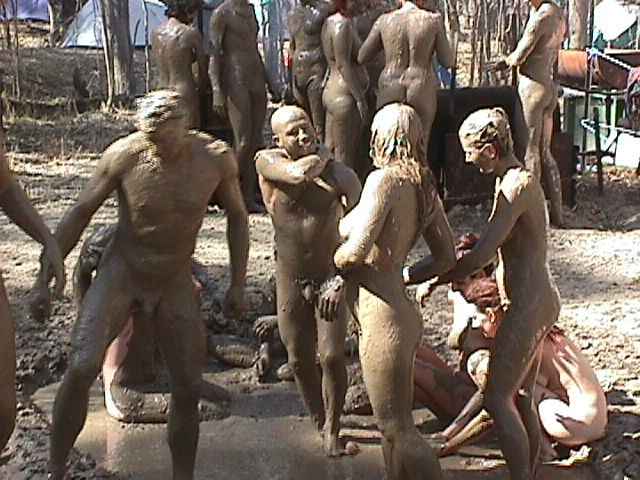
Extending this theory, it's easy to see why (pop)festivals go out of their way to feature mud. Even the first festival of festivals (Woodstock) saw revelers seek to unconsciously shock older generations with a mud bath.
Besides underlining their supposed street credibility, at the end of the day a mud bath is just plain fun. Do note that clothing was / is optional and often dispensed of, in favour of practicality while simultaneously increasing the 'shock' value (at least initially, now not so much more in current days ...).

Just a few of the global examples are Woodstock '94 (U.S.A.), Paleo-Nyon (France, the only festival which has institutionalized the mud bath), ConFest (Australia), Big Green Gathering (Australia), Glastonbury (U.K.), Future Music (Australia), Burning Man, (U.S.A.), Down to Earth, (Australia), Rainforest Festival (Malaysia), Confest (Australia), Boryeong (Korea), Bloco de Lama (Brazil) and Sziget (Hungary). Just to name a few.

The Burning Man festival plays out on a dry lake bed deep in Nevada, U.S.A.. Despite the hot spring (muds) of Trego nearby, revelers take the opportunity to enjoy a mud bath during the festival itself. Photo by Gorightly:
'mud_people The attack of the naked mud people, Burning Man, 1997 or 98'.
Note:
Not under anti-society but with the summing up of festivals, in India the festival of Babba Jitto (Jhiri, Jammu) pays tribute to the liberator of the farming community. Besides a holy bath devotees also cover themselves with 'holy' mud (source).
  • Mud is different
Seems logical.
  • Mud is cheap.
Mud is everywhere, so a mud bath can be had virtually everywhere as long as it doesn't freeze. That said, there is a tendency for mud baths to take place in the summer or in warmer climes.
In reality there are not many naturally occurring hot mud baths. Nearly everywhere where there is hot mud, there's hot water and thus the latter is more desirable for consummation ...

That's not to say that taking a mud bath in a spa is cheap. Glen Ivy in California charges $85 while in the same state in Calistoga spa's charge about $65. Prices in Europe are no less cheaper ...

Muck around the world
Following is just a short overview of natural mud baths (excl. those spontaneous ones occurring after a rain shower) as well as whether or not these are thermal mud baths (gt: geothermal). Oddly many mud baths are also located on or near a beach.

A Calistoga mud bath. By Simon Edward

America's

'Volcan del Totumo'.
A real mud volcano with a mud bath inside. Colombia. By davidcovo

Europe
Vulcano island mud bath, Italy. By daturi
Africa
Oceania
Asia
Hoyoland mud onsen, Beppu, Japan; blogged by lorraineorsunshine

Muddying in Southeast Asia
So if worldwide available, they most certainly exist in Southeast Asia? Yes, they do.

Though hot springs have a certain following / touristic value, mud baths are yet to catch up in possibilities despite all what can be said in their favour.

As said Thap Ba (in Vietnam) is by far the most popular in Southeast Asia (even though the mud is resourced from elsewhere, the suggestion that there is both a hot spring and hot mud endures) and others spas and hot springs in the same country are catching up, for instance Binh Chau.


Outside of Vietnam there is the Phu Klon of Mae Hon Song province, Thailand which combines hot water and naturally occurring mud. Marketing wise they are mainly focused on the 'spa' crowd (as opposed to those who want to experience / have fun). At the lower end is the ad-hoc mud bath near one of Pai's hot springs.

The same focus on higher end tourists applies to the mud baths of
Pinatubo, Philippines.

Then there are the mud 'volcanoes' on Malaysia's
Pulau Tiga, an off-shore island off the state of Sabah; the islands high point for tourists is the experience of a mud bath.

Another hot item on the tourism trail. Malaysia's Tiga island mud volcanoes. By cephiroth.chin:
'Pulau_Tiga_27
Here you are: Transformed into Mud Man! Actually its adviseble not to jump inside the mud area, to avoid mud go into your eyes & mouth~~~'
Sarawak hosts Kampung Meritam's mud volcanoes (source). Here's an experience by Wilson Chin. 

More off the track is Bali's Singsing waterfall which should include a mud bath. Not when I was there.

More popular is the mud bath of Vang Viang (Lao) which probably is just a wallow of mud watered from the nearby Nam Song river; with the large amount of near drunk visitors and the lack of drainage there's probably a health issue here, but nevertheless popular. It's more for the rite of passage than any health aspect.


Are there any more mud baths in Southeast Asia?

Muddying the business
Sensing both the increasing popularity and the untapped resources of mud bathing in Southeast Asia, one would expect this to be a growing trend both to expand the offers as well as appealing to a younger generation.
Soaking in hot springs in Southeast Asia as well as worldwide is mostly associated with the elderly and as this blog entry witnesses, the young are often as eager, if not more so, to indulge a soak if dirty (and weird) business is included.

One aspect that might deter the popularization of mud baths, is that muddy baths require possibly even higher standards of hygiene, a fact which could give the whole sector (especially here in Southeast Asia) an impulse to improve standards (but a not much loved move away from naturally, the way Soaking in Southeast Asia approves of ...).

Certainly in Vietnam, I have seen some companies willing to get in on the business. Especially around Nha Trang, despite the proximity of Thap Ba, many high-end hotels are offering their 'own' mud treatments. Naturally they will be followers and though to a certain limit stand to profit from Thap Ba's popularity. On the other hand they'll miss most of the free publicity, why on earth would visitors sign up for an expensive clinically mud treatment when the real thing is just around the corner? Snobbery?

But think about it, Vietnam for instance has quite a few hot springs but usually they are at least 2-3 hours away from each other, so most probably no competition from each other. Another factor favouring the development is mud's cheapness.

Even more exciting is the recent event of new 'mud volcanoes' coming to life. Though Azerbaijan is struggling with it's mud volcano, in Ninh Thuan, Vietnam new mud volcanoes have occurred. Who know's, this might be a destination of the future. Do note that a mud volcano does not always offer an opportunity for a mud bath ...

That's not saying that all mud is good. Probably the worst example of mud gone bad is here in Southeast Asia where in Indonesia, the Lapindo mud lake stands for poor planning, poor regulation and implicit government involvement in avoiding offering adequate compensation to those affected.

Epilogue
So quite an exciting business, might just warrant a blog of it's own ...

On a totally different aspect, I came across an article in the Sueddeutscher.de about Munchen's last mud bath. In the article it mentions how in 2009 the last public multiperson mud bath of 2 by 4 m of Munchen was to close.
Decreasing numbers of visitors:
'"Wellness muss eher sauber und steril aussehen" - und nicht braun und schlammig'.
Which translates as wellness should be clean and sterile - not brown and muddy. Really. Soaking in Southeast Asia begs to differ.
And increasing costs: Two truckloads of mud were required each week costing 400 Euro each. Not so dirt cheap!

So is the exception to the rule?

[Note: special extensive mud feature on European Natural Soaking Society (Jan 2013)]
Related Posts with Thumbnails
Copyright 2009 © Soaking in Southeast Asia. All rights reserved.
No reproduction or republication without written permission.