Showing posts with label hygiene. Show all posts

Wednesday, 29 October 2014

Light bulbs


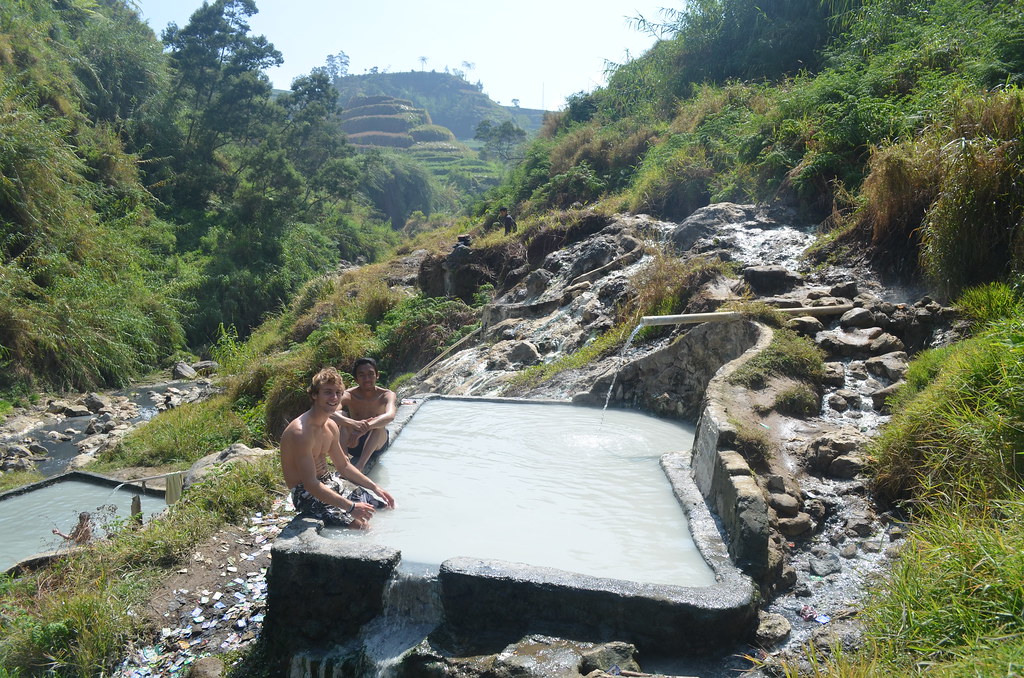
 Who doesn't emoji️ #hotsprings ? #dieng #java #indonesia #travel #nikon #nofilter #latergram
(source) 
Fine Line 
In the most recent posting on this blog, I presented a possible definition of a soaker:
Soaker: a person who enjoys and values (possibly through  maintaining the vicinity, but with reference to traditions and history) hot naturally occurring liquid which mostly is publicly accessibly / free of charge with a preference for natural bathing habits.
Though this may be the global definition, would it stand for Southeast Asia? 
If we exclude the most popular soaks of Southeast Asia, which tend to be micro Disneyworlds with little regard to soaking, soakers in Southeast Asia are mostly driven by potential health benefits. There are always entry fees to contend with, albeit mostly nominal. Dining is a quintessential part of the experience. Natural bathing habits are out (and with it hygiene!), though socialising is in ...
So a Southeast Asian soaker definition could be:
A person who enjoys and values the therapeutic qualities of hot naturally occurring liquid which is affordable and includes dining opportunities for the (extended) family / friends. 

Not so standard news
Probably the most striking bit of news the past two months concerning wellness came from Germany. What makes it more mind-boggling is how it has been disregarded by the mainstream news channels.
Bad PR for the wellness branch:
'In fast zwei Drittel der Pools von Wellnesshotels entspricht die Wasserqualität nicht den Hygienevorschriften'. 
So two-thirds of the (swimming) pools of wellness hotels fail hygiene rules. The results were taken from hotels in Germany and Austria and make poor reading. In general outdoor facilities were cleaner and using the facilities around lunch time was the advice, later and earlier gave worse results ...
If in Germany this was the result, one can only imagine how poor such facilities are in general as regards to hygiene ...
'A man was hospitalized after jumping into a hot spring on the northern Nevada desert to rescue a dog'. (source). 
No word on the condition of either jumper or dog.

Looking for a different soaking connection: mountain biking and hot springs.
'The Hot Springs Route is a brand new mountain biking route, the brainchild of Casey Greene, an avid rider and a cartographer for Adventure Cycling in Missoula, Mont. Casey came up with the idea after doing a 10-day bike tour across North Idaho and Montana when he and some friends biked to a different fire lookout tower every night. "At the end of the tour, I thought this whole concept of having a destination where you end up each night was kind of cool ... basically, destination mountain biking," Casey said.
The light bulb for the hot springs route went off when he was soaking at a hot springs in Pole Bridge, Mont. He was thinking that Idaho had the highest concentration of hot springs in North America, so why not try to connect the dots? He started evaluating the situation from looking at maps, plotting the hot springs, looking at connecting routes, and came up with a tentative route. Then he ground-proofed them to see if it would work. Last summer, he rode the whole route that's connected by dirt roads, all 517 miles of it, and he also logged a number of singletrack routes that add spice to the whole experience'.
What happens when you crash a drone in a hot spring? RT (Sep. 23) notes that:
'The German tourist who crashed a camera-equipped drone into a lake in Yellowstone National Park in July has agreed to a plea deal that would ban him from the park for one year, as well as unsupervised probation in his home country [yeah, right]'.  
But then 2 days later Reuters reports (Sep. 25):
'A Dutch tourist has been ordered to pay penalites of more than $3,000 for crashing a drone aircraft into a famous hot spring at Yellowstone National Park, a park spokesman said on Thursday'.
So how come the difference in sentencing?
 
Uncertainty about a Japanese onsen experience? Japan Realm has a guide (Sep. 24) on how to get naked with strangers. Apparently for normal non-Japanese this is a possible situation of pure terror. Embrace it, is the main advice ... 

A hot tub gondola? Yes, in Japan (source).

We've heard about the declining bathing culture in Japan (mostly non-hot spring sourced). So what to do with bath houses having been closed? Rocketnews24 (Oct. 2): 
'Japan has been going through something of a hot spring renaissance over the past decade, but at the same time, things are tough for Japan’s other traditional venues for communal bathing, sento, or public bathhouses. Despite a recent uptick in their number of foreign customers, most Japanese have a pretty lukewarm reaction to the prospect of taking a soak with others if the water isn’t heated by geothermal sources.
For the current generation, a hot bath drawn from the tap is no longer a luxury nor something that necessitates leaving home for, and so sento have been shutting down around the country. But rather than close their doors for good, a few have converted their bathing facilities into dining spaces and been reborn as stylishly retro sento cafes'.
Complete with 5 examples.

Onsenaddict (Oct.) has a top 5 of the best cascading hot spring massages.

Foreign Affairs need not always lead to a panacea for hot spring development. The NZ Herald (Oct. 27): 
'A master plan to turn the picturesque Waiwera thermal resort into an international destination with jobs and other economic benefits became bogged down in red tape'. 
That seems to be the case, but there were quite a few question marks concerning the investor which drew out the process. Money doesn't always pave the way.

Geothermal
A very good read. From thinkgeoenergy (Oct. 8) Alexander Richter let's us know how he started up the website and how he hopes to continue doing so. A very genuine article and thought provoking.

The Economist has a very upbeat article (Oct. 26) on geothermal energy in the USA. Despite being one of the cheapest means of power generation, subsidies to let this sector mature have been lagging. No word on double use (power & soaking) of generated steam though.

From Bandung.bisnis (Sep. 20) an article about developing the geothermal power development of Kamojang near Bandung (Java, Indonesia). At the same time they hope to develop the tourism potential. Thinkgeoenergy was a recent visit here (Oct. 27), no news of the tourism potential though.

Hotspring waterfall in #mountrinjani #lombok #indonesia #hotspring #waterfall
(source)

Not top notch
  • Indonesia
A great posting on Sumatra's answer to Turkey's Pamukkale (tripzilla, 22 Sept.):
'At a glance, Kawah Putih Tinggi Raja resembles the natural rock pools of Pamukkale, Turkey. “Kawah Putih” literally translates to “white crater” in Indonesian, and it is one of North Sumatra’s best kept secrets. Found in the village of Tinggi Raja in the Simalungun province, Kawah Putih is a natural hot spring that has hardened to form white terraces rich in calcium carbonate deposits.
It takes about 4 hours to drive from Medan to reach these “warm snow” terraces. Bear in mind that this location is not a typical tourist hotspot with top-notch facilities. It’s completely off the beaten path and the road leading to it is paved with huge uneven stones. If you don’t mind a super bumpy car ride, hiring a four-wheel drive is the way to go'. 
Unfortunately the springs are too hot to soak in, it's more a place for sightseeing ...

It's all Sumatra btw, in this update. Yahoo Singapore notes (Aug. 14) that Sumatra's capital Medan is highly underrated. One of the 16 reasons to visit:
'To soak off all that travel fatigue, I highly recommend a soak in one of the hot springs at the foot of Mount Sibayak. The warm sulphur water can relieve rheumatism and help you de-stress. The smell of bad eggs and the entrance fee of S$0.30 is a small price to pay for a spa experience surrounded by nature'.
Photo:

They do fail to tell prospective tourists that due to an eruption of the Sinabung volcano the area is covered in ash ...

Lonely Planet on Flores (Oct. 8): 
'Like a fiery dragon snaking out of the Komodo Sea, Flores boasts a sinuous highland landscape that is spiked with no less than fourteen active volcanoes (only Java and Sumatra have more). This is the heart of the ring of fire and volcanic activity is visible everywhere from the black sand beaches to the smouldering mountain peaks. Near the village of Moni, there is a pair of sacred thermal springs, one reserved as a bathing area for men, the other for women. After work the entire village frequently gather to bathe in the gigantic hot-tubs and chat happily about the pleasures of highland life'.
Not really natural, but the Australian Traveller names six of Ubud, Bali's best spa retreats.
  • Malaysia
An overview of 10 hot springs in Malaysia.

Another extensive photo review (Sep. 23) of Banjaran hot springs. So many photo's. But no people, let alone no soakers?

  • Philippines
Oi pre?! Nakayakap kaba skin? Wahahah @hi5ange emojiemojiemoji ayysoosss nmn! @simplyarmie @nvrheard emojiemoji @ #mtIsarogHotspring #hotspring #tripniprince #galaniprince #bicolandia #bicoliscool
'Just two hours away from the hustle and bustle of Iloilo City, the unassuming town of Anini-y offers a much-needed respite to weary travelers.  Rugged and bountiful, this 4th class municipality in Antique Province is home to some tourist attractions worth a visit'. 
And what are then the attractions? Yahoo Philippines (Oct. 5): 
'Siraan Hot Spring is a local favorite. Here, one can take a refreshing dip at any of the hot springs enclosed in bathtubs and pools. A mossy swimming pool with sulfuric water is the key feature of Siraan. The water flowing here is believed to be therapeutic; it is said to cure skin diseases like fungal infections and eczema as well as soothe muscle and body aches'.
  • Singapore
Experiencing an onsen. In Singapore. The concept of onsen bathing is slowly being introduced to the city elites of Southeast Asia. Albeit without the natural surroundings. And even the natural waters. Just the concept. The Evacomics has a blog entry (Sep. 23) on the experience of the Ikeda Spa in Singapore. Score: very impressed.
  • Thailand
#squaready #タイ#パーイ#温泉#hotspring#GoPro#GoPro#GoPro#水が茶色い 三ヶ月ぶりくらいにお湯浸かりました。のぼせた。
(Pai, source) 

Just out of our geographical scope, but a nice read nonetheless, how to soak in Taiwan. Ligeia describes (Sep. 7) her experiences at the Long Nai Tang Hot Springs:
'Wanting to include a hot springs experience in my day trip to Taipei’s Beitou district, I looked up places online and found an vast array of choices. Long Nai Tang Hot Springs seemed the most appealing as it was the oldest, dating back to 1896, and it had no website of its own. I only found it because a blogger had visited and wrote about his experience there using words like “local” and “authentic”. So, of course, I had to give it a try.
It is not the easiest place to find unless you can read Chinese. But the concierge at a hotel (that turned out to be right next door) pointed me in the right direction.
I was greeted by the most efficient older Chinese man, who responded to my “Ni hao” with “naked”. Clearly waiting for a response, I said, “naked is ok”. “Towel”, he continues. “I have my own towel”, I said pointing to my bag. “One hundred”, he replied holding out his hand. I paid the money and he said, “shoes” and pointed me towards the women’s section'.
Thus becomes easy communication. 

'Mateo Hot and Cold spring'
Sorsogan, Bicol, Philippines (Source)

Wednesday, 9 November 2011

Bombs, nuclear bombs, eve, jokes and belief: an update

Soaking in Southeast Asia has added another couple of last hot spring reports, just a few more left ...

A potential terrorist threat?
Meanwhile, it's not often that a hot spring / wellness issue hits the front pages, but Britain's the Sun news(?)paper lead story on the 18th of October concerns the
'virus bombs'
that are fish foot spa's, aka Dr Fish. Luckily the story actually determines that the risks are
'extremely low'.
Energetic discussions
Not only are soakers cautious on geothermal energy development, headlines by bloomberg (September 18, 2008!) suggest that naked bathers are staging protests in Japan! Not a handful, but
'millions of naked bathers'.
However the article does little do substantiate the claim of staging protests and why specifically naked bathers are opposed to geothermal energy (are textilites pro?). The article does once more highlight the difference in interests concerning thermal waters and the lack of possible consequences that geothermal power production may well or not have on other uses.
Better documented is the Guardian's reporting from 2009, though now the soakers are in a lather!
'Geothermal developers insist that power plants and Japan's thousands of spas - or onsen - can happily coexist. But the 7,400 people of Kusatsu, more than 90% of whom depend on the tourist trade for their living, are not convinced. The fear that energy development will rob the town of its precious supply of hot, mineral-rich water has propelled them to the forefront of the anti-geothermal movement'.
A case in hand is just a snippet of very recent news from energybusinessnews.com.au which actually misleads readers in thanking that developing the Innot hot spring into a geothermal plant will create a spa resort, despite Innot hot spring already being a well-visited tourist site (see onsen soaker's review)!
And then back to what this blog is about, the current day. The Daily Telegraph runs a blog (October 28, 2011) on how geothermal energy will be the answer to Japan's nuclear problems.
'Such a measure would invariably face opposition from the powerful “onsen” lobby – but would clearly mark a step in the right direction in terms of Japan finally tapping into the potential of one of its most powerful but overlooked natural resources'.
Surprisingly more than 70 persons comment on the blog.


Another two days earlier none lesser than the
Wall Street Journal (October 26 2011) again looks at the issues at hand, but with reference to Indonesia. Poor regulation are hampering the investment in geothermal energy. And then there is this:
'Some projects have been delayed by local politics. Geothermal start-up Bali Energy, on the resort island of Bali, started exploration close to 15 years ago and received most of the necessary approvals in the 1990s. Its plans to rev up production several years ago hit a bump when some groups expressed concern that tapping geothermal wells would drain a nearby lake. Hindu leaders, meanwhile, worried that meddling with nature’s pressure points could anger the gods'.
And pointing to the Lapindo mess (see below), the Hindu leaders may have a point ...

Finally another threat, mentioned from the Borneo Post (November 1). Melaka's chief minister is eying up the potential of his state's two hot springs for commercialization as spring water. It would even
'generate good income for the people'.
Stuff the soakers?


Risk management

Though geothermal mud usually has medicinal qualities, the
case of Lapindo in Indonesia illustrates how the lack of geological know-how and a gun-ho mentality can have severe adverse consequences.
The human tragedy is yet to be addressed, but the Indonesian government is
reported to be lining up $2 billion as compensation.

Back to nuclear and geothermality.
Revitalizing Fukushima's onsen's is highlighted by the
need to get Hula girls to the front. A past ploy to stand out from the crowd was to use Hula girls to attract customers to the spa town of Iwaki. With the re-opening of the local soaks imminent the Hula girls will need to attract previous customers and somehow let the visitors forget how close they are to Fukushima ...

Claims to fame
The Dead Sea, though not geothermal, has it's own medicinal qualities due to it's high salt content and it's mud. Less well-known are China's own versions of the Dead Sea. Highlighted by a recent posting on
factsaboutchina.com there is Daying in Sichuan (a multi-million $ resort pumping salty waters from 3000m depth; a great success as it is now granted the accolade 'world's most packed swimming pool'!), Yuncheng in Shanxi (or Salt Lake City, apparently a lake with medicinal mud) and Shouguang (Shandong, a 'don't sink lake').

Planet's most incredible and exclusive hot springs
contains a few Asian inclusions (Kamuiwakka, Beppu, Yangbajing, Oymyakon and Betiou) but none from Southeast Asia. Asia's strangest spa therapies lists durian rubdowns and Buddhist massages though why the latter is included is unclear. A list too far? Twenty truly odd relaxation techniques has hot stone therapy (seen in Ranong), cupping and Dr Fish.

And on October 31st Getty Images runs a picture of 14,325 soakers in Chongqing China.


Bloggosphere
Malaysia
  • Another condemnation of Bentong hot spring posted by Leven Woon:
    'The spring has gone to seed; it was filthy and several used condoms could be seen on the ground'.
    He asked the local council why so? As always they deflected responsibility and looked at the bright side:
    '“But beginning last year, the state awarded the management contract to Suria Management Berhad,” he said. He [Bentong Municipal Council urban planning department head, Affandi Razali] added that the company is now surveying the land and will soon clean up and revamp the place. “They will build a resort and a conference room at the place, and start imposing door fares at the gate,” he added'.
    Oddly enough, on the internet just the one link to this company. Now two ...
  • So instead visit another nearby hot spring, like ummmm ..., Selayang. Kenneth says reports that the third well is least hot but the reason for its' under usage is as follows:
    'We were told that people normally urinate in the well while soaking in it. Didn’t feel the need to find out for ourselves, so we avoided that one like the plague'.
    Despite this he manages to have a good experience and makes mentions of the possible positive attributes of this spring. He likes it so much that the next week Kenneth makes another pleasant visit.
'Les pieds dans l eau et le souffre, 45 degres !'
By Tonio et Marion, Dieng, Java Indonesia.

Indonesia
  • Bali soaking goes upmarket with the Ayu Kintamani Hot Spring Private Villa, eight suites (some?) with hot spring jacuzzi's. tripadvisor?
    'The hotel is a joke'.
  • Visiting hot springs can turn deadly. On their way to Ciater a traffic accident killed 4 potential soakers.
  • Despite Indonesia being a densely populated country, there are still hot springs to be discovered. This blog, based on an off-chance of encountering a Sumatran Tiger near Kerinici ends up in a very undiscovered and unnamed hot spring:
    'There I am alone in the jungle with nothing but the sound of running water and the melodious chirping of birds. Something about standing naked in the Sumatran jungle makes one feel a bit like Adam in the garden of paradise. Unfortunately, Eve was nowhere to be found'.
    And no tiger either, a very enjoyable read.
Singapore
  • In Singapore more of the same. Wildshores blogs on a rare plant trek by involves the off-chance of discovering the
    'fabled hot spring'.
    Alas?
    'I managed to reach this series of pools with white stuff on the ground. The water in most of the pools were cold, but in this one, the water was quite warm! I didn't smell any sulphur though. Is this the hot spring that Dr John Yong told me about?'
Thailand
  • Another newish find, Phra Nang Waree Raksa, a private resort near Klong Thom hot spring, Krabi. Bangkok Post (24 September 2009) has a nice write up of a visit there.
Philippine
  • Soaking is healthy science tells us. In Los Baños there is also the belief that the waters can heal.
A final note, though Asia prides itself on hot spring eggs, Italians are reknown for hot spring spaghetti ..

Saturday, 10 January 2009

Angseri, a green paradise?

Below beyond the rice paddies next to the river are a number of huts which might be the green paradise of Angseri hot springs.

And now ... a green paradise(?)
Taking a cue from the discussion from the previous posting on Toya Bungkah hot springs, the visit to Angseri hot spring should be completely different. My source of information,
nomad4ever.com describes it as follow:
'Imagine a green paradise nestled between lush rice paddies with small streams and creeks of water coming from everywhere. Need some privacy in a closed cabin to relax and enjoy the hot waters without any outside interference?
Welcome to Angseri Hot Springs!'
Well, this description is very enticing as well as what follows on their posting of their visits to this hot springs. I'd imagined it as distinctly local, non-commercial and very natural. Arguably I only used the search terms Angseri + "hot springs" which hardly gives two pages of references (that's not even 20), a couple of which were to the story above, two even to my own site!

However I must contend that there is much about Angseri and hot springs to be found, just not in English. This site gives a comprehensive review of the soakings site of Angseri, while yogamaharini has some photo's. These guys like showing off their girlfriends at the place. And for more photo's either see my own flickr site as well as the aforementioned nomad4ever.

But I was still imagining a "green paradise".

Next door
It started off well. In the regional town of Bedugul, roughly halfway between Bali's south and north coasts, I had asked directions while ordering a coffee. Our waitress who ominously knew from heart that it was just down the road (2 km) and 100m up a side road. Could that possibly be a green paradise?


The directions differed from what I had deduced from the previously mentioned web site. Still she seemed very certain of herself, so without any doubts we trundled off back from where we came, only to discover that the 2 km was in fact 10 km. The short side road, dipped straight down into a valley followed by an equally steep ascent. The by then rutted road met up with a nice two lane road coming straight from Bedugul! Where I had started off!

At this t-junction there was a clear sign with hot springs and some 10-15 minutes later we took the turn off through the village of Angseri. The road got worse as we climbed out of the village and finally in the forest, the road dropped all the way back down to a bridge around which a makeshift parking area had been created.

Who said paradise?
So far from civilization this must be a paradise ..., if not for the number of cars on the parking area. After parking in some deep mud, we paid the low entrance fee and followed an irrigation channel which headed for the nearby rice paddies. As we were staying on the same height as the irrigation ditch, the river had dropped away dramatically and after following the recently cemented staircase down, we also were next to the river.

Canteen

Left of us was a canteen, in front an oval not so deep pool (for kiddies and mothers) while to the right was a path that passed through a number of huts and ended at the rock face next to a 5 m high waterfall. If it weren't for the many people wandering around, this would be nice, but it was holiday season. No foreign tourists by the way.

The huts were a collection of toilets, changing cubicles and 4 huts for more or less private soaking. More or less, as the huts were made of bamboo and to avoid outsiders looking in, plastic wallpaper had been used on the inside. Which was a bit flimsy. All these huts were taken and a nice line stood outside the changing hut.

Taking the waters

For me, this line was no problem: I am getting good at changing under a towel, possibly more persons should perfect this technique. After changing, I set off in the direction of the waterfall where the main pool was to be found.

A great looking pool next to the thundering waterfall, it was inhabited by some bored youths of the male kind. Being bored, they were very actively pursuing other avenues of entertainment: cartwheels diving into the pool being the most popular, as well as smoking which seems at odds with hot springs promoting health issues.


There seemed little regard as to where the ashes were going and little semblance of relaxation (but maybe I'm being an old fart), so the soak itself was not so comfortable. Once two Indonesian girls joined the pool, the shouting lessened but the acts of machismo crescended.


I took an awkward shower under the waterfall, awkward because the waterfall comes straight down on slippery and naturally uneven rocks.

Developed versus paradise?
So how much better was this site? It was tastefully (and cheaply) enhanced, acknowledging that the natural surroundings are a part of the attraction of the site. The waters were a bit tepid. But arguably the waters were not very clean nor hygienic, both of which seem to be the essential requirements of a public bathing spot. The aforementioned site (nomad4ever) did mention cleaning of the main pool, so some thought has been put into keeping the site clean, but much more could be attained.


The question then arises, why this not happening. Is it ignorance? Or is it something culturally? Signs of the times ("we want more") Or unwillingness?

Would a private company be in a better position to achieve this? I doubt it. So a public entity should just as well be able to achieve a site of both naturalness with high regards to health and hygiene standards. Would this cost more? Yes, but not much more.

As said the site is not often visited, probably I was unlucky to visit during the main holiday time. So is it acceptable for standards then to drop,? Neither I, nor other outside visitors would agree, but clearly the local youth have different ideas.

I certainly believe that the site can attract many more visitors. Why not? It's not too far from many other attractions and it's natural surroundings make it a great catch. Then again, why do we always need more?

Certainly a great way to relax if you can put up with the crowd. In the foreground the main soaking pool, the waterfall is behind.


Getting there: From Bedugal market crossroads, head down the left lane, rather than the right lane heading to the 'Botanical gardens'. Continue following this ( for 5 km) until you reach a t-junction with a clear sign indicating Angseri to the right. From here it's possible 10 km before a right turn to Angseri village. This is basically a one lane road, so continue driving onwards leading to a forest. Possibly park on the hill top, before the drop. The entrance is where the road crosses the next river.

Selamat Datang (welcome) di Air Panas (hot springs) Alam Angseri

Soaking experience: With a lot lesser people I might have been a joy, however with an over-influx of soakers the joys also dissipated.

There is certainly lots of scope for a pleasant soaking experience, both due to the natural surroundings as well as the large pools / private pools and accessible waterfall. On any other day outside the Indonesian holiday calender I would be great, but better to avoid and/or arrive early otherwise.

Overall impression: With the tasteful, yet unobtrusive improvements, it certainly was very nice. Then again it's not a green paradise. But still one of the best I've visited. Who know's? Next time I'm in Bali, I'll have to verify my findings ....

A more recent blog entry mentions

'hygiene looks very good'.
Yeah if you are blind! And while you at it, why do those photo's look so familiar? At least two of them I took myself!

Related Posts with Thumbnails
Copyright 2009 © Soaking in Southeast Asia. All rights reserved.
No reproduction or republication without written permission.