Guiding help Insightguides probably has one of the better maps on Vietnam (including Lao and Cambodia), at least in my opinion. The province of Khanh Hoa, one of the lower provinces of Vietnam’s central coast, contains references to no less than 3 hot springs. The northern most hot spring of the province is that of “Tu Bong”.
Other references to this hot spring on the internet are scarce to say the least. However during the first week of March, I was in the circumstances to be able look into it’s existence first hand.
It’s clearly described as being short of Dai Lanh pass (see source: “There’s a hot stream called Tu Bong, 9 kilometers to the south of the Pass”) which forms the border between Khanh Hoa and the northerner province of Phu Yen through which Vietnam’s highway 1 has to go through. Somewhere near the town of Hai Trieu. With just this info, my taxi driver (with whom I could only communicate with grunts and hand signals) was sent up and down the highway, trying to gain info from the frequent petrol stations.
Cross the track Eventually, after 70 plus km (possibly 74 km?) from Khanh Hoa’s capital of Nha Trang, we were close, but we needed to walk the remainder towards the spring. A very non-descript village was where we were.
We followed a sand track 100 m downhill, crossed the railway line, 10 m left, 10 m down, 30 m left. Our track joined another track presumably also from the main road. Along the track were a few low houses with incessant dogs barking as we continued through what was left of the village. At the last house, my taxi driver ascertained we were still on course and we continued the stroll through barren rice fields and along a plot used as burial ground.
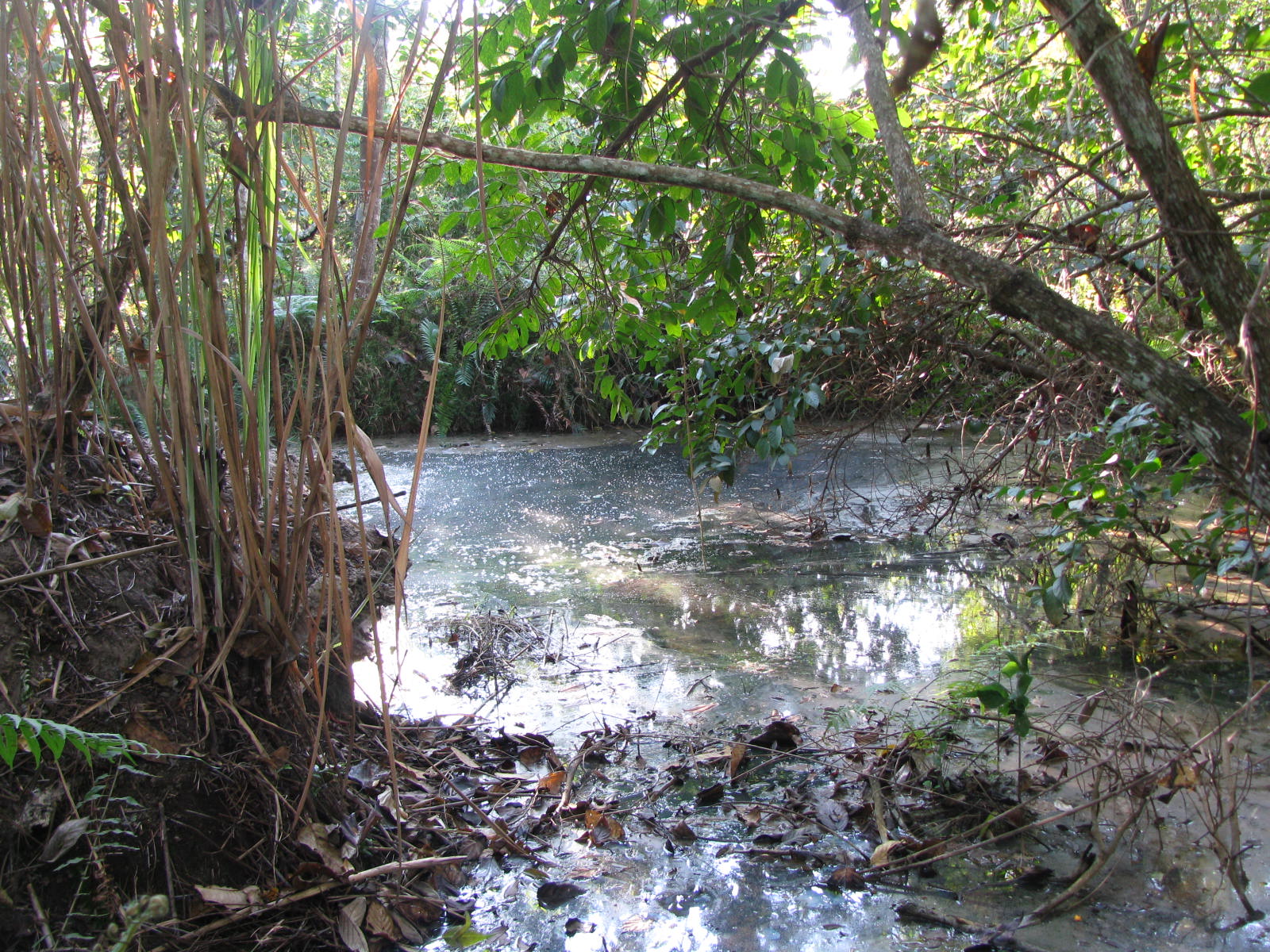
Out in the near treeless open we could see towards the sea and in the distance were the dunes that formed the connection between the continent and the Hon Gom Peninsula, Vietnam’s eastern most point. Just beyond the burial site we saw a lone waterpump gushing water which produced some amounts of steam. Evidently this was the spring.
The pump like structure was based on a cement platform, 5 m in diameter, which protruded from the remaining swamp by like 60 cm. The large discharge flowed over the cement and found a way to the swamp around it.
Chooks It was too hot to touch. The waterpump was also fed by a metal pipe which came from where we had come from. Later I learnt that this pipe was the pipe which brought the hot water here. It was explained from 8 m away but I had noticed on the way down that there was a small stream, 200 m away from the tap, near the houses of water which might have been from a hot water source.
On return I established that yes it was warmer and it tasted soda like, similar to what was coming from the tap. On the tap itself was some coating which my driver said was salt, from the sea, but tasting it, it was soda.
So a find? Yes there is a hot spring in Tu Bong, but where does it actually come from? A mystery.
Clearly the locals attributed no significance to this source of hot mineral water. I was told it’s only use was for de-feathering fowl after slaughter, which by the amounts of feathers lying around the site must be true. Odd that that would be the only the use for such a unique product.
Elsewhere some of the scarce references note that Tu Bong would make a great site for geothermal power generation and why not if it's not being utilized otherwise?
Evidence No piccies though. Ever since I bought Olympus µ-550WPcamera I’ve been plagued by my folie decision to be blinded by the fact that this camera can shoot underwater. But it sucks, the memory card is more for phones, meaning you need to keep a card adapter (or cable) with you if you want to upload to computer. It has a specific battery which can only be loaded with a battery charger larger than the camera itself (excl. the cable and plug; plug is nearly bigger than camera). It came with a handy camera bag which if not closed properly will mean that camera will disappear and is certainly not a good place to store extra memory card / battery. Anyway setting the thing is near impossible eventually leading to me (on this occasion) losing pictures of three hot spring visits. Thanks Olympus for such a fine product.
Anyway not much is lost with Tu Bong.
Getting there: approximately 14 km north of the railway crossing in Van Gia, the district headquarters.
If only life could be so good: Beer Lao & Hot Spring
Developing
The best known hot spring of Xieng Khouang province, Lao, is that of Baw Njai (Bo Nyai) which translates as big hot spring. It's also known for it's more advanced stage of development: no more just a spring, it is a real resort, with separate bathing facilities.
'A hot mineral spring can be visited near Muang Kham. Baw Nyai is large and lies 18km east of Muang Kham, 51km from Phonsavan. The spring source is in a heavily wooded area where several bamboo pipes have been rigged so that you can bathe nearby, although the experience is a little disappointing owing to the muddy texture of the water'.
The LP Laos guidebook adds that it was originally built by Kaysone's wife (Kaysone was a leader of the Lao revolution) as a way of treating and entertaining foreign politicians.
My guiding info comes from A Guide to Xieng Khouang Mountain Province in Northern Laos [1] which I also used on my other Lao hot spring visit (to Baw Noi), another 15+ kms away in the direction of Muang Kham.
The spring(s) Having visited Baw Noi previously and now expecting a major improvement in bathing facilities we were off on our way. The first advantage over the smaller spring was the entry fee (5,000 kip; 0,60 $US): the entry fee collector was on a break, possibly long term. Though the entry fees seem negligible, our driver believes we are having a really good lucky day, all smiles.
The entrance is about 2 km from road to Nong Het. Passing the entrance, one glides into an expansive compound with about 10 large bungalows. On the side of the road is a path which indicates the direction of the hot spring.
This tree lined dirt track goes through a forested area to a fenced-in pond. The pond is about 20m in circumference and one can walk around. On the far side one can observe the water springing and steam slowly rises above the pond.
Mukarin has a photo when there was proof of more forest in the immediate vicinity. A sign of the times?
From this pond, one can also walk to a smaller pond. This track is less wide and ends in a marsh-like pond (see photo below) which contains hot water, but not really hot.
Experience We return back to the resort proper and having decided earlier that we were in need of a soak, head for the restaurant which doubles up as ticket sales point for soakers. Behind this restaurant are a number of small, stinky, damp and dark cubicles with small tubs. Though the soak would cost just 5,000 kip, for the sack of sanity we skip this part.
It always surprises me how such 'developed' sites have little or no idea what a soaker would like. Me quick thinking: take away most of the walls (so one has a nice view of the surrounding) forest, expand the tubs, add a shower and a resting/relaxing corner and you really have something tourists will go out of their way to experience. Now Baw Njai only produces disappointed potential soakers.
Convincing?
I'm not the only one disliking the soaking facilities. ordinary lishtar :
'I’m abysmally disappointed by the hot springs I was sure I was going to experience. The hot spring was there – green and pristine, but to try it out, I would have to go into a small room, equipped with a bathtub and toilet where the hot spring water was connected to. That’s it? I couldn’t believe it. I don’t want to try it out!'
'a hot spring that looks like a development project gone wrong, even though the water is really hot'.
Some are more fortunate by opting to stay the night in a bungalow. At least here the bathrooms seem do-able, but not necessarily an exciting prospect. Achikochi Takema has an expansive blog entry on Baw Njai as well as on Baw Noi. His Baw Njai experience describes staying overnight and having a private bath. Drawing the bath though takes more than 5 minutes, just for the hot water to arrive. He also speculates that the spring appeared after a bomb fell at this place, thus explaining the existence of the pond. The fence would have been constructed to protect the spring from the free roaming water buffalo. He also pic's the bathing rooms in the guest bungalows, describing them as a more hygienic way of soaking.
The right way In a way, it's quite disturbing this lack of insight in tourists (perceived) needs. In this one should take the example of New Zealand. Well-known for it's mountains and geothermal activity, not often do these two combine. So in response there are innovative projects which are not / can not using natural springs but copying the soaking experiences.
'You have an amazing place there, absolutely beautiful'
and Glacier Hot Pools (Overall Winner West Coast Southern Alps Tourism Awards 2010).
The above are just proof of how easy it is to attract tourists if one adjusts to their demands. It needn't be so difficult.
On the positive side, some redeveloping of Baw Njai was in the process (bungalows), though I have my doubts whether it will result in better soaking facilities. If only i were manager ...
More More info (mostly photo's) from the recently discovered Japanese language blog site by yoshidanoharuo. He/she has traveled extensively across the world looking for hot soaks. He/she ranks Baw Noi higher than Baw Nyai, three stars versus two on a scale of just 3.
Getting there:From Phonsavan, Xieng Khouang's provincial capital, head north east to Muang Kham and continue 20 km beyond Muang Kham in the direction of Nong Het. The turn off is well signposted. The resort itself is about 2 km's from the main highway.
Soaking experience: Only for the blind and gullible?
Overall impression: The impression we left with was that of a missed opportunity. How difficult can it be to get it wrong? If I compare with other hot spring haunts in Southeast Asia it's certainly a common theme in the developing of such soaks. Development = not good.
Notes:
[1] Creutz, S., J. Van Den Bergh (2009) A Guide to Xieng Khouang Mountain Province in Northern Laos. Lao National Tourism Authority, Vientiane, Laos.
Coming back from a recent visit to Lao, there are 2 entries coming. Both from Xieng Khouang province: one already published, one to be published later this or next month. This brings the list of countries with hot springs featured up to 7, nearly 40 featured soaks in all.
Despite the difficulties in traveling Lao it must rank high on anyone's 'to do' list. Culture and scenery are beautiful. And if willing to put up some effort, there are also nice hot springs and beautiful waterfalls to be visited (see Waterfalls of Southeast Asia). More entries in the waterfalls blog have taken place on Thailand, Lao and Cambodia.
Publishing new entries on Hot springs of the Himalaya has come to an end, from now on there will be only re-publishing as and when time allows, hopefully keeping the info published up to date.
Press Other interesting news is being kept to a minimum, despite this being the ultimate season for soaking in Asia. Sydney Morning Herald has put in a glowing overview of Banjaran Hotspring Resort near Ipoh, Malaysia. "Spectacular" is a quote which seems to justify the reporters free overnight stay; other than that she seems not very impressed. Thanhniennews has a feature on Binh Chau, a hot spring I visited (and featured) earlier last year. added info is the fact that the springs were
' “discovered” in 1928 by a French doctor named Salle'.
As if not known before ...Overall a very positive article though again not very journalistic.
Further away, Cityweekend's Shanghai edition hopes it can get it's readers naked. At Tangshan hot spring.
'People have been getting naked there for 1,500 years, due to the hot springs and their famously curative waters. It was fenced off as a royal sanitarium for most of that time. These days, though, anyone with a little coin can take the plunge'.
'You see, the Kayumanis is all about privacy. The 21 villas—each over 300 q. meters—are all enclosed by high walls. Inside you’ll find a cold plunge pool and what you came for—your own private hot spring nourished by 50 degree Celsius waters containing numerous healing elements. High walls means no roving eyes. Bathrobes are optional in your private estate, even in cold, early spring weather'.
The walls come with a price, upwards of $600 per night! Stay a few nights and you could have spent the same amount on a new bathroom with your own hot spring (?!).
Geothermality A mainstream article by National Geographic looks at the future of geothermal power generation. Apparently Kenya will be leading the way followed by Indonesia.
Readers'tips From the UK press, the Guardian comes this list of reader's tips concerning
'spa's and hot springs - the best places to chill out in warm water'.
The winning tip concern's New Zealand's Hot Water Beach and Kerosene Creek, even though they are nearly a day's drive away. From Southeast Asia the only tip concern's Thap Ba (Vietnam) while Asia at large gets tips on a hot spring in Jordan and 2 in Japan. So much for soaking being a popular past time ...
As with Songgoriti hot spring, Cangar hot spring can most easily be accessed from Batu city (East Java, above Malang). However public transport fails to make it this far up the mountain. From Batu one takes a minibus as high up the mountain as possible but at least in the direction of Sumber Brantas, which lies beyond Selecta. At the end point don’t walk. It’s still a long way up (and down).
Hiring an ojek (motorcycle with driver) seems to be the best option to continue. From here one continues up the mountain, passing apple orchards and potato fields. Eventually one passes the mountain pass and the road descends steeply.
Cangar At the bottom of this descent are a number of competing parking areas all providing access to the hot springs.Entry is 3,000 INR (~2,75$US). From the ticket office (photo above), a trail heads down and across a small stream. Beyond the bridge are the hot spring(s?) themselves. Amenities consist of toilets and changing cubicles, 2 each for either gender.
Unfortunately one needs a long wait to be able to use these at best makeshift changing rooms, which at 1,000 INR are still not worth it.
The hot springs themselves consist of two large kidney shaped, half meter deep basins which on this Saturday (July 2010) are lined with soakers. Otherwise there is another larger cooler pool and an area where women can bathe, though this is half open to observation so why these separate facilities are required is beyond me.
The direct vicinity of the pools are far from clean, all kinds of refuse are just disbursed of with little regard to the entire situation. Most bathers are fully clothed, even males, another of this odd situations, what would men have under their singlets / shirts that need covering?
Positively, most women lay off their headscarves for the soak (see photo above), which begs the question why wear them in the first place?
Obviously I am the only foreigner and the only person with swimmers on. Though the waters are sufficiently hot, I have my doubts about the hygiene. As is common throughout Java (and Indonesia?) smoking seems to be a habit difficult to shake: many soakers while soaking are still smoking! Smoking hot?
Sharing opinions It's not only my own opinion. Take this blogger for instance:
'Hey, you know what my first impression of Cangar was? DIRTY!! ... No need to change into swim suit, just wear our clothes (everyone do that, why shouldn't us), and enjoy the spring'.
The former answering partially my aforementioned queries (not).
The area around Batu is well-known for it's mild climate and this is already a major draw for the many tourists who visit Batu during the weekend.
Nearby Cangar are caves used by the Japanese during their occupation of the Indonesia isles.The entry on Cangar by eastjava.com describes slightly more details of these caves. Little info on the history of the hot spring itself.
On the way up from Batu, one can also visit the Selecta pool (an open air pool built by the Dutch and fed by spring water) and the Coban Talun waterfall.
Getting there: From Batu head for Selecta (north) and continue up the road and over the mountain pass. It’s at the end of the steep descent. In total it should be slightly over 20 km from Batu depending on where you start.
Soaking experience: That’s a difficult one. The pools are great, flagstone lined with a gravel bed. Water temperature is good. But my fellow soakers could do with a tip or on hygiene …
Overall impression: Despite the misgivings of the soak itself and the lack of changing facilities, the air is crisp and cool meaning a hot soak is just what’s needed. The direct surroundings are also heavily wooded and management of the site is evident (though lacking).
Surprise visit to Paris Sometimes hot springs are surprises. The hot spring of Parang Wedang, the only hot spring in Yogyakarta province, is one of such.
Parang Wedang can be found in the village of Parangkusumo, which in reality is just part of the seaside town of Parangtritis, which the locals refer to as Paris!Though I stated that Parangtritis is a seaside town one should not conjure images of a blinding white beach swayed with gentle waves, everyone hanging out under the coconut trees.
Instead it’s a wide windswept black sand beach between the mouth of a river and huge cliffs to the east. Behind the 200m wide beach strip, a strip of houses whose main cause is to assist visitors in sheltering from the wind. Where the waves are crashing on the shore there are a couple of stalls along the high tide mark, catering (and providing shade) to the visitors. Risk-takers try getting into the surf but know when enough is enough; the beach is full with signboards advising against swimming. Motorcyclists and quads thunder up and down the beach overtaking the horsedrawn carts.
Mythical Paris One would hardly expect that Parangtritis is the place of myths, but the opposite is the case. Author Barrie Lie-Birchall who has an often copied (and plagiarized) travel article titled ‘Parangtritis – a beach not too far’ which itself is unfortunately undated, but I suspect is from as far back as 2002.
‘Parangtritis is steeped in Javanese mysticism and culture. It is believed there is a south axis connecting Mount Merapi, the Kraton and Parangtritis Beach. According to legend, the Queen of the South Seas - Kanjeng Ratu Kidul together with her confident Nyai Loro Kidul reign over the Southern seas and all within it. It is said that any person wearing clothing coloured green will be lured into the sea by the Queen and to their fate - a superstition firmly entrenched in the minds of all Javanese; even as far North as Jakarta. It is the legend of Parangtritis that entrances all who listen - according to the legend, Kanjeng Ratu Kidul was at one time wed to Panembahan Senopati, a ruler of the mighty Mataram kingdom and enjoyed his company on occasions. The Western section of Parangtritis beach - Parangkusumo Beach - is believed to have been the meeting place between the two mighty rulers; that of the sea and of the land. It is also at Parangkusumo Beach where the ceremony of 'Labuhan' is performed, coinciding with the inaugural commemoration of Sri Sultan Haamengku Buwono X. Each year, on the 30th day of the Javanese month of 'Rejeb', offerings are given to Kanjeng Ratu Kidul. These offerings, in the ceremony of Labuhan, consist of fingernail cuttings and hair of the Sultan of Yogyakarta, food and clothing - all cast into the sea in the hope that the Sultan and the people of Yogyakarta will have continuous peace and prosperity. The same ceremony is held on top of Mount Merapi and Lawu. According to legend, volcanic activity also occurred at Parangkusumo Beach. This resulted in a formation of rocks supposedly where the Sultan of Yogyakarta and Kajeng Ratu Kidul met to discuss the well-being of the people of Yogyakarta - and of their love for each other. Upon this formation of rock was built a small rest house’.
This does add an additional dimension to an otherwise non-descript wind-swept village, though other than the annual celebration myths are just that.
Pottering around
Apart from the attraction of the mythical mystery there are other attractions in Parangtritis such as a well-perched resort and good fishing in front of it.
Then there are caves in the cliffs beyond Paris, most notably a peculiar located meditation cave:
‘How about Langse cave, according to the legend, this is the place of Nyai Loro Kidul. And the cave often visited by Sultan of Mataram. It would be a challenged to reach the cave, situated high up 400 meters on the cliffs. The nature stairs exist from some stones and roots. Once in the cave you can take a bath in one of the room. The water comes from the springs of the cave, cold and it consist high sulfur to make your tired body very relaxed. After doing some bath you can do meditation. The silence of the cave can help you that. You will only hear the sound of the south sea '(source).
Hot Spring And then there is of course the hot spring. Heading back out of town towards Yogyakarta from Parangtritis, after 1 km one sees the well-signposted ‘Sumber Air Panas - Parang Wedang’. It lies at the foot of a small hill on the land side of the road.
Through the small entrance in the wall one believes to have arrived at a temple complex. On this weekday ( July 2010) everything is serene and the few people there seem more to be annoyed by our visit. We nose around, to see whether we are in the correct place. This is at once all too obvious by the existence of the many cells, each with a blocked pipe sticking out of the wall. All these cubicles are situated around a large pond which most probably is the hot spring itself.
For a meager price (4,000 INR, 0,35$US) one rents an as best described as rudimentary cubicle, takes out the blockage and using the mandi one continues to bathe oneself, no real soaking just a rinse.
There’s a small stall with a couple of biscuits and soda’s. More info The water is hot (guess-estimate 40 C) and saltish. This source adds:
‘Parangwedang is a hot spring that is rich of mineral (the mostly elements are Na, Cl, and Mg). Uniquely, the sulfur element, the most common content of spring, is not found there’.
‘Parangwedang well is a warm mineral water resource of 1140 square meter .There you may find a reservoir of 9 m length and 8 m width,6 warm water bathrooms and other 6 fresh water bathrooms’ [see photo below].
The aforementioned Barrie also ventured to take a soak here:
‘A mineral hot spring, named Parang Wedang, with continuous flowing water attracts visitors who bathe there because it is believed to have healing properties for skin ailments - although not in need of it, I found the water to be soothing and pleasant. Small change rooms or lidos are available for those wishing to bathe in private. The pool, as I was told, was found by Sri Sultan Hamengku Buwono VII. He found it his duty to care for the pool. Many locals believe the place to be a sacred site - many meditate there and congregate to discuss matters of importance affecting their village’.
Which sort of goes some way as to why I would call the atmosphere temple-like. Another unknown aspect which a website provides is as follows:
'Sawo Kecik: This ugly fruit called Sawo Kecik- or small sawo- Manilkara Kauki . The taste is very watery sweet . Long time ago this sawo kecik only owned by the royal families but now you can find them everywhere. Mostly Javanese families planted them in the front yard . Some people believe that it will bring some lucks. Whether it is true or not , i like this fruit so much !!!
Overnite If desperate one can stay overnite at Parangtritis, especially the resort east of town is fabulously located. But otherwise Yogyakarta is one of Indonesia’s main tourist towns, what with the Borobodur, Merapi volcano and the city having it’s own palace.
Soaking experience?
Getting there: From Yogyakarta buses leave for Parangtritis quite regularly, best to be picked up from Parangtritis street with. The journey to Parangtritis (less than 30 km) takes an hour and you can sit upright in this local bus!
Soaking experience: As stated it was more of rinse than a soak. Pity a good soak was not possible; the natural salty-nish would result in a special soak. Cubicles were poorly maintained, unhygienic (?).
Overall experience: If heading for Parangtritis add a visit to Parang Wedang on your way back, to wash off the sand and seawater. Otherwise the setting was sort of special but not necessarily something for soaking.
Prominent in the news is the World Geothermal Congress (WGC) currently being held in Bali, Indonesia. Though we would expect that soaking and tourism would function in this, it seems to be all about generating power (literally and figuratively?). No less than Indonesia's president has vowed to make the country the world's geothermal power leader by 2025. That's if other countries don't pre-empt him.
But what about making Indonesia the world's number 1 destination for soaking? Currently it are countries as diverse as Japan, Costa Rica, Hungary, New Zealand and Iceland (the Blue Lagoon, Iceland's no. 1 tourist destination?) who make soaking a priority in their intentions to draw foreign tourists. Not so in Southeast Asia.
And by the looks of the WGC programme not much seems to change. Tourism is just a small side session and even the day-programmes on offer for the participants fail to include at least 1 visit to a Balinese hot spring. Maybe the majority of the participants are only interested in wallowing in wealth in the prospect of the $$$ which will arrive once the geo is harnessed.
What is on offer are a number of presentations, three of the ten on Iceland. There is a paper on the Indian Himal by the Arya's:
'Need of the hour is to come up with simple but effective solutions to renovate these geothermal resources and judiciously use it in our day to day life'.
If you have following the Hot springs of the Himalaya blog it seems that management is lacking, especially in the face of a tourism onslaught in the better accessible area's of the Indian Himal.
Chow Weng Sum presents an overview of the hot springs in the Malaya Peninsula (Malaysia) which hardly delves into any soaking aspects. Interesting he and his co-authors mention after sampling mineral water:
'Only two of these hot springs [of a possible 60?] meet all the requirements for drinking and mineral water'.
Furthermore the call to harness the sites for power generation.
In the poster session a poster by Charles Davidson, an Australian with a passion for soaking. The poster focuses on himself and how taking a leaf from the Japanese soaking tradition has tried (and succeeded) to undertake the same on the Mornington Peninsula of the Australian state of Victoria, the undertaking aptly called Peninsula Hot Springs. In this Google Doc an extensive overview of how Charles became Australia's premier soaker (?).
Finally there is a presentation by Patricia Erfurt-Cooper who is becoming the soak guru in the scientific world. With co-authoring 2 books on geothermal tourism in the last 2 years she is certainly the person to lift tapping-the-thermal-waters to a more prominent position, the question is whether her message would intrigue participants. The abstract certainly intrigued and the order to Amazon is underway for 2009's
'Health and Wellness Tourism: Spas and hot springs'.
And then there is this years
'Volcano and Geothermal Tourism'
edited by Ms. Erfurt-Cooper, which draws on world wide experiences, though not exclusively focusing on soaking. Might have to save up some money before ordering this ...
After visiting Binh Chau hot spring in the south of Vietnam, I was astounded at the contrast of experience of soaking here and that in other Southeast Asian countries. Was I witnessing progress? Could what is achieved here, be only be done with communist autocratic government? Or are the Vietnamese so totally different?
The main swimming pool complete with faux rocks and cascades.
Vung Tau But let's start at the beginning. Binh Chau is a hot spring located in Ba Ria province, about 150 km from Ho Chi Minh city (or as some say Saigon), a two and a half hour drive away. Besides Ba Ria, Vung Tau is another large city in this province and the focal point of tourism; Vung Tau being the beach of Saigon. From the point of Cap Saint Jacques, Vung Tau is essentially a major area of hotels and beach resorts stretching for about 10 km along the sea facing shore until an expansive coastal flood plain after which a number of smaller resorts dwindle as one continues along the coast north and eastwards. On the Saigon side large scale industrialization has taken place.
One of these smaller northeastwards located resorts, Binh Chau is a reasonable sized town located 70 km from Vung Tau. As the number of resorts peter out here, so does the quality of the road. From Binh Chau one needs to drive 2-3 km inwards towards the hot spring site itself.
Claims to fame? Once through the entrance area there is a massive development, wide avenues and big reception buildings. Our car is parked close to the entrance. A 200 m long road leads to an intersection where one can proceed onward by foot to more park -like area, accommodation and the springs proper. Go right and one goes to the soaking section.
The hot spring resort is run by an investment operation called Saigon-Binh Chau Tourist Joint Stock company which includes a local beach resort. Since the turn of the century facilities have been improved and
'in August 2003, the happiness and success of this investment are rewarded by the World Travel Organization’s recognition that Binh Chau Hot Spring is one of the 65 areas of sustainable ecotourism development of 47 nations around the world'.
Yes, that accolade looks good. But looked at it in more detail, reveals that Binh Chau was merely
'a compilation containing 65 case studies received from 47 countries about exemplary practices in small ecotourism businesses (SMEs)'.
I.e., a slap on one's own back rather than 'recognition'. As the publication is not freely available on the web, little insight can be given to the aforementioned claim. It's also not clear exactly what the WTO understands as ecotourism, their website lacks any definition.
More possible future (investment) development around the Binh Chau includes a safari park and villa's, which might just throw a different light on the eco claim ...
The naming game: call it eco and it is?
Developing hot springs and protecting the environment Aside from the eco claim, it's not totally clear, but there are a number of references putting Binh Chau hot springs as part of a larger protected area. Amongst these is Lonely Planet which lists:
'Until about a decade ago there was wildlife in the area, including tigers and elephants, but it seems humans have nearly won the area over'.
Binh Chau's own web site refers to the ecological reserve:
'11.000 hectares of forest, known as Binh Chau - Phuoc Buu natural preservation zone'.
Note that Bin Chau hot springs site themselves are only 35 ha.
More info on the natural reserve can be found in this document from 1997. It contains a forewarning:
'Binh Chau hot springs is designed to suit the tastes of affluent Vietnamese tourists. The flower-lined walkways among hot springs, shady cabanas and a litter of bright painted stucco figures is pleasant and charming.
But, more concerning, the resort also holds a small zoo containing several rare species. Among other things, an eagle sulks in a purpose-built cage shaped like giant a spider's web and listless binturong (Arctitis binturong). It is illegal to keep the endangered binturong. I could not identify the eagle but several species of eagle and buzzard in Vietnam are on the IUCN Red List of Threatened Animals. Long-tailed macaques Macaca fascicularis, also on the IUCN Red List, were in two small cages. The centre-piece of this exhibit is a giant painted concrete structure resembling a coiled snake, strangling a rampant deer. When I visited in December 1996, new structures were being added to the zoo complex.Clearly, this architecture enforces common perceptions of nature as mysterious and evil. 'Nature' - the Vietnamese word is 'nguyen', - carries a reproachful connotation of 'primitiveness'. Zoos of this character do nothing to show how precious is nature of itself. Nothing is here about the natural history of these species. Nothing to allow people to empatize with wildlife. Nothing to encourage them to protect their wild resources'.
It's therefore chilling to note the following announcement:
According to Management Board of Binh Chau - Phuoc Buu Natural Reserve, from the beginning to May, 2009, the reserve has attracted 20 tourism projects under ecological- tourism forms. Total investment area of these projects are about of 1,500ha'.
Soaking To proceed to the soaking section one needs to purchase entrance tickets in an adjacent building.
This building incorporates changing facilities, showers and lockers, never seen a locker at a soaking site in Southeast Asia!
Beyond the entrance are two palm fringed pools against a backdrop of faux rocks stacked up 5-10 m. This tiled area is backed up by a free form 2 m wide pool, meant for kiddies, containing less warmer water.
In 1 corner are amenities while beyond the kiddies pools are places for mud treatment and VIP soaking rooms. On the other side a track extends into a swamp where there a number of other in-huts-enclosed-tubs, varying in size and thus price.
The main pool though is heated and goes to depths of more than a meter. The soaking experience is somewhat placid, late on a hot weekday most visitors are middle-aged Vietnamese, day visitor tourists already having left. The pool itself could do with some painting and the visible quality of the water could be better.
However, strikingly, almost all patrons are wearing bathing costumes, much in contrast to nearly all other soaking facilities in Southeast Asia. So much so that I wonder whether this is in Southeast Asia at all. It could be Europe or Australia. Canada or the states. I wonder whether this bathing custom is something Vietnamese or simply limited to these facilities.
The sights of Binh Chau: mud baths, hot pool, more mud baths, private pools and jacuzzi.
Throwing Mud On offer are also mud baths or the opportunity to cover oneself in healing (?) mud.
Possibly this claim is true but what I find weird is why if it it so good, why the need to keep bathing clothes on. Especially women wearing a full one piece suit can be seen covering their suit in mud (below), can't see much health gains in that.
And though there are private enclosures, these are not meant for au naturel bathing. Inside photo's (above) disprove this as well as the fact that the material used allows for outside viewing.
Nguyen Pham's untitled muddy picture from Binh Chau. Question is if mud equals health, does this mean that females can not fully profit from the perceived health benefits?
An introductory youtube video on Binh Chau hot springs
Getting there: From Vung Tau head north / east along the coast until Binh Chau village. Take a left on the other side of the village followed by a right turn and after a km you'll arrive at the hot springs site.
Soaking experience: Certainly pleasant, considerable effort has been made to make soaking a worthwhile experience. Of the near 30 soaking experiences I have visited in Southeast Asia, this ranks highly amongst them even though the metamorphosis into a some what sterile soaking area comes at a loss of naturalness.
Overall impression: With in mind that this has been created to attract tourists, one could argue that this has been done tastefully. Certainly it could be a lot worse.
Part of the attraction park are the natural hot springs located away from the soaking pool itself. It's said that they number more than 70.
Still can't shake off the need to post updates though I hope they will get shorter in length as we proceed through this year.On the Hot soaks of the Himal site additions have included many hot springs of Tibet or better said Tibet Autonomous Region. I am currently in the processing of tying up some loose ends and looking to head where from here.
On this site our first Vietnamese addition, Binh Chau should hit the site soon.
News Malaysia gives a new meaning to soaking? The Banjaran by Sunway describes itself as a 'Hot springs retreat'. Much effort has been put into this newly opened resort, though it seems that it's intent is to cream off the very rich. No kids are allowed. And though this Tripadvisor thread has some positive feedback, the feeling lingers that they just might be asking too much from the market. Already Agoda were discounting this by half to just US$ 529! A bargain! Frog and Princess have some pics.
Others
Development of hot springs in Southeast Asia has often come about by Japanese during WW II. However Hulu Langat in Malaysia is now referred to as the Korean hot spring, so writes Hoteden:
'For some unknown and strange reasons, almost like storylines of those 'weird' yet wonderful Korean horror films, the hot spring of Sungai Serai in Hulu Langat, Selangor seems to be a 'popular joint' for Koreans living in and around Kuala Lumpur'.
Many things seem to shock Singaporeans. What about this:
'This woman was seen filling many pails to the brim with water from the Sembawang hot spring, and using the 'free' water to wash her clothes. She did it even though there was a sign that stated “不要在这里洗衣服” (Do not wash your clothes here)'.
The horror. I dare not say it, but there are also photo's. Safe for work? In Singapore? Umm ....
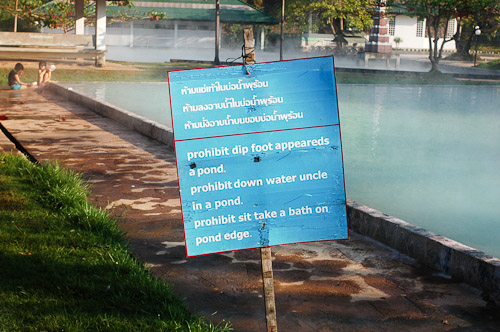
'A sign at Pha Bong Hot Spring, 12km from Mae Hong Son'.
Finding The first day of this year saw me visit two waterfalls (Cyber and Pha Rom Yen), the day to be capped off with a visit to the local hot spring. One of the first problems with finding soaking sites in Thailand is exactly that, the finding.
From info I had printed before I knew that Samo Thong was a hot spring in Uthai Thani province. Somewhere in Tambon Khok Khwai. From highway 3282 north of Ban Rai the hot spring was mentioned to be a whopping 24 kms from the highway.
Submerged Samo Thong hot spring had been an usual hot spring, the water gushing from the ground and flowing away. However the area around it had been flooded when a large irrigation dam was constructed, creating Huai Khun Kaeo reservoir. But a decision was made to save the springs and a earth bund had been erected around and over the springs so that they would not be flooded.
The above mentioned highway follows the northern stretches of the reservoir and the turn off (a ridiculous 150 degree turn) were clear, only 24 km to go. Surprise, surprise, it's just a km up this road. Why the disinformation?
Development awaited After saving the springs, it was thought that the soaks would become attraction points and a larger island was created to stimulate future recreative development. Thus when one arrives there's a big car park with to your right a single restaurant. Left is an official building which it turns out sells soaking tickets, rents out bicycles, where you pay for camping and provides a massage if required.
Before purchasing the right to a soak though, let's discover what the soak entails. Along 1 shore are a number of soak cells. Still fail to grasp why they would put these at such a place with that beautiful view; if the 4 person tubs inside fail to have any view than that of the inner walls and roof which does excellent work to capture the hot air, why come here? Towards the back are bigger cells, with bigger tubs and the exclusivity of being able to access a toilet. Somewhere forlorn between the various structures is a covered foot bath which is packed this New Year's day.
Biding your time, waiting for a space to soak your feet?
The springs Clearly it's a hot spring resort but where is the hot spring itself? In a depression one sees a pond with water bubbling up. that must be it. But on closer inspection the bubbles come from blue pipes and soon this flow stops temporarily as a mechanic is throwing some taps. Opposite this though are 2 cement rings sticky up, revealing two deep hot water sources. One distinctly has some sulfur smells.
The source?
Soaking This being a family day we and the mother-in-law rent ourselves a cabin. The moment we take possession of our cell the tub is empty, but water flows in swiftly, but also disappears just as fast. The attendant gets down the slope of the reservoir slope turns the discharge tap and our tub begins to fill. We close the door, undress and envelop ourselves in the heat.
Your Thai soak cell.
For the faithful After the soak we wander around the island which has a second attraction a 20m high golden Buddha. It sees nearly more visitors than the springs themselves. But that's all there is to see.
Experience discussed I must say I enjoyed this find. But what always trouble's me is that much more could be made of the location. The reservoir continues for miles to the southwest, in the opposing direction are high mountains (the 1500m + Khao Yai). Due to it be an island seclusion, privacy is guaranteed on three sides.
Soaks should be followed by a refreshing plunge and lo and behold this lake is just meters away from the soak sites, but inaccessible. When will be a real soak established in Thailand?
Just the other day I was looking at a programme which is aired every weekend on Channelnewsasia. It involves two middle age Japanese ladies who are traveling and discovering their own country, Japan. They focus mostly on food but yesterday they also visited 3 onsens on the Izu peninsula. But hey, two onsens were really special (one added brime, the other Arame, edible sea weed) while the third had a beautiful sweeping view of the sea. Why is that not possible here?
'This is a small spring that sprouts up to the surface. The hot water from underground converges to form a little stream that flows down to Than Khok Khwai or Huai Khun Kaeo. The water is clear and pungent with the aroma of sulphur. The water is so hot that it can boil an egg in 5 minutes. The Royla Irrigation Department has constructed Huai Khun Kaeo Reservoir, flooding the stream and the spring itself. However, and earth levee has been developed around the spring and some landscaping has been done to create a good rest area for visitors. The spring has an area of 4,000 square metres and consists of 3 springs. A mineral bath is available for tourists and nearby is a 20-metre-high Buddha image sitting high amidst the wonderful scenery of the area'.
The only other original source is a blog on Uthai thani province:
'Formerly a natural hot spring gushing over the ground's surface, the water is clear, but with a sulfur dioxide semll. The temperature of the spring sits between 80-86 C, hot enough to boil an egg in five minutes. The hot spring has now been modified into a public park 4,00o square meter with bathing pools for visitors to enjoy a healthy bath.The public park has three hot spring wells 4-5 meters deep, with cement rimes around them one meter high. In the middle of the park sits a Buddha statue some 20 meters tall painted in gold, which can be seen from a good distance. Near the statue you'll find a reservoir. This landscape forms a beautiful scene and a pleasant atmosphere. visitors can enjoy fishing or cycling around the reservoir'.
Cement rimes?
Getting there: From Ban Rai take the 3282 highway north in the direction of Lan Sak. At km marker 41 follow the road heading due east (you'll be coming from the northeast) and follow for 1 km and you are there.
Soaking experience: This being a relatively cool day, the soak at the end of the afternoon certainly was worth the visit. That said, once inside the soaking cell, the experience is the same whether you are in Samo Thong or somewhere else in Thailand. Depends on your mood.
Overall impression: Good, the area around is certainly relaxing. Possible because of new year, business (such as refreshments and restaurants) were doing well, adding to a conducive atmosphere. A stroll around the island is possible and pleasing with sights of mountains and the lake.
If you have been following the other Soaking in Southeast Asia associated sites, you'll have seen quite some progress on the Hot Soaks of the Himalaya blog. Besides Bhutan, Sikkim and half of Nepal has been added, yet again providing the most extensive info on hot springs in these area's. The intention is to slowly go west ward, before returning east and north.
Elsewhere there has been an update on Bo Klueng hot spring (Thailand) and another personally visited hot spring site will be added (Samothong, Thailand) on the Soaking in Siam site.
News/Features
Bangkok Post (17-12-09) has an article on Mae Chaem, southwest of Chiang Mai, Thailand. It includes a short description of Ob Luang National Park and it's hot spring:
'Just 12 kilometers northwest of park headquarters is one with 10 private baths, but it is not that popular among visitors. It charges 50 baht for a 20-minute dip and 150 baht for an hour. Also available is message service'.
It includes the photo's of the Thai institution of cell like hot tubs. Why is it not popular among visitors?
Where I live (Cambodia) there has been an interesting article in the local Phnom Penh Post (16-12-09) on the so-called Dr. Fish business which has been reported previously here on some occasions.
Cambodia's tourist hot spot of Siem Reap has seen a proliferation of businesses offering a 10-20 minute spell with fish eating your feet. The original entrepreneur who started up this business imported the original fish from their origin (Turkey) and was doing a swimmingly business. However locals have seen that success and copied it and undercut the original entrants prices. The proliferation has seen the town's main evening scene street offer the same treatment but with a free coke / beer. This has lead to a recriminations by the original entrepreneur that his competitors are not using the right fish (which have no teeth). That said the competitors say they have access to local fishes which they starve before feeding them foreign feet! Fishy business this.
BTW, co-incidentally the Sydney Morning Herald (9-12-09) features Dr Fish under the caption
'You can't do that'.
Tip, go to some Thai waterfalls (Erawan for instance) and you'll be regarded as food by the many large fish (cat fish, carp) while you try to cool down. And they bite. Though mostly out of curiosity. And not only on your feet. Keep your body protractions covered ...
Spafinder believes it already knows the future and lays claims to the coming trends, which are:1. Pampering is out, prevention is in [doubt it].2. Hammams [that trend I thought was behind us].3. Spa membership; so as to make spa-ing a more social event rather than an individual [spa's, sauna's, soaking are always best enjoyed with (new found) friends I believe; if anything that's why soaking has always been a number one pasttime, from ancient civilisations].4. Online spa, i.e. booking more spa's via email.5. Spa hybrids, i.e. spa's and fitness / hospital.6. Discounting to continue.7. Wellness tourism wows. Making spa-ing less boring? [The original spa's (sauna's, onsens, hammams, banya's, sweat hut's) remain popular because they are social institutes not wows].8. More scientific significance given to spa treatment achievements.9. Diversity: instead of upper class women, more men, youngsters, elders and ethnic groups will hit the spa's.10. Emphasis on silence and slowness as in slow-food so as to enhance the experience.In short simply a continuation of prior processes evolving. Spafinder also sums up the main trends of the last 10 years, somehow quite similar to above ...
I've come across a number of special soaks:
The first is a soak in Tajikistan, Bibi Fatima:
'Mathieu and Yann had the first session, then Myriam and I got to enter the hot spring water with a bunch of cute old naked Tajik women. Women supposedly come to bathe here for help with fertility problems. The water comes directly from the spring into a small cave where a cabin has been built to shelter the cave. Other than the teenage attendant who decided she would stand a foot away from Myriam and I while we changed, the springs were very pleasant'.
Then from the States an underwater hot spring which can only be enjoyed a few days per month when the tide recedes sufficiently. It's an apparent secret ...
Following last months report on soaking in Beaujolais in Japan, Channelnewsasia (from Singapore) shared with viewers a report on soaking with oranges or better said mandarin's. Or ...
I've been trying to find more on this, though it seems not to be a novelty; this site on bathing rituals in Japan mentions mandarin orange peel being added to baths. And here it mentions that during the winter solstice (which explains why I saw it on TV recently) it's customary to soak with yuza's, a citrus cross between grapefruit and mandarins. Though they may also be called mikans ... Or both.
One could in Japan also soak in soja if one wishes. Where does it stop?It doesn't:
'The Yunessan spa in Japan's hot spring town of Hakone has added noodles to its wine, sake and chocolate menu. You quite literally bath in a big 2m-wide pot of steaming edible broth, while a chef dips noodles and stirs them around you. You literally bob up and down on the noodles'.
A few mentions from blogs:
Singapore
From one of the world's most uptight countries comes a description of a visit by Singaporites to a hot spring in Taiwan. They had major problems with the local custom of nudity:
'kinda disturbing'
is how Denise describes naked people. Conditioning has been well accomplished in Singapore as she describes the following:
'Horrifying, I saw boobs everywhere. And bushes too. But it was even weirder when I saw my family members in the nude'.
Somehow the opposite may be regarded as just as weird ... She ends the blog entry more positively:
'haha but it got less awkward after a while, kinda get the hang of it. The hot spring was damnnnn shiok. Anyone that goes to Taiwan should give it a try, nude of course :)'
Fellow Singaporean (Happy Rainbow) picks up on pictures concerning a hot spring opening in China. The lengths to go to promote soaking in (Southeast) Asia.
'Look at this hot spring opening event, 1 bikini girl vs 3 uncles. What is funny is the girl is wearing bikini, yet all the uncles are covered so much'.
Malaysia
A recent photo entry on Langkawi's hot spring. Under construction (the hot spring).
Thailand
How do Thai hot springs size up with those elsewhere? Leon reports on an unmentioned hot spring near Chiang Mai:
'Unfortunately being Thailand these weren’t as nice as one would hope for and we had to settle for the swimming pool rather than a private hot bath once getting over this and the eggy smell the water had it was quite soothing'.
'What feels good after a long trek? Soaking in a hot spring. :) After Mt. Tapyas, we headed to Maquinit Hot Spring, somewhere in the depths of the forests of Coron. Okay, just kidding. It’s somewhere in Coron, but the travel to the hot spring kind of freaked us out because we had to go through this dark, dirt road surrounded by trees, and it was absolutely dark save for the light of our tricycle and we couldn’t help but feel paranoid about our surroundings. All good, though. I wonder how different it is if we traveled during daylight.
The hot spring was HOT. And full of algae. But the heat of the water felt really good. :D Watch out for ghosts, though. ;) '
With this site I hope to get interest in the geological phenomenon known as hot springs. And enjoying them. Soaking. Here. In. Southeast Asia. In many countries visiting hot springs is a favourite past time, strange as it may sound in such steamy nations, hot springs tourism is well, er ... hot in Southeast Asia. I am trying to maintain this site with supplying first hand knowledge, trolling the net for other sources and hopefully contributions from other soakies. So if you ever feel the need to contribute just contact me,
jhdubbeldam@ hotmail.com
Soaking in Southeast Asia visited hot springs postings
Worry
-
*nudeblogru*
*🧖♀️🧄☁️*
It feels a bit odd to start off an entry on European hot springs with the
confines of a sauna. But alas, can't delve up a good h...
Beat
-
*geekrebel Few things beat the sense of freedom of a naked swim at a
waterfall with no one else around - sadly the forest behind where I’m
standing has b...
Therapy
-
Well, Nepal is briefly back in the global focus. As usual not for the right
reasons. And as soon as they were in the spotlight, global focus has
shifted el...
Cooked
-
*kamshingwai*
*Cooked ♨️🇹🇭 #hotsprings#thailand*
A look at a couple of photo's popping up from the soaks of Siam.
Starting south-ish.
Above Taryn hot ...
Spa Scandinave Les Bains Vieux Montréal
-
When you enter Spa Scandinave Les Bains Vieux Montréal, it is a very
different Scandinave experience. Though the circuit is familiar, the
setting is not. I...
The Terme di Sirmione and its Miraculous Waters
-
Featuring Guest Blogger Sophia Knowles We are pleased to feature a guest
blog by Sophia Knowles, who presents our first article on the geothermal
waters of...
Seoul, Dongdaemoon - Haevitch (Havitz) Spa World
-
Guest reviewer: Cami
This spa is on the 12th floor of the Cerestar building in Dongdaemun, right
behind the Migliore building. Exit Dongdaemun station at...
Spring Dance Hot Tubs Virtual Showroom
-
Our owner Dan Sine was recently interviewed about our company during the
Suburban Home & Garden Show last month.
In this quick video he talks about the hot ...