Thursday, 25 February 2010

Another update, February 2010

Still can't shake off the need to post updates though I hope they will get shorter in length as we proceed through this year. On the Hot soaks of the Himal site additions have included many hot springs of Tibet or better said Tibet Autonomous Region. I am currently in the processing of tying up some loose ends and looking to head where from here.

On this site our first Vietnamese addition, Binh Chau should hit the site soon.

News
Malaysia gives a new meaning to soaking? The Banjaran by Sunway describes itself as a 'Hot springs retreat'.
Much effort has been put into this newly opened resort, though it seems that it's intent is to cream off the very rich. No kids are allowed. And though this
Tripadvisor thread has some positive feedback, the feeling lingers that they just might be asking too much from the market.
Already
Agoda were discounting this by half to just US$ 529! A bargain!
Frog and Princess have some pics.

Others
  • Development of hot springs in Southeast Asia has often come about by Japanese during WW II. However Hulu Langat in Malaysia is now referred to as the Korean hot spring, so writes Hoteden:
    'For some unknown and strange reasons, almost like storylines of those 'weird' yet wonderful Korean horror films, the hot spring of Sungai Serai in Hulu Langat, Selangor seems to be a 'popular joint' for Koreans living in and around Kuala Lumpur'.
  • Many things seem to shock Singaporeans. What about this:
    'This woman was seen filling many pails to the brim with water from the Sembawang hot spring, and using the 'free' water to wash her clothes. She did it even though there was a sign that stated “不要在这里洗衣服” (Do not wash your clothes here)'.
    The horror. I dare not say it, but there are also photo's. Safe for work? In Singapore? Umm ....
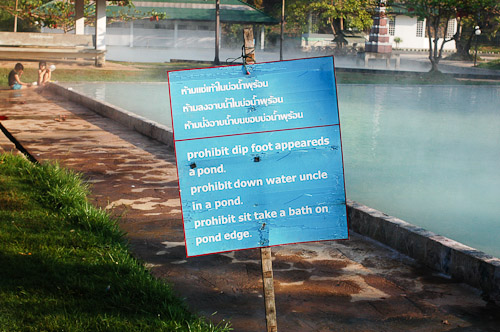
'A sign at Pha Bong Hot Spring, 12km from Mae Hong Son'.
By
Real Thai. What does uncle mean?

Slightly cheaper than the above mentioned Banjaran are Siem Reap's, Cambodia Dr Fish treatment. For just $3. Including a beer!

Monday, 1 February 2010

Updates for January 2010

Despite my intention to stem the flow of self typed updates, there were quite a few worthwhile articles on internet to warrant yet again another monthly update.

The Soaking Blogs
During the past months I have been updating the links list. Some links have gone dead, mostly those of government sites and/or geocities sites which have ceased to exist. I've tried to replace some links, though others remain (dead) as the alternatives were non-English sites or links to PDF files which I feel reluctant to link to. Other links have altogether disappeared, but I'll maintain these in the listing, I've seen that with the growth in internet they can reappear again.

In all there are / were 376 links, one third of which come from Indonesia. Others with many links are Thailand (94) and the Philippines (69).

First hand visits now account for 28 of these links, over half of which are from Thailand. Maps have been added to give a (rough) idea of where they are located as Google Maps coverage of Southeast Asia is not yet up to standard whereby one can directly pinpoint the correct location.

On the Himalaya site more (descriptive) links have been added on soaks in Nepal, India and Tibet.

Southeastasian Soaking News
Vietnam's Binh Chau hot spring, already one of the country's better developed hot springs, is set to be turned into a massive development site:
'The Kim To Trading and Service Co., Ltd late last week started work on its Binh Chau Hot Spring Villa project in southern Ba Ria –Vung Tau Province with a total investment capital of VND470 billion (US$254.5 million)'.
That last amount has the decimal in the wrong place, it's only US$ 25.5 million! Included are shopping facilities ...


Phuket, Thailand is adding attractions which it's visitors are supposed to love. Despite Phuket already being Southeast Asia's premier tourist destination, nothing is complete without a water park. So Phuket see's two water parks opening up for bizniz in the coming months (source). Surprisingly Splash Jungle includes a hot spring pool (natural or not?) which serves as an 'escape for parents'. And a wave pool, located just a few hundred meters from the beach!

In Malaysia, Sabah is all set to add another tourist trap in the form of a hot spring park in Tawau. Already possessing one of Southeast Asia's most sought out soaks (Poring; beware though, most visitors are quite disappointed), government and bizniz seem to think that more of the same is required. Apparently because not so many folk visited the natural springs development more development was needed so as to make the general public aware of the benefits of hot spring soaking. Tough luck for those nature lovers ....
The 16+ ha park-like setting contrasts with the previous
natural setting. Luckily the developers will also concentrate on ensuring that visitors enjoy fresh air.

Soaking Gone Crazy
Yes, so it seems. From travelpod.com a (slightly delayed) report from 10,000 students gone soaking in Xianning, Hubei, China:
'A total of 10,012 students bathed simultaneously in the city's seven hot springs, setting a new Guinness World Record'.
Last month I highlighted the weird ways of soaking in Japan, unaware that all all this can be experienced in just one onsen in Hakone, Yunessun. Coffee and wine for instance. And:
'From there it got even crazier: Green Tea bath, Sake bath, Black Tea bath, and then a Japanese Traditional Bath. That one was super cool because it had literally 50 floating half-grapefruits in it, along with a ton of other fruit and lemons and citrus... just floating in it?! This is apparently a very traditional bath style and it rocked'.
Asian Soaking Etiquette
Onsensoaker has a revealing post on wani's (Japanese crocodiles) who are making bathing uncomfortable for female soakers in Japan's (hot spring) baths. Trouble is that the more uncomfortable one is, the less females participate. This in turn means that the wani's have less to focus on, leaving the remaining victims who do soak, even more uncomfortable.
Time for societies to change? At least the government should start opening the 'hunting season' for the wani's without giving too much coverage to the subject. As soon as the media pick up on this they have to picture it in black / white terms because they believe their public will otherwise not understand the issue at hand. To be continued.

Malaysian soaker in Korea experiences some awkwardness despite the absence of wani's:
'I kept looking at the floor so that I didn't have to see any...er...interesting things'.
In Hin Dat, Thailand a blogger believes it's all Russia's fault for the poor pool spring water quality:
'bus hordes of Russians were unloaded and headed straight for the pools. But … not a single specimen of the pallid northerners headed for the toilets.
Well, a few minutes after dozens of Russians took over the pools a strange subtle odor seemed to emerge from beneath. Not the kind of sulphur smell. But an acrid, distinct urine-like smell.
In an instant we were out of the water heading straight for the showers. Must have missed a similar busload the other day … Russians arrive there every day by the busloads, we were afterwards told'.
Cross cultural mis-communication of sorts?

Tuesday, 26 January 2010

Rant

Friday nite I was watching the film Julie & Julia with Meryl Streep as lead actress. The plot revolves around a modern day blogger who manages to change her life by creating a blog on the re-creation of Julia Child’s 1960’s cook book, Mastering the Art of French Cooking. Besides entertaining, it also got me thinking.

Apart from cooking and baking, my passions in life (other than family) are football (playing, coaching, watching and reporting), cycling, swimming and … enjoying the outdoors. Alas the former is not so easy to pursue here in Cambodia. Yeah, there are great outdoors here, but somehow I have motivation problems. Could it be that temperature and the hassles of city life are simply demanding too much energy? That added to the fact that the outdoors (jungle) in Cambodia is pretty much inaccessible.

When I started this blog, it was an act of unselfishness; centralized (and extensive) info on the web concerning hot springs in all Southeast Asian countries is not available. It also gave me a goal while enjoying the (more accessible) outdoors.
I’ve since visited quite a few hot spring sites mainly during (short) holidays. Though I do try to avoid dragging my family around, from one soak site to the next. From my childhood, I remember the image of my ‘holiday in hell’: a distant relative of mine used to visit a couple of churches on a daily basis in Europe solely to admire the organs with little regard for the other family members wishes. How can that be healthy? So I always try to vary the holidays and minimize the drive to add more soaks to the blog list.
This need for variation has lead me to seek out waterfalls (as a more pleasurable (?) pursuit); often a fresh dip beats a soak in these countries. And especially in Thailand waterfalls are still very natural with the forests around them well protected.
Any road, my hot spring holy grail would be an untouched and natural spring, deep in the jungle, uncrowded, with locals enjoying and socializing with each other and welcoming to the outsider.

Unfortunately it doesn’t seem that this type exists anywhere in Southeast Asia, therefore I have expanded my web-search to include the Himalaya’s as well as describing the joys of water-holes. Up in the mountains there certainly must be great soaks. From living in Nepal in the nineties I have been to a few hot springs. And again, at the same time I’m centralizing information and assisting fellow (potential) soakers. And other outdoor enthusiasts.
Despite the success in part of the objective (95% of the visitors arrive at this web site from search sites), I am still not so satisfied. The unselfishness of the above stated objectives is not the reality. The blogging is a means of driving me to explore new places, to expand my imagination and make myself worthwhile to society. Or so I at least hope. And like the blogger in the film above, it might just make me rich (though I have no delusions on this). I suspect a regular job would be of more assistance …

Ultimately in this search for hot springs in the real world, what I have missed is the fun part. Having visited so many natural hot springs in various Southeast Asian countries they all seem to alternate as local attraction parks, rather than sites which cater to soakies; be it for recreation or for health purposes. Poor management is synonymous with these sites, resulting in some places having such poor water quality that the “hot spring = healthy” phrase seems to have been reversed. In all honesty most hot springs (with a few exceptions) are trashed. Oddly it doesn’t matter if it is Bali or Bokeo, Sumatra or Sankhampaeng. Same, same.
The best I can hope for is that through this blog, increased awareness of uniqueness of hot springs (and waterfalls) and their natural surroundings will lead to better soaking and cleaner facilities. In some cases tasteful, but not over the top. Enhanced natural surroundings, though preferably undisturbed. Until then, I’ll continue the quest in person and on the internet, a relentless search for the ultimate Shangrila La. Who knows? As with Julie in the film it might just change my life. Or inspire others ….

An artificial picture of an artificial geyser. Fang Thailand. Caption:
'Painting in acrylics by NAPAT YOTHONGYOS'.

Saturday, 16 January 2010

Under water

This concerns a re-posting from Soaking in Siam.


Finding
The first day of this year saw me visit two waterfalls (Cyber and Pha Rom Yen), the day to be capped off with a visit to the local hot spring. One of the first problems with finding soaking sites in Thailand is exactly that, the finding.

From info I had printed before I knew that Samo Thong was a hot spring in Uthai Thani province. Somewhere in Tambon Khok Khwai. From highway 3282 north of Ban Rai the hot spring was mentioned to be a whopping 24 kms from the highway.


Submerged
Samo Thong hot spring had been an usual hot spring, the water gushing from the ground and flowing away. However the area around it had been flooded when a large irrigation dam was constructed, creating Huai Khun Kaeo reservoir. But a decision was made to save the springs and a earth bund had been erected around and over the springs so that they would not be flooded.


The above mentioned highway follows the northern stretches of the reservoir and the turn off (a ridiculous 150 degree turn) were clear, only 24 km to go. Surprise, surprise, it's just a km up this road. Why the disinformation?

Development awaited
After saving the springs, it was thought that the soaks would become attraction points and a larger island was created to stimulate future recreative development. Thus when one arrives there's a big car park with to your right a single restaurant. Left is an official building which it turns out sells soaking tickets, rents out bicycles, where you pay for camping and provides a massage if required.

Before purchasing the right to a soak though, let's discover what the soak entails. Along 1 shore are a number of soak cells. Still fail to grasp why they would put these at such a place with that beautiful view; if the 4 person tubs inside fail to have any view than that of the inner walls and roof which does excellent work to capture the hot air, why come here? Towards the back are bigger cells, with bigger tubs and the exclusivity of being able to access a toilet. Somewhere forlorn between the various structures is a covered foot bath which is packed this New Year's day.

Biding your time, waiting for a space to soak your feet?

The springs
Clearly it's a hot spring resort but where is the hot spring itself? In a depression one sees a pond with water bubbling up. that must be it. But on closer inspection the bubbles come from blue pipes and soon this flow stops temporarily as a mechanic is throwing some taps. Opposite this though are 2 cement rings sticky up, revealing two deep hot water sources. One distinctly has some sulfur smells.


The source?

Soaking
This being a family day we and the mother-in-law rent ourselves a cabin. The moment we take possession of our cell the tub is empty, but water flows in swiftly, but also disappears just as fast. The attendant gets down the slope of the reservoir slope turns the discharge tap and our tub begins to fill. We close the door, undress and envelop ourselves in the heat.


Your Thai soak cell.
For the faithful
After the soak we wander around the island which has a second attraction a 20m high golden Buddha. It sees nearly more visitors than the springs themselves. But that's all there is to see.


Experience discussed
I must say I enjoyed this find. But what always trouble's me is that much more could be made of the location. The reservoir continues for miles to the southwest, in the opposing direction are high mountains (the 1500m + Khao Yai). Due to it be an island seclusion, privacy is guaranteed on three sides.

Soaks should be followed by a refreshing plunge and lo and behold this lake is just meters away from the soak sites, but inaccessible. When will be a real soak established in Thailand?


Just the other day I was looking at a programme which is aired every weekend on Channelnewsasia. It involves two middle age Japanese ladies who are traveling and discovering their own country, Japan. They focus mostly on food but yesterday they also visited 3 onsens on the Izu peninsula. But hey, two onsens were really special (one added brime, the other Arame, edible sea weed) while the third had a beautiful sweeping view of the sea. Why is that not possible here?

From the internet
Tourism Thailand:
'This is a small spring that sprouts up to the surface. The hot water from underground converges to form a little stream that flows down to Than Khok Khwai or Huai Khun Kaeo. The water is clear and pungent with the aroma of sulphur. The water is so hot that it can boil an egg in 5 minutes. The Royla Irrigation Department has constructed Huai Khun Kaeo Reservoir, flooding the stream and the spring itself. However, and earth levee has been developed around the spring and some landscaping has been done to create a good rest area for visitors. The spring has an area of 4,000 square metres and consists of 3 springs. A mineral bath is available for tourists and nearby is a 20-metre-high Buddha image sitting high amidst the wonderful scenery of the area'.
The only other original source is a blog on Uthai thani province:
'Formerly a natural hot spring gushing over the ground's surface, the water is clear, but with a sulfur dioxide semll. The temperature of the spring sits between 80-86 C, hot enough to boil an egg in five minutes. The hot spring has now been modified into a public park 4,00o square meter with bathing pools for visitors to enjoy a healthy bath. The public park has three hot spring wells 4-5 meters deep, with cement rimes around them one meter high. In the middle of the park sits a Buddha statue some 20 meters tall painted in gold, which can be seen from a good distance. Near the statue you'll find a reservoir. This landscape forms a beautiful scene and a pleasant atmosphere. visitors can enjoy fishing or cycling around the reservoir'.
Cement rimes?

Getting there: From Ban Rai take the 3282 highway north in the direction of Lan Sak. At km marker 41 follow the road heading due east (you'll be coming from the northeast) and follow for 1 km and you are there.

Soaking experience: This being a relatively cool day, the soak at the end of the afternoon certainly was worth the visit. That said, once inside the soaking cell, the experience is the same whether you are in Samo Thong or somewhere else in Thailand. Depends on your mood.

Overall impression:
Good, the area around is certainly relaxing. Possible because of new year, business (such as refreshments and restaurants) were doing well, adding to a conducive atmosphere. A stroll around the island is possible and pleasing with sights of mountains and the lake.


Add ImageStriking a pose for 2010?

Friday, 8 January 2010

Updates for December 2009

If you have been following the other Soaking in Southeast Asia associated sites, you'll have seen quite some progress on the Hot Soaks of the Himalaya blog. Besides Bhutan, Sikkim and half of Nepal has been added, yet again providing the most extensive info on hot springs in these area's. The intention is to slowly go west ward, before returning east and north.
Elsewhere there has been an update on Bo Klueng hot spring (Thailand) and another personally visited hot spring site will be added (Samothong, Thailand) on the Soaking in Siam site.

News/Features
Bangkok Post (17-12-09) has an article on Mae Chaem, southwest of Chiang Mai, Thailand. It includes a short description of Ob Luang National Park and it's hot spring:
'Just 12 kilometers northwest of park headquarters is one with 10 private baths, but it is not that popular among visitors. It charges 50 baht for a 20-minute dip and 150 baht for an hour. Also available is message service'.
It includes the photo's of the Thai institution of cell like hot tubs. Why is it not popular among visitors?

Where I live (Cambodia) there has been an interesting article in the local Phnom Penh Post (16-12-09) on the so-called Dr. Fish business which has been reported previously here on some occasions. Cambodia's tourist hot spot of Siem Reap has seen a proliferation of businesses offering a 10-20 minute spell with fish eating your feet. The original entrepreneur who started up this business imported the original fish from their origin (Turkey) and was doing a swimmingly business. However locals have seen that success and copied it and undercut the original entrants prices. The proliferation has seen the town's main evening scene street offer the same treatment but with a free coke / beer. This has lead to a recriminations by the original entrepreneur that his competitors are not using the right fish (which have no teeth). That said the competitors say they have access to local fishes which they starve before feeding them foreign feet! Fishy business this. BTW, co-incidentally the Sydney Morning Herald (9-12-09) features Dr Fish under the caption
'You can't do that'.
Tip, go to some Thai waterfalls (Erawan for instance) and you'll be regarded as food by the many large fish (cat fish, carp) while you try to cool down. And they bite. Though mostly out of curiosity. And not only on your feet. Keep your body protractions covered ...

Spafinder believes it already knows the future and lays claims to the coming trends, which are: 1. Pampering is out, prevention is in [doubt it]. 2. Hammams [that trend I thought was behind us]. 3. Spa membership; so as to make spa-ing a more social event rather than an individual [spa's, sauna's, soaking are always best enjoyed with (new found) friends I believe; if anything that's why soaking has always been a number one pasttime, from ancient civilisations]. 4. Online spa, i.e. booking more spa's via email. 5. Spa hybrids, i.e. spa's and fitness / hospital. 6. Discounting to continue. 7. Wellness tourism wows. Making spa-ing less boring? [The original spa's (sauna's, onsens, hammams, banya's, sweat hut's) remain popular because they are social institutes not wows]. 8. More scientific significance given to spa treatment achievements. 9. Diversity: instead of upper class women, more men, youngsters, elders and ethnic groups will hit the spa's. 10. Emphasis on silence and slowness as in slow-food so as to enhance the experience. In short simply a continuation of prior processes evolving. Spafinder also sums up the main trends of the last 10 years, somehow quite similar to above ...

I've come across a number of special soaks:
  • The first is a soak in Tajikistan, Bibi Fatima:
    'Mathieu and Yann had the first session, then Myriam and I got to enter the hot spring water with a bunch of cute old naked Tajik women. Women supposedly come to bathe here for help with fertility problems. The water comes directly from the spring into a small cave where a cabin has been built to shelter the cave. Other than the teenage attendant who decided she would stand a foot away from Myriam and I while we changed, the springs were very pleasant'.
  • Then from the States an underwater hot spring which can only be enjoyed a few days per month when the tide recedes sufficiently. It's an apparent secret ...
  • Following last months report on soaking in Beaujolais in Japan, Channelnewsasia (from Singapore) shared with viewers a report on soaking with oranges or better said mandarin's. Or ... I've been trying to find more on this, though it seems not to be a novelty; this site on bathing rituals in Japan mentions mandarin orange peel being added to baths. And here it mentions that during the winter solstice (which explains why I saw it on TV recently) it's customary to soak with yuza's, a citrus cross between grapefruit and mandarins. Though they may also be called mikans ... Or both.
  • One could in Japan also soak in soja if one wishes. Where does it stop? It doesn't:
    'The Yunessan spa in Japan's hot spring town of Hakone has added noodles to its wine, sake and chocolate menu. You quite literally bath in a big 2m-wide pot of steaming edible broth, while a chef dips noodles and stirs them around you. You literally bob up and down on the noodles'.
A few mentions from blogs:
Singapore
  • From one of the world's most uptight countries comes a description of a visit by Singaporites to a hot spring in Taiwan. They had major problems with the local custom of nudity:
    'kinda disturbing'
    is how Denise describes naked people. Conditioning has been well accomplished in Singapore as she describes the following:
    'Horrifying, I saw boobs everywhere. And bushes too. But it was even weirder when I saw my family members in the nude'.
    Somehow the opposite may be regarded as just as weird ... She ends the blog entry more positively:
    'haha but it got less awkward after a while, kinda get the hang of it. The hot spring was damnnnn shiok. Anyone that goes to Taiwan should give it a try, nude of course :)'
  • Fellow Singaporean (Happy Rainbow) picks up on pictures concerning a hot spring opening in China. The lengths to go to promote soaking in (Southeast) Asia.
    'Look at this hot spring opening event, 1 bikini girl vs 3 uncles. What is funny is the girl is wearing bikini, yet all the uncles are covered so much'.
Malaysia
  • A recent photo entry on Langkawi's hot spring. Under construction (the hot spring).
Thailand
  • How do Thai hot springs size up with those elsewhere? Leon reports on an unmentioned hot spring near Chiang Mai:
    'Unfortunately being Thailand these weren’t as nice as one would hope for and we had to settle for the swimming pool rather than a private hot bath once getting over this and the eggy smell the water had it was quite soothing'.
Philippines
  • The refineme organisation visits Maquinit hot spring:
    'What feels good after a long trek? Soaking in a hot spring. :) After Mt. Tapyas, we headed to Maquinit Hot Spring, somewhere in the depths of the forests of Coron. Okay, just kidding. It’s somewhere in Coron, but the travel to the hot spring kind of freaked us out because we had to go through this dark, dirt road surrounded by trees, and it was absolutely dark save for the light of our tricycle and we couldn’t help but feel paranoid about our surroundings. All good, though. I wonder how different it is if we traveled during daylight. The hot spring was HOT. And full of algae. But the heat of the water felt really good. :D Watch out for ghosts, though. ;) '
Related Posts with Thumbnails
Copyright 2009 © Soaking in Southeast Asia. All rights reserved.
No reproduction or republication without written permission.