Despite my intention to stem the flow of self typed updates, there were quite a few worthwhile articles on internet to warrant yet again another monthly update.The Soaking BlogsDuring the past months I have been updating the links list. Some links have gone dead, mostly those of government sites and/or geocities sites which have ceased to exist. I've tried to replace some links, though others remain (dead) as the alternatives were non-English sites or links to PDF files which I feel reluctant to link to. Other links have altogether disappeared, but I'll maintain these in the listing, I've seen that with the growth in internet they can reappear again.In all there are / were 376 links, one third of which come from Indonesia. Others with many links are Thailand (94) and the Philippines (69).First hand visits now account for 28 of these links, over half of which are from Thailand. Maps have been added to give a (rough) idea of where they are located as Google Maps coverage of Southeast Asia is not yet up to standard whereby one can directly pinpoint the correct location.On the Himalaya site more (descriptive) links have been added on soaks in Nepal, India and Tibet.Southeastasian Soaking NewsVietnam's Binh Chau hot spring, already one of the country's better developed hot springs, is set to be turned into a massive development site: 'The Kim To Trading and Service Co., Ltd late last week started work on its Binh Chau Hot Spring Villa project in southern Ba Ria –Vung Tau Province with a total investment capital of VND470 billion (US$254.5 million)'.
That last amount has the decimal in the wrong place, it's only US$ 25.5 million! Included are shopping facilities ...Phuket, Thailand is adding attractions which it's visitors are supposed to love. Despite Phuket already being Southeast Asia's premier tourist destination, nothing is complete without a water park. So Phuket see's two water parks opening up for bizniz in the coming months (source). Surprisingly Splash Jungle includes a hot spring pool (natural or not?) which serves as an 'escape for parents'. And a wave pool, located just a few hundred meters from the beach!In Malaysia, Sabah is all set to add another tourist trap in the form of a hot spring park in Tawau. Already possessing one of Southeast Asia's most sought out soaks (Poring; beware though, most visitors are quite disappointed), government and bizniz seem to think that more of the same is required. Apparently because not so many folk visited the natural springs development more development was needed so as to make the general public aware of the benefits of hot spring soaking. Tough luck for those nature lovers ....
The 16+ ha park-like setting contrasts with the previous natural setting. Luckily the developers will also concentrate on ensuring that visitors enjoy fresh air.Soaking Gone CrazyYes, so it seems. From travelpod.com a (slightly delayed) report from 10,000 students gone soaking in Xianning, Hubei, China: 'A total of 10,012 students bathed simultaneously in the city's seven hot springs, setting a new Guinness World Record'.
Last month I highlighted the weird ways of soaking in Japan, unaware that all all this can be experienced in just one onsen in Hakone, Yunessun. Coffee and wine for instance. And: 'From there it got even crazier: Green Tea bath, Sake bath, Black Tea bath, and then a Japanese Traditional Bath. That one was super cool because it had literally 50 floating half-grapefruits in it, along with a ton of other fruit and lemons and citrus... just floating in it?! This is apparently a very traditional bath style and it rocked'.
Asian Soaking EtiquetteOnsensoaker has a revealing post on wani's (Japanese crocodiles) who are making bathing uncomfortable for female soakers in Japan's (hot spring) baths. Trouble is that the more uncomfortable one is, the less females participate. This in turn means that the wani's have less to focus on, leaving the remaining victims who do soak, even more uncomfortable.
Time for societies to change? At least the government should start opening the 'hunting season' for the wani's without giving too much coverage to the subject. As soon as the media pick up on this they have to picture it in black / white terms because they believe their public will otherwise not understand the issue at hand. To be continued.
Malaysian soaker in Korea experiences some awkwardness despite the absence of wani's: 'I kept looking at the floor so that I didn't have to see any...er...interesting things'.
In Hin Dat, Thailand a blogger believes it's all Russia's fault for the poor pool spring water quality: 'bus hordes of Russians were unloaded and headed straight for the pools. But … not a single specimen of the pallid northerners headed for the toilets.
Well, a few minutes after dozens of Russians took over the pools a strange subtle odor seemed to emerge from beneath. Not the kind of sulphur smell. But an acrid, distinct urine-like smell.
In an instant we were out of the water heading straight for the showers. Must have missed a similar busload the other day … Russians arrive there every day by the busloads, we were afterwards told'.
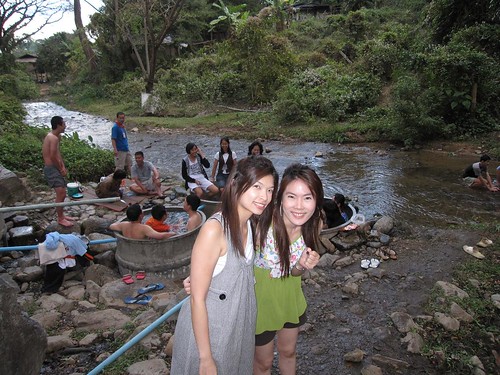
Cross cultural mis-communication of sorts? Kaekie:
'Enjoying hot spring Thai style'.
Probably in Chiang Dao.
Funny though, their 'enjoying' is simply making takes of tubby Thai tubbers.Not taking a soak themselves.
 Kanchanaburi
The province of Kanchanaburi is a well trodden piece of Thailands tourist path. Besides historical highlights (as in the Burma railway), it excels in natural highlights. In this, the Erawan waterfall meets most tourists expectations of a beautiful tropical waterfall paradise.
But there is much more nature to be discovered. Many more waterfalls and caves. So it may not be surprising that hiking and rafting are increasingly becoming popular pursuits, especially for the more wealthy middle class Bangkok citizens; Bangkok located not more than 2 hours drive from these delights.Hin Dat hot spring
As said there are a couple of hot springs, non more well-known than that of Hin Dat (or Hindad / Hindard / Hindat / Hin Dad or formerly known as Kuimang; the name on the tickets though is Hindaad). Not only in Kanchanaburi, but Hin Dat rates as one of the more recognized names in hot springs in Thailand.Located at a fair distance from Kanchanaburi town it's just a km off the near perfect highway 323 heading west. Judging from the ample space for parking, it surely is part of the main tourist road, even a number of coach parking spaces are available. Parking outside the main gate, a small fee was required to enter, though why nationals only get charged 10 Bt and foreigners four times that amount seems a bit weird; do foreigners get more value for money?Beyond the gate is another parking area with many stalls around, for drinks, food, tourist nick-knacks, souvenirs and orchids / plants. Tickets get checked before a bridge. From the bridge one has a good overview of the hot spring pools themselves. This being a rainy Sunday afternoon around 3 o'clock, the sides of the two pools are lined with soakers, though not many are immersing themselves. Is the water too hot? Just a meter from the pools is a swift flowing stream; it having rained during the preceding days. The banks of the stream are also lined with people half in the water. Sunday afternoon: packed soakers
.
Finding a dry spot to put my things down is quite a challenge, but once found it's off to find a spot on the side of the pool to adjust to the water. Of course there is still a place available: right next to the source, which is well over 40C apparently. After a couple of minutes I slide into the hotter of the two pools. After a nice soak, I get out and cool off in the stream.
The bank of the stream has been lined with steps of flagstones and though the river current is strong, it's a great pleasure to enjoy a natural cooling off. By the time I'm ready for a second round, the pools are starting to clear of their visitors, possibly having to return to the big smoke. But without the crowds, the soaks are even more enjoyable. A few more rounds follow and to top off a short massage is required. All 'n all a great soak. Soaking Thai style.
However most mentions of the hot spring concern tourist web sites mentioning the possibility of soaking. Some credit the Japanese occupiers (during WW II) with finding and enhancing these springs: '.. discovered beside a stream of cool water by Japanese troops during WWII and two cement wells were then constructed at the site'.
Both pools are still there. However there is also the following mention: 'This hot spring has a long history and has been with the local villagers for over 150 years'.
It does seem logical that the hot springs were there before the Second world war, why the Japanese get the credit for discovering them is beyond me. Though no doubt they did enhance and popularise them.
But it does seem that not much has changed since. The site has been enhanced with ample parking spaces, a bridge, changing rooms, toilets, ticket vending office and private pools. The latter though don't seem to be too popular, but they are located on the hill overlooking the site, without access to the stream and thus probably provide a less superior experience. They also cost the foreigner a foot or more, upto 1,000 Bt (~$US 30). Pay more, get less. Other bloggers mention - AbsoluteBangkok.com:
'Well, what else you need when you got large hot water tubs lined with natural stone - and a clean (!) fresh mountain stream two meters away to cool you down again. You could rent private bath tubs, but what would you need narrow walls and a roof for when the sky’s the limit?
...
And don’t trust the name of the nearby Green World Hot Spring & Golf Resort. They have no access to the hot spring water, but talk about repairs and broken pipelines and … screw them.
All they have is a rotten jacuzzi in the cellar. Go for the real thing at the public bath. The only thing to worry: I always wonder when visiting a public bath in Thailand why you won’t find cleaner toilets than in a Thai public bath. As nobody uses the toilets'.
- Bluestar guesthouse:
'the springs are a God send'.
- caryn:
'This one is rather simple, yet it attracts numerous tourist'.
- andydaniels:
'The springs were really nice, big pools that fit a lot of people and were deep'.
 After four: quiet and serene.
There is also a Hin Dat hot spring festival, each year in November: 'In the festival, there are booths of agricultural products and tourism exhibition of Amphoe Thong Pha Phum'.
The waters are said to have as a healing property for various ailments such as beriberi and rheumatism [1], holy water that can cure diseases [2] and gout [3].
There are two locations to stay overnight nearby: the above mentioned Green Valley which might be more appealing to golfers and the Phatad Valley Hot Springs resort, which actually is still a couple of kms away and has nothing to do with the hot springs!Nearby are also the Pha Tad watertfalls, probably a great place for a swim. As it is a national park, entry is a hefty 100 Bt, unfortunately during my visit three was too much water to make a swim possible. This site has more info on Pha Tad which are only located some 10 km from Hin Dat. Gushing waterfalls of PhaTad.
But I always have doubts about hygiene. Currently in Thailand you can sanitize you hands at every reception desk, though it's disputable whether the swine flu can be obtained over the counter. However without batting an eyelid, all soakers jump in in their already-worn clothing to soak; somehow missing out on the hygiene lessons. Outside of Southeast Asia though, customs (based on hygiene) determine that rigorous cleansing should take place before soaking ...
 Follow the signboards
Saw a sign along the road in Namtok town, Kanchanaburi province. It indicated a left turn to go to Wang Krachae hot spring. It was only 4 kms which was fine, couldn't be too much of search. It turns out Wang Krachae was also the name of the sub-district. Went past the sub-district office, completed the 4 km, only to find another sign, slightly different to the first one which was placed along the 323 highway, headed for Burma. A right turn this time was required to get to 'Wangkrajae hot spring'. Distance was 3 km. Fine again, getting closer. The road then slowly deteriorated as well as it got steeper and nearer to the mountainside. Finally the hot spring! But it was eerily silent. A large car park area was obvious. There were also some small sturdy buildings and the contours of a pool. But much was overgrown. Where's the hot water?Getting out of the car disturbed a sunning rat snake; the only sign of life. It slithered away in the direction of two pools. Delicately I went up to the two pools. The greenish water in both of the pools was cool. The two buildings were open and revealed facilities (toilets), both of which could be described to be in a reasonable state of affairs. Looking further around revealed a temple-like structure, in disrepair.  Wang Krachae's not so hot spring: beware of snakes!
 'Without I find a signboard called "WANGKRACHAEHOTSPRING" along terminal / Nam Toku Station outskirts of the train, R323 on the way and I listen considerably and turned around, but I am good, and understanding it'.
????Provincial soaksPrior to heading off for Kanchanaburi, I'd looked into more detail concerning the hot spring sites of the province.
The previously posted Rock Valley I failed to find out about on forehand. Hindad (next blog post) though, is very well-known and a highlight of Kanchanaburi province, so it seems. Others I obtained from a Thai language hot springs list (starts at KC 01 and continues on next page) These are: Toong Chang, Pong Rong (twice (!), but in different locations, one in Sai Yok district, the other in Nong Prue; Pong Rong translates as hot water), Kao Pang (or Khao Pang, otherwise known as Sai Yok Noi waterfall) and Don Lamyai.
Then there are two apparently in Sri Nagarindra in National Park: 'Huai Mae Kamin: there are 2 hot springs, suitable for bathing'.
I've tried to put up links to these two, but Thailands Department of National Parks website somehow fails to be linked deeply. Find your own way around our site, it seems to imply. Which is a great loss to them. Fancy putting all that information on internet and making it near impossible to find, nor to link to! Oh well, I suppose they have their reasons. Unseen Thailand indeed! The source itself revealed: a roof, four walls, hot water inside and a fence structure.
But what happened? And where does the water go?
I'll not bore too many of you, out there. As you can see there are a couple of original postings added / being added to the blog from a recent sojourn near Kanchanaburi, to the west of Thailand's capital of Bangkok.Again I'm astounded that there are more hot springs than thought but despite the Thailand promoting it's 'unseen' side, there's too often difficulties in accessing these unseen places, while simultaneously there are places with loads of signboards which turn out to be decrepit sites, long beyond use.From the press there is not too much going on. China, not being in Southeast Asia, does though provide some original news:First of all there's the case of a fish spa, with ferocious fish. Though still to catch on elsewhere (and not always deemed safe, see blog entry 'Updates for May 09'), fish which tend to eat dead skin off soakers and as such, add an extra spa treatment. These fish succeeded in biting where you would not believe them to be: 'The man, .... sat in the water for half an hour without realizing the special fish were nibbling on his special parts instead of the dead skin. The manager of the club saw the man bleeding as he stepped out of the water and rushed him to a nearby hospital'.
The China Daily article (9 July 2009) does not mention what exactly was the damage. He was refused financial compensation as the manager mentioned that 'it was mandatory to keep pants on during treatments in the club'.
Some questions remain. If the fish are supposed to devour dead skin, what on earth were they doing there? If it was mandatory to have bathers on, why was the soaker naked?The naked issue brings me to the next piece of press. Singapore's Strait Times (23 July 2009) mentions how soaking naked is a hot topic in China: 'Hangzhou - A naturist swimming resort to be open Saturday has ignited heated discussion in China where public nudity is still taboo'.
It appears that a hot sporing site was wanting to create two different pools, one for the ladies, one for gents and that bathing au naturel would be de-rigeur. 'Naturism has its root in western culture as Europeans were eager for self-expression after the Renaissance, which has little to do with the Chinese culture, said a column in Qilu Evening News in the eastern Shandong Province.'A naked pool is totally unacceptable in Chinese tradition and social customs. China need not to be in line with international practice in this regard,' the column concluded'.
Well, the Strait Times simply agrees by the looks. But is it the case? Surely in times bygone bathing naked in China was common (see link, scroll to Huaquing hot spring). In last months updates, there was precise the issue of soaking half-naked in China, which outside the developed eastern part seems still to take place. Even in the east, China does not seem so closed as it's rulers would like: ''The naturist pools also have supporters. A survey by Zhejiang Online, a major portal Web site of Zhejiang province, showed that more than 40 per cent of the netizens said 'yes' to the naturist resort while 30 per cent regarded it unseemly and immoral'.
So 40% yes, 30% unsure, 30% against. Well, those against would need not to visit, so marketing wise it's should be ok, socially it seems ok, but ... those in say have other ideas, sadly.
And then there's giving the west the fault, surely Japan's bathing culture can't be categorized as western?
According to the Shanghai Daily (27 July 2009): 'A naturist swimming resort in Zhejiang Province was told its patrons must wear swimsuits the night before it opened as the authority described its business as "indecent."'
Bummer. It shows just how much Asian rulers are behind in times, a point which I have raised on other occasions when it comes to skinny dipping in Southeast Asia.
A 23 July 2009 article from the same Strait Times, but describing an author's onsen experience: 'In contrast, I and two other girls from Singapore tittered nervously before eventually dropping our robes. Thankfully, no one stared and we quickly grew comfortable walking around in a crowd of women. After a while, we even ventured outdoors to try the outdoor hot spring or rotemburo. Here, water gurgled down a tiny waterfall and into smoking pools under the sky and trees. Lying lazily in the hot water with the cold night air buffeting my upturned face and the sounds of rustling leaves and soft laughter, I could not remember why I had ever felt awkward. We emerged rosy, glowing and wonderfully relaxed'.
Back home in Singapore, this would be an obscenity even if done in one's own house! In the coming updates I'll illustrate that simple nakedness and soaking need not be immoral.More on this article from China from Asianaturist and Cat's Chat.
 More though, there actually already is a bathing area in China which allows nudity:
 'A nudist bathhouse at a resort in Hongya, Sichuan Province, reopened Saturday, six years after closing due to pressure from local campaigners, the Sichuan Daily reported Sunday. The facility is at the Yuping Mountain Scenic Area and provides separate bathing for men and women. Security guards patrol the area and the taking of photographs is forbidden, Li Jun, manager of the resort, said.
...
“In foreign countries nudist bathhouses are usually opened by groups of like-minded people, but in China they always have a commercial purpose and attract a lot of pubic attention,” he said.
Apparently it was shut down after a year ... Actually it's unclear either way ... Anyway it concerns waterfalls, not a hot spring! In the Yuping Mountains ...Blogging then:I've weeded through all the searches and hardly found anything, but some photo's.
PhilippinesLisa Felipe from the Philippines enjoying a naked ('really') hot tub on Bohol(?). - Some beautiful pictures from Mainit hot spring made by hradcranska.
- Coron, a picture of non-naked immorality?

 From Dylulena's flickr account the photo was taken last month:
 'Indonesia, North Sulawesi, not too far from Tondano lake. I arrived there with the afternoon light .. Couldn't start shooting before my soul were fulfilled. There's a natural hot springs pond as green as the rice fields around it, naturally divided for men and women... Villagers keep coming there regularly just for the afternoon bath.. The view was unforgettable and will be always on my mind'.
- More info available on Suban hot spring (South Sumatra) here, looks good.
Thailand Suan Mokkh, Chaiya: not for men, not for women, but for monks. Photo by witpim.
Sorry, nothing from Malaysia ...
 Jaws VI?
Out west from Thailand's capital city, Kanachanaburi province is famous for it's waterfalls and it's history, though it's role in the Second World War is one of notoriety as indentured labour by locals and foreign captives were used to construct a railroad to Burma under 'hellish' circumstances.
Less well-known is that Kanachananburi hosts 5 hot springs. There's Hindad, the most famous and another 4 of which I failed to gather much information, despite them being listed. Not on the list is Rock Valley, it's yet to have a Thai name. I'm unsure whether 'Rock Valley' hot springs counts as a hot spring though (see below).
But seeing it prominently sign-posted, the car swerved off the road and uopthe valley in search of this not so Thai-named hot springs.Rocky ValleyIt quickly became apparent that the owners had gone out of their way to attract customers. Despite it being about 10 km off the main highway, at every twist and turn, small signs, some more clearer marked than others, showed the way. In the end it was a well-travelled 1 km dirt road, which to lead to the site.
Perched on the Kwai Noi River, most visitors come from upstream resorts by boat. As the day was drawing to a near, the reception provided an ad-hoc service, explaining that it would be 1 hour before the site would close and it would cost 500 Bt (~$US 15). That sounded steep, but a quick tour showed prime pools simply waiting for a late customer. There were a number of pools laid out along each other, using local rocks with some cement walls and floors. Here was defintly an enhanced resort! Plants had been added, a high screen to protect the bathers from the sun and all with a view of the river.The soakSo 500 Bt poorer, I was proivided with a towel and a locker key and a pair of local style bathing pants. The changing facilities were extensive and certainly encouraged a cleansing shower before the soak. After hitching the pants up and making sure that they stayed there, it was time to test the waters. I had been forewarned not to try the hottest option, but a more cooler variant. This was a 36-38C pool which was large with a number of coves. These could be used if you might have problems with the throngs of fellow soakers, but there were none. In two corners of these coves, showers and waterfalls had been created. Dr Fish pool, for real.
 that the waters are safe and can be used for soaking.
What's more, the need to used sanctioned soakwear means that efforts are in place to at least keep the water from being contaminated, no fully dressed nor are swimmers allowed, only what they provide, a unicum in Thailand I believe.It is unclear though, whether these are waters obtained are from natural springs. There are no sulphorous smells and the spa itself mentions that the waters are obtained from 20-30m down, where it has a temperature of 58-60 degrees.The info obtained reveals that the scaly nibblers are "Tilapia gangsters', which nibble deteriorating skin cells or exfoliate skin, thus stimulating better blood circulation.
Oddly though there is little to none other info outside of Thai websites and You Tube vid's. Getting There: Rock Valley is located up the main 323 highway from Kanchanaburi town to the Burmese border. Just beyond the turn-off for Sai-Yok district a clear sign will tell you when to turn left. It takes a right and a left turn before crossing the Kwai Noi river. On the other side, you turn right and follow the river upstream for 9 km's when you cross a small stream and make a sharp turn to your left. The entrance road is 500m up from here on your right. The spa is a km down this good track.Soaking Experience: It's a great soak, well adapted to regular users, though supposedly the well-heeled ones. Pity is that there is no big bassin, nor more private facilities; however the different bassins provide for a good and varied experience. There's also a drinking and eating facility. And it's also possible to take a massage. Friendly and helpful staff
.
Overall Impression: Best soaking spa in Thailand? Could be: the pools are in nice settings, have been naturally enhanced. There is variation in the number of pools and what they are intended for. Beautiful setting. One of the coves of the not-so-hot pool, with a 'shower'.
Copyright 2009 © Soaking in Southeast Asia. All rights reserved.
No reproduction or republication without written permission.
 Kaekie: