Showing posts with label Asia. Show all posts

Saturday, 13 May 2017

Addiction

icangdio at Gunung Ciremai national park, West Java:
Feels like a prince 👑 lol
#nature #hot #hotsprings #westjava #jawabarat #kuningan #ciremai #adventure
Well overdue, let's just check some photographic evidence of what's hot in Southeast Asia!

Starting off with Vietnam. Below what resembles a natural soaking environment, in fact it's part of a whirlwind tourist attraction.

alin_ov at Yangbay, Nha Trang:
😻😻😻
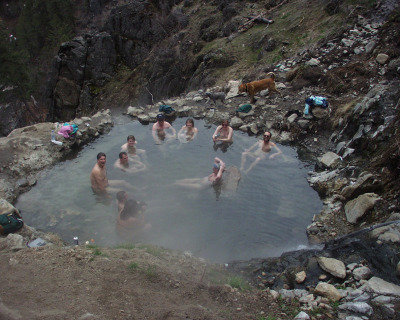
Bunch of buddies, some fun local kids, a natural hot spring in the remote forest Venilale in East Timor... sounds like a great moment for us.
#weekend #trip #friends #mates #kids #local #hotsprings #nature #mothernature #jungle #moment #love #share #travelblogger #traveladdict #travel #traveldiaries #travelphotography #picoftheday #photooftheday #travelgram #instatravel #couple #expatlife #islandlife #roadtrip
Less tourists (above) in Timor, looks very soothing. Below the ubiquitous northern Thai soak at Pai.

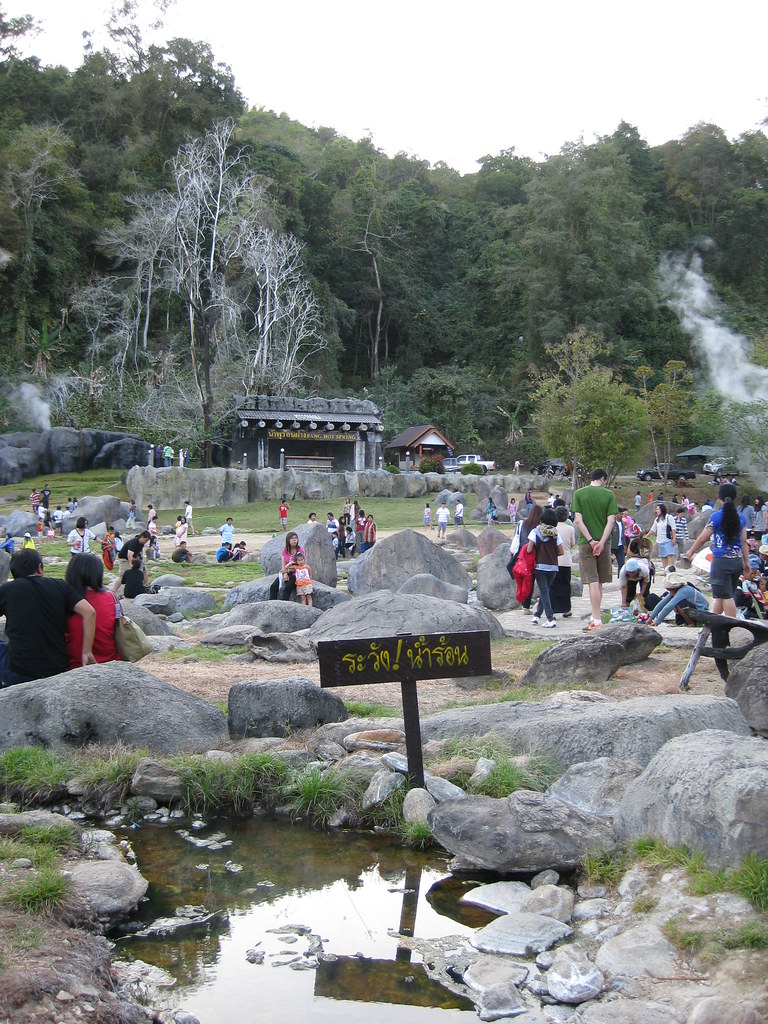
sarahf49 at Sai Ngam, Mae Hong Son province:
Mud masks and hot springs #pai #hotsprings
Phenomena

Sembawang Hot Spring in Singapore
It was my first time here but the place gave me a nostalgic feel.
The families gathered there were enjoying themselves soaking their feet in the hot spring water, the kids were playing with the water and also waiting for their eggs to get cooked.
It had that familiar Kampong feeling which I haven't felt in a long time. Maybe it's time to slow down my pace of life and not get caught in the hustle and bustle of life.
Singapore's only hot spring which may or may not change if recent developments are to be believed.
But below, the Philippines still apparently having soaking secrets.

faithpatayon_1 not saying where:
 Immersed ourselves in this natural hot spring that lies beneath these volcanic boulders by the sea. Again; no tourist, no entrance fee! I could say that this is the most spectacular place I have known all my life! Lowtide was just in time for sunset which made the experience more phenomenal! Even the word "AMAZING" is an understatement!
Indeed, The best things in life are free!☝
Let's take care of Mother Nature the best way we can, it's the only way we can pay her back

#blessedbeyondimagination #naturalhotspring #hotspring #mindanao #philippines #wheretonext #philspots #pinas #sunset #cannon #love #leavenotrace #explore #secretspot
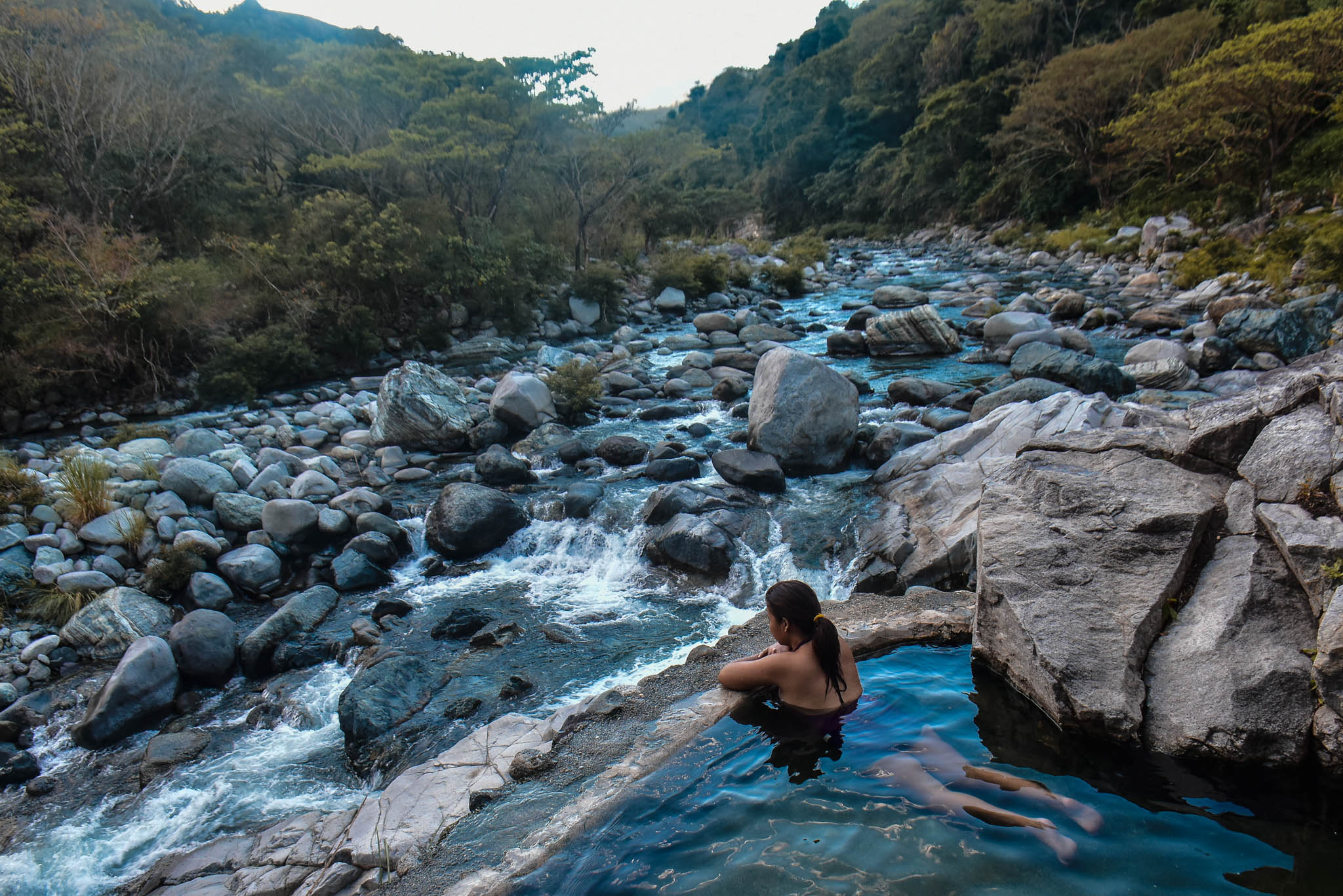
Inside SoutheastAsia, Abra (Luzon) Philippines
Kili hot spring 
Crocs
Suria Hot Springs Resort, Bentong, Pahang.
GPS Coordinates : 3.409379, 101.891356
I had a lovely stay at the Suria Hot Springs Resort. The hotel staff were all so welcoming and accommodating. Parking was easily accessed and secure.
Check-in was quick and friendly. Breakfast was fresh and delicious. I was upgraded to a lovely spacious villa with a hot springs pool and mountain views.
The only 'downsides' were the mobile network coverage namely Celcom, Maxis and webe (I'm using only these 3 telcos for my cellphones so please don't ask about DiGi and Umobile) are very very poor at the resort area. I can't connect to the hotel's Wi-Fi network at the villa at all. But the Wi-Fi was good in the lobby and restaurant. #suria #hotsprings #pool #Bentong #Pahang #instapic #travel #travelingram #traveller #travelbugs #travelling #visitpahang2017 #resort #eryabysuria #eryabysuriahotspringbentong #oneplus3t
Alas, not the natural soak we crave for (above, Malaysia), but that's what commercialism gives you.
Below northern Lao: less money, more nature.

arne_duehr at Xam Neua:
Hot Pool 🔥
#laos #hotsprings #hotpools #nationalpark #happyeaster #muanghiam #swimwithcrocs #travel
Pixies
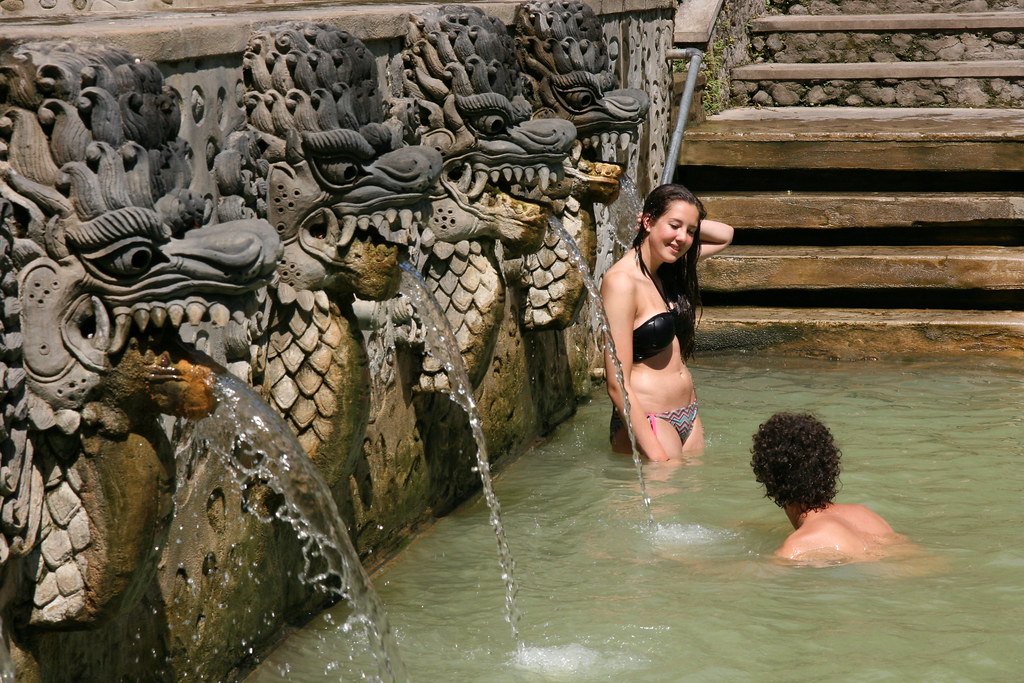
antaurpe at Yeh Panes, Bali:
Right here.
Right now.
It's all coming true.
#infinitesourceyoga #spiritledtt #hotsprings #bali #indonesia #followyourheart #trust #goddess #pixiedust
Finishing this photographic addition, Indonesia. Above you guessed the private pools on Bali, below under the volcano near Sumatra's Brastagi.
 
monicasilaban at Lau Side Bukbu, Sumatra Utera:
jadi manusia yg berprilaku kemanusian jangan berperilaku kehewanan 😆😆

Thursday, 18 July 2013

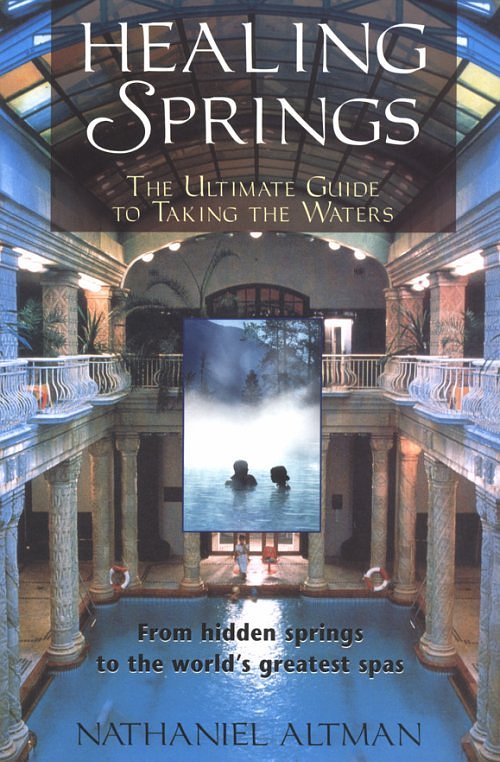
Publications: Healing Springs - The ultimate guide to taking the waters [?]


Non-existent
Soaking literature is far and few between. 

There are indeed many a hot spring guide book, in the US quite a few and in New Zealand as far as I know. Supposedly there will also be quite a few connoisseurs guides in Japanese.

But with instant internet, there's little or no need to publish these guides any more. We can all delve the info required with a swish and pointer or two. All up to date as well as the latest visitor who wishes to diss the place. The photo's are always there, explaining every nook or cranny. And even pre-buying an entrance fee to the fancier resorts becomes apparent. All the pre-visit pleasures.

This does mean that the enthusiast / upcoming soaking expert is depraved of an avenue to exhibit his or her expertise. In print. And who's not being printed does not exist. So goes the old adagium.

But beyond the world of lists and links there is surprisingly little info on what hot springs are and why so. Altman's now slowly dated Healing Springs wishes to link the two worlds and probably back in 2000 that might have worked. But nowadays a book a third filled with alist of potential soaking spots and a small collection of soaking picca's instantly seems out of place. And soakers in Southeast Asia need to note: we are not included! So much for our beloved soaking culture.

Best efforts to no avail? Krabi, Thailand's Klong Thom hot springs by Cholthicha Pornpan

Lost
But in the other two thirds, Altman has gone out of his way to seek to prove beyond doubt that soaking is indeed a healing process. 
Altman's expertise is in alternative healing (he's an hand analyst) and he seeks to combine natural waters with immediate health benefits. Mineral content is linked to disease remedies while diseases are linked to types of hot springs. It transpires that soaking isn't the only healing aspect, one needs to include drinking and inhaling mineral spring content. Emphasis is awarded to the Euro concept of taking the waters where states have enabled soaking industries to expand and medicalise the hot spring experience itself.
And that is where to me the healing aspect is lost.

Healing and hot springs is as much about inspiring and relaxing rather than solely something to heal. Altman does try though. There is a chapter on the ambiance of soaking. But describing this book as the ultimate? Even in 2000 that wouldn't have covered the content.

Though he admires the Euro soaking states, he's right in emphasizing that soaking nowadays is something we might be interested in; but gone are the days in which states could afford soakers to indulge for weeks on end. Better are the Japanese concept with ample bathing facilities which can afford daily experiences. Already this fits much more in with northern Europe's hang towards sauna. Or the old daily English bath.

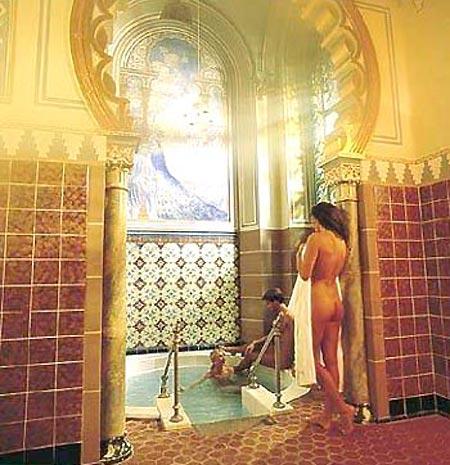
The author raves on about his Bad Wildbad experience, Germany. Unfortunately his own photo's are not available any more. The caption to this photo:
'A swimming fairy tale come true ... The classicist façade of the Graf-Eberhard-Bad (Count Eberhard Pool) looks rather unsophisticated in relation to what it contains. Behind the Florentine sandstone walls you will find oriental bathing splendour that is certainly unique in Europe.
This building, once threatened by decay, was restored with the help of significant financial backing, good planning and artistic effort to its original luxury as a bathing landscape, a dream from 1001 Nights. Today it is a modern temple of health with the refined feeling of the orient.
A grand architectonic effort thus succeeded in creating symbiosis between necessary modern form and an atmosphere of nostalgia. The Moorish Hall, the Princes' Baths and the Great Lords' Bath, where the statue of Venus by the Danish sculptor Bert Thorwaldsen can be seen, and above all the exclusive sauna landscape are part of the wonderful framework for a healthy visit. No resort visitor should miss this attraction: no one leaves without being impressed'.
Other aspects included are a nice historic overview where he notes that hot springs and human interest can be traced back for 600,000 years, but what with the lack of writing skills, use of mineral waters can be traced to Greek and Roman scripts as well as ample evidence in the form of archeological remains.

Altman does add a chapter on the preventive aspects of heated baths (leading to higher states of immunity) which assist in cleansing the body of toxins. We also learn that water pressure leads to increased flows of oxygen-rich blood. There is much more added to the list to the preventive powers of soaks, aspects of negative ions, micro-nutrients. You'll need to read for yourself.

So to sum up is Healing Springs a no buy? Well, I think the book cost me 0.14 cents which is about just above scrap value. The question is the book worth the transport costs? Hmm ...

Healing Springs has 4.8 stars at Amazon (4 reviews), while only 3 stars at good read (2 ratings).

Reference
Altman, N. (2000) Healing Springs - The ultimate guide to taking the waters. Healing Arts Press, Rochester, Vermont, United States of America.

Sunday, 3 March 2013

To do

Soaking in Southeast Asia is a winter tradition and thus we have now seen the busiest months in many of the region's hot springs. Rereading many of the internet features published recently, there does seem to more features on the previous natural soaks, but now up and coming thermal spa's. Or whatever they may be developed into.

Gone are the hot springs with natural features, common people and soaking bliss. Of course economic development has resulted in free time or cash at hand; thus the need to develop the natural world to make fit for the consumer.
What remains are facilities ill-equipped to deal with the many visitors or exclusive clubs where the willingness to line the pockets of distant shareholders results in an exclusivity. 
I always wonder, how is it possible that this has not occurred on this scale in Japan?

'Quite possibly the best Hot Spring I've found out here in Thailand yet! Multiple pools of varying temps, and a #creek to cool off in, for 100 #Baht entrance, definitely worth a visit!'
Porn Rang hot springs, Ranong, Thailand. From the webstagram site of skoisirius.

Advice wanted
As always those Japanese traditions are being challenged. Possibly innocent, but what to think about this poster on tripadvisor who wants to experience an onsen but is in a quandry
'... being a Westerner, I am a bit shy of being naked in public. If we go to an onsen where the gender are separated, I`m thinking it won`t be that much fun. On the other hand, if we go to a mixed-gender onsen, I`m thinking it will surely be awkward (not for me but I don`t want people to look at my wife)'. 
Talk about thinking backward! Some of the answers: 
'We had very similar concerns, especially because I speak some Japanese but my wife doesn't so she was not comfortable going to a gender segregated onsen where she'd have to cope on her own. In the end I went on my own to a gender segregated bath in central Osaka'. 
Problem solved. Why take the wife at all when travelling? Saves money ...?!
'I don't know what other people think, but I want some time of my own alone apart from my partner sometimes; I don't want to share toilet and pee with her. I also like gentlemen's gatherings at an izakaya/bar without ladies. But then Girlfriend might want to go shopping alone without a grumpy boy. I am always frustrated by the length of time girls spend on make ups and hair do.
Do you always take a shower or bath together with your partner? I don't'.
As the saying goes ..., when in Rome .... Begs the question why travel if you're not willing to adapt / tolerant different customs?

Geothermal power
Japan has it's own in problems in preservation of it's age old soaking rites (see above) and rights. Yomiuri online (26 Feb. 2013) has another article concerning the direction of Japan's power status and the possibility of developing geothermal power. Concentrating on Hokkaido's Daisetsuzan National Park it mentions that whatever happens 
'... the entire process from the initial survey to geothermal power generation could take anywhere from eight to 10 years'. Which will mean that it takes nearly forever ...'.
It also mentions that one reason why geothermal power generation is under development in respect of the potential is that much of the potential lies within National Parks.
'After regulations were relaxed in March last year, however, many plans to build geothermal power plants have appeared nationwide. However, with the exception of Daisetsuzan, many plans have been met with local opposition as development could adversely affect the environment and onsen hot spring sources.
In the case of Daisetsuzan, the Sounkyo Onsen hot spring resort is about four kilometers from the planned construction site.
However, the survey can be carried out as local residents, including the resort's local tourism association, have welcomed the plan. Furthermore, there is also a plan to reuse the hot water discharged from power generation to heat public facilities'. 
The best way forward is a win-win? Now why is that most if not all geothermal power plans neglect local soaking potential?

Geothermal power potential in the Philippines by CNN: A short intro.

Rock bathing?
Well via Hot soaks of the Himal we have been introduced to hot stone baths and in a previous entry here we have discovered what Ganbanyoku is.  
Onsen addict recently adds from Japan: 
'Lying on rocks is a great way to relax after a hard day at the office. The rocks might be flat slabs of heated granite, or thousands of tiny rocks that warm your body, like a thick quilt.  Ganbanyoku, (岩盤浴, is a "bathing" method that is spreading in popularity across Japan, and from Japan to other countries, because it feels so invigorating.  Low, comfortable, constant heat opens your skin pores, and you sweat out the dirt and impurities from your body while dozing or spacing out in softly lit rooms. The rocks below you are heated through the floor. Afterwards, a more traditional Japanese onsen, or hot spring, will leave your skin soft and pure'.
After an extensive description of what is on offer at Ryusenji-no-yu he laments that TVs should be banned from hot springs! 

Top
Lonely Planet has a top 10 of Japanese hot springs. Among them the best hidden hot spring; now something tells me that will not last long ...

The doddid.com site has a top 7 of Indonesia's Natural Thermal Baths. All quite surprisingly but nonetheless than Banyuwedang hot spring, probably Bali's least known. Funny that the picture includes Banjar hot spring, notmentioned at all in the top 7 ...

Another top, the top 5 onsens to visit in Japan.

Then there is the global top 10 by Reuters Business Travel. Only one Asian entry, but altogether a surprising 10. Focus on more natural hot springs but also noted is Peninsula hot spring, Australia.

Blogged:
  • Malaysia 
A hot spring seeing a surge in visitors is that of Panchor Dayak. Through my lens has a blog entry:
'... the spring has been there for a long time since the 1800, known only to the local villagers. It has only been recently acknowledged by the government and the official opening ceremony was done by the local Deputy Tourism Minister on the 8th September 2012. Since then there have built some basic amenities for the visitors and the place looks better and more organized'. 
And less natural. Highly critical:
'Water quality by my observation is not all that awesome.. I’d have to say that I would not use it to gargle or wash my mouth yet alone taste it. It flows slowly to the back of the compound and left to disperse by itself. 
... 
There is also no bathing place at the compound for rinsing your body after wards, don’t know if it’s intentional just to simplify operations or not; however there are toilets and changing rooms provided'.
A photo:


A press entry stemming from the Borneo Post (27 Jan.) concerning the same hot spring. What do we learn?
'... he [Deputy Tourism Minister Datuk Dr James Dawos] has met two persons whose helath improved after frequenting the hot spring.
...
At one point, there were people who came all the way from Lawas for a cure at Panchor Hot Spring.
“This is why the Tourism Ministry has upgraded the hot spring for all to stay healthy and happy.”
Panchor Hot Spring is a community-based tourism project developed by the ministry at a cost of RM450,000 and completed in May last year.
...
The ministry is looking at introducing a women’s section for more privacy.
...
On Panchor Hot Spring, he suggested that locals come up with a plan to develop a hotel and resort around the area to draw visitors.
“Some tourists want to come to the hot spring, but there is no hotel around. So it will be nice to have a resort next to the hot spring.”'
Perceptions of what is understood with development ...

Borneo Post (Jan. 2) has another hot spring related article, this time it has a feature on a new hotel near poring hot springs, Sabah. Named Hot Spring Garden it's more directed to the everyday tourist rather than upmarket clientèle. And the hot springs?
'He [the proprietor] assured guests could always enjoy the hot springs nearby from 5pm to 9pm, sparing them the hassle of competing for the hot tubs and swimming pools with othre day-trippers or those staying at the resorts within the area'.
'Annah Rais Hot Spring - Another view from a distance'.
From the blog of My Beautiful Malaysia
  • Myanmar
Despite having the same rulers as the last 30-40 years, jetting into Myanmar has now become hot; see it before disappears?  Inle Lake is high of the to be visited list. 
Kaung Daling is the name of a hot spring on the shores of the lake. Michi in a photo booth
'This spa is recommended by Lonely Planet as well so people are interested to go there but when they see that it is in fact a real spa with pools (they give you robes and shampoo…full treatment!) they are probably disappointed. They expect something wilder from Myanmar..we were happy with what we found! We also had a little discount because we were the first customers that day'.
'3 days and around 21 hrs of hiking later ...a well deserved break'
Myanmar opening up to soaking discoveries. From webstagram site of paulinebatista
  • Philippines
Another rave about Puning, this time a photoblog by ambot-ah, nice views of this increasingly popular hot spring.
Not a very extensive blog entry, but not often commented on. Badekbek near Daclan (Luzon) was visited by Rojae
'The smoke and sulfuric scent emitted could be seen and smelled from a distance. The hot water from the spring is believed to have some therapeutic effects'.
Ardent Hot spring, the Philippines. Blogged by Loopie.
  • Thailand
'Hotsprings'
Pai, Mae Hong Son, Thailand
From the flickr site of LewMez.
 
Sometimes development isn't always a solution. From thaivisa forum (1 Jan.):
'My girlfriend and I visited the OnSen Hot Springs Resort, in Sankampaeng [Chiang Mai], on New Year's Eve day. In the past, you could spend the day using their hot springs in a private room. The resort now limits your stay to 50 minutes for the same price as the previous day usage. I couldn't help notice that in addition to the limited time you could spend in a room, it appeared they have dismissed their cleaning staff. If that wasn't bad enough, the resort no longer has hot spring water, lol'. 
Note: 
'OnSen Resort is only about a minute or two drive from the San Kampheng Hot Springs. Up until this year, it was a high end resort'.
The hot springs of Chiang Dao, Chiang Mai, Thailand. From the webstagram site of buhnibear.
  • Vietnam
Half Japanese Aki Avis visits the hot spring of Thanh Tan, Hue. Expectations not met:
'Vietnamese-style hot springs resembles more a water park than a relaxing bath! There were also baths just to soak in, but the bulk of the resort was made up of water slides, a giant wave pool (which was being cleaned and sadly unusable), and play parks. Needless to say I was very happy have had wrong expectations. The mix of decadent relaxation (i.e. the two massages I indulged in) with sheer excitement (one of the slides was so fast that you actually went airborne on it! Not up to Canadian-safety standards if I had to guess...) was unique and refreshing! What a way to spend hump day...'.
Another find, revealed from the phuyennews are Tra O hot springs: 
'Unlike a natural stream, Tra O hot-mineral water has a temperature of about 700C, flowing from two dragon-heads built on an area of about 3m2. This system is designed as a shrine of the mountain-god. On the roof and the small lake under are the architecture of two dragons with sacred and mysterious features, behind is a space with a size large enough for a person to enter deep inside to have a sauna, the way people here do to have a better health, or cure a number of rheumatic diseases, skin diseases 
… According to many local people, the hoses in the hot spring were built in the French invasion time when cultural traces hadn’t been discovered yet. When the road is improved, trees are planted, the hot spring is sundered into hot-water pools…, it will attract many tourists to visit and enjoy euphoria feeling as having a bath in the fresh-hot water'. 
In Asia, it's the more (visitors) the merrier ..., hmmm.

Mud bath competition. The i-resort in Nha Trang is attracting more and more visitors. Tripadvisor posters note that it is more expensive. The compaison: 
'I just went there yesterday. it is a much better experience than thap ba. two big hot pools, several warm and cool pools including 3 natural style pools. overall it feels like a real resort. Make sure you go early. at 7am when it opened there was just us and two others. from 9-11am 300 people had shown up'. Priorities: 'Went today and I must say what a great day out it was first time I have had a mud bath and will go back for more . The food as the resort very good 2 noodle soups and fried rice 4 bottles of tiger total cost of 200,000 and very nice '.
China heading forward
Looking into how you develop a hot spring resort in China? In Mianyang, Sichuan they are developing a resort ...: 
'This luxury hot spring resort is built around the hilltop of Luo Fu Shan, in Sichuan Province. The site is 300Mu or 21Ha, with 70.000 m2 built surface. AIM has designed the master plan, landscape, architecture and interiors.
The project is unique to us as we are in control of almost all aspects of the projects. The masterplan is set up to use the different landscape opportunities on the site. The different functions have different types of buildings that each benefit from their immediate surroundings. This results in an architectural range that is at the same time diverse and unique'. 
Design by AIM Architecture.

More top end developments in China. Opening up is the Chongqing Beibei Banyan Tree
'Nestled in the Jin Yun mountain, Banyan Tree Chongqing Beibei features 107 contemporary Suites and Villas, each showcasing a private dipping pool fed by water from nearby hot springs'. 
It will open up step by step from the end of February 2013 (source).

'Can we get in on this? @kathy_macleod and I hot spring #chilaxing in Mae Hong Son. @jessvsworld @wesleyhsu @veronosaurus @lifecw'
From the flickr site of RealThai

Wednesday, 13 June 2012

Spotlight

Two entries already on European hot spring visits in the European Natural Soaking Society. More to follow.

Topical
Hot on the heels of the last update's weird and wacky hot spring and sauna experiences come's Estonia's sauna car! Follow the link and watch the clip.
I do not know if this applies to the sauna car, but in Japan you can visit a hot spring and earn airmiles!

Regional
Seldom do we see such good work in (re-)seeking hot springs in Southeast Asia, most prefer the over-trodden paths. However the blog entry 
'Unearthing Timor-Leste's Hidden Gems - Marobo's Natural Hot Springs 
by  Barry Greville-Eyres and Francisco Carlos de Araujo is a real gem by itself: 
'On a short descent we encountered ruins and remnants of what was supposedly spa or resort styled accommodation, at a picture-perfect location, surrounded by a labyrinth of ridges and valleys. Despite conflicting reports on the origins of the development - some sources attribute it to Japanese occupation forces during WWII (1942-1945) others to the Portuguese colonial occupation-era pre-dating WWII - its highly likely that local Timorese villages were instrumental in the construction of the associated infrastructure.
Much toil and backbreaking effort must have gone into the construction of the access road; distinguishable accommodation units; hundreds of metres of retaining walls; hot water diversion, distribution and drainage systems; the main bathing pool (approximately 25mx15m); an ablution facility and individual external mineral or mud baths.  Although the facility is now clearly abandoned, it still remains an important part of Timor-Leste's natural heritage and a potential drawcard for both domestic and international tourists'.
 It also lists a short overview of all Timor-Leste's hot springs. 

'A parting shot of Marobo's natural hot springs - 
yet another of Timor-Leste's hidden gems'.
Foreign control? Locals in Sabah state, Malaysia are worried that their natural wonders are being privatized. 
Always this never ending story: private ownership of public lands results in entrance fees / profiteering possibly exclusion of certain groups of persons (based on income) or public control by public organisations which (in Malaysia) don't seem to be interested in the public interests. The essence of the freemalaysiatoday article (7 June 2012):
'Ranau STAR division chief, Jalibin Paidi, said the transfer or takeover of the management of money-making Kinabalu Park or parts of it as well as the popular Poring Hot Spring near here had become a hot topic among people in Ranau and they want to know the truth'.
More worrying is the emphasis on foriegn control as if this makes non-public control worse ... 
Note also that the article mentions that all of this is rumour, hot air thus ...

The mud baths of Thap Ba (Nha Trang, Vietnam) now have a local competitor / imitator. Read more on the Thap Ba Soaking in Southeast Asia entry.
In the same area, Waterfalls of Southeast Asia reports that the famous Yangbay waterfall park, will soon expand, to include a (natural) hot spring ... 

Meanwhile in Los Baños, the Philippines, the gamble is on big-business tourism, so states inquirernews (30 May 2012): 
'The master plan also includes setting up a cable-car system along the Makiling terrain, rehabilitating the heritage sites in the town’s poblacion, and renovating the local spa and hot spring resorts'. 
More of the same thus?

Another entry on the Pinatubo hot springs:
'According to tour organizers, most of the resort’s clients are foreigners, with Koreans in the majority since it was developed by a Korean investor married to a Filipina. The resort also provides employment to indigenous Aetas, the original residents of the area, who were displaced during the volcano’s eruption.
With smoke billowing out from mountain crevices, natural pools and waterfalls sprouting from the dry earth, and oddly-shaped geologic formation, the terrain looks almost prehistoric.
It’s almost surreal to see modern amenities instead. Like in most developed resorts, there are several bathrooms and changing areas near the pools, with alert attendants handing out fresh towels to newly-arrived guests. Picnic huts, paved stairways and cement banisters made to look like wooden logs, have been carved from this mountain of stone and soil.
I dipped my foot gingerly into one of the hot pools and immediately retreated as the heat pierced through my skin. I moved to another pool where there were more people and found it relaxing in a feverish sort of way. Beads of sweat broke out on my forehead as my body slowly adjusted to the temperature. The heat of the pools really seeped in and soothed one’s aching muscles in no time'.
A great entry on an as-of-yet not-on-this-site-listed hot spring: Bogyah hot spring, neatly nestled in the Hapao rice terraces, Luzon, the Philippines. A great blog entry:
'When we got to Bogyah Hot Springs, there were locals relaxing in the hot spring. I did not mind, this was their place and I was happy that while dipping on the hot pool I get to know some bits and pieces of their life'. 
Note end line: 
'Let us not change Hungduan [where Bogyah is located] , let it change us'. Too ture.
Travelfish have added a section on the Dieng plateau, Java, Indonesia: 
'The main attractions in Dieng are the numerous temples and the geothermal area around Kawah Sikidang'.
Less local
More money being thrown around (or away?):
'GOCO Hospitality is working with Sanli Guo Yuan to develop the Xiangshan Hot Spring Wellness Center, a 6,000 sq,m. facility with an onsite natural hot spring, located 30 minutes outside Ningbo, China'. 
The cost will be only $US 25 million. For this: 
'The Xiangshan Hot Spring Wellness Center will offer exceptional wellness programs that are results-oriented and address the health concerns of the modern Chinese consumer—beauty enhancement, weight loss, detoxification, stress relief and ageing well. Benchmarked against leading thermal facilities internationally, Xiangshan will set a new standard in design aesthetics and service quality, seamlessly blending Western and Eastern wellness modalities'.
 Continuation of soaking vs geothermal energy dilemma:
'... opposition from local hot spring operators is stalling proposed large scale geothermal development in the Prefecture of Fukushima'. 
So reports the thinkgeoenergy.com last month. Seeing how the nuclear plant nearby which should be one of the most regulated industries went haywire, how is one top believe assurances from companies? Take for instance a recent entry on the soakersforum which mentions hot springs being sucked up ...

More  energetic activity in the region. $11.5 have been allocated to the Tawau, Sab ah, Malaysia project, no soaking opportunities? The Leyte, Luzon, Philippines geothermal plant will cash in (read privitize), with global energy prices at a remaining all-time high. Then there is news on Sulawesi (potential) and elsewhere on the Philippines (Kalinga).

Banjar hot spring, Bali, Indonesia (source)

Wednesday, 6 April 2011

Southeast Asia's Top 10 2011

More than one and a half years have past since a collated data on the internet savviness of Southeast Asian hot springs and present to you in a top 10. Back then Soaking in Southeast Asia wrote:
'Though arrived at through repeatable measurement, it has to be acknowledged that there is considerable bias in the results.
  • English is the main language in some countries and counts especially for Malaysia and Philippines.
  • Income and thus internet use once again counts in favour of Malaysia.
  • Names for hot springs are sometimes fluid, especially in Thai, where one can have many different versions for the same hot spring. In Vietnam and the Philippines this is less the case.
  • Due to changes in ownership, hot springs change name which does not favour a large number of hits. See for instance Toya Bungkah, which was previously known as Kintamani, a much more often used name. And would have made the top 10.
  • Internet is disproportionally skewed towards English. Vietnam sees relatively more non-English speaking tourists.
  • Some hot springs carry easy names referring to larger places, such as Fang or regions. Banjar for instance, would have been third instead of fifth if Lovina (the name for the region) would have been used'.
Much of the above is still very much true.

Used were searches on google, bing (new), flickr, tripadvisor's Asian forum and google blog (new).

So again caution when interpreting the following top 10 as of April 5 2011:

1. (1) Poring, Malaysia

2. (4) Fang, Thailand

3. (3) Ardent, Philippines

4. (5) Banjar, Indonesia

5. (-) Asin, Philippines
6. (2) Sungai Klah, Malaysia
(7) Thap Ba, Vietnam

8. (-) Kham, Lao

9. (10) Tambun, Malaysia

10. (-) Pedas, Malaysia
(-) Binh Chau, Vietnam

Sungai Klah drops, possibly an anonomy. Purely on Flickr, the number of Sungai Klah photo's has doubled, though ranking stayed the same. With tripadvisor many of the other hot springs scored better.

Muang Kham in Lao is a newcomer as is Asin (Philippines), no idea why they have become so much more popular. Maquinit (Philippines) dropped away altogether, would now be twelfth.


Country wise, Indonesia seems less popular.


It's surprising how in just one and a half years much more info has come online. Fang for instance has received more than 150 times more links. Sankampaeng (Thailand) has seen the number of links on Flickr increase 5 fold.


Do note that this says nothing of the quality of the soaks nor over the degree of greatness of each soak. It might just be the opposite ....


By the looks of it, Fang hot spring is getting hotter! Photo by Hannah Says Hi:
'Fang Hot Springs This water is SO HOT. A geyser shoots every 20 minutes. Family fun!'

Tuesday, 18 January 2011

Updates 15 January 2011

Coming back from a recent visit to Lao, there are 2 entries coming. Both from Xieng Khouang province: one already published, one to be published later this or next month. This brings the list of countries with hot springs featured up to 7, nearly 40 featured soaks in all.

Despite the difficulties in traveling Lao it must rank high on anyone's 'to do' list. Culture and scenery are beautiful. And if willing to put up some effort, there are also nice hot springs and beautiful waterfalls to be visited (see Waterfalls of Southeast Asia). More entries in the waterfalls blog have taken place on Thailand, Lao and Cambodia.

Publishing new entries on Hot springs of the Himalaya has come to an end, from now on there will be only re-publishing as and when time allows, hopefully keeping the info published up to date.

Press
Other interesting news is being kept to a minimum, despite this being the ultimate season for soaking in Asia.

Sydney Morning Herald has put in a glowing overview of Banjaran Hotspring Resort near Ipoh, Malaysia. "Spectacular" is a quote which seems to justify the reporters free overnight stay; other than that she seems not very impressed.

Thanhniennews
has a feature on Binh Chau, a hot spring I visited (and featured) earlier last year. added info is the fact that the springs were
' “discovered” in 1928 by a French doctor named Salle'.
As if not known before ... Overall a very positive article though again not very journalistic.

Further away, Cityweekend's Shanghai edition hopes it can get it's readers naked. At Tangshan hot spring.
'People have been getting naked there for 1,500 years, due to the hot springs and their famously curative waters. It was fenced off as a royal sanitarium for most of that time. These days, though, anyone with a little coin can take the plunge'.
Then it transpires they mean Kayamunis:
'You see, the Kayumanis is all about privacy. The 21 villas—each over 300 q. meters—are all enclosed by high walls. Inside you’ll find a cold plunge pool and what you came for—your own private hot spring nourished by 50 degree Celsius waters containing numerous healing elements. High walls means no roving eyes. Bathrobes are optional in your private estate, even in cold, early spring weather'.
The walls come with a price, upwards of $600 per night! Stay a few nights and you could have spent the same amount on a new bathroom with your own hot spring (?!).

Geothermality
A mainstream article by National Geographic looks at the future of geothermal power generation. Apparently Kenya will be leading the way followed by Indonesia.

Readers'tips
From the UK press, the Guardian comes this list of reader's tips concerning
'spa's and hot springs - the best places to chill out in warm water'.
The winning tip concern's New Zealand's Hot Water Beach and Kerosene Creek, even though they are nearly a day's drive away. From Southeast Asia the only tip concern's Thap Ba (Vietnam) while Asia at large gets tips on a hot spring in Jordan and 2 in Japan. So much for soaking being a popular past time ...

Hot Water Beach: dig in? (visited 2007)

Thursday, 21 October 2010

Update October 2010

In the ever expanding soaking related blogs concerning Thailand, Southeast Asia and the mainland Asia more has been added.
Visits to hot springs in Indonesia (Songgoriti, Cangar, Parang Wedang, Cumbleng/Saptatirta and Thailand (Mae Kasa and Mae Klong).
In depth features on now nearly all hot springs in the Himal (added Afghanistan, India's Northeast) Uzbekistan, Kazakhstan and Turkmenistan Guanxi/Guizhou and Mongolia) and north of that.
And the addition of a Tumblr photo site, just to celebrate soaking. Called Spirit of Soaking it compiles photo's from all over the world of people enjoying a hot soak as naturally as possible.

Just one of today's entries to Spirit of Soaking: Skinnydipper hot springs, Idaho, USA.

Art
Many of Southeast Asia's soaking sites are replicable and certainly not inspiring. Often it's the natural setting that makes them more likeable.
However that may not need to be the case always. An example of thinking out of the box came via this
article on Naoshima sento (bathhouse), Miyanoura Japan. Residents in Miyanoura, Japan can now soak in their bathhouse which doubles as a work of art itself.

Naoshima bathhouse exterior

More art. Jennifer West makes films. Two and a half minutes long. One film from 2007 is entitled: 'Naked Deep Creek Hot Springs Film'. Not posted on Youtube?

Avoiding face
Despite some places in Asia where bathing naked is the custom, when entertaining guests from here, not always is this practice commonplace / accepted.
Alan Eagle:
'When night falls during the Canadian summer, vacationers often peel off their clothes and jump in the water for a refreshing dip. It's partly to feel naughty, but mostly to feel free of society's burdens, gliding through the water like happy wild animals.
Recently a friend and I visited the beach at Beidaihe, and after a few late night drinks, decided it was time for a skinny dip. We invited some other friends to join in, but there were no takers. In fact, our Chinese friends seemed absolutely scandalized.
This puzzles me. I peeled off my clothes steps from the water, in the dark, where no one had a chance to see me au naturel. I think you could say the act was quite modest.
Especially as the tight Speedos favored by Chinese men leave no detail to the imagination. You can easily take the full measure of a man with a quick glance - something impossible to do with the baggy bathers preferred by Westerners.
(This is in contrast to the modest one-piece swimsuits with attached dresses and built-in falsies favored by Chinese women.)
So I'm not sure by what standard my midnight swim would be calculated as immodest. At any rate, I don't care because I enjoy shocking people'.
Talking about swimming naked, CNNGo has nothing better to do than list
'7 sexy skinny dips - Seven spots in Asia where clothing is just a chore'.
China, Sri Lanka, Thailand; all are places where going au naturel is fine. But strangely they are all exclusive resorts where the privacy you might want comes at a gigantic price, the cheapest quote 373 $US, most above $600. Surely the are other secluded places where the same effect can be achieved at no cost at all?


Malaysia
A slightly delayed update on Banjaran hot spring, near Ipoh. Since opening it has been getting good feedback and winning awards. Pity though that the price makes it exclusive. Nice for photo opts, not so for soaking ... the Star signs out as follows:
'The Banjaran experience calms your mind, energises your body and gives you a healthy glow, but since it is a plush retreat, expect a dent in your wallet . . . but worth every sen'.


Thailand
A new resort in Thailand's upcoming destination of Krabi. Scheduled for a January 2011 opening, Natthawaree is a hot spring resort and spa located at Ban Phueng, south of Krabi town. Forty four rooms (source) and many pools though the website says 77 rooms, so let's just see.
It's located near all other Krabi hot springs, might just be worthwhile visiting there this November ...


Singapore
More info on the history of Singapore's only public hot spring Sembawang. A very thorough article.

People gather around the hot springs
'People gather around the hot springs. Kawah Domas, Mount Tangkuban Perahu'
by Ripi
Related Posts with Thumbnails
Copyright 2009 © Soaking in Southeast Asia. All rights reserved.
No reproduction or republication without written permission.