Showing posts with label development. Show all posts

Sunday, 8 September 2013

Development blends

Norm
What's always intrigued me as how bathing customs differ, how they evolve and how current culture seeks to cope with the differences and the outer world trying to influence local culture. 

However, with the lessening of cultural and social diversions, traditional bathing cultures are increasingly threatened. 

Unfortunately the Southeast Asian bathing culture is a modernist one which with elitist overtones has regarded au-naturel bathing as backward and laughable. However the last laughs I believe are of those fully clad snobs who must feel tremendously uncomfortable. Or not?

But internationally, in the bathing custom discourse it are the anglo-saxon wannabe star cultures which are pushing their agenda however unknown. 
For instance, many a blog entry on Japanese onsen reflect on the backwardsness of naked single-sex bathing. 

Which raises the question why travel to a foreign culture at all, if you disapprove?
Others express fear of the unknown, but find out that it's actually a pleasure and become life-long converts. Southeast Asians, while radically opposed to disrobing, will do everything to blend in, however opposite it is of their own culture (remember in Singapore private nudity is even forbidden). Alas, their voices are often too meek in the current day internet overload. The same goes for us Europeans who have less binds either way.
Back in July I visited two hot springs, one in Aachen (Germany), one in Holland (Thermae 2000). In Holland it was a costume free day, which 99% happily enjoyed, whereas in Germany a beautiful part of the springs was suit-free. Not many have qualms about the lack of dress. But that said, overseas guests are at minimum and when researching internet the English language responses are often filled guilt / shame ridden. 
To me simple nakedness is purposeless (we are bathing after all), but it leads to increased self-esteem, self-confidence and acceptance of nature.

Sheepish
Here are some recent examples of au-naturel bathing experiences by you. First by Irreplaceable, from Malaysia (July 14) enjoying an experience in Korea:
'Yeah, the very first time getting naked in public with two of my girlfriends. If you never have such experience before, this might sound so awkward for you, am I right?
In fact, I had been struggling for so long whether shall I try this nude hot spring. For me, it is just so embarrassing to appear in front of strangers without wearing a single piece of cloth. But after all, I decided to try it. How brave am I right. Bravo. To make you clear, it is a hot spring only for girls. Not mix one okay.
...
Miss that wonderful hot spring soaking moment with my girls. Wish to visit other nude hot springs of another country next time LOLOL. Don't think I am crazy okay I am not. Come on. Don't be shy. You all must try it if you all have a chance. That gonna be a very unforgettable memories I promise. :D 
Peace'.
Peace to you too. Then Big on trips from Singapore in Japan (July 21):
'I started out a bit self-conscious and sheepish about the whole thing. But having the husband in the same bath made me feel more comfortable. It helps that the baths are also sprawling so you can easily stake out your own little nook where no one can see you. After a while, you just get used to seeing everyone’s bits and realise that man or woman, it’s just a different anatomy so no point getting the knickers in a twist about it. Plus if you go as a couple, it is nice to be able to enjoy the onsen together'.

There is the odd exception and some are written with great wit. Take Joann from the USA in Japan (August 12):

'So it was that Diane and I, two fairly well-endowed women, stepped outside, naked as the day we were born, whereupon we made three crucial discoveries: we were the only Gaijin (foreigners) at the spa, the resort was co-ed, and the two of us were missing one small, but essential item. Every Japanese person we encountered, and 99.9 percent of them were of the male persuasion, was holding a small hand towel the size of a wash cloth, over his genitals.
Diane and I were not just naked. We were beyond naked. We were Über-naked.

Had we missed the warning sign in the locker room: “Please remember, don’t shame Buddha, all of the Shinto deities and the memory of hundreds of generations of your ancestors by stepping outside without your little washcloth?” Or perhaps there was no sign because the Japanese are born holding these tiny cloths as they exit the birth canal?

Desperate to cover ourselves, Diane and I crisscrossed our arms over our bodies. With our hands hovering ineffectively over our nether regions, we darted to the nearest hot spring for cover. The dark gray, mineral-laden water conveniently covered our nudity, and thankfully, we were alone.
But not for long.
Apparently, word of the two, too-naked, big-breasted American women, had spread like wildfire throughout the spa. Suddenly, dozens of extraordinarily friendly men, also unclothed, but of course with the obligatory washcloths, joined us in our pool. I did my best to fend off the many overtures from these interlopers who floated dangerously into my personal space, trying to chat us up. The Japanese love nothing more than to practice English, but the last thing I wanted to do was encourage naked fraternizing.
After a few minutes, I noticed that I had begun sweating profusely from the intense heat. After fifteen minutes, I felt nauseous.
I knew that I had to get out of this bubbling caldron, but escaping would have required climbing up a three-foot ladder to exit the pool, thereby providing a front-row view of that to which only gynecologists and lovers should be privy. My mind, which was now melting along with the rest of me, struggled to reason that I was thousands of miles from home, and the chance that I would ever see any of these men again was infinitesimally small. But I couldn’t bear the thought of baring my undercarriage, free of charge, to this rapt group of strangers. Diane agreed, so the two of us waited it out with a steely determination that would have impressed any prisoner of war.
One by one, our fan club left, and finally, we were alone, once again. We quickly made our getaway. Like two boiled lobsters plucked from a pot, steam rose off our crimson bodies, as we climbed out and once again scurried for cover to the nearest pool.
And so it went.
We spent the rest of the afternoon sprinting from one hot spring to another until we came to the last one of the day. Divided into three sections, each about the length and width of a bathtub, Diane and I chose adjacent pools. As we stretched out, we discovered that the water was only a few inches deep, so our entire torsos were completely exposed to the air.
We sat up and struggled to reposition ourselves to find some cover. A moment later, a man in a deep pool next to ours who had witnessed our thrashing, floated over to us, stuck his foot out of the water and pointed at it. It took only a moment to realize that Diane and I were lying in the footbaths—a fitting end, I suppose, to an altogether much too naked and humiliating day'.
In an overview of current day nudism in China (which 'reveals' a few hot springs where nudity may or might have been common practice). From nakedhistorian (August 8):
'Whilst there is very little nudism amongst the dominant Han Chinese, there is more tradition of nudist activity amongst China’s minority groups, especially down south.
...
In western Yunnan, the De’ang tribe bathe in the Imperial Hot Springs whose waters are rich with coal and salt extracts. We’re not entirely sure how they’d feel about foreigners stripping down and hopping in alongside them, but if you ask nicely, the chances are they’d clear a space.
The Mosuo minority believe in the disease curing properties of their local water, so they frequently bathe naked. During the Cultural Revolution, the government built walls across their pools to segregate men and women, but the Mosuo tore them down soon after. The pools were opened to tourists in the 1990s.
A little further north in Sichuan Province, nudism seems to be all the rage. Chongqing Girls Nude Bathing Area;sounds more like the title of a dodgy DVD, but it’s actually an area set aside for women in the Ba’nan District’s tranquil East Spring Village. The pool has been in use since the Ming Dynasty, and its water is said to cure blindness. If you fancy a dip, you’ll be pleased to know that it’s open to tourists. Female ones'.
A Thai in Japan (Nation, August 28): 
'Most of the skiers in Niseko spend their off-piste time in the Onsen. The Green Leaf Onsen stands out as one of the most beautiful natural rock pools in Niseko. The Onsen has separate indoor and outdoor pools for men and women with the water source originating from mineral spring.
But stripping off my clothes, soaking in hot spring with other men and watching huge flakes of snow swirling down, doesn't turn me on. I decide instead to occupy a bar stool and exchange words of wisdom with the bartender though I do agree to take a side-trip to Otaru and Yoichi'.
That's despite visiting onsen is no. 2 of Japan's Top 5 (Lonely Planet, Sept 8).

Blending in. In Uganda I believe (source).

Geo-spirit
Thinkgeoenergy (July 12) has an article by Jon Cheetham who can not understand why Indonesia is not embracing geothermal energy more whole heartedly:
'As my proof, take a look at PT Supreme Energy, who just received approval from the Rajabasa indigenous people to explore for geothermal resources in Lampung. What it took was frank information and compromise from Supreme Energy chief Triharyo Indrawan Susilo, who informed the Rajabasa of the minimal environmental damage to be feared from geothermal exploration, and promised to plant double the amount of trees that have to be cut down. How is that for a truly admirable renewable spirit? That was all it took; now Bp. Triharyo gets to go ahead with his project hoping to make himself and his employees successful, and the Rajabasa have nothing to fear for their environment. Everyone wins. The country wins. This generosity and openness is the attitude that is needed'.
In New Zealand they fail to understand why the Chinese would want to invest in geothermal energy in the already saturated energy market in NZ (Thinkgeoenergy, July 1). But also at stake is New Zealand nationalism:
'Overseas Investments Office, so the news, has just approved the deal, but it immediately receives criticism. ”Power is a critical component of any economy,” says New Zealand First leader Winston Peters. “To give away its ownership and profits to a foreign interest is not capable of being explained away.”'
In Italy opposition is growing towards the proposed Amiata Bagnore 4  geothermal plant. From Smartplanet (August 8): 
'He [Andrea Borgia, a geologist and volcanologist who works in the Italian High Commission for Environmental Impact Assessment] opposes the new plant because, he says, geothermal fields have already dropped Amiata’s water table, increasing the concentration of naturally occurring arsenic. What’s more, Borgia says that Enel is releasing carbon dioxide and other pollutants such as hydrogen sulfide, ammonia and mercury into the air — and that it doesn’t have to. (Of the geothermal fluid extracted at the plant, only a quarter is re-injected into the reservoir, and the rest, containing these pollutants, is released in the form of vapor.)'. 
All-in-all it's a very complex issue and it seems both sides have the truth on their side. However: 
'She [Adele Manzella, a geophysicist and researcher at the National Research Council] believes the controversy stems from the residents’ lack of trust in Enel and local policy: They did not solve air pollution problems in the Amiata area for a long time, creating bad publicity that is fueling suspicions about the drinking water.
Unfortunately, Manzells says, there is no conclusive evidence as to whether the geothermal work is affecting the level of the drinking water, and a study will take years: “It is a matter of debate, and people there do not know what to believe. It is left to the opinions of the people or scientists or other experts having one interest one way or another.”'
Then we already discussed dual use systems, as proposed for in the Philippines (source). Thinkgeoenergy has an article (August 12) on the Icelandic success of dual use. But that's not all: 
'While the Blue Lagoon remains the top tourist spot in Iceland, the power plants – all can be visited – are among the most visited tourist attractions in the country'.
Malaysia hopes to get it's first own geothermal energy as of 2016 (Thinkgeoenergy, August 8): 
'The power plant at Apas Kiri, would be the first renewable and sustainable project of its kind in Malaysia, with power to be sold to the Sabah Electricity Sdn Bhd (SESB) grid. It was originally scheduled for completion in 2015'.
Apex
Ever heard of the Global Spa and Wellness Summit? Well, the upcoming 2013 meeting slated for early October 2013 set for New Delhi hopes to attract hot spring operators and leaders to discuss soaking issues: 
'According to co-organizer Charles Davidson, from Peninsula Hot Springs in Australia, the Forum will include presentations and open discussions on how the best hot springs operators in the world’s most competitive markets build profitable spa, bathing and accommodation businesses; which evidence-based studies in hot springs bathing practices provide proof of the health benefits of hot springs; and the various ways cultures utilize natural hot water for health, wellbeing and community happiness.
Participants will also jointly explore ways the global hot springs industry can work together in marketing, research and development and on philanthropy projects to bring hot springs bathing facilities to communities in third-world countries'.
The press release certainly pushes the right buttons and this initiative is to be applauded. What I have my doubts about, is the insistence on commercialism. Little is done to preserve, protect and allow enjoying hot springs so how hob-nobbing with the rich will enhance this remains a question mark.

More in depth soaking enthusiasts will be looking at:
'On the table for discussion:
  • How do the best hot springs operators build profitable businesses? 
  • What are the key evidence-based studies supporting hot springs bathing practices? How can they be promoted better? 
  • How do global cultures use natural hot water for health, wellbeing, and community happiness? 
  • How can the global hot springs industry better work together in marketing, research and development? 
  • Are there joint philanthropy projects that can bring hot spring facilities to third-world communities? '
Tellingly there is yet to be a sponsor for this part of the programme .... 

Especially in China, hot spring development is taking on a commercial dimension unbeknown to traditional soakers. Take the doughnut hotel (Yahoo, July 20):
'It's a hotel Homer Simpson could love.
China's Sheraton Huzhou Hot Spring Resort's deliciously shaped oval design looks like a giant doughnut. The building, dubbed the "horseshoe hotel," opens next month in the town by the same name, Huzhou'. 
Though it names itself a hot spring hotel it's own web site is conspicuously silent on what it entails.

More high end development pouring in. Banyan Tree Chongqing is receiving it's first guests (Breakingtravelnews, September 6): 
'Nestled within the new Banyan Tree Chongqing Beibei, the first international hot spring resort in Chongqing, the resort embraces the natural healing waters of the North Hot Springs'. 
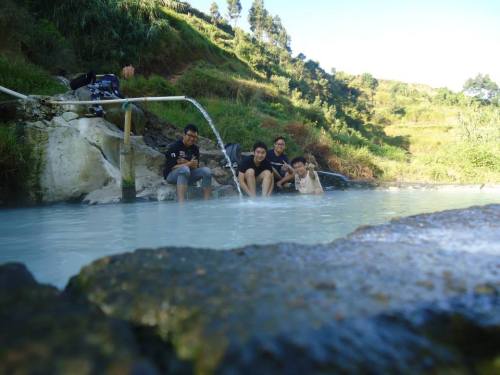
Dieng plateau, Java, Indonesia. From My Journey keeps Inspiring.

Mostly unhopeful dreams 
  • Brunei
Brunei is eyeing yet again the development of a remaining hot spring. Read what the article (mysarawak, July 30) thinks is the good news: 
'Second Minister of Resource Planning and Environment Datuk Amar Awang Tengah Ali Hasan said lessons could be learnt from the Republic of Czechoslovakia, which managed to turn a valley with a hot spring into a renowned medical tourism attraction.
“Tourism is a money spinning industry, and it can provide employment and economic spinoffs. Czechoslovakians used their creativity and innovation on the valley, which now contributes to their national coffers,” he said at a Sarawak Energy Berhad (SEB) gathering in Hotel Seri Malaysia to present Raya goodies to orphans, the disabled (OKUs), and single mothers over the weekend.
Awang Tengah said Lawas had great attractions in the Merarap hot spring and Mount Murud, the highest mountain in Sarawak'.
'Indigosix outing! Yipeeee ...'
West Bali, Indonesia: Menjangan hot springs. Source: nininathania
  • Laos
Hot springs are increasingly becoming popular says the Vientiane Times (July 19). But is this the start of the end?
'The house's rooms will be built as many visitors like to bathe naked in the spring; however, visitors are required to bring a large towel to cover themselves when they emerge from the water. Bathers say they feel healthy after they finish and walk out of the bathrooms at the hot spring.
Since the bath opened last year, visitors there are mostly Lao people. Mr Phouvanh added about 40 foreign tourists per month have visited the hot spring to relax in the refreshing water. The cost to use the bath is 5,000 kip for a foreigner and 2,000 kip for a Lao person.
The department has received funding from the state to build a bathhouse and a souvenir shop at the site'.
It's bye-bye to this?
'For many local people, the spring is even better than a regular hot shower – while they have electricity installed in their homes, most still head to the springs for the traditional experience.
The local community often prefers to bathe communally in the hot spring before turning in for the night and again before breakfast'.
Then on the 25th of August, the same source mentions finding a new hot spring:
'Zone Administrative Office Head, Mr Somphone Southam, said a group from his office visited the hot spring at Poungloc village earlier last week on an unofficial trip, and discovered the spring was the biggest any of them had seen in the province.
“The spring boiled in the middle of a stream in the centre of the village; it bubbles hot water to a height of about 40cm while the stream covers the entire area,” he said. Mr Somphone said a local official had told him the village was located near an ancient volcano, which explained the hot spring activity'. 
Obviously, authorities want to develop the site ....


Viengthong hot spring, as it is.
  • Malaysia. 
Another nail in the coffin for a yet to be well visited hot spring? Metro online broadcast Malaysia (21 August ) reports
'AMONG hot springs in Hulu Selangor, two are already well known — Kerling and the Hulu Tamu hot spring in Ulu Yam. 
However, a third hot spring is begging for some attention. It is located in Jalan Ariff 12, Taman Ariff, Kuala Kubu Baru.
Although the hot spring was discovered almost 10 years ago, it remains a well-kept secret among locals.
...
Last year, the Hulu Selangor District Council (MDHS) beautified the area by covering the dirt road to the area with gravel, building a small concrete pathway, and a few seats. However, there are still no toilets and changing facilities.
MDHS’ aim is to make the Kuala Kubu Baru hot spring an international tourist destination'.
  • Philippines
Asian Correspondent (September 2) visits Manquinit hot springs, Coron islands, the Philippines: 
'... reputedly one of just two saltwater hot springs in the world'. 
Not really good research. A simple google search will lead you to f.i. the Zhaori Saltwater Hot Springs, Taiwan. It's 
'This is one of only three saltwater hot springs in the world along with the springs on Kyushu Island of Japan and Sicily in Italy'. 
But no Manquinit. Or what about Mount Mangunui, New Zealand? Triton Bay, China?

   
Who knows this hot spring in Chaiya, Thailand?

  
Further afield. The Secret of India website lists a couple of Indian hot springs.

Sunday, 2 June 2013

Zeroing on toxic (developments?)

Yeh panes hot spring, Bali, Indonesia. From instagram of cara_elyse:
'Chilling in the hot springs.. Which were kinda lukewarm..'
Toxic rash
Time again I have commented on the lose of natural soaking sites. If it's not (local) government selling out to private interests and thereby locking out local public access (save the privileged few) then there is the often unregulated geothermal power lobby which with many a flowery argument seeks private control over natural process of thermal flows.

Oddly in recent months it's the Philippines which is showing some guidance. 
It had to happen. A good idea gets followed up. What simply stupefies me is that it took so long. The Blue Lagoon Reykjavik, Iceland has earned itself as the national no. 1 tourist attraction. But in essence it's just an overflow of a large geothermal power generation project. What with everybody now plumbing their own geothermal projects and killing off many a local soak, linking the two seems so obvious. 
From thinkgeoenergy.com (22 May 2013): 
'Philippine geothermal developer Constellation Energy Corp. plans the development of lakeshore areas with hot spring and wellness center near its 20 MW geothermal power project in Oriental Mindoro [Montelago]'. 
Let's hope they don't hash the development ...

Then there are those that are questioning the  impact of geothermal power. Sadly despite all the arguments, it's hardly ever highlighted that there could be any negative implications of geothermal power other than a couple of social ones.
The Philippines BusinessMirror (May 21) has an article on opposition to establishing geothermal plant: 
'After two decades, the people of Irosin continue to stand up against advocates of geothermal energy, this time the Department of Energy (DOE) and contractor Summa Kumagai Inc. (SKI), who want to set up a multimillion-dollar geothermal power plant in the town, Dr. Gante [Irosin Coalition Against Geothermal (ICAG) Chairman] said.
...
Gante expressed profound concern over human exposure to hazards entailing geothermal operations.
She said arsenic concentration is high in all geothermal sites, adding the deeper the operation goes down, the higher the concentration.
“Arsenic is converted into other compounds but never destroyed once outside of the soil,” she said. “It contaminates water, including sources of drinking water.”
She said arsenic is highly toxic for the human body. Exposure can cause cancer. It is a Category 1 poison, according to the World Health Organization.
The ICAG chairman said the drilling period is very toxic-laden since at the time, there is not yet reinjection of waste back into the earth.
She said Hiromi Hironaka’s finding in 1993 which reports that residents along the Mantigao and Marbel Rivers had elevated levels of arsenic, hydrogen sulfide and manganese traced from hair samples.
These people experienced headache and stomach upset during the construction of Mount Apo Geothermal Power Plant, she said
...
She dismissed geothermal zero-waste backlog claimed by project proponents, and pointed out that such claim has been refuted by people living close to geothermal plants who are getting sick from toxic emissions.
The ICAG chairman cited skin disease on residents of Barangay Osiao in Bacon district near the BacMan geothermal power plant, saying areas near the Tiwi geothermal plant have signs warning of the hazards of hydrogen-sulfide discharge.
Irosin has a bustling tourism for its hot springs. But geothermal operation may drain local tourism after depleting water in the area, Gante said.
“Our main tourist destinations in Irosin are the hot springs,” she said.
A geothermal plant can also sewer the active tourism in nearby Bulusan, which is retraced by visitors for its choices of cold springs, Gante said' 
Positively, Thinkgeoenergy (May 21) has made a short and correct summary of the article. Though no comment on the issues raised ...

That's the plus side. Now the low side. China is swiftly losing it's wilder soaks and with it goes public access. How about Angsana Tengchong Hot Spring Village in western Yunnan. By Banyan Tree. Spaopportunities (22 May 2013):
'Angsana Hotels and Resorts is set to launch its first hot spring destination retreat 
...  
The resort’s wellness area spans 17,083sq m (183,879sq ft) and is formed of a three-storey indoor Hot Spring Centre and outdoor hot spring area.' 
Basically soaks are available everywhere. Traveldailymedia (16 May) adds:
'Angsana Tengchong Hot Spring Village is the fourth Angsana resort to launch in China, and the second hot spring resort to be announced by Banyan Tree in recent weeks, following the Banyan Tree Chongqing Beibei, which also opens this summer'.
Hot springs and beauty. A recent study suggests that soaking does enhance beauty (we all knew all along): 
'One onsen in particular, named Ryujin (lit. Dragon God), is also known as bijin no yu or “the beautiful women hot spring.” It is hailed as a hot spring for enhancing beauty and the waters are said to smooth and moisturize skin. Despite these claims being repeated for hundreds of years, some may still be skeptical. However, a recent study suggests that the waters of Ryujin Onsen actually have beautifying capabilities'.  
Article originally from NHK News Web (May 24).

Innovation kiwi style: a bike tour of hot springs! 
'Thermal by Bike - Te Ara Ahi offers a 74 km cycling adventure through a thermal wonderland of steaming vents, bubbling mud pools and spectacular geysers'.
News from the region
  • Cambodia
Somebody (Meas Roth) has actually made it to the nations only hot spring of Tei Teuk Pous:
'This is 'Te Teuk Pous' or Hot Spring in Aoral district, Kampong Speu province. It's hard to believe if I don't see by my own eyes the hot water emerging from the ground'.
  • Indonesia
An Indonesian take on our relation with water by Byron Black on the Jakarta Globe (May 7, 2013). 
'Indonesians are basically fastidious people, and even the poor try to wear clean clothing and wash themselves. You can’t imagine the horrid stench of old human sweat and dirt you encounter on a bus in India or in any Arab country; even a crowded Economy-class train or bus here won’t stink like that.
Indonesians are, however, not fundamentally water babies. Travel to Germany or Japan and you’ll be amazed at the devotion to ‘taking the waters’. 
After touching on the habits of both (Japanese love of hot water and Germans love their birthday suits (so should you!))) he concludes: 
'Millions of years ago we emerged from the oceans, to evolve into land creatures. But many of us (including this writer) are still fond of swimming, bathing, splashing and diving'.
Also reminiscing earlier times before modernity hit the region connectlocally on worldnomads has the following story:
'Mount Batur [Bali] smokes silently. Threateningly. It’s the reason we’re here, standing naked in our embarrassment, the natural hot springs are therapeutic, we’re promised.
Okay, how does this work? My friend and I stop and watch for a while.
In one area women dip clothes into hot soapy water, then rinse them in the cold clear lake – an ancient twin tub washer.
Alongside, men and women wash themselves, graduating from the cold lake to ever-hotter pools of steaming, mineral-laden water… and back again.
The women enter the water draped in a sarong. The men are, as men are everywhere, arrogant in their nakedness beneath the water. So it’s ‘kit off’ for men? In we go!
Mount Batur rumbles.
The problem was that we didn’t do enough touching. We should have cupped our ‘bits’ in our hands and kept them out of view while we lowered ourselves into the water.
Instead we’re a couple of big swinging inappropriate white guys!'
  • Malaysia
A hot spring along the East-West highway. Yew Aun:
'A few km ahead was a hot spring and I stopped there as well. What's unique about this hot spring is that the area has natural cold river flowing and hot spring water joining together at one pool. I submerged myself in this pool and the sensation I got was WARMTH, just like 5am after a downpour under your comfortable duvet'.
And inclusive of a warmth (or hot?) photo 

Sungkai felda hot spring, Perak Malaysia. From instagram account of ahmadlatif90
'FELDA Residence hot springs'
  • Philippines
A good photographic blog entry by Iloveeverythingaboutit on a lesser known hot spring on Negros at Palinpinon. Compare notes: 
'It's a very great place to spend time with the families, friends and loved ones. You can enjoy the very peaceful place, the nature, the breathtaking air, the view, relaxation and the hot spring'. 
The evidence: 


Yet again highlighting Puning hot spring. BusinessMirror (June 1) has a long expose:
'Ma. Carmencita Luciano Kim and her group did not waste time after seeing the huge potential of the hot spring and the adventures that go along with it.

In 2008 the Puning Hot Spring and Restaurant officially opened to the public.

There was a struggle between the developers and the Aytas of Inararo and Sapang Bato during the resort’s construction but it ended when the Aytas were assured of livelihood opportunities and the protection of their general welfare.

The hot springs are basically borne out of the eruption of Mount Pinatubo. No one ever thought then at the height of Mount Pinatubo’s wrath that there was opportunity left for Pampanga'.
Now Puning rates as one of the Philippines major hot spring destinations. Owners are quoted as saying that the amount of visitors goes up by 2-30% annually.

Lublob#hOtspring#familybonding#weekend special
 Another Filipino hot spring.
  • Thailand
Other innovation: hot spring yoga! Brought to you by Outdooryoga Chiang Mai. From their Facebook page: 


Apparently no yoga during the actual soaking? See also their homepage.

Not only humans need a soak. From the Bangkok Post (May 29) this article on a black leopard sighting. It quotes the photographer:
'As usual, I'd set up camera traps at a hot spring not far from the ranger station some 50km deep in the interior, accessible only by a dirt road. This natural seep is visited by all the large mammals including tigers, leopards, elephants, gaurs, bantengs, tapirs and sambars as well as many smaller creatures, and provides excellent opportunities for some great animal shots'.
  • Vietnam
The tourist city of Nha Trang has many a waterfall located nearby, some of which have been turned into veritable tourist traps. Yang Bay waterfall is the top-notch tourist trap. Having visited Yang Bay in 2011, I was unable to find the apparent hot spring. From Travelblog.org this on recent developments: 
'Ho Cho hot spring - Yang Bay park: There are two pools for tourists to swim in'.
Vietnam surprise has published it's top 7 most famous hot springs of the nation:
1. Bang Hot Mineral Water Spring in Quang Binh province
2. Kim Boi hot spring in Hoa Binh province
3. Kenh Ga hot spring in Ninh Binh province
4. Tay Vien hot spring in Quang Nam province
5. Binh Chau hot spring in Ba Ria – Vung Tau province
6. Dam Rong hot spring in Lam Dong province
7. Hoi Van hot spring in Binh Dinh province

On the former the jury reads: 
'The most interesting in this spring is that when the sun sets, the air stream from the hot water circuit genealogy fly into space, creating natural picture has nowhere just to make you feel like you are playing with in a certain paradise'.

Sunday, 3 March 2013

To do

Soaking in Southeast Asia is a winter tradition and thus we have now seen the busiest months in many of the region's hot springs. Rereading many of the internet features published recently, there does seem to more features on the previous natural soaks, but now up and coming thermal spa's. Or whatever they may be developed into.

Gone are the hot springs with natural features, common people and soaking bliss. Of course economic development has resulted in free time or cash at hand; thus the need to develop the natural world to make fit for the consumer.
What remains are facilities ill-equipped to deal with the many visitors or exclusive clubs where the willingness to line the pockets of distant shareholders results in an exclusivity. 
I always wonder, how is it possible that this has not occurred on this scale in Japan?

'Quite possibly the best Hot Spring I've found out here in Thailand yet! Multiple pools of varying temps, and a #creek to cool off in, for 100 #Baht entrance, definitely worth a visit!'
Porn Rang hot springs, Ranong, Thailand. From the webstagram site of skoisirius.

Advice wanted
As always those Japanese traditions are being challenged. Possibly innocent, but what to think about this poster on tripadvisor who wants to experience an onsen but is in a quandry
'... being a Westerner, I am a bit shy of being naked in public. If we go to an onsen where the gender are separated, I`m thinking it won`t be that much fun. On the other hand, if we go to a mixed-gender onsen, I`m thinking it will surely be awkward (not for me but I don`t want people to look at my wife)'. 
Talk about thinking backward! Some of the answers: 
'We had very similar concerns, especially because I speak some Japanese but my wife doesn't so she was not comfortable going to a gender segregated onsen where she'd have to cope on her own. In the end I went on my own to a gender segregated bath in central Osaka'. 
Problem solved. Why take the wife at all when travelling? Saves money ...?!
'I don't know what other people think, but I want some time of my own alone apart from my partner sometimes; I don't want to share toilet and pee with her. I also like gentlemen's gatherings at an izakaya/bar without ladies. But then Girlfriend might want to go shopping alone without a grumpy boy. I am always frustrated by the length of time girls spend on make ups and hair do.
Do you always take a shower or bath together with your partner? I don't'.
As the saying goes ..., when in Rome .... Begs the question why travel if you're not willing to adapt / tolerant different customs?

Geothermal power
Japan has it's own in problems in preservation of it's age old soaking rites (see above) and rights. Yomiuri online (26 Feb. 2013) has another article concerning the direction of Japan's power status and the possibility of developing geothermal power. Concentrating on Hokkaido's Daisetsuzan National Park it mentions that whatever happens 
'... the entire process from the initial survey to geothermal power generation could take anywhere from eight to 10 years'. Which will mean that it takes nearly forever ...'.
It also mentions that one reason why geothermal power generation is under development in respect of the potential is that much of the potential lies within National Parks.
'After regulations were relaxed in March last year, however, many plans to build geothermal power plants have appeared nationwide. However, with the exception of Daisetsuzan, many plans have been met with local opposition as development could adversely affect the environment and onsen hot spring sources.
In the case of Daisetsuzan, the Sounkyo Onsen hot spring resort is about four kilometers from the planned construction site.
However, the survey can be carried out as local residents, including the resort's local tourism association, have welcomed the plan. Furthermore, there is also a plan to reuse the hot water discharged from power generation to heat public facilities'. 
The best way forward is a win-win? Now why is that most if not all geothermal power plans neglect local soaking potential?

Geothermal power potential in the Philippines by CNN: A short intro.

Rock bathing?
Well via Hot soaks of the Himal we have been introduced to hot stone baths and in a previous entry here we have discovered what Ganbanyoku is.  
Onsen addict recently adds from Japan: 
'Lying on rocks is a great way to relax after a hard day at the office. The rocks might be flat slabs of heated granite, or thousands of tiny rocks that warm your body, like a thick quilt.  Ganbanyoku, (岩盤浴, is a "bathing" method that is spreading in popularity across Japan, and from Japan to other countries, because it feels so invigorating.  Low, comfortable, constant heat opens your skin pores, and you sweat out the dirt and impurities from your body while dozing or spacing out in softly lit rooms. The rocks below you are heated through the floor. Afterwards, a more traditional Japanese onsen, or hot spring, will leave your skin soft and pure'.
After an extensive description of what is on offer at Ryusenji-no-yu he laments that TVs should be banned from hot springs! 

Top
Lonely Planet has a top 10 of Japanese hot springs. Among them the best hidden hot spring; now something tells me that will not last long ...

The doddid.com site has a top 7 of Indonesia's Natural Thermal Baths. All quite surprisingly but nonetheless than Banyuwedang hot spring, probably Bali's least known. Funny that the picture includes Banjar hot spring, notmentioned at all in the top 7 ...

Another top, the top 5 onsens to visit in Japan.

Then there is the global top 10 by Reuters Business Travel. Only one Asian entry, but altogether a surprising 10. Focus on more natural hot springs but also noted is Peninsula hot spring, Australia.

Blogged:
  • Malaysia 
A hot spring seeing a surge in visitors is that of Panchor Dayak. Through my lens has a blog entry:
'... the spring has been there for a long time since the 1800, known only to the local villagers. It has only been recently acknowledged by the government and the official opening ceremony was done by the local Deputy Tourism Minister on the 8th September 2012. Since then there have built some basic amenities for the visitors and the place looks better and more organized'. 
And less natural. Highly critical:
'Water quality by my observation is not all that awesome.. I’d have to say that I would not use it to gargle or wash my mouth yet alone taste it. It flows slowly to the back of the compound and left to disperse by itself. 
... 
There is also no bathing place at the compound for rinsing your body after wards, don’t know if it’s intentional just to simplify operations or not; however there are toilets and changing rooms provided'.
A photo:


A press entry stemming from the Borneo Post (27 Jan.) concerning the same hot spring. What do we learn?
'... he [Deputy Tourism Minister Datuk Dr James Dawos] has met two persons whose helath improved after frequenting the hot spring.
...
At one point, there were people who came all the way from Lawas for a cure at Panchor Hot Spring.
“This is why the Tourism Ministry has upgraded the hot spring for all to stay healthy and happy.”
Panchor Hot Spring is a community-based tourism project developed by the ministry at a cost of RM450,000 and completed in May last year.
...
The ministry is looking at introducing a women’s section for more privacy.
...
On Panchor Hot Spring, he suggested that locals come up with a plan to develop a hotel and resort around the area to draw visitors.
“Some tourists want to come to the hot spring, but there is no hotel around. So it will be nice to have a resort next to the hot spring.”'
Perceptions of what is understood with development ...

Borneo Post (Jan. 2) has another hot spring related article, this time it has a feature on a new hotel near poring hot springs, Sabah. Named Hot Spring Garden it's more directed to the everyday tourist rather than upmarket clientèle. And the hot springs?
'He [the proprietor] assured guests could always enjoy the hot springs nearby from 5pm to 9pm, sparing them the hassle of competing for the hot tubs and swimming pools with othre day-trippers or those staying at the resorts within the area'.
'Annah Rais Hot Spring - Another view from a distance'.
From the blog of My Beautiful Malaysia
  • Myanmar
Despite having the same rulers as the last 30-40 years, jetting into Myanmar has now become hot; see it before disappears?  Inle Lake is high of the to be visited list. 
Kaung Daling is the name of a hot spring on the shores of the lake. Michi in a photo booth
'This spa is recommended by Lonely Planet as well so people are interested to go there but when they see that it is in fact a real spa with pools (they give you robes and shampoo…full treatment!) they are probably disappointed. They expect something wilder from Myanmar..we were happy with what we found! We also had a little discount because we were the first customers that day'.
'3 days and around 21 hrs of hiking later ...a well deserved break'
Myanmar opening up to soaking discoveries. From webstagram site of paulinebatista
  • Philippines
Another rave about Puning, this time a photoblog by ambot-ah, nice views of this increasingly popular hot spring.
Not a very extensive blog entry, but not often commented on. Badekbek near Daclan (Luzon) was visited by Rojae
'The smoke and sulfuric scent emitted could be seen and smelled from a distance. The hot water from the spring is believed to have some therapeutic effects'.
Ardent Hot spring, the Philippines. Blogged by Loopie.
  • Thailand
'Hotsprings'
Pai, Mae Hong Son, Thailand
From the flickr site of LewMez.
 
Sometimes development isn't always a solution. From thaivisa forum (1 Jan.):
'My girlfriend and I visited the OnSen Hot Springs Resort, in Sankampaeng [Chiang Mai], on New Year's Eve day. In the past, you could spend the day using their hot springs in a private room. The resort now limits your stay to 50 minutes for the same price as the previous day usage. I couldn't help notice that in addition to the limited time you could spend in a room, it appeared they have dismissed their cleaning staff. If that wasn't bad enough, the resort no longer has hot spring water, lol'. 
Note: 
'OnSen Resort is only about a minute or two drive from the San Kampheng Hot Springs. Up until this year, it was a high end resort'.
The hot springs of Chiang Dao, Chiang Mai, Thailand. From the webstagram site of buhnibear.
  • Vietnam
Half Japanese Aki Avis visits the hot spring of Thanh Tan, Hue. Expectations not met:
'Vietnamese-style hot springs resembles more a water park than a relaxing bath! There were also baths just to soak in, but the bulk of the resort was made up of water slides, a giant wave pool (which was being cleaned and sadly unusable), and play parks. Needless to say I was very happy have had wrong expectations. The mix of decadent relaxation (i.e. the two massages I indulged in) with sheer excitement (one of the slides was so fast that you actually went airborne on it! Not up to Canadian-safety standards if I had to guess...) was unique and refreshing! What a way to spend hump day...'.
Another find, revealed from the phuyennews are Tra O hot springs: 
'Unlike a natural stream, Tra O hot-mineral water has a temperature of about 700C, flowing from two dragon-heads built on an area of about 3m2. This system is designed as a shrine of the mountain-god. On the roof and the small lake under are the architecture of two dragons with sacred and mysterious features, behind is a space with a size large enough for a person to enter deep inside to have a sauna, the way people here do to have a better health, or cure a number of rheumatic diseases, skin diseases 
… According to many local people, the hoses in the hot spring were built in the French invasion time when cultural traces hadn’t been discovered yet. When the road is improved, trees are planted, the hot spring is sundered into hot-water pools…, it will attract many tourists to visit and enjoy euphoria feeling as having a bath in the fresh-hot water'. 
In Asia, it's the more (visitors) the merrier ..., hmmm.

Mud bath competition. The i-resort in Nha Trang is attracting more and more visitors. Tripadvisor posters note that it is more expensive. The compaison: 
'I just went there yesterday. it is a much better experience than thap ba. two big hot pools, several warm and cool pools including 3 natural style pools. overall it feels like a real resort. Make sure you go early. at 7am when it opened there was just us and two others. from 9-11am 300 people had shown up'. Priorities: 'Went today and I must say what a great day out it was first time I have had a mud bath and will go back for more . The food as the resort very good 2 noodle soups and fried rice 4 bottles of tiger total cost of 200,000 and very nice '.
China heading forward
Looking into how you develop a hot spring resort in China? In Mianyang, Sichuan they are developing a resort ...: 
'This luxury hot spring resort is built around the hilltop of Luo Fu Shan, in Sichuan Province. The site is 300Mu or 21Ha, with 70.000 m2 built surface. AIM has designed the master plan, landscape, architecture and interiors.
The project is unique to us as we are in control of almost all aspects of the projects. The masterplan is set up to use the different landscape opportunities on the site. The different functions have different types of buildings that each benefit from their immediate surroundings. This results in an architectural range that is at the same time diverse and unique'. 
Design by AIM Architecture.

More top end developments in China. Opening up is the Chongqing Beibei Banyan Tree
'Nestled in the Jin Yun mountain, Banyan Tree Chongqing Beibei features 107 contemporary Suites and Villas, each showcasing a private dipping pool fed by water from nearby hot springs'. 
It will open up step by step from the end of February 2013 (source).

'Can we get in on this? @kathy_macleod and I hot spring #chilaxing in Mae Hong Son. @jessvsworld @wesleyhsu @veronosaurus @lifecw'
From the flickr site of RealThai
Related Posts with Thumbnails
Copyright 2009 © Soaking in Southeast Asia. All rights reserved.
No reproduction or republication without written permission.