Showing posts with label geothermal spring. Show all posts

Sunday, 3 May 2020

Publications: Stories from a heated earth

It's been a while, but another book to review. 
It's also a bit outdated, now 20 years old. Stories from a Heated Earth is an excercise to take on the globe's soaking opportunities and explain how their culture views them. In taking this task on, it's not only a huge task to align the various cultures, it has also proven to be even more difficult to align the authors, as each chapter has a different author. So though you do get the odd chapter with new cultural insights, there are others which only list the hot springs of nation x or y. Not much of a story.

So other than the above what did I learn? 
Well, despite the huge effort to see the book read, I was made aware that Roman soaking culture was in fact a duplication of Etruscan culture which relied heavily on connecting hot springs in the Tuscan setting. Then how Greek gave even religious significance to hot springs. How cranes were rumoured to spend time in Korean hot springs so as heal wounds to their legs. Or the connection between the original inhabitants of north America and the then existing hot springs. So not all bad.


There is a possibly better review, this from P. and R. DiPippo (University of Massachusetts) that starts as follows:
'Fact or fiction? People in several Korean communities got so fed up with lepers and other diseased folks over-running their villages to bathe in their hot springs that they poisoned the springs with dead dogs and even buried the springs so they could no longer be used.
Fact or fiction? Icelanders complained about the nuisance of hot springs on their farms to convince the tax assessor to set a low value on their properties.
Fact or fiction? The French Revolution nearly lead to the destruction of the geothermal district heating system at Chaudes-Aigues that had been operating smoothly since the 1300s.
All of those are true and represent but a few of the fascinating items to be found in Stories from a Heated Earth - Our Geothermal Heritage. This handsome volume is a collection of articles skillfully assembled into 34 chapters by three editors well-known in the geothermal community: R. Cataldi from Italy, S. F. Hodgson from California, and J. W. Lund from Oregon. There are stories from at least 41 countries, written by 47 individual authors, within its 588 pages'. 
The review itself is 3 pages long and seems this pitch is to justify the outlay maybe? 

But if willing to invest the time and effort there may be some stories within that might pique your interest.

Reference:
Cataldi, R., S. F. Hodgson, J.W. Lund (Eds., 1999) - Stories from a heated earth. Geothermal Resources Council, Davis, U.S.A. & International Geothermal Association, Bonn, Germany.

Sunday, 11 September 2016

Treats

annaashbarry 
#Bali #hotsprings @bensingleton66
Just a short photographic whirlwind through the region. 
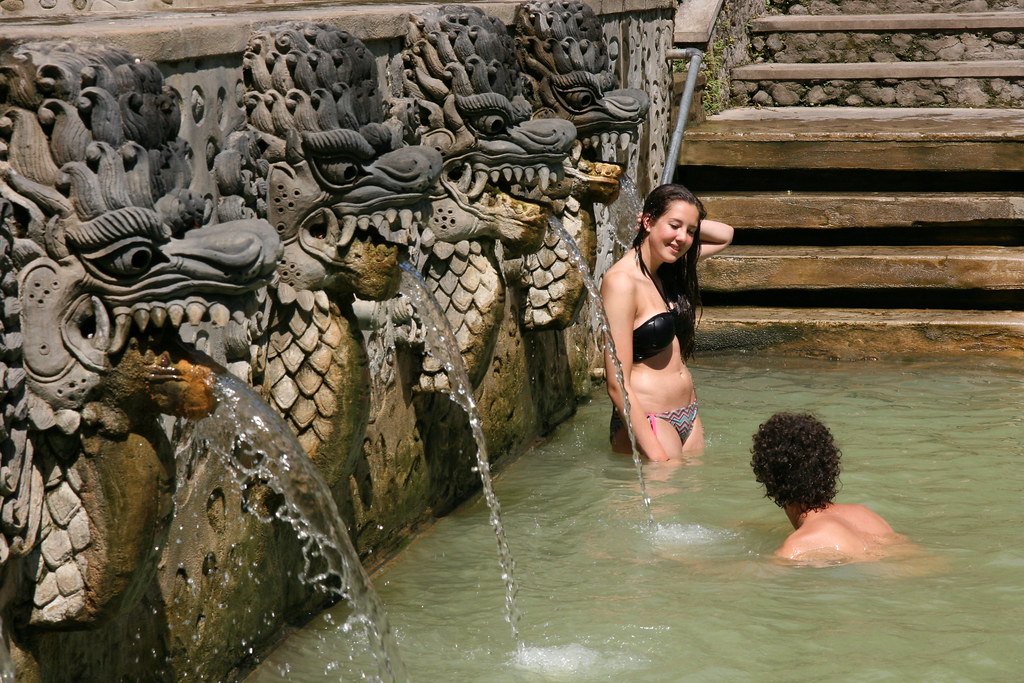
Above Bali's Angseri hot springs with a waterfall as backdrop, below a geothermal hot mud bath in South Vietnam.

Binh Chau Hot Springs. Горячие источники "Binh Chau" #вьетнам #турыизвунгтау #экскурсииповьетнаму #горячиеисточники #минеральныеводы #лечебнаягрязь #путешествия #туризм #vungtautravel #binhchau #hotsprings #mud #travelling #relaxation
Crossings
Hot Springs Krabi #hotsprings #krabi #travel #thunderstorm #thailand
Thailand always haves a perfect hot spring just waiting for you; above near the southern tourist hub of Krabi. Following another agreeable hot spring in the for Thai famous hot spring town of Ranong, though not so many foreign tourists visit.

To wrap up the chapter slightly further afield in Taiwan a more rustic experience 9and locally popular) from Wulai.
 
น้ำแร่ร้อน น้ำเย็น น้ำแร่ร้อน น้ำเย็น วนไปครัช #งานลงน้ำด่วน #บิ้กซีมีทุกอย่างที่ระนอง #เจ้าบ้านบอกต้องลองเองไม่งั้นจะขายของไม่ได้ #TacB #onsenranong #onsenthailand #ranong #thailand #blumonkeyhotels
#hotsprings
More fun
This chika galor moment while in the hotspring. I wanna go back @suecorleone 😭💦🙈👙 #hotsprings #pulangbato #redrockhotspring #itsmorefuninthephilippines #travel #byaherangseth #bucketlist 💯✅💋👣
Besides Thailand, both Indonesia and the Philippines are jam-packed with hot springs. Malaysia (the last photo in this paragraph) is less so fortunate, though the Banjaran is probably top-notch though also possibly overclassed ...
 
 42 Grad und es wird noch heißer! 🌞🌋 #hotsprings #therapeutic #neverstopexploring #Cebu #Visayas #Philippines #Pilipinas #itsmorefuninthephilippines #globelletravels #bisaya #Urlaub #Sommer
♨️ #birthdayretreat #banjaranhotspringsresort #hotsprings #ipoh #malaysia
Forests
Finishing off with a couple of Indonesia's forest hot springs.
 
Vai di terme... #hotsprings #malanage #bajawa #nusatenggara #timur #indonesiantour #selfie #flores #likes #beardedman #holiday #gopro #inked
Family outing on a hot springs #nature #forest #tropical #river #hotsprings #mataair #hutan #sumatra #indonesia

Sunday, 8 September 2013

Development blends

Norm
What's always intrigued me as how bathing customs differ, how they evolve and how current culture seeks to cope with the differences and the outer world trying to influence local culture. 

However, with the lessening of cultural and social diversions, traditional bathing cultures are increasingly threatened. 

Unfortunately the Southeast Asian bathing culture is a modernist one which with elitist overtones has regarded au-naturel bathing as backward and laughable. However the last laughs I believe are of those fully clad snobs who must feel tremendously uncomfortable. Or not?

But internationally, in the bathing custom discourse it are the anglo-saxon wannabe star cultures which are pushing their agenda however unknown. 
For instance, many a blog entry on Japanese onsen reflect on the backwardsness of naked single-sex bathing. 

Which raises the question why travel to a foreign culture at all, if you disapprove?
Others express fear of the unknown, but find out that it's actually a pleasure and become life-long converts. Southeast Asians, while radically opposed to disrobing, will do everything to blend in, however opposite it is of their own culture (remember in Singapore private nudity is even forbidden). Alas, their voices are often too meek in the current day internet overload. The same goes for us Europeans who have less binds either way.
Back in July I visited two hot springs, one in Aachen (Germany), one in Holland (Thermae 2000). In Holland it was a costume free day, which 99% happily enjoyed, whereas in Germany a beautiful part of the springs was suit-free. Not many have qualms about the lack of dress. But that said, overseas guests are at minimum and when researching internet the English language responses are often filled guilt / shame ridden. 
To me simple nakedness is purposeless (we are bathing after all), but it leads to increased self-esteem, self-confidence and acceptance of nature.

Sheepish
Here are some recent examples of au-naturel bathing experiences by you. First by Irreplaceable, from Malaysia (July 14) enjoying an experience in Korea:
'Yeah, the very first time getting naked in public with two of my girlfriends. If you never have such experience before, this might sound so awkward for you, am I right?
In fact, I had been struggling for so long whether shall I try this nude hot spring. For me, it is just so embarrassing to appear in front of strangers without wearing a single piece of cloth. But after all, I decided to try it. How brave am I right. Bravo. To make you clear, it is a hot spring only for girls. Not mix one okay.
...
Miss that wonderful hot spring soaking moment with my girls. Wish to visit other nude hot springs of another country next time LOLOL. Don't think I am crazy okay I am not. Come on. Don't be shy. You all must try it if you all have a chance. That gonna be a very unforgettable memories I promise. :D 
Peace'.
Peace to you too. Then Big on trips from Singapore in Japan (July 21):
'I started out a bit self-conscious and sheepish about the whole thing. But having the husband in the same bath made me feel more comfortable. It helps that the baths are also sprawling so you can easily stake out your own little nook where no one can see you. After a while, you just get used to seeing everyone’s bits and realise that man or woman, it’s just a different anatomy so no point getting the knickers in a twist about it. Plus if you go as a couple, it is nice to be able to enjoy the onsen together'.

There is the odd exception and some are written with great wit. Take Joann from the USA in Japan (August 12):

'So it was that Diane and I, two fairly well-endowed women, stepped outside, naked as the day we were born, whereupon we made three crucial discoveries: we were the only Gaijin (foreigners) at the spa, the resort was co-ed, and the two of us were missing one small, but essential item. Every Japanese person we encountered, and 99.9 percent of them were of the male persuasion, was holding a small hand towel the size of a wash cloth, over his genitals.
Diane and I were not just naked. We were beyond naked. We were Über-naked.

Had we missed the warning sign in the locker room: “Please remember, don’t shame Buddha, all of the Shinto deities and the memory of hundreds of generations of your ancestors by stepping outside without your little washcloth?” Or perhaps there was no sign because the Japanese are born holding these tiny cloths as they exit the birth canal?

Desperate to cover ourselves, Diane and I crisscrossed our arms over our bodies. With our hands hovering ineffectively over our nether regions, we darted to the nearest hot spring for cover. The dark gray, mineral-laden water conveniently covered our nudity, and thankfully, we were alone.
But not for long.
Apparently, word of the two, too-naked, big-breasted American women, had spread like wildfire throughout the spa. Suddenly, dozens of extraordinarily friendly men, also unclothed, but of course with the obligatory washcloths, joined us in our pool. I did my best to fend off the many overtures from these interlopers who floated dangerously into my personal space, trying to chat us up. The Japanese love nothing more than to practice English, but the last thing I wanted to do was encourage naked fraternizing.
After a few minutes, I noticed that I had begun sweating profusely from the intense heat. After fifteen minutes, I felt nauseous.
I knew that I had to get out of this bubbling caldron, but escaping would have required climbing up a three-foot ladder to exit the pool, thereby providing a front-row view of that to which only gynecologists and lovers should be privy. My mind, which was now melting along with the rest of me, struggled to reason that I was thousands of miles from home, and the chance that I would ever see any of these men again was infinitesimally small. But I couldn’t bear the thought of baring my undercarriage, free of charge, to this rapt group of strangers. Diane agreed, so the two of us waited it out with a steely determination that would have impressed any prisoner of war.
One by one, our fan club left, and finally, we were alone, once again. We quickly made our getaway. Like two boiled lobsters plucked from a pot, steam rose off our crimson bodies, as we climbed out and once again scurried for cover to the nearest pool.
And so it went.
We spent the rest of the afternoon sprinting from one hot spring to another until we came to the last one of the day. Divided into three sections, each about the length and width of a bathtub, Diane and I chose adjacent pools. As we stretched out, we discovered that the water was only a few inches deep, so our entire torsos were completely exposed to the air.
We sat up and struggled to reposition ourselves to find some cover. A moment later, a man in a deep pool next to ours who had witnessed our thrashing, floated over to us, stuck his foot out of the water and pointed at it. It took only a moment to realize that Diane and I were lying in the footbaths—a fitting end, I suppose, to an altogether much too naked and humiliating day'.
In an overview of current day nudism in China (which 'reveals' a few hot springs where nudity may or might have been common practice). From nakedhistorian (August 8):
'Whilst there is very little nudism amongst the dominant Han Chinese, there is more tradition of nudist activity amongst China’s minority groups, especially down south.
...
In western Yunnan, the De’ang tribe bathe in the Imperial Hot Springs whose waters are rich with coal and salt extracts. We’re not entirely sure how they’d feel about foreigners stripping down and hopping in alongside them, but if you ask nicely, the chances are they’d clear a space.
The Mosuo minority believe in the disease curing properties of their local water, so they frequently bathe naked. During the Cultural Revolution, the government built walls across their pools to segregate men and women, but the Mosuo tore them down soon after. The pools were opened to tourists in the 1990s.
A little further north in Sichuan Province, nudism seems to be all the rage. Chongqing Girls Nude Bathing Area;sounds more like the title of a dodgy DVD, but it’s actually an area set aside for women in the Ba’nan District’s tranquil East Spring Village. The pool has been in use since the Ming Dynasty, and its water is said to cure blindness. If you fancy a dip, you’ll be pleased to know that it’s open to tourists. Female ones'.
A Thai in Japan (Nation, August 28): 
'Most of the skiers in Niseko spend their off-piste time in the Onsen. The Green Leaf Onsen stands out as one of the most beautiful natural rock pools in Niseko. The Onsen has separate indoor and outdoor pools for men and women with the water source originating from mineral spring.
But stripping off my clothes, soaking in hot spring with other men and watching huge flakes of snow swirling down, doesn't turn me on. I decide instead to occupy a bar stool and exchange words of wisdom with the bartender though I do agree to take a side-trip to Otaru and Yoichi'.
That's despite visiting onsen is no. 2 of Japan's Top 5 (Lonely Planet, Sept 8).

Blending in. In Uganda I believe (source).

Geo-spirit
Thinkgeoenergy (July 12) has an article by Jon Cheetham who can not understand why Indonesia is not embracing geothermal energy more whole heartedly:
'As my proof, take a look at PT Supreme Energy, who just received approval from the Rajabasa indigenous people to explore for geothermal resources in Lampung. What it took was frank information and compromise from Supreme Energy chief Triharyo Indrawan Susilo, who informed the Rajabasa of the minimal environmental damage to be feared from geothermal exploration, and promised to plant double the amount of trees that have to be cut down. How is that for a truly admirable renewable spirit? That was all it took; now Bp. Triharyo gets to go ahead with his project hoping to make himself and his employees successful, and the Rajabasa have nothing to fear for their environment. Everyone wins. The country wins. This generosity and openness is the attitude that is needed'.
In New Zealand they fail to understand why the Chinese would want to invest in geothermal energy in the already saturated energy market in NZ (Thinkgeoenergy, July 1). But also at stake is New Zealand nationalism:
'Overseas Investments Office, so the news, has just approved the deal, but it immediately receives criticism. ”Power is a critical component of any economy,” says New Zealand First leader Winston Peters. “To give away its ownership and profits to a foreign interest is not capable of being explained away.”'
In Italy opposition is growing towards the proposed Amiata Bagnore 4  geothermal plant. From Smartplanet (August 8): 
'He [Andrea Borgia, a geologist and volcanologist who works in the Italian High Commission for Environmental Impact Assessment] opposes the new plant because, he says, geothermal fields have already dropped Amiata’s water table, increasing the concentration of naturally occurring arsenic. What’s more, Borgia says that Enel is releasing carbon dioxide and other pollutants such as hydrogen sulfide, ammonia and mercury into the air — and that it doesn’t have to. (Of the geothermal fluid extracted at the plant, only a quarter is re-injected into the reservoir, and the rest, containing these pollutants, is released in the form of vapor.)'. 
All-in-all it's a very complex issue and it seems both sides have the truth on their side. However: 
'She [Adele Manzella, a geophysicist and researcher at the National Research Council] believes the controversy stems from the residents’ lack of trust in Enel and local policy: They did not solve air pollution problems in the Amiata area for a long time, creating bad publicity that is fueling suspicions about the drinking water.
Unfortunately, Manzells says, there is no conclusive evidence as to whether the geothermal work is affecting the level of the drinking water, and a study will take years: “It is a matter of debate, and people there do not know what to believe. It is left to the opinions of the people or scientists or other experts having one interest one way or another.”'
Then we already discussed dual use systems, as proposed for in the Philippines (source). Thinkgeoenergy has an article (August 12) on the Icelandic success of dual use. But that's not all: 
'While the Blue Lagoon remains the top tourist spot in Iceland, the power plants – all can be visited – are among the most visited tourist attractions in the country'.
Malaysia hopes to get it's first own geothermal energy as of 2016 (Thinkgeoenergy, August 8): 
'The power plant at Apas Kiri, would be the first renewable and sustainable project of its kind in Malaysia, with power to be sold to the Sabah Electricity Sdn Bhd (SESB) grid. It was originally scheduled for completion in 2015'.
Apex
Ever heard of the Global Spa and Wellness Summit? Well, the upcoming 2013 meeting slated for early October 2013 set for New Delhi hopes to attract hot spring operators and leaders to discuss soaking issues: 
'According to co-organizer Charles Davidson, from Peninsula Hot Springs in Australia, the Forum will include presentations and open discussions on how the best hot springs operators in the world’s most competitive markets build profitable spa, bathing and accommodation businesses; which evidence-based studies in hot springs bathing practices provide proof of the health benefits of hot springs; and the various ways cultures utilize natural hot water for health, wellbeing and community happiness.
Participants will also jointly explore ways the global hot springs industry can work together in marketing, research and development and on philanthropy projects to bring hot springs bathing facilities to communities in third-world countries'.
The press release certainly pushes the right buttons and this initiative is to be applauded. What I have my doubts about, is the insistence on commercialism. Little is done to preserve, protect and allow enjoying hot springs so how hob-nobbing with the rich will enhance this remains a question mark.

More in depth soaking enthusiasts will be looking at:
'On the table for discussion:
  • How do the best hot springs operators build profitable businesses? 
  • What are the key evidence-based studies supporting hot springs bathing practices? How can they be promoted better? 
  • How do global cultures use natural hot water for health, wellbeing, and community happiness? 
  • How can the global hot springs industry better work together in marketing, research and development? 
  • Are there joint philanthropy projects that can bring hot spring facilities to third-world communities? '
Tellingly there is yet to be a sponsor for this part of the programme .... 

Especially in China, hot spring development is taking on a commercial dimension unbeknown to traditional soakers. Take the doughnut hotel (Yahoo, July 20):
'It's a hotel Homer Simpson could love.
China's Sheraton Huzhou Hot Spring Resort's deliciously shaped oval design looks like a giant doughnut. The building, dubbed the "horseshoe hotel," opens next month in the town by the same name, Huzhou'. 
Though it names itself a hot spring hotel it's own web site is conspicuously silent on what it entails.

More high end development pouring in. Banyan Tree Chongqing is receiving it's first guests (Breakingtravelnews, September 6): 
'Nestled within the new Banyan Tree Chongqing Beibei, the first international hot spring resort in Chongqing, the resort embraces the natural healing waters of the North Hot Springs'. 
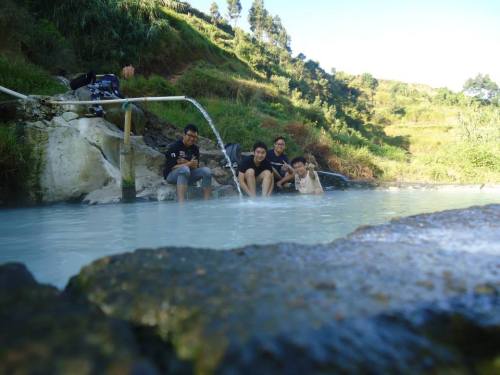
Dieng plateau, Java, Indonesia. From My Journey keeps Inspiring.

Mostly unhopeful dreams 
  • Brunei
Brunei is eyeing yet again the development of a remaining hot spring. Read what the article (mysarawak, July 30) thinks is the good news: 
'Second Minister of Resource Planning and Environment Datuk Amar Awang Tengah Ali Hasan said lessons could be learnt from the Republic of Czechoslovakia, which managed to turn a valley with a hot spring into a renowned medical tourism attraction.
“Tourism is a money spinning industry, and it can provide employment and economic spinoffs. Czechoslovakians used their creativity and innovation on the valley, which now contributes to their national coffers,” he said at a Sarawak Energy Berhad (SEB) gathering in Hotel Seri Malaysia to present Raya goodies to orphans, the disabled (OKUs), and single mothers over the weekend.
Awang Tengah said Lawas had great attractions in the Merarap hot spring and Mount Murud, the highest mountain in Sarawak'.
'Indigosix outing! Yipeeee ...'
West Bali, Indonesia: Menjangan hot springs. Source: nininathania
  • Laos
Hot springs are increasingly becoming popular says the Vientiane Times (July 19). But is this the start of the end?
'The house's rooms will be built as many visitors like to bathe naked in the spring; however, visitors are required to bring a large towel to cover themselves when they emerge from the water. Bathers say they feel healthy after they finish and walk out of the bathrooms at the hot spring.
Since the bath opened last year, visitors there are mostly Lao people. Mr Phouvanh added about 40 foreign tourists per month have visited the hot spring to relax in the refreshing water. The cost to use the bath is 5,000 kip for a foreigner and 2,000 kip for a Lao person.
The department has received funding from the state to build a bathhouse and a souvenir shop at the site'.
It's bye-bye to this?
'For many local people, the spring is even better than a regular hot shower – while they have electricity installed in their homes, most still head to the springs for the traditional experience.
The local community often prefers to bathe communally in the hot spring before turning in for the night and again before breakfast'.
Then on the 25th of August, the same source mentions finding a new hot spring:
'Zone Administrative Office Head, Mr Somphone Southam, said a group from his office visited the hot spring at Poungloc village earlier last week on an unofficial trip, and discovered the spring was the biggest any of them had seen in the province.
“The spring boiled in the middle of a stream in the centre of the village; it bubbles hot water to a height of about 40cm while the stream covers the entire area,” he said. Mr Somphone said a local official had told him the village was located near an ancient volcano, which explained the hot spring activity'. 
Obviously, authorities want to develop the site ....


Viengthong hot spring, as it is.
  • Malaysia. 
Another nail in the coffin for a yet to be well visited hot spring? Metro online broadcast Malaysia (21 August ) reports
'AMONG hot springs in Hulu Selangor, two are already well known — Kerling and the Hulu Tamu hot spring in Ulu Yam. 
However, a third hot spring is begging for some attention. It is located in Jalan Ariff 12, Taman Ariff, Kuala Kubu Baru.
Although the hot spring was discovered almost 10 years ago, it remains a well-kept secret among locals.
...
Last year, the Hulu Selangor District Council (MDHS) beautified the area by covering the dirt road to the area with gravel, building a small concrete pathway, and a few seats. However, there are still no toilets and changing facilities.
MDHS’ aim is to make the Kuala Kubu Baru hot spring an international tourist destination'.
  • Philippines
Asian Correspondent (September 2) visits Manquinit hot springs, Coron islands, the Philippines: 
'... reputedly one of just two saltwater hot springs in the world'. 
Not really good research. A simple google search will lead you to f.i. the Zhaori Saltwater Hot Springs, Taiwan. It's 
'This is one of only three saltwater hot springs in the world along with the springs on Kyushu Island of Japan and Sicily in Italy'. 
But no Manquinit. Or what about Mount Mangunui, New Zealand? Triton Bay, China?

   
Who knows this hot spring in Chaiya, Thailand?
  
Further afield. The Secret of India website lists a couple of Indian hot springs.

Thursday, 20 December 2012

#socialsoakingsilently


Social media

Love it or not, social media is increasingly becoming a feature in our lives. 
And how about (social) soaking? 

Well, you are of course all familiar with the Facebook page of Soaking in Southeast Asia. Besides this there are many other hot spring Facebook pages, mostly dedicated to just the one soak. Particulary active are the U.S. Facebook pages of Cougar, Deep Creek and Pah Tempe. Beyond these though there's no much on offer, surely no regular original content. 
Certainly not in Southeast Asia. Or is there? (Note, there are many Japanese language hot spring pages ...).

Twitter? No idea.

Pinterest? What about this one, I Love Hot Springs? Personally, I don't get Pinterest ...

Soaking spirit, my alter ego on Tumblr, seems to be the globe's choice of tumblr soakers. There are though a few more solely dedicated to hot springs, but with very irregular postings ...

Instagram seems to receive quite a lot of photo's concerning nextgen soakers, just use the search function followed by #hotspring.

Surging ahead
Ongoing drama. The CS Monitor (Nov. 5, 2012) questions nuclear or geothermal for Japan. 
'Located nine miles southwest of Fukushima city, Tsu­chi­yu is launching a bold test in harnessing the potential of Japan's huge subterranean reserves of volcanic water.
By spring 2014, Tsuchiyu hopes to be generating 250 kilowatts of electricity – about a quarter of its total needs – at a new geothermal plant located on its outskirts'.
The Financial Times (Nov. 4, 2012) then has an article on the same theme, but concerning Indonesia. It notes many regulatory and technical shortcomings but remains upbeat:
'As the world’s most volcanically active country, Indonesia has been bestowed with unparalleled potential reserves of geothermal energy, which is renewable and produces almost no carbon emissions.
With the Indonesian government trying to fulfil surging energy demand while reducing carbon emissions, it is keen to accelerate the development of a raft of proposed geothermal power plants backed by local and international investors'. 
Though it highlights the dilemma between soaking and electricity generation in Japan, it neglects the issue in Indonesia. Is there no dilemma in Indonesia?

Apparently not, Japan's Sumitomo completes a 110 MW plant on Sumatra, Indonesia: 
'Located in the Ulubelu district, Tanggamus county in Lampumg Province at the southern tip of Indonesia’s Sumatra Island, the Ulubelu power station was built as the first large scale geothermal power generating facility on the island'.
Malaysia is developing it's first geothermal plant, to commence in two years. What the future entails
'In addition, to enable access to the project site and transport drilling rig, plant and equipments, an access road of approximately 18km in length, including 3 bridges, need to be constructed'. 
Soakers need not apply.

Meanwhile things are going so smooth on Leyte, Philippines: 
'Several groups have joined forces to oppose the sale of the unified Leyte geothermal plants on Leyte, Philippines. This is based on the fear of increasing electricity prices for the single most important power plant complex in the country'.
Just (or unjust?) politics then...

Create your own?
  • Malaysia
A new find, Kampung Bongkek, Negiri Sembilan, Malaysia. From the New Strait Times (21 Oct., 2012): 
'The hot spring can still be seen today, right by the river bank and  with shrubs growing around it.
Basri said there were suggestions and efforts to develop the hot spring to attract more tourists to the village, in view of its history.
“However, the land belongs to someone who is not willing to give it up yet so we have no right to develop it”'.
Yea!
  • Singapore

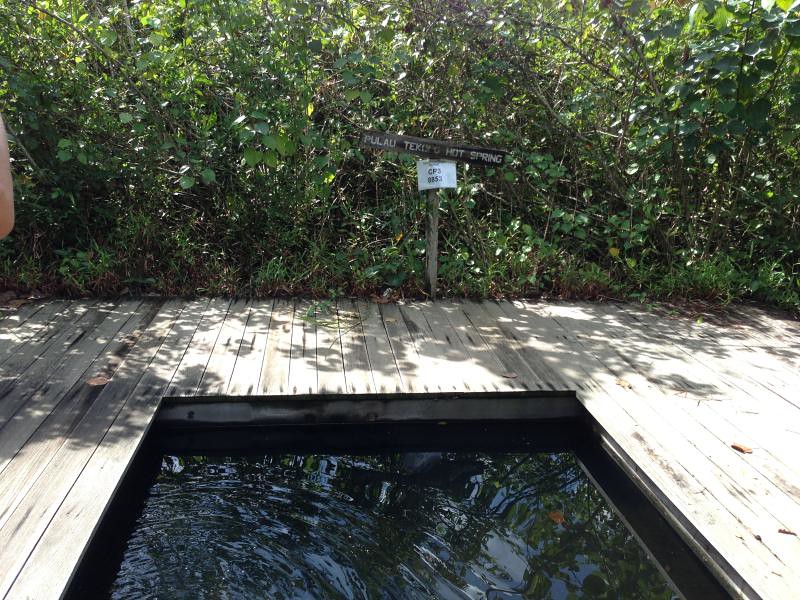
'Tekong Hot Spring'.
Singapore. From flickr member chia_alfred
  • Indonesia
Another write up on Angseri hot springs, Bali, Indonesia. It adds this: 
'The natural attractions in Angseri Hot Spring used only as a traditional bathhouse. Starting from the strong desire of local communities to manage the hot water source and on the idea of ​​thinking Angsari six villagers in October 2007 where it was built and opened to the public a comfortable bathing area. Furthermore formed groups totaling 80 people and brought the name of the citizens Angseri Group Is Nature Angseri with legal forms CV'.
Another Angseri experience:
'Each cabin contained a stone bathtub, large enough to seat five people. A black-and-white checkered cloth covering the lower part of the bamboo walls allowed some privacy to soak in the invigorating, clear water that was hot enough to render my friend’s skin as red as a boiled prawn'. 
The same author also condures up the following on the hot springs of Tempuran, Wonosobo: 
'The first ponds weren’t exactly located in Wonosobo, but in a similarly blessed district on its west:  Banjarnegara. The hot springs were scattered in a neighborhood called Wanayasa, and together they form a bathing compound called Tempuran.
Please be warned that you shouldn’t go there at night, the way we foolishly did. We gambled with our lives when thick mist suddenly blanketed the hills and we had only about a five-meter field-of-view of the road, kind of like in the horror movie Silent Hill. All the while a deep gorge was on one side of the path we traveled on our motorbikes. My ex cried and begged to go home. But we soon forgot the terrifying time spent on the route from hell once we got to Tempuran.
...
Tempuran has different ponds for males and females, but the last two don’t. Women and little kids usually go there earlier than the men. To give you a heads up, most people bathe naked in all of these ponds'.
'A hot springs pond in Tempuran late at night. Cold and traumatized, we quickly jumped into it as soon as we arrived. Photo by Indra Nugroho'.
And steadying the nerves. Can anyone tell me why the need to smoke?
  • Thailand 
Sometimes soaking news can be very special: 
'Occupiers of a row of rented apartments in Huay Yai Village, located on the southern outskirts of Pattaya [Thailand] reported the possible discovery of a geothermal hole situated at the front of one of the apartments on Wednesday afternoon.
Although highly unlikely, officials from the Pollution Control Department, the Department of Natural Resources & the Environment along with Huay Yai Municipal Officers led by the Mayor of Hua Yai made their way to the block of rooms to see for themselves the hole which had been created by locals to uncover the hot undersoil which was producing steam.
A thermometer recorded a temperature of 50C inside the hole and a demonstration involving a Chicken egg took place whereby it was cooked and ready to be consumed in under 20 minutes after being placed inside the hole. Checks were made and an explanation was given by officials who blamed poor installation of electrics and the rise in the water table due to recent rains. We were told that checks on the electrics installed in the rooms, which were constructed 4 years ago, indicated a leak of power into the ground which accounts for the occupiers unusually high electric bills which, up until now, could not be explained. As the water table rose it came into contact with the leaking electric causing the water to increase in temperature and evaporate which produced the steam and made the ground warm under-foot'. 
Can't believe it's true ...

Is there a post 21st?
What will the future look like?
'Tongjing Hot Spring Resort will start construction at the end of 2012, planned to be completed in March 2013, after which it will become a tourism highlight in Chongqing, the hot spring capital of the world, according to Chongqing Municipal Government on November 5, 2012.
Covering 342 mu with an investment of 1.28 billion yuan, the Resort is located in Tongjing Town, Yubei District, Chongqing. It will be built in accordance with the national 5A standard with a capacity of 1 million tourists. The hot spring center covers an area of 75 mu, including an indoor hot spring center and a outdoor park, able to hold 2,500 persons'. 
Hope not!

Sunday, 14 October 2012

Sulfur, Siam & self-indulgence

Not much self generated news this time, so let's go to the regional soakers press:
The Jakarta Post (12 Oct) has a feature article of the hot springs at the foot of Gunung Sibayak on Sumatra (Indonesia), previously highlighted on this site. The village of Semangat Gunung counts 9 commercial soaking sites and according to the article can 
'remove dandruff'. 
Also noteworthy: 
'Sulfur powder is obtained by sieving sulfur water after being laid exposed for one night. It is sold at the price of Rp10,000 (US$1.04) for three packs. Many tourists buy the powder. Sugiran, a tourist from Medan, was one of the visitors buying the powder. He said he had taken a sulfurous bath for the first time and was interested in applying the powder to heal his skin disorder. “The rash on my body will hopefully be cured by this powder,” added Sugiran while soaking in a pool'.
Bathing in Borneo
 The local Post reports (9 Sept): 
'The hot spring at Kpg Panchor Dayak along Kuching [Malaysia]- Serian road recorded 15,076 visitors in the first eight months of this year'.
That's 60 a day for recently improved springs. 
'The Mambong MP [Deputy Tourism Minister Datuk Dr James Dawos] advised the village chief to request for parking space from the local council and electricity to be connected to the area. He said his ministry was willing to help'.
Hmmm, lets not hope it's a road to ruin. 

A very neutral review of Southeast Asia's most popular hot spring, Poring, with the addition of this: 
'If you are shy to bath in public, you can pay a little more for the private room located in the cabin behind the hot spring. Each room can accommodate two people. Remember to bring your swimsuit as you are not allowed to get naked in public in a Muslim country...'. 
?

Thai Tales
Travel Thailand has an entry on Thasatorn hot spring, Suratthani, Thailand. Some nice pictures, other not much to add to the Soaking in Siam blog entry. Travel Thailand does have an entry on the hot spring of Samet, Chaiya, Suratthani: 
'At Tambon Samet in Amphoe Chaiya, Surat Thani Province. away from Amphoe Chaiya about 4 kilometers hot springs is holy water. consists of two small caves and two natural hot spring'
Again. nice photo's.

Sai Ngam hot spring, Pai, Mae Hong Son province, Thailand. 
Photo found on picasa site of Ka zu. Apparently this hot spring is a tourist destination waiting to be discovered with a few tourist bungalows present.


By the way, Soaking on Siam has once more an overview of press clippings on the newly opened Yunomori onsen, a natural hot spring bath house in the center of Bangkok. Most comment on how outlandish the Japanese bathing culture is towards the conservative Thai society (as well as that towards the anglo-saxon reporters backgrounds), though they note that many Thai join in. All glowing repotrys (not only literally ...). 
I have two questions, one about the source of the water and the need to keep the water sanitary. And the other weather this may prove to be a new trend in Siam soaking, set to be replicated by the copycats (I WISH)?

Meanwhile in the Phillippines, an individual is doing just that ... 
'It was deserted but not closed. I was the only guest that day. Perfect for skinny dipping which I did!' 
Looneyplanet visited the hot spring of Baslay on Negros. And enjoyed it, despite the absence of crowds. Or because there were none ...

Otherwise
An interesting side theme. Ahave, an Israeli cosmetics company has been accused of war crimes by mining Palestian-owned resources: mud. The company response: no comment. Report by Sydney Morning Herald (4 Sept. 2012). More info on the controversy on Wikipedia.

Geothermal news: this time it is the New York Times (Oct 1) which picks up on the discussion in Japan on whether or not to promote geothermal energy generation.
'Then came the Fukushima disaster.
In March, the government lifted its decades-old ban to allow geothermal projects in five new potential sites in national parks and monuments to go ahead, under strict oversight.
Tightly regulated or not, that decision has inevitably caused tension between conflicting local business interests, environmentalists and geothermal energy developers. In Yuzawa City, for example, existing and prospective geothermal power generation facilities typically are close to the hot spring resorts.
...
Mr. Sakaguchi, the researcher at the industrial science and technology institute, said he understood the concerns of Oyasu’s onsen innkeepers.
In two known cases outside Japan, geothermal power developments have caused hot springs to dry up, he noted. One such case was recorded in the 1970s in Steamboat Springs, Nevada, he said.
Still, “a clear case of geothermal development causing a hot spring to dry up has not occurred in Japan,” Mr. Sakaguchi added. “The technology to pick up underground movements and simulation technology has really improved in the last two decades, so the risk is much lower.”
It typically can take 20 years to develop a geothermal plant, if only because it takes time to earn the trust and cooperation of local people, Mr. Sakaguchi said'.
Elsewhere a review of Japan and renewables mentions this: 
'Even geothermal, touted as a vital energy investment in Japan given the country’s abundant hot springs, is facing a battle with local resorts – the Kusatsu Hot Spring Resort association, on Kyushu island, announced opposition to developing the clean energy for fear that the precious mineral hot springs would decrease in supply'.
Meanwhile other nations are less restricted by the soaking set. Vietnam announces a project to come online at the end of this year.


'Thai Drama,
Chiang mai
San Kamphaeng Hot Spring
Thailand

NEX 3 , SIGMA 30 , MEIKE box (water/dust/sand proof )'
Found on flickr, posted by setsunalee

Wednesday, 13 June 2012

Spotlight

Two entries already on European hot spring visits in the European Natural Soaking Society. More to follow.

Topical
Hot on the heels of the last update's weird and wacky hot spring and sauna experiences come's Estonia's sauna car! Follow the link and watch the clip.
I do not know if this applies to the sauna car, but in Japan you can visit a hot spring and earn airmiles!

Regional
Seldom do we see such good work in (re-)seeking hot springs in Southeast Asia, most prefer the over-trodden paths. However the blog entry 
'Unearthing Timor-Leste's Hidden Gems - Marobo's Natural Hot Springs 
by  Barry Greville-Eyres and Francisco Carlos de Araujo is a real gem by itself: 
'On a short descent we encountered ruins and remnants of what was supposedly spa or resort styled accommodation, at a picture-perfect location, surrounded by a labyrinth of ridges and valleys. Despite conflicting reports on the origins of the development - some sources attribute it to Japanese occupation forces during WWII (1942-1945) others to the Portuguese colonial occupation-era pre-dating WWII - its highly likely that local Timorese villages were instrumental in the construction of the associated infrastructure.
Much toil and backbreaking effort must have gone into the construction of the access road; distinguishable accommodation units; hundreds of metres of retaining walls; hot water diversion, distribution and drainage systems; the main bathing pool (approximately 25mx15m); an ablution facility and individual external mineral or mud baths.  Although the facility is now clearly abandoned, it still remains an important part of Timor-Leste's natural heritage and a potential drawcard for both domestic and international tourists'.
 It also lists a short overview of all Timor-Leste's hot springs. 

'A parting shot of Marobo's natural hot springs - 
yet another of Timor-Leste's hidden gems'.
Foreign control? Locals in Sabah state, Malaysia are worried that their natural wonders are being privatized. 
Always this never ending story: private ownership of public lands results in entrance fees / profiteering possibly exclusion of certain groups of persons (based on income) or public control by public organisations which (in Malaysia) don't seem to be interested in the public interests. The essence of the freemalaysiatoday article (7 June 2012):
'Ranau STAR division chief, Jalibin Paidi, said the transfer or takeover of the management of money-making Kinabalu Park or parts of it as well as the popular Poring Hot Spring near here had become a hot topic among people in Ranau and they want to know the truth'.
More worrying is the emphasis on foriegn control as if this makes non-public control worse ... 
Note also that the article mentions that all of this is rumour, hot air thus ...

The mud baths of Thap Ba (Nha Trang, Vietnam) now have a local competitor / imitator. Read more on the Thap Ba Soaking in Southeast Asia entry.
In the same area, Waterfalls of Southeast Asia reports that the famous Yangbay waterfall park, will soon expand, to include a (natural) hot spring ... 

Meanwhile in Los Baños, the Philippines, the gamble is on big-business tourism, so states inquirernews (30 May 2012): 
'The master plan also includes setting up a cable-car system along the Makiling terrain, rehabilitating the heritage sites in the town’s poblacion, and renovating the local spa and hot spring resorts'. 
More of the same thus?

Another entry on the Pinatubo hot springs:
'According to tour organizers, most of the resort’s clients are foreigners, with Koreans in the majority since it was developed by a Korean investor married to a Filipina. The resort also provides employment to indigenous Aetas, the original residents of the area, who were displaced during the volcano’s eruption.
With smoke billowing out from mountain crevices, natural pools and waterfalls sprouting from the dry earth, and oddly-shaped geologic formation, the terrain looks almost prehistoric.
It’s almost surreal to see modern amenities instead. Like in most developed resorts, there are several bathrooms and changing areas near the pools, with alert attendants handing out fresh towels to newly-arrived guests. Picnic huts, paved stairways and cement banisters made to look like wooden logs, have been carved from this mountain of stone and soil.
I dipped my foot gingerly into one of the hot pools and immediately retreated as the heat pierced through my skin. I moved to another pool where there were more people and found it relaxing in a feverish sort of way. Beads of sweat broke out on my forehead as my body slowly adjusted to the temperature. The heat of the pools really seeped in and soothed one’s aching muscles in no time'.
A great entry on an as-of-yet not-on-this-site-listed hot spring: Bogyah hot spring, neatly nestled in the Hapao rice terraces, Luzon, the Philippines. A great blog entry:
'When we got to Bogyah Hot Springs, there were locals relaxing in the hot spring. I did not mind, this was their place and I was happy that while dipping on the hot pool I get to know some bits and pieces of their life'. 
Note end line: 
'Let us not change Hungduan [where Bogyah is located] , let it change us'. Too ture.
Travelfish have added a section on the Dieng plateau, Java, Indonesia: 
'The main attractions in Dieng are the numerous temples and the geothermal area around Kawah Sikidang'.
Less local
More money being thrown around (or away?):
'GOCO Hospitality is working with Sanli Guo Yuan to develop the Xiangshan Hot Spring Wellness Center, a 6,000 sq,m. facility with an onsite natural hot spring, located 30 minutes outside Ningbo, China'. 
The cost will be only $US 25 million. For this: 
'The Xiangshan Hot Spring Wellness Center will offer exceptional wellness programs that are results-oriented and address the health concerns of the modern Chinese consumer—beauty enhancement, weight loss, detoxification, stress relief and ageing well. Benchmarked against leading thermal facilities internationally, Xiangshan will set a new standard in design aesthetics and service quality, seamlessly blending Western and Eastern wellness modalities'.
 Continuation of soaking vs geothermal energy dilemma:
'... opposition from local hot spring operators is stalling proposed large scale geothermal development in the Prefecture of Fukushima'. 
So reports the thinkgeoenergy.com last month. Seeing how the nuclear plant nearby which should be one of the most regulated industries went haywire, how is one top believe assurances from companies? Take for instance a recent entry on the soakersforum which mentions hot springs being sucked up ...

More  energetic activity in the region. $11.5 have been allocated to the Tawau, Sab ah, Malaysia project, no soaking opportunities? The Leyte, Luzon, Philippines geothermal plant will cash in (read privitize), with global energy prices at a remaining all-time high. Then there is news on Sulawesi (potential) and elsewhere on the Philippines (Kalinga).

Banjar hot spring, Bali, Indonesia (source)
Related Posts with Thumbnails
Copyright 2009 © Soaking in Southeast Asia. All rights reserved.
No reproduction or republication without written permission.