Showing posts with label Facebook. Show all posts

Sunday, 2 February 2014

Best Practice

Personal
With the gradual expansion concerning my personal experience on hot springs and the ever growing know-how of hot springs themselves, I have been thinking about how can we add additional original content to the experience concerning natural hot springs soaking, the (bathing) culture involved and the increasing need for conserving the few natural hot springs remaining?

One idea is to make conservation, natural bathing and cultural awareness a recurring theme in these posts. Witness past updates on this blog. 
Another idea is to expand to other internet media; with tumblr this is a resolute success, whereas Facebook somehow has missed the bus altogether ...

Another idea I want to give a try, is to seek alliance's between persons who have similar views or are at least passionate about bathing in natural hot water(s). 
Through the years I have noticed quite a few persons who present their love for soaking either through business associations, through tourism promotion, through consumer consumption or through internet presentation. 
This alliance could take place through actively seeking out these persons by presenting interviews where they can put their views forward or try to understand their thoughts / experiences on soaking in hot spring.

To launch this series of interviews, I have approached the public face of Peninsula Hot Springs (Victoria, Australia), Charles Davidson. Besides being an inspiration and the driving force of Peninsula HS, he has gone out of his way to highlight cultural aspects and conservation of natural hot springs. More recently he put himself forward at the 2013 Global Spa and Wellness Summit where a special forum on global hot springs was held as a means of upgrading our knowledge on soaking in general.

Great way to start the day #peninsulahotsprings

Introducing Charles
Despite it's size, Australia seems not to be well-endowed with reference to the occurrence of natural hot springs. Certainly if compared to many Asian countries. With the exception of a few scattered hot springs, Australia is far from a soakers haven. 

Well, at least until recently. 

Dedicated hot spring followers will have noticed that the internet savvy crowd are mass photo-opting the Peninsula HS (website), located roughly 100 km south of Australia’s second largest city Melbourne. 

The increasing popularity is due in part to the vision and perseverance of Charles Davidson. 
While working and living in Japan during the early nineties of last century, Charles became accustomed with the Japanese love of hot springs with it’s specific bathing culture. 
Some years later, by coincidence he came into knowledge about the existence of hot springs buried in shallow rock not so far from his home town of Melbourne. Forming a partnership with his brother Richard and Norm Cleland, it took five years before a bore-hole revealed 54 degrees hot water found at more than 600m below the current site.

With development starting slowly, it has only been in recent years that visitor numbers to Peninsula HS have swelled. 

Rather than focusing bathing activities on a sole water basin, Peninsula HS is a testament to many of our globes styles of hot water bathing practices, which are combined with many well- and lesser-known wellness practices. 
With annual growth of 30% during the last year, one can see that the vision has paid back. Peninsula HS is now not only a leader in Australia’s wellness sector, it is also one of Victoria's prominent tourism destinations. But more will be in the offering as plans are under way for their stage three of the Peninsula HS blueprint for development.

Charles, you have experienced many a hot spring in the world, but what would have been your most favorite experience? 
"There are many incredible hot springs around the world and selecting one to be my favourite would be like trying to select one of my four children as my favourite - really impossible. So I'll provide three, and provide a brief explanation and a photo of each". 
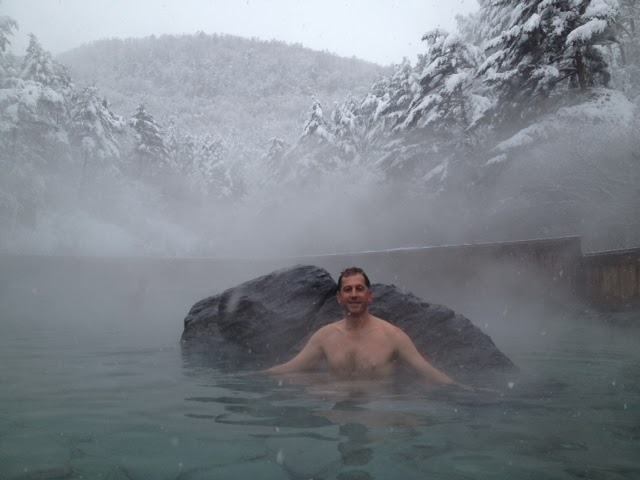
'Sai-no-Kawara hot springs in the town of Kusatau in Japan. This was the first place I enjoyed natural hot springs in March 1992 and was the experience which started my lifelong passion for hot springs bathing. It was in early spring and the open air hot springs looked out over snow covered trees and the surrounding mountains. I has an epiphany in that pool realising that this was the most gentle and relaxing experience. At that moment I decided I wanted to help people relax in the environment and with each other through the connection of thermal waters. I had been seeking a way to bring together global cultural understanding in a harmonious and sustainable way and thermal waters was a natural connector. Photo taken in December 2013'.
D.I.Y.
When one reads the development story of Peninsula HS, it is evidence of persistence and dedication to fulfil in part your dream.
Concerning the development of Peninsula HS how have you been able to pay the development costs without any certainty about the outcome of both the exploration as well as the development? 
"I feel very fortunate to have been able to lead the life I have had. Passion, perseverance and determination are a few of the traits that have made Peninsula HS possible.
We started with very little money and a dream to bring the wonderful sensation of hot springs to Australia. We have grown slowly over the past eight years, one bath at a time. The money we receive from each visitor to Peninsula HS is spent on staff, maintenance of the facility, community projects and the continual development of the facility. More than 90% of the profit is re-invested into the business and the evolution of the master plan for the site. It all takes time, so patience is also an important trait".
Many of your visits have been to natural occurring hot springs. Can hot springs emanating from bore holes (such as Peninsula HS) be categorized as natural? And irrespective of this, do you believe the future ahead for experiencing hot water bathing is by expanding the number of boreholes?
"Certainly the water that comes from bores is natural and the heat source is also natural so in that sense they are natural. There is, however, a very clear distinction between a free flowing natural hot springs and a bore fed hot springs. I prefer the idea of free flowing hot springs but very often these are only available in remote locations and are very inaccessible.
I think there is a future for both free flowing and bore fed hot springs. Bore fed hot springs enable the relaxation of hot springs to be available to more people. Making sure that our interaction with the environment, and specifically in this instance water resources, is sustainable is essential."
Understood
You have been successful in introducing many of the world's bathing experiences to Peninsula HS, but without the traditions associated. Is this against your philosophy, is it driven by commercialism or do you believe that Australians will be put off by f.i. nudity?
"There are many bathing practices all over the world. Depending on the country and the culture of the country the way of enjoying the hot springs varies. There are actually very few countries where bathing naked is practiced. In Germany male and female bathers all bathe naked together, in Japan male and female bathers have segregated naked bathing areas (that is since the Meiji Restoration in 1868 - before then there was no segregation), and apart from that there are a few rare naked bathing venues in U.S.A., China and Europe. 
The remainder of the world (Middle East, North and South America, Africa, China, Russia, all around Southeast Asia, etc) wear bathers in hot springs. I believe cultural factors are behind this and not commercial factors.
It is also cultural factors and not commercial factors that were behind the choice to require bathing costumes to be worn in the main bathing experiences at Peninsula HS. We have always wanted to provide bathing experiences in which people of all nations and all ages can enjoy together. One of our company visions is achieving 'International understanding through hot springs'. If we only offered naked bathing we would be alienating most of the cultures of the world. 
That being said I personally believe that naked bathing is a much better experience - it feels better. At Peninsula HS we do also offer the opportunity for guests to bathe naked in private indoor and outdoor baths and pools. Guests hire these pools for 30-60 minutes and can choose to bathe with or without a bathing costume. In the future I would also like to offer a Japanese bath house experience in which people can choose to enjoy the traditional Japanese style of bathing. We have many more bathing styles that are planned to be introduced at Peninsula HS. These have been, and continue to be, learned from travels to hot springs all over the globe. Our business is in a constant state of evolution and change".
 
'Bitter Springs at Mataranka in the Northern Territory in Australia. The Bitter Springs are literally a river of crystal clear hot springs that flow over limestone and are surrounded by palm trees and a tropical oasis in the centre of arid semi-dessert country. Visitors can swim and dive (with snorkels and goggles) in the thermal waters together with fish and turtles. Many birds fly overhead in the tall trees. My children swam in the waters and said, 'this is better than the Great Barrier Reef'! A very big statement indeed. We visited Bitter Springs on a family driving holiday in September 2011 when we drove across Australia from North to South (Darwin to Melbourne)'.
To what degree would you support conservation of the very few natural hot springs left in this world?
"Sustainability is a key prerequisite for any business and hot springs are definitely no exception. To evolve hot springs into a global industry that offers natural relaxation and wellbeing to many people can only happen if it is done with the highest level of integrity and concern for the environment. 
I am currently involved in a 2-3 year research project called 'Global best practice in the hot springs industry'. The original goal of the research was to create a blueprint for the creation of the hot springs industry in Victoria, Australia. The study involves learning from hot springs cultures all over the world how they use hot springs for the health and wellbeing of their customers and communities. Central to the research is the question of sustainability and resource management. Without learning there will be no understanding and without understanding there can be no systems around the conservation of and respect for the natural gift of hot springs. The study is looking at both commercial operations and also at traditional indigenous cultural connections to hot springs. You will also see in the details of the Global Hot Springs Forum [below] that I was suggesting that the global hot springs industry could come together to build hot springs facilities as community projects in developing countries. These would have to be built sustainably using the natural resource and with the highest level of cultural respect and understanding".
Can you report on your active participation with the Global Spa and Wellness 2013 Summit (GSWS '13)? Is this the right venue for putting hot springs on the agenda? 
"If the hot springs business is to provide a service to the communities they need to be able to operate at a profit. The GSWS is a gathering of people active and interested in health and wellbeing and coming together to help shape the future. The knowledge gained at the conference is shared with the world free of charge.
In the case of the Global Hot Springs Forum held for the first time at the GSWS in Delhi, India in October 2013, it brought together people from the hot springs industry in many countries. There was a panel of hot springs representatives who lead the discussion. Panel members came from Germany, Japan, China, New Zealand and Australia. The individual presentations from the Hot Springs Forum are available on the GSWS'13 website on Day 3 Monday 7th October.
From the minutes of the forum you will see in this document some ideas for the future evolution of the business and how global hot springs are able to work together".
'Khirganga hot springs, Himachalpradesh, India. A days hike along goat and sheep trails from the town of Manikaran in the Indian Himalayan mountains this is a natural hot springs paradise. It is only open in the summer months and in winter is deep under snow. There is a shanty backpackers tourism village built below the springs'.
Home & Away
Many hot springs worldwide are falling victim to development. Companies are taking over community run resources and changing these into bland, run of the mill, catering to the rich and famous hot spring facilities where the original community is barred and bathing traditions are based on individual-based mainstream therapies. None more so than in China. 

Do you believe mainstreaming hot spring development such as for instance your participation in the aforementioned GSWS '13 will hasten the disappearance of community, natural and often rustic hot springs? Or will it highlight the need to maintain a certain naturality?
"I think it is better to create forums and have discussion on all topics rather than not to have them. There are many issues that need to be addressed and your concern and respect for the maintenance of traditional cultural values and practices is certainly one of them. If discussion does not occur, and particularly at the level of the participants of the GSWS, then there will not be any opportunity to create frameworks around which the industry evolves. Global best practice in the hot springs industry can only be understood if it embraces and involves people from all over the globe".
You describe that there are similarities between Peninsula and the aborigine belief being one with the land. Do Aborigines have connotations with (hot) water?
"There is a long and established tradition of Aboriginal connection to the land and water. Hot springs are found in various parts of Australia and Aborigines have had a connection to them for many thousands of years. Probably the best article I have read that explains the relationships of Aborigines with hot springs is by Dean Ah Chee [1].
I will be travelling in April to the desert country of northern South Australia to meet and learn from Dean Ah Chee the author of this article and a park ranger".
I have heard the bathing world as follows: Asia-natural, Europe-medical, America's-relaxing. Do you really believe this is so clear cut? 
"At the broadest level I think this observation is correct. However the division I use is: 
  • Japan / Asia - natural bathing,
  • Europe - medical / health bathing,
  • U.S.A. - spa industry (retail product driven commercial motivation)
In my presentation at the GSWS Global Hot Springs Forum I changed this by taking out U.S.A. (which offers a combination of Asian and European plus public thermal pools) and adding in 'India - Spiritual'. 

I recently completed another hot springs research tour in U.S.A. and Canada (in September / October) and can say that the majority of hot springs in U.S.A. are natural bathing style. 
There was a strong thermal bathing tradition in U.S.A. a hundred years ago and that largely came from Europe with major influences from the medical / health bathing tradition. The emphasis on medical and health cure caused its downfall as it came head-to-head with the rise of allopathic medicine and the pharmaceutical industry. It became much easier for consumers to take drugs to find answers to their illnesses than travel, often great distances, to spend weeks at hot springs wellness centres. 
The reality is that there is a huge divergence in all aspects of global cultures and hot springs is no exception. It is impossible to be clearcut about any categorisation as in most countries one can find all these styles of bathing. These divisions are just generalisations to help develop understanding".
Charles, thank you for your participation in this interview. I wish you all the best and hope you continue to highlight the ideas and philosophies put forward above. And of course all the best for the future of Peninsula Hot Spring! 

Notes
The photo's of Sai-no-Kawara, Mataranka and Khirganga are used courtesy of Charles Davidson. 
For more information on Sai-no-Kawara, visit one of the many English language websites f.i. this one. For Mataranka Bitter Springs visit this website. And for Khirganga see a posting on Hot soaks of the Himalaya on Himachal Pradesh.

More recent info on Charles Davidson and Peninsula Hot Springs. Mind you this is just a small selection ... : 
References:
[1] Ah Chee, D. (n.d.) Indigenous people's connection with kwatye (water) in the Great Artesian Basin
(Save and exchange .aspx file extension with .pdf)

Sunday, 14 April 2013

Relax

'Swimming in the hot springs on the Rinjani trekking tour ! Lombok - Indonesia'
From webstagram page of gogi29

What's customary? 
A variety of recent articles / blog entries follows, all concerning customs of foreigners vis à vis local customs.

Travelling to foreign countries opens oneself to different experiences. In this piece by CNN (Apr. 10) they discuss the advent of Chinese tourists abroad. Both the expectations of those coming and those offering hospitality are challenged. However when both adapt great experiences may occur.
The same source follows it up with more comments: basically all  tourists which come in hordes irrespective of nationality are hard to handle: 
'Summing up the "just because you've got money doesn't mean I have to respect you" contingent, THEGenuineOLiTWiST wrote: "In general, most mainland Chinese who are 40 or over are suffering from this money= respect syndrome. The younger ones are much better at 'fitting in' with their travel destination's social and cultural norms"'.
So how does one re-act to outlandish social norms? With hot springs? This (young?) lady, from Singapore, while in Japan does go into the onsen. Though she has misgivings:
'Then we unpack and went to the hotspring only me and chenhong went seriously i think between friends it's also a very awkward thing looking at each others boobs and vagina and everyone (locals) were like so open about showing their body.... you know there's those door then you go in is locker room you see in anime?
But in real life the moment you enter the door you see all the naked aunties saggy boobs young kids boobs and many people not blow drying their hair but their vagina hair. FUCKING WEIRD RIGHT.. I took such a long time to undress myself and psycoing myself that this will be my only experience i should just go....'.
From the above citation it can be expected to conclude that this is a the first part of an overall poor experience. It's not, the lady in questions does enjoy the experience. 
It's odd that on the one hand when from Singapore, a society which is possibly one of the most prudish in the world, one has no qualms about at least partaking in the locals' habits however contrite. On the other when abroad, Asians (in general) are very well aware that this is not home ... and adapt ...

This attitude seems to differ from for instance North Americans (Anglo-based), where experiencing traditions not meeting the social norm known, means a no-no to the experience ....
That it is not always the case, illustrates the following experience from i heart rachabees (Mar. 27): 
'When people ask me what was the best thing I did in Japan, I usually mull over the question, my mind wandering to the weekend trip with my friends to Naoshima, the day spent celebrating a small local festival in Himeji, biking the Shimanami Kaido or the big dance festival in Kagoshima. However, when it comes down to a unique, off the beaten path experience, Kita Onsen was possibly the absolute best.
...
I came across Kita Onsen as a photo on tumblr, an atmospheric shot of a woman reclining in steaming waters under the imposing face of a giant tengu demon mask. I was so intrigued that I started researching the mysterious hot springs hotel, discovering it dated back to the 1600s, and, even better, it was relatively affordable for me (at least in comparison to other onsen hotels).
 ...
After they retired for bed, I decided to take advantage of the late hour and go in the mixed onsens without a bathing suit. I crept outside to the big outdoor pool. The wind was absolutely howling and I quickly jumped into the warm water, beautiful and surreal in the dark night. The sky had semi-cleared and there were stars visible and clouds lit white-blue by the half moon were racing across the sky. I swam and swam, as great gusts of wind whirled autumn leaves around me and chilled any inch of me not covered by warm water.
Next I went to the Tengu no Yu, where I sat in the bath and took in my strange surroundings, the enormous masks watching me with their scowls. Then the third floor baths, where I soaked for a bit, listening to the strangled gurgling of the old drains'.
What about differing soaking habits without foreign tourists? An interesting discussion on the Facebook site of the Friends of Cougar (hot spring), Oregon, U.S.A.. Administrator posts this: 
'This weekend at Cougar I interviewed several people and came up with what I think are the reasons many people don't go nude [for which this hot spring is partially known for]: 
The relative importance of each varies with each person.
Common:
1. Vibe. Presence of people in suits relative to people nude.
2. Fear of inferiority. Self conscious about their suit-covered areas.
3. Insensitivity. A disregard for suits causing discomfort for people nude or wanting to be nude.
4. Habit. Long instilled habitual behavior.
Special cases: 
5. Fear of superiority. Fear of being judged too hot and getting too much attention and scrutiny. 
6. Friends. Presence of judgment of friends / family'. 

After much response this evolves to:
'With the help of your suggestions, I've revised my list: 
Common: 
Vibe. Presence of people in suits relative to people nude. 
Body image. Being self conscious about one's suit-covered areas. 
Habit. Long-instilled social programming. 
Insensitivity. A disregard for suits causing social and aesthetic discomfort for people nude or wanting to be nude. 
Special cases: 
Shyness. Fear of getting too much attention and scrutiny. 
Friends. Presence of judgment of friends / family'.
One later response:
'It is so strange that so many clothed people go to cougar. Obviously they are ok with nudity...weird'. 
An interesting discussion on an interesting and thought provoking page. 
  
Other strange tourist habit news. Debat on Sanya, Hainan, China's (only?) nudist beach. China.org (Mar. 25): 
'Many tourists have posted nude photographs while vacationing at Sanya's nudist beach in south China's Hainan Province, giving the Chinese public a vivid imagination of what happens at Sanya, Taiwan newspaper Want Daily reported.
Sanya is a popular tourist destination in China. The so called nudist beach lies on Da Dong Hai (Great East Sea) beach, is only three kilometers from Sanya. It has become increasingly common to see groups of people chatting and playing cards in the nude at the far end of the beach.
There is no sign posted to inform tourists that the area is for nudists, and there have been reports of embarrassing encounters between clothed and nude beach goers.
An internet user called "yilunanfeng" said that the beach used to be frequented by foreigners on vacation, but gradually more and more Chinese tourists took over the nudist beach'.
Solution: 
'"Yilunanfeng" [internet user] advised that the local government should set up a notice to remind people that there is a nude beach here'.
Apparently, some habits are not so outlandish as one would suppose ....

Another example in the customary section. Is Thailand uptight? TTR weekly (Apr. 10) reports that just one third of respondents to a Thai national poll were uncomfortable with perceived relax of dress code during Thai new year celebrations (Songkran): 
'The poll of 1,253 people countrywide reported 36.79% were unhappy and opposed celebrations involving females wearing skimpy or see-through dresses or suggestive dancing'. 
Strange? Just to put this perspective, nearly half of the respondents thought the government should ban the sale of alcohol during Songkran! Priorities or common sense?

More (or less) on the same. One could be surprised (shocked even?) in Malacca, Malaysia:
'"It was a real shock to see someone in the nude like this in conservative Malacca," he said.
Security guard P. Saravanan, 39, said he reprimanded the [French?] woman but she was nonchalant about it.
"She only replied 'I am going naked to save the world. I am a naturist' and she continued walking," he said.
Saravanan said he called the police, who came and took her away'. 
It doesn't mention if she managed to save the world, at the very least it's not worse off. 
One may frown on the police action, but alas, this is very much the same action police would do all over the world: clearly an outlying free-thinking individual, have to stop this in the bud (google naked rambler).
Toya Bungkah, Bali, Indonesia. kailey_styles:
'Just swimming next to a volcano, the usual'.
Apping
Is there a hot springs app? hotspringsfinder.com has an app for the US: a long overview of all (commercial) hot springs and reviews. Chapters of for instance California and Idaho chapters cost $9,99; Oregon is slightly cheaper. The owner (author) Richard:
'Many of my friends tried to dissuade me from publishing a hot springs guide fearing that hordes of iPhone users would descend on their favorite soaking hideaways. Alas, this was the only application that intrigued me enough to actually see methrough allthe hard work. It was the first thing I really wanted on my iPhone, so for better or worse I was hopelessly hooked.
To mitigate the impact, I decided to price the app at $9.99, higher than the usual $0.99 or $1.99, but cheaper than the equivalent paper guide books. I know many iPhone user's won't be happy about this but I felt it was the responsible thing to do, even though it will greatly reduce the project's annual revenue.
Although I don't worry about the commercial springs being overrun, many of the primitive sites are fragile. You can help by becoming a hot spring steward, not just a hot springs consumer. Tread lightly and help pickup after the people who don't understand how precious these magical places are'.
Maybe a future project for this blog?

Geothermal news
Nuclear leaks have forced Marubeni, one of Japan's largest companies, to look at geothermal power. Japan Times (Apr. 4):
'More than 70 percent of respondents in an opinion poll by the Asahi Shimbun in February said Japan should scrap nuclear power, a stance favored by environmentalists who note geothermal energy does the same thing as nuclear with much less risk.
“To import a very complex and difficult technology to boil water in the world’s most seismically active country when there is such vast geothermal potential strikes me as madness,” David Suzuki, a Canadian author, environmentalist and board member of the Japan Renewable Energy Foundation, said in an interview.
...
The projects threaten to revive conflict with hot springs resorts, which are concerned commercial geothermal plants will siphon away the same reserves that they tap. Geothermal developments were largely off-limits before the Great East Japan Earthquake in March 2011 because heat reserves were set aside for the resorts.
“We realize geothermal is one of our energy options,” said Hirokazu Nunoyama, secretary general of the Japan Spa Association. “But there are impacts on the environment. There are cases of hot spring resources running out or thinning, or a drop in water temperatures.”'
The article finishes as follows, not upbeat for the soakers: 
'“Geothermal plants are rapidly increasing in major geothermal countries abroad, and we are the only country that is not moving ahead,” Susumu Tanaka, chairman of the Japan Geothermal Association, said in a statement on the group’s website'.
And though some might view this as positive, the same article on Bloomberg has a less positive headline: 
'Marubeni Targets National Park in Japan for Geothermal'
So whose side are they on?

Meanwhile: 
'Japan’s Ministry of Economy, Trade and Industry (METI) is currently considering 21 geothermal projects as part of its overall renewable energy strategy', 
so reports thinkgeoenergy.

Der Spiegel (Mar. 10) relates about Japan's search for geothermal power generation: 
'Dabei ist das eigentliche Problem ein anderes: Knapp ein Dutzend regionale Stromversorger haben das Land unter sich aufgeteilt. Diese Platzhirsche stemmen sich gegen unerwünschte Neuerungen. "Sie haben kein Interesse an Wettbewerb, und sie arbeiten auch nicht zusammen", sagt Kosuke Kurokawa, Chef des Japan Council for Renewable Energy'. 
I.e. regional power companies are not interested in new potential as this counters their current position / interests.

In Central America companies are eyeing up national parks as well: 
'The President of Costa Rica signs decree that will start a public interest investigation into potential geothermal power development in the National Park of Rincon de la Vieja'.  
Recent
'Various environmental organizations oppose legislation that would open the Rincon de la Vieja National Park in Costa Rica to geothermal development'.
Indonesia is capitalizing on geothermal.
A new geothermal field found near Kolaka, Sulawesi, Indonesia (source). No news as to how one finds a new geothermal field ...
Japanese development aid gets used to develop geothermal power in Indonesia: 
'Japan International Cooperation Agency (JICA) is providing a development loan of $53.4 million to the Tulehu [Ambon] geothermal power project of PLN in Indonesia'. 
A thing of the past:

'Hot-Spring Tulehu, Ambon Island'
From the flickr page of helenanya-simon

Turkey would like to invest in Java, Indonesia's geothermal potential. Invest heavily
'Turkish group Hitay is planning investment of up to $2.5 billion in three projects in Indonesia, at Mount Bromo, Mount Lamongan and Raung, East Java. The estimated potential for all three project is at about 1,100 MW'.
Around the region
  • Malaysia
The aclaimed Travelfish authority has a take on Langkawi island's hot spring Ayer Hangat: 
'Malay-style buildings create a village-like environment on the lush landscaped grounds, with cool and hot water pools. A series of small canals run through the grounds and connect hot spring water collected from two wells with cooler water, offering you temperature variation options. Surprisingly, the hot springs are natural salt water, which seeps up from the shallow tide table. The springs claim to be medicinal, helping improve chronic skin conditions, detoxing and joint pain resulting from injury or gout'.
But are the springs worth a visit / soak?
  • Thailand
Hot spring festivals are catching on (Pattaya Mail, Mar. 22): 
'The province is holding an eight-day festival “Mineral Hot Spring Bathing” from today through March 30 at the health park near Ranong’s municipality office to promote health tourism.
Hot spring bath services, spa treatment, Thai traditional medicines, mineral water and herbal products are available at 30-50 per cent discounts'.
In Thailand an idea has been to renew government legislation of the spa sector (the Nation, Mar. 25): 
'However, the spa scene has been unfortunately partly plagued by a sexual image. If word of mouth by tourists on this issue spreads, the industry will no doubt be hit.
This is one of the troubles for Krod Rojanastien, the new president of the Thai Spa Association. He admits the industry has faced barriers at a time when Thai spas are growing in popularity in the global market.
...
A new law is needed to help shape up and modernise the industry. The industry has been stuck with the Spa Act of 1966, as amended in 2003, to cope with the rapidly-changing industry. It has waited for a decade for the law to be approved by Parliament.
The Spa Act defines a spa like a massage service. This is way out of date.
If the law passes, law enforcement will lead to a big change in the industry. That means spas will be scrutinised in detail as a way to crack down on sex-oriented openings.
Also, those working in the industry will be upgraded professionally with a proof of licence via a training programme designed by the Public Health Ministry. A committee, chaired by the minister, will be set up to check standards regularly to ensure the industry's sustainability'.
Kantang, Trang, Thailand. From webstagram page of harrietwh.
  • Vietnam
An interesting blog entry on Tien Lang hot spring, Hai Phong, Vietnam. The promise: 
'Especially, Tien Lang Hot Spring Tourist Site promises to bring the tourists to a wonderful world with feelings of enjoying, relaxing, and reinforcing health by the staff that are technically philological and major in massaging with a lot of experience'.
More cash
Big companies in hot spring development (Travel Daily, Mar 27): 
'Banyan Tree Hotels & Resorts has signed a new hot spring resort close to the Chinese city of Chongqing.
... 
All rooms feature private hot spring pools. The resort will also feature a large Banyan Tree spa with seven different outdoor and indoor hot spring pools with waters at a constant temperature of 38⁰C, plus nine treatment rooms, a gymnasium and yoga room'.
'Evening hot spring session'
Palawan, Philippines

Thursday, 20 December 2012

#socialsoakingsilently


Social media

Love it or not, social media is increasingly becoming a feature in our lives. 
And how about (social) soaking? 

Well, you are of course all familiar with the Facebook page of Soaking in Southeast Asia. Besides this there are many other hot spring Facebook pages, mostly dedicated to just the one soak. Particulary active are the U.S. Facebook pages of Cougar, Deep Creek and Pah Tempe. Beyond these though there's no much on offer, surely no regular original content. 
Certainly not in Southeast Asia. Or is there? (Note, there are many Japanese language hot spring pages ...).

Twitter? No idea.

Pinterest? What about this one, I Love Hot Springs? Personally, I don't get Pinterest ...

Soaking spirit, my alter ego on Tumblr, seems to be the globe's choice of tumblr soakers. There are though a few more solely dedicated to hot springs, but with very irregular postings ...

Instagram seems to receive quite a lot of photo's concerning nextgen soakers, just use the search function followed by #hotspring.

Surging ahead
Ongoing drama. The CS Monitor (Nov. 5, 2012) questions nuclear or geothermal for Japan. 
'Located nine miles southwest of Fukushima city, Tsu­chi­yu is launching a bold test in harnessing the potential of Japan's huge subterranean reserves of volcanic water.
By spring 2014, Tsuchiyu hopes to be generating 250 kilowatts of electricity – about a quarter of its total needs – at a new geothermal plant located on its outskirts'.
The Financial Times (Nov. 4, 2012) then has an article on the same theme, but concerning Indonesia. It notes many regulatory and technical shortcomings but remains upbeat:
'As the world’s most volcanically active country, Indonesia has been bestowed with unparalleled potential reserves of geothermal energy, which is renewable and produces almost no carbon emissions.
With the Indonesian government trying to fulfil surging energy demand while reducing carbon emissions, it is keen to accelerate the development of a raft of proposed geothermal power plants backed by local and international investors'. 
Though it highlights the dilemma between soaking and electricity generation in Japan, it neglects the issue in Indonesia. Is there no dilemma in Indonesia?

Apparently not, Japan's Sumitomo completes a 110 MW plant on Sumatra, Indonesia: 
'Located in the Ulubelu district, Tanggamus county in Lampumg Province at the southern tip of Indonesia’s Sumatra Island, the Ulubelu power station was built as the first large scale geothermal power generating facility on the island'.
Malaysia is developing it's first geothermal plant, to commence in two years. What the future entails
'In addition, to enable access to the project site and transport drilling rig, plant and equipments, an access road of approximately 18km in length, including 3 bridges, need to be constructed'. 
Soakers need not apply.

Meanwhile things are going so smooth on Leyte, Philippines: 
'Several groups have joined forces to oppose the sale of the unified Leyte geothermal plants on Leyte, Philippines. This is based on the fear of increasing electricity prices for the single most important power plant complex in the country'.
Just (or unjust?) politics then...

Create your own?
  • Malaysia
A new find, Kampung Bongkek, Negiri Sembilan, Malaysia. From the New Strait Times (21 Oct., 2012): 
'The hot spring can still be seen today, right by the river bank and  with shrubs growing around it.
Basri said there were suggestions and efforts to develop the hot spring to attract more tourists to the village, in view of its history.
“However, the land belongs to someone who is not willing to give it up yet so we have no right to develop it”'.
Yea!
  • Singapore

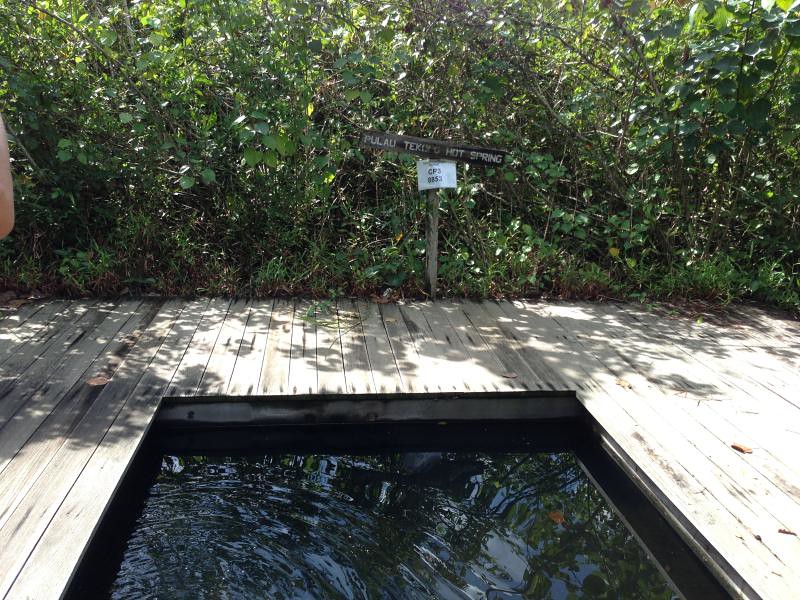
'Tekong Hot Spring'.
Singapore. From flickr member chia_alfred
  • Indonesia
Another write up on Angseri hot springs, Bali, Indonesia. It adds this: 
'The natural attractions in Angseri Hot Spring used only as a traditional bathhouse. Starting from the strong desire of local communities to manage the hot water source and on the idea of ​​thinking Angsari six villagers in October 2007 where it was built and opened to the public a comfortable bathing area. Furthermore formed groups totaling 80 people and brought the name of the citizens Angseri Group Is Nature Angseri with legal forms CV'.
Another Angseri experience:
'Each cabin contained a stone bathtub, large enough to seat five people. A black-and-white checkered cloth covering the lower part of the bamboo walls allowed some privacy to soak in the invigorating, clear water that was hot enough to render my friend’s skin as red as a boiled prawn'. 
The same author also condures up the following on the hot springs of Tempuran, Wonosobo: 
'The first ponds weren’t exactly located in Wonosobo, but in a similarly blessed district on its west:  Banjarnegara. The hot springs were scattered in a neighborhood called Wanayasa, and together they form a bathing compound called Tempuran.
Please be warned that you shouldn’t go there at night, the way we foolishly did. We gambled with our lives when thick mist suddenly blanketed the hills and we had only about a five-meter field-of-view of the road, kind of like in the horror movie Silent Hill. All the while a deep gorge was on one side of the path we traveled on our motorbikes. My ex cried and begged to go home. But we soon forgot the terrifying time spent on the route from hell once we got to Tempuran.
...
Tempuran has different ponds for males and females, but the last two don’t. Women and little kids usually go there earlier than the men. To give you a heads up, most people bathe naked in all of these ponds'.
'A hot springs pond in Tempuran late at night. Cold and traumatized, we quickly jumped into it as soon as we arrived. Photo by Indra Nugroho'.
And steadying the nerves. Can anyone tell me why the need to smoke?
  • Thailand 
Sometimes soaking news can be very special: 
'Occupiers of a row of rented apartments in Huay Yai Village, located on the southern outskirts of Pattaya [Thailand] reported the possible discovery of a geothermal hole situated at the front of one of the apartments on Wednesday afternoon.
Although highly unlikely, officials from the Pollution Control Department, the Department of Natural Resources & the Environment along with Huay Yai Municipal Officers led by the Mayor of Hua Yai made their way to the block of rooms to see for themselves the hole which had been created by locals to uncover the hot undersoil which was producing steam.
A thermometer recorded a temperature of 50C inside the hole and a demonstration involving a Chicken egg took place whereby it was cooked and ready to be consumed in under 20 minutes after being placed inside the hole. Checks were made and an explanation was given by officials who blamed poor installation of electrics and the rise in the water table due to recent rains. We were told that checks on the electrics installed in the rooms, which were constructed 4 years ago, indicated a leak of power into the ground which accounts for the occupiers unusually high electric bills which, up until now, could not be explained. As the water table rose it came into contact with the leaking electric causing the water to increase in temperature and evaporate which produced the steam and made the ground warm under-foot'. 
Can't believe it's true ...

Is there a post 21st?
What will the future look like?
'Tongjing Hot Spring Resort will start construction at the end of 2012, planned to be completed in March 2013, after which it will become a tourism highlight in Chongqing, the hot spring capital of the world, according to Chongqing Municipal Government on November 5, 2012.
Covering 342 mu with an investment of 1.28 billion yuan, the Resort is located in Tongjing Town, Yubei District, Chongqing. It will be built in accordance with the national 5A standard with a capacity of 1 million tourists. The hot spring center covers an area of 75 mu, including an indoor hot spring center and a outdoor park, able to hold 2,500 persons'. 
Hope not!
Related Posts with Thumbnails
Copyright 2009 © Soaking in Southeast Asia. All rights reserved.
No reproduction or republication without written permission.