Showing posts with label failed development. Show all posts

Sunday, 14 October 2012

Sulfur, Siam & self-indulgence

Not much self generated news this time, so let's go to the regional soakers press:
The Jakarta Post (12 Oct) has a feature article of the hot springs at the foot of Gunung Sibayak on Sumatra (Indonesia), previously highlighted on this site. The village of Semangat Gunung counts 9 commercial soaking sites and according to the article can 
'remove dandruff'. 
Also noteworthy: 
'Sulfur powder is obtained by sieving sulfur water after being laid exposed for one night. It is sold at the price of Rp10,000 (US$1.04) for three packs. Many tourists buy the powder. Sugiran, a tourist from Medan, was one of the visitors buying the powder. He said he had taken a sulfurous bath for the first time and was interested in applying the powder to heal his skin disorder. “The rash on my body will hopefully be cured by this powder,” added Sugiran while soaking in a pool'.
Bathing in Borneo
 The local Post reports (9 Sept): 
'The hot spring at Kpg Panchor Dayak along Kuching [Malaysia]- Serian road recorded 15,076 visitors in the first eight months of this year'.
That's 60 a day for recently improved springs. 
'The Mambong MP [Deputy Tourism Minister Datuk Dr James Dawos] advised the village chief to request for parking space from the local council and electricity to be connected to the area. He said his ministry was willing to help'.
Hmmm, lets not hope it's a road to ruin. 

A very neutral review of Southeast Asia's most popular hot spring, Poring, with the addition of this: 
'If you are shy to bath in public, you can pay a little more for the private room located in the cabin behind the hot spring. Each room can accommodate two people. Remember to bring your swimsuit as you are not allowed to get naked in public in a Muslim country...'. 
?

Thai Tales
Travel Thailand has an entry on Thasatorn hot spring, Suratthani, Thailand. Some nice pictures, other not much to add to the Soaking in Siam blog entry. Travel Thailand does have an entry on the hot spring of Samet, Chaiya, Suratthani: 
'At Tambon Samet in Amphoe Chaiya, Surat Thani Province. away from Amphoe Chaiya about 4 kilometers hot springs is holy water. consists of two small caves and two natural hot spring'
Again. nice photo's.

Sai Ngam hot spring, Pai, Mae Hong Son province, Thailand. 
Photo found on picasa site of Ka zu. Apparently this hot spring is a tourist destination waiting to be discovered with a few tourist bungalows present.


By the way, Soaking on Siam has once more an overview of press clippings on the newly opened Yunomori onsen, a natural hot spring bath house in the center of Bangkok. Most comment on how outlandish the Japanese bathing culture is towards the conservative Thai society (as well as that towards the anglo-saxon reporters backgrounds), though they note that many Thai join in. All glowing repotrys (not only literally ...). 
I have two questions, one about the source of the water and the need to keep the water sanitary. And the other weather this may prove to be a new trend in Siam soaking, set to be replicated by the copycats (I WISH)?

Meanwhile in the Phillippines, an individual is doing just that ... 
'It was deserted but not closed. I was the only guest that day. Perfect for skinny dipping which I did!' 
Looneyplanet visited the hot spring of Baslay on Negros. And enjoyed it, despite the absence of crowds. Or because there were none ...

Otherwise
An interesting side theme. Ahave, an Israeli cosmetics company has been accused of war crimes by mining Palestian-owned resources: mud. The company response: no comment. Report by Sydney Morning Herald (4 Sept. 2012). More info on the controversy on Wikipedia.

Geothermal news: this time it is the New York Times (Oct 1) which picks up on the discussion in Japan on whether or not to promote geothermal energy generation.
'Then came the Fukushima disaster.
In March, the government lifted its decades-old ban to allow geothermal projects in five new potential sites in national parks and monuments to go ahead, under strict oversight.
Tightly regulated or not, that decision has inevitably caused tension between conflicting local business interests, environmentalists and geothermal energy developers. In Yuzawa City, for example, existing and prospective geothermal power generation facilities typically are close to the hot spring resorts.
...
Mr. Sakaguchi, the researcher at the industrial science and technology institute, said he understood the concerns of Oyasu’s onsen innkeepers.
In two known cases outside Japan, geothermal power developments have caused hot springs to dry up, he noted. One such case was recorded in the 1970s in Steamboat Springs, Nevada, he said.
Still, “a clear case of geothermal development causing a hot spring to dry up has not occurred in Japan,” Mr. Sakaguchi added. “The technology to pick up underground movements and simulation technology has really improved in the last two decades, so the risk is much lower.”
It typically can take 20 years to develop a geothermal plant, if only because it takes time to earn the trust and cooperation of local people, Mr. Sakaguchi said'.
Elsewhere a review of Japan and renewables mentions this: 
'Even geothermal, touted as a vital energy investment in Japan given the country’s abundant hot springs, is facing a battle with local resorts – the Kusatsu Hot Spring Resort association, on Kyushu island, announced opposition to developing the clean energy for fear that the precious mineral hot springs would decrease in supply'.
Meanwhile other nations are less restricted by the soaking set. Vietnam announces a project to come online at the end of this year.
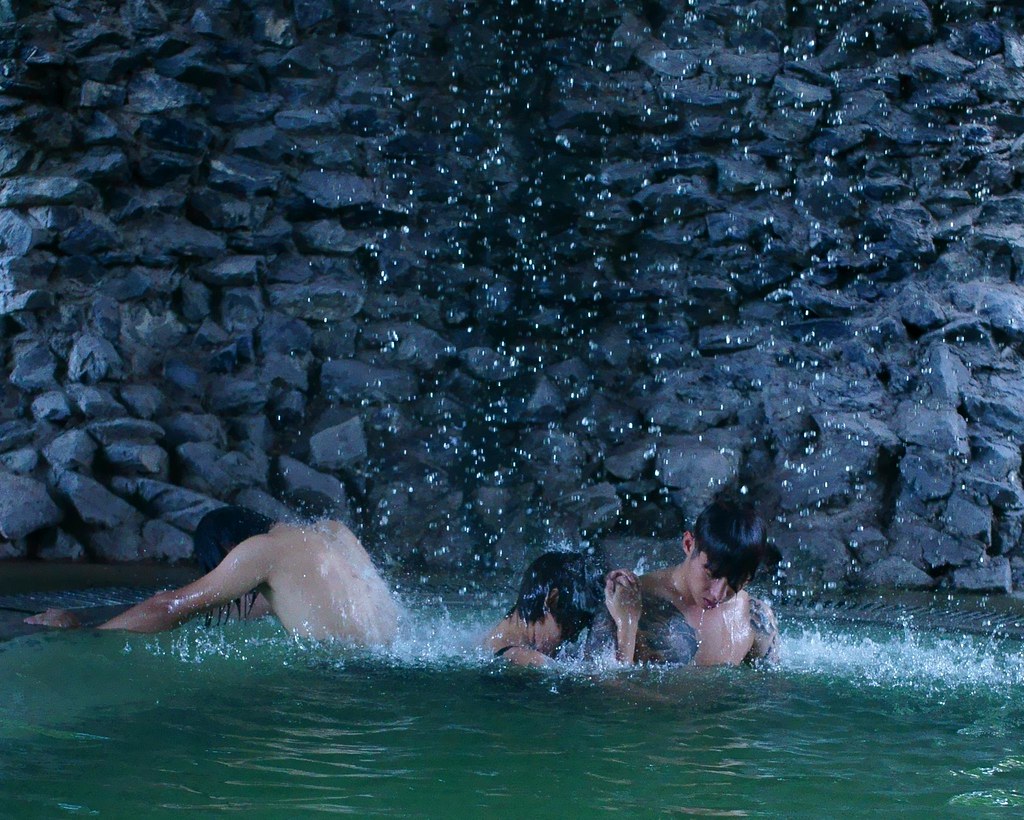

'Thai Drama,
Chiang mai
San Kamphaeng Hot Spring
Thailand

NEX 3 , SIGMA 30 , MEIKE box (water/dust/sand proof )'

Found on flickr, posted by setsunalee

Monday, 21 March 2011

Water and dirt


Populous
Thap Ba hot spring rates as one of Southeast Asia’s most popular hot springs. In Oct '09, Soaking in Southeast Asia compiled a Top 10 of most popular soaking sites based on references from internet sites such as tripadvisor, flickr, google and yahoo. The outcome saw Thap Ba ranked seventh.

So what factors would help in making a hot spring site popular?
For one many people have to visit it, so close to major concentrations of persons.

  • Yes, Thap Ba is close to a large city, but so are Sembawang (Singapore) and Bentong (Kuala Lumpur). But not highly ranked.
Touristy area then.
  • Yes, Thap Ba is just outside Nha Trang, the number 4 destination in Vietnam. But other hot springs are also near popular tourist sites such as Hin Dad (Kanchanaburi), Pha Soet (Chiang Rai) and Klong Thom (Krabi). But not Top 10 material.
So it must be Thap Ba itself.

Many tourists recommend (see blog sites / tripadvisor) a visit to Thap Ba hot spring and though on occasion these authors will go out of their way to write down their negatives, it must be due to the shared positive experience that they feel compelled to share this on internet. Thus contributing to Thap Ba receiving even more fame, more visitors.

Also their feedback helps out with sites such as LP (mysteriously LP ranks Thap Ba as only the no. 5 thing 'to do in Nha Trang'), whereas tripadvisor ranks it as no. 1 of things to do in Nha Trang. This despite there being local competition from for instance a huge man made resort, Vinpearl Land, which includes the world’s longest over-the-sea cable car and the biggest wave pool in Southeast Asia (even though being next to the beach).


Independently,
in2vietnam.com alludes that Thap Ba is Vietnam's 'most famous' hot spring.

Access
Located on the outskirts of Nha Trang, Khanh Hoa province, the hot spring of Thap Ba is easily accessible. After crossing the Cai river and 100m after passing Po Nagar Thap Ba tower one needs to take the road right.

Po Nagar is a Cham-culture ruin whose origin predates even Angkor; suggestions date it's origins back to the 7th century. A sight in itself, it’s a nice place to look around, view over the Cai river, but possibly not much has been left over of the original building.


A relief on Po Nagar. Photo by EDME MICHEL

Anyway, the small street off the major northern artery leading out of Nha Trang winds it’s way over a few hillocks through what could be described as Vietnam’s suburbia: freshly built narrow 2/3 story buildings interspersed with vacant lots. At the end of the road (2 km), beyond a street full of shops selling tourist knick-knacks, lies the entry to Thap Ba Hot Spring Center.


Late afternoon, there are still crowds willing to enter. The ticket office is the place where one needs to decide what treat(ment) one requires, even though it’s not so clear what the to be paid fee include.


Ummmm

Murky
Ten $US lighter, I can enter the site, on my way to a mud bath (single), followed by a hot bath.
However before that fun can start I need a drink and manage to sneak off to the restaurant, much to the annoyment of the counter ladies. Drinks are for afterwards (?). They really are organized here.

After lessening my thirst I return to the counter where (after showing my ticket) I’m given a towel and told to change, ‘men at back’. Behind the lockers are about 10 'tents' where the men are supposed to change.


'Asian Adventure 2008 152
Mud baths, Nha Trang, Vietnam'
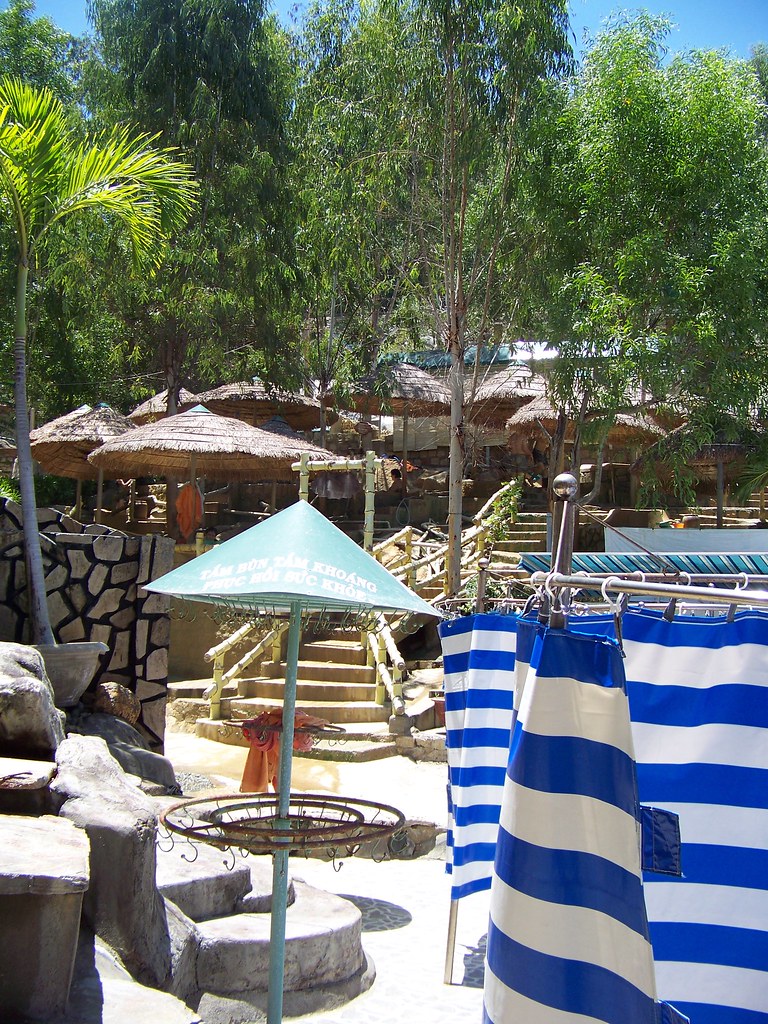
Mud baths on terraces to the rear, blue and whiter changing tents for men.
From flickr, by
pinkpapper8

Thereafter I am sent up the hill, past big empty basins. I then hand my ticket to an attendee and are told to take a shower. After obliging, I am shown the first wooden tub which is filled with fluid warm mud in 10 seconds. Take a seat.

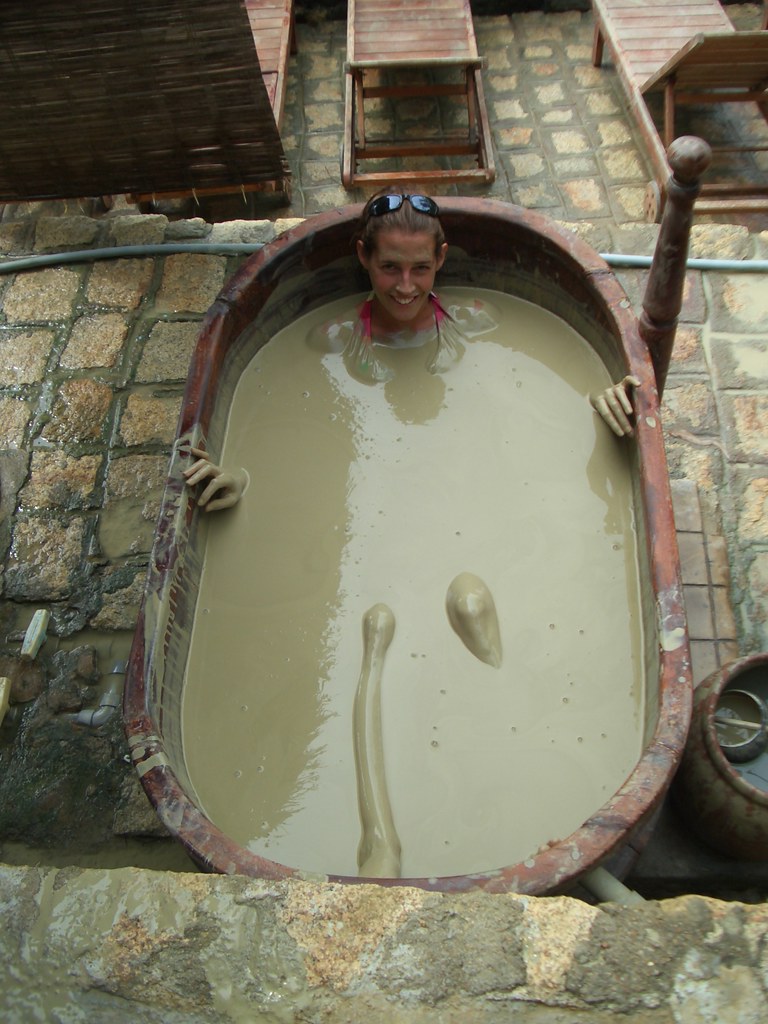
Well one can actually lie down: the tubs big enough for two. I have to admit, the mud bath is very appealing: it's warm and silky. I stayed in the mud for about as long as allowed; eventually the attendee tires and sends me on my way.

The tubs are shaded and are located above each other on terraces going up the eucalyptus clad hill. Though intended with view, the view itself is not really enchanting. The hill though is alive with soothing local music, unless of course you get all worked up, having to involuntarily listen to Vietnamese muzak.


'Mud bath, Nha Trang
Bathing in mud at a natural hot spring in Nha Trang, Vietnam. The minerals are supposed to be really good for you, and despite being a bit sceptical about the actual health benefits, we went anyway because, let's face it, playing in mud is just fun!'
Photo by birdandfrog

I also have first class seating overlooking the showers and can observe the trials and tribulations of rinsing after a mud bath. Especially women with full bathing suits are struggling.
Once it’s my turn to shower I discover why: even after a 10 minute shower, a hot bath soak, swimming in the mineral water pool, sitting underneath a waterfall shower; still then my speedo’s contain a handful of sand/grit.


And clear
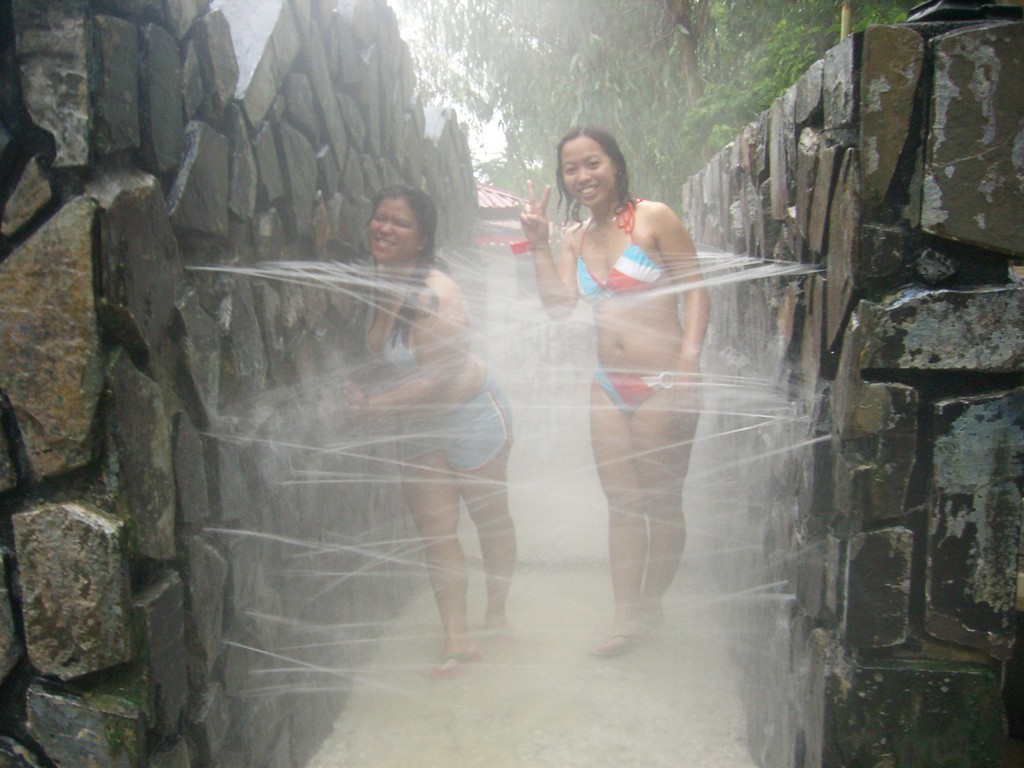
Once one has believed to have rid oneself of most of the mud, it’s back down the hill, where another attendant tells you to go through the hydrotherapy walls. These walls are five meter in length, and water is spouted out from the wall with high pressure, as a way of massage. One can walk to and fro but this concept seems to have forgotten that many visitors who partake are foreigners, whose body mass is above belly-button height.


By poell

Directly behind the hydrotherapy walls are about 20 cement basins (some bigger than others, but even the smallest accommodates two persons easily; these are heart shaped …) which are filled up individually for you. Half an hour max here again and then the surplus paid part of the ticket comes to an end.

Beyond all this are two large hot water pools (not too hot), one free form deep pool, another less deep and circular. Using these pools can be done at leisure and independent of the mud part. And those who have paid up for mud treatments receive loungers to while away and recuperate ...


The larger pool

Secrets no more
So have I found the secret to Thap Ba’s popularity?

Possibly not, but judging from the great numbers of visitors, many who make the impression of being regulars, the facilities would be high on the 'to do' list of many Nha Trang visitors.

The experience? Possibly a bit too routine for everybody, the treatments on offer though, are way below western prices and are enjoyable in themselves without the need for proof of additional health effects. It seems that a visit here has become a Nha Trang visit-must. Even though publications such as LP [1] hardly provide any form of lip service (is that possible with books?). It does mention that Thap Ba

‘is one of the most fun experiences on offer here [Nha Trang]’.
Sims [2] notes
‘It’s a must for Vietnamese tourists who swear by the healing power of the springs, though most tourists just get a kick out of taking a communal bath in a mud broth for the first time in their lives’.
Other positives I can take away from here are the ease of access and mostly clean facilities. Management of the therapeutic side are good, though the restaurants seem a bit dilapidated with at least the pizzeria having exceptional poor service.

Thap Ba management are well content with themselves: outside the entrance is a small building containing all the prizes/accolades the facilities have won!

However feeling intrigued by the many positive postings on (mud baths of) Thap Ba, I am planning on a future posting on exactly that, mud baths. In my research I found that much of the feedback concerning mud baths worldwide actually concerns Thap Ba. A google blog search of for instance "mud bath"+ "hot spring" reveals that nearly 1 in 5 links actually concern Nha Trang!

It also transpired that much of the global mud baths are spa treatments for mostly singular or duo consumption. Expensive, these mostly are directed at older audiences. Whereas the cheaper Thap Ba version for groups find many much younger (and possibly internet savvy) takers. Voila, the secret!
(I also assume that as one of the first hot spring centers in Southeast Asia to offer a mud bath, that they also receive much 'free' publicity).

The best?

So could it improve? I think so. It seems sometimes a bit like an assembly line business with little or no personal touch. Having better showers or allowing nudity would also help, especially if promoting the wholesomeness of mud and water while simultaneously requiring bathing costumes (which in itself is very un-Southeastasian like).
kyralove adds:
'Next is mud-bath! Hippy me is expecting a private bath, or at least a woman's section and a men's section, but all the baths are next to each other. Not that I care about being naked in front of others, but if I get so many stares with my clothes on, then no way does putting on a show for the local boys sound fun. Since it is late there is only one other couple in another tub... But ours is still not private at all. WTF? I have on a white bathing suit, no way am I getting it muddy! Who takes mud baths in their clothes? It's just wrong!
Somehow I gracelessly maneuver out of my bathing suit under my skimpy towel and get into the warm mud. Ahhh... warm mineral mud under mountains and stars. Uh, oh, I float in this mud. It's harder than it sounds to keep my body completely submerged. It seems like as soon as I get comfortable, the mud starts disappearing. Oh no! They are draining the tub! I somehow manage to get my bathing suit back on, just in the nick of time (my towel has mysteriously vanished). So much for keeping my white bathing suit white....'
The lengths one goes to keep the whites white ...Going more upscale does enable more naturalness. Apparently privacy is for sale at Thap Ba. Under the name of V.I.P. Spa ('Secluded and deluxe recreation') one can have a private pool higher up the mountain, included with a villa. The price is just under US$ 100 p.p., prices dropping with more persons. This website adds
... service as soaking in mineral mud, massage with natural medicinal herbs, sauna – steam bath, private swimming pool and complete relaxation in a private room'.
The exclusivity is used as a major selling point, it’s seldom in the hot spring company's p.r. that one sees a pool full of mud bathers, though many pictures of a naked back of a female soaker (see this website for instance).

Sign outside the entrance. See top part of billboard for V.I.P. p.r. ....

And that while most guide books indicate that nakedness in Vietnam is strongly disapproved of. For instance LP[1]
‘totally inappropriate, even on beaches’.
Despite all the paintings and arts you'll experience when visiting Vietnam celebrating exactly that and many legends dedicated to bathing fairies (see for instance the legend of Hon Chong promotory, just outside of Nha Trang).

Where were we? Uh, yes. A step lower in price than Thap Ba's V.I.P. spa is the Tien Sa mineral water pool ('Enjoy your love from nature'), the privilege of one's own hot tub is less than US$ 50 p.p., again prices dropping to US$ 250 for 6 persons. From the photo's it seems very private between forest with it's own loungers next to the tub, not at all bad ...

Then there is also the possibility of a steambath and massage (US$ 11 p.p.).

So all in all, not too much to improve on ....

More info

Thap Ba's p.r. also goes out of it's way to promote soaking and especially the source of it's waters. They are slightly salty which is
‘rich in Sodium Silicate Chloride’
and finds it’s source from 100m deep underground. Furthermore
‘The mineral water penetrates the skin, depositing NaCL and some other elements under the skin, cleansing and rejuvenating it as well, increasing the body immune system and capability of resisting inflammation’.
On mud:
‘Therapeutic mud bath and salty mineral water can help cure chronic rheumatism, gynecologic inflammation, bone tuberculosis.
The mineral mud in Thap Ba Hot Spring Center is an inorganic mud especially rich in Sodium Silicate Carbonate as well as some other micro-elements. These elements stimulate the nerves under the shin, creating reactions in the whole body through the cerebral center and the cortex. The stickiniess of the mineral cleanses the skin, leaving it finer and smoothier’.
It does not mention that the mud comes from 60 km away, the source though highlighting the (possible) significance of 'health tourism' in general for Vietnam by focusing on Thap Ba:
'Despite natural medicinal tourism being new to the country, Thap Ba received some 400,000 visitors last year, about 5 percent more than in 2007'.
Then there is this document which adds more:
'mineral water is pumped from a depth of 100 m directly from Vinh Phuong mineral mine 4 km from the centre. It is completely hygienic. Mud extracted from (Ninh Loc) Ninh Hoa experiences centrifuge in order to move away sedimentary mixtures such as sand, stones, gravel, etc for the softest mud. It is then heated for bath'.
So what is playing out is not so natural after all.

It also adds:

'The centre though a non-State enterprise and operating in a new field has soon perfected itself and become a springboard for the advance of the Khanh Hoa economy in general and tourism in particular. Its advent positively changes the living condition of residential areas with the most exceptional difficulties in socio-economy of its kind in Nha Trang, increases local budget collection and provides jobs to over 100 local labourers'.
The interesting article concludes with a research overview of the potentials of the local hot water.

Anyway as a parting gift, let me assure you that Nha Trang is a nice place, it has a beautiful and bustling shoreline and many islands to explore, a great destination for a holiday. Inland are also some great places to discover such as the waterfalls of Ba Ho and Suoi Tien stream.

Getting there
: Head north out of Nha Trang taking the inner bridges over the Cai river. After 100m past the Po Nagar ruins take a left and continue (2km) to the end.

Soaking experience: A grand experience, must rank as one of the best I have visited. (Other greats are Tatopani (Nepal), Hamner and Turangi (New Zealand). 

Overall impression: Full marks, even though experienced with nature out of bounds.
Update [June 2012]
As could be expected when something has become so popular you will get the cheap rip-offs. Nha Trang is full of spa's which also let you experience the mud, but whether or not the mud is genuine is a mystery. The same could also be said  for this mud bath. The only advantage it may have over all the others are the social aspect (big baths), the shared aspect (there are many others) and the fact that they have more to lose.

But losing may be well on the cards. A mid-2012 opening of I-resort looks set to drive Thap Ba out of the market. Placing itself slightly more upmarket, slick design and the avoidance of cheaper guests are set to draw in the more creditworthy locals as well as a significant portion of the well-heeled tourists. It's very neat website has quite a bit of promo material and the site located not even that far from it's competitor surely must be able to tempt potential visitors.
A review:
'We paid VND2 million (US$96) for a mud bath, which is the rate for a family of two to four. We were given a hut with wooden basins to pour mud and mineral hot water over ourselves. There were also soft drinks, fruits, ginger tea, snacks, and massage for the money.
The service is excellent with staff always available outside the hut, ready to meet any customer need'.
And one on tripadvisor:
'We were driving around in search for the thap ba mud baths but saw signs for another one and stumbled upon a fancier mud bath and mineral water facility close to nha trang. A little bit of a drive but very quiet surroundings. It was more expensive than thap ba but well designed and affordable. We got a mud bath tub (had some salt and extra herbs or something in the mud too) which included use of the mineral waterfalls and swimming pools for 300,000 per person (inc. water, towels and a locker). There is a restaurant and bar inside too and to our surprise with very reasonably priced food and drink.
There is also a spa too but a little expensive for Vietnamese standards. Lots of Vietnamese people and Russians here too.
Overall a great mud bath experience in a clean, peaceful surrounding'.
More styleful photography of the resort can be found here
Success may not be guaranteed, the company involved is mainly focussed on seafood ...

Notes:

 [1] Ray, N., Y.-M. Balasingamchow, I. Stewart (2010) Vietnam. 10th Edition. Lonely Planet, Footscray, Australia
[2] Sims, A. (2010) Nha Trang Guide Book 2011-2012 Edition
EBT Media, Nha Trang, Vietnam.

Tuesday, 1 February 2011

Life's good? Or not?

If only life could be so good: Beer Lao & Hot Spring

Developing
The best known hot spring of Xieng Khouang province, Lao, is that of Baw Njai (Bo Nyai) which translates as big hot spring. It's also known for it's more advanced stage of development: no more just a spring, it is a real resort, with separate bathing facilities.

LP (Things to do in Xieng Khuang) describes it as follows:
'A hot mineral spring can be visited near Muang Kham. Baw Nyai is large and lies 18km east of Muang Kham, 51km from Phonsavan. The spring source is in a heavily wooded area where several bamboo pipes have been rigged so that you can bathe nearby, although the experience is a little disappointing owing to the muddy texture of the water'.
The LP Laos guidebook adds that it was originally built by Kaysone's wife (Kaysone was a leader of the Lao revolution) as a way of treating and entertaining foreign politicians.

My guiding info comes from A Guide to Xieng Khouang Mountain Province in Northern Laos [1] which I also used on my other Lao hot spring visit (to Baw Noi), another 15+ kms away in the direction of Muang Kham.

The spring(s)
Having visited Baw Noi previously and now expecting a major improvement in bathing facilities we were off on our way. The first advantage over the smaller spring was the entry fee (5,000 kip; 0,60 $US): the entry fee collector was on a break, possibly long term. Though the entry fees seem negligible, our driver believes we are having a really good lucky day, all smiles.


The entrance is about 2 km from road to Nong Het. Passing the entrance, one glides into an expansive compound with about 10 large bungalows. On the side of the road is a path which indicates the direction of the hot spring.


This tree lined dirt track goes through a forested area to a fenced-in pond. The pond is about 20m in circumference and one can walk around. On the far side one can observe the water springing and steam slowly rises above the pond.


Mukarin has a photo when there was proof of more forest in the immediate vicinity. A sign of the times?

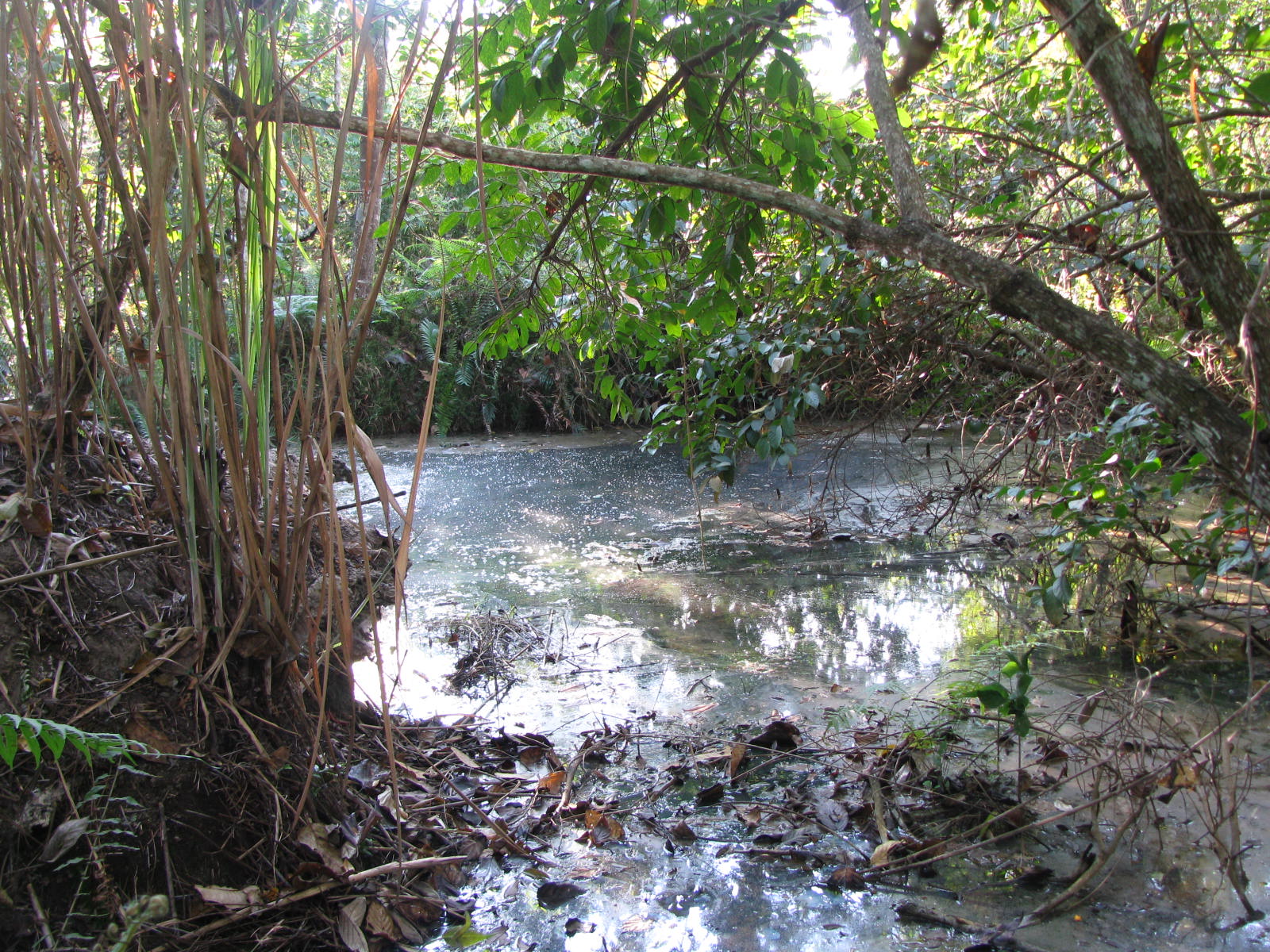
From this pond, one can also walk to a smaller pond. This track is less wide and ends in a marsh-like pond (see photo below) which contains hot water, but not really hot.


Experience
We return back to the resort proper and having decided earlier that we were in need of a soak, head for the restaurant which doubles up as ticket sales point for soakers. Behind this restaurant are a number of small, stinky, damp and dark cubicles with small tubs. Though the soak would cost just 5,000 kip, for the sack of sanity we skip this part.


It always surprises me how such 'developed' sites have little or no idea what a soaker would like. Me quick thinking: take away most of the walls (so one has a nice view of the surrounding) forest, expand the tubs, add a shower and a resting/relaxing corner and you really have something tourists will go out of their way to experience. Now Baw Njai only produces disappointed potential soakers.

Convincing?

I'm not the only one disliking the soaking facilities. ordinary lishtar :
'I’m abysmally disappointed by the hot springs I was sure I was going to experience. The hot spring was there – green and pristine, but to try it out, I would have to go into a small room, equipped with a bathtub and toilet where the hot spring water was connected to. That’s it? I couldn’t believe it. I don’t want to try it out!'
ignatris blogs on Baw Nyai:
'a hot spring that looks like a development project gone wrong, even though the water is really hot'.
Some are more fortunate by opting to stay the night in a bungalow. At least here the bathrooms seem do-able, but not necessarily an exciting prospect. Achikochi Takema has an expansive blog entry on Baw Njai as well as on Baw Noi. His Baw Njai experience describes staying overnight and having a private bath. Drawing the bath though takes more than 5 minutes, just for the hot water to arrive. He also speculates that the spring appeared after a bomb fell at this place, thus explaining the existence of the pond. The fence would have been constructed to protect the spring from the free roaming water buffalo. He also pic's the bathing rooms in the guest bungalows, describing them as a more hygienic way of soaking.

The right way
In a way, it's quite disturbing this lack of insight in tourists (perceived) needs. In this one should take the example of New Zealand. Well-known for it's mountains and geothermal activity, not often do these two combine. So in response there are innovative projects which are not / can not using natural springs but copying the soaking experiences.

See for instance
Onsen Hot Pools of Queenstown
'TripAdvisor members have voted Onsen Hot Pools the best of 74 Queenstown activities for over two years!',
Omarama Hot Tubs
'You have an amazing place there, absolutely beautiful'
and
Glacier Hot Pools (Overall Winner West Coast Southern Alps Tourism Awards 2010).

The above are just proof of how easy it is to attract tourists if one adjusts to their demands. It needn't be so difficult.

On the positive side, some redeveloping of Baw Njai was in the process (bungalows), though I have my doubts whether it will result in better soaking facilities. If only i were manager ...


More
More info (mostly photo's) from the recently discovered Japanese language blog site by yoshidanoharuo. He/she has traveled extensively across the world looking for hot soaks. He/she ranks Baw Noi higher than Baw Nyai, three stars versus two on a scale of just 3.

Getting there: From Phonsavan, Xieng Khouang's provincial capital, head north east to Muang Kham and continue 20 km beyond Muang Kham in the direction of Nong Het. The turn off is well signposted. The resort itself is about 2 km's from the main highway.

Soaking experience: Only for the blind and gullible?

Overall impression: The impression we left with was that of a missed opportunity. How difficult can it be to get it wrong? If I compare with other hot spring haunts in Southeast Asia it's certainly a common theme in the developing of such soaks. Development = not good.

Notes:
[1] Creutz, S., J. Van Den Bergh (2009) A Guide to Xieng Khouang Mountain Province in Northern Laos. Lao National Tourism Authority, Vientiane, Laos.

Sunday, 12 September 2010

Cambodian recall

A feature article in Phnom Penh Post's September 11/12, 2010 weekend supplement, 7D, highlights Tei Teuk Pous, Cambodia's only known hot water spring.

Since my visit (two and a half years ago) nothing seems to have changed. Better background info, though the bottom line is that it still not really worth a visit ...

The article (poorly scanned) but readible. Just open in new tab.
Related Posts with Thumbnails
Copyright 2009 © Soaking in Southeast Asia. All rights reserved.
No reproduction or republication without written permission.