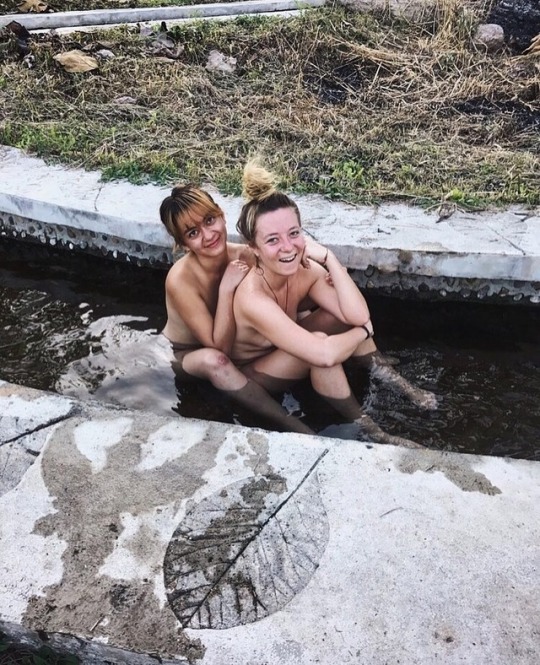
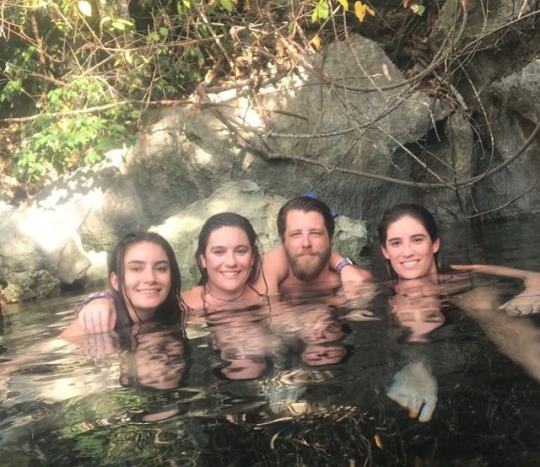
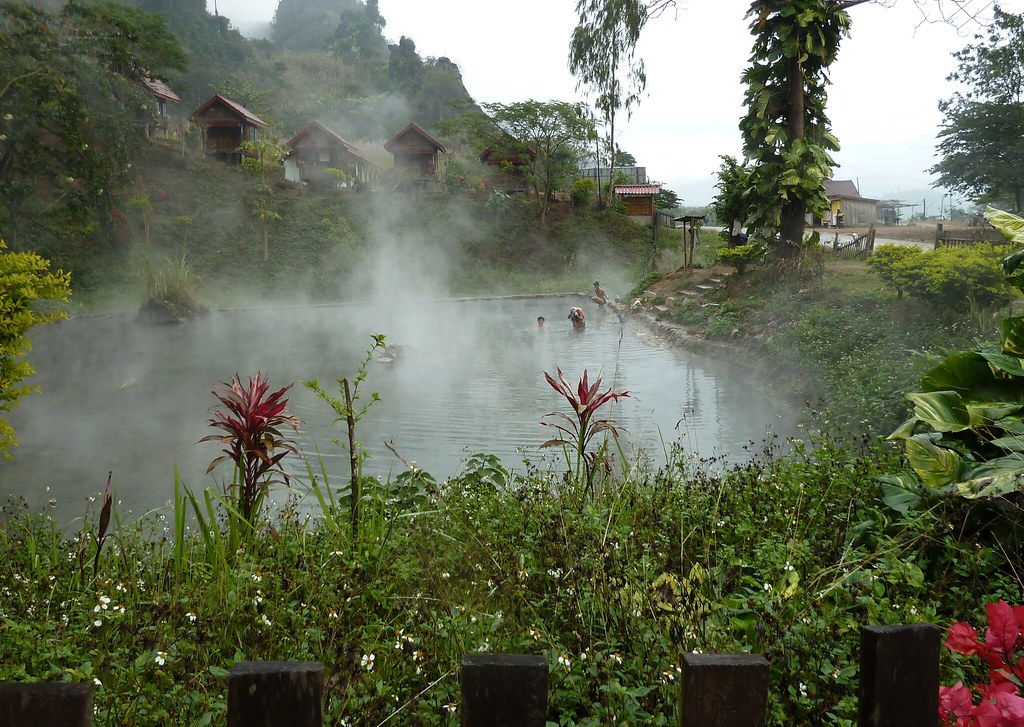
If only I’d packed a thermometer in my bag, then I could tell you how HOT this water was! 🚣🏿💦🌴 #palawan #philippines#hotsprings #holiday #family#backpacking#sangat
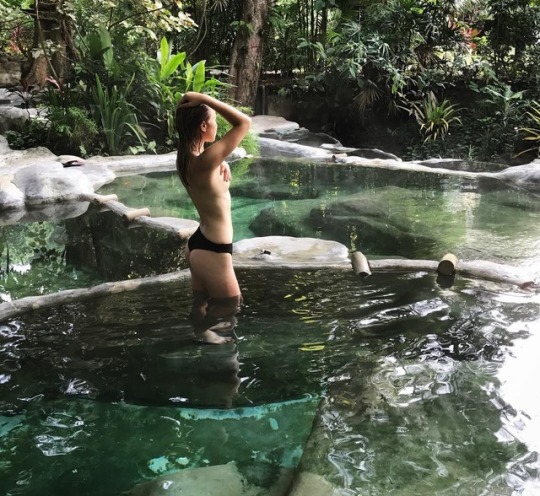
I had an incredible first onsen experience at @hotspringspark!Although it was somewhat uncomfortable for me to completely undress myself in a public place, the fact that we had pretty much the whole place to ourselves made it so much easier to ease into it, as well as taking pictures for the gram 😜.Particularly, I enjoyed the hottest and the coldest baths there, which were around 40 and 18 degree, where both made my skin super smooth and nice afterward ✨..Nov 23, 2017 | #onsen #onsen♨️ #resort#skinnydipping #dipping#shutterremote#wanderlust #travelgram #travel #wander#instatravel#wandering #danang #trip#backtonature #hotsprings#luxurylife#hotspringspark #nuithantai #travelling#wearetravelgirls#exploringvietnam#takingabath
Regionally speaking there are not many theme's attracting attention, so let's start off this posting elsewhere on the globe.
Problems
in the land of free soaking; authorities have first
taken action to limit use of Umpqua hot springs (oregon, U.S.A.) after concluding that
the E. Coli bacteria count was way over the limit (yuck).
Further testing
has now revealed the opposite (Oregon Live, Oct. 9):
'The Umpqua Hot Springs, about 70 miles east of Roseburg, closed to the public due to "very high" E. coli counts
two weeks ago, and now forest officials say the popular springs are
suffering from another possible public safety concern: bleach'.
Though
the former seems to solve the latter, what is evident is the lack of
management (be it government and / or volunteer). This is leading to a number
of unwanted situations with health concerns being the most important. The bleach is also unwanted as it now affords
the authorities with a real good excuse to take severe action which
ultimately will mean less opportunity for soaking. However both situations
are undesired, so in this case we just might have to have a little
faith in government and hopefully the solution will only affect the less
dedicated soaker ....
#nopooping #iceland
Hrunulaug, Iceland: apparently common sense is on a wane; thus the need to heed the hordes?
Also from the US, the situation surrounding the Skinnydipper hot springs is not faring well either. A latest posting on Facebook (Sep. 14):
'I started this page to save skinny dipper hot springs, we got a lot of
likes (almost 10,000!) a lot of people stepped up to help and invested a
lot of time and effort to "save skinny dippers" we met with the blm,
spent countless hours trying to come up with solutions that remedied the
concerns the blm had, remedies that could not appease them because
ultimately they (the blm [= Bureau of Land Management]) wants skinny closed due to the fact there is a
history of documented issues over the many years it has been open.
....
the real issue for the blm that is not being spoken about is that it is
more profitable for the blm to close this beauty than to keep it
open(business is business'.
So not good news
Better news from New Zealand: a geyser has sprung back to life (NZHerald, Sep. 9):
'A geyser which has been dormant for more than 35 years has caught locals off guard after suddenly erupting'.
Though possibly they were not too surprised as the rewired geyser will hardly stand out:
'The Papakura Geyser is located at the Te Puia Te Whakarewarewa Thermal Valley in Rotorua, where there are more than 500 geothermal wonders'.
Having been there myself, there are no immediate soaking opportunities to be had nearby.
Synchronizing Moving on.
Sometimes the sprucing up of local soaks can result in something quite attractive. Dezeen magazine (May 5) reports on a recently constructed architectural gem at Mian Yang (Sichuan). Oddly the pictures are devoid of people. Apparently it's named Well Water Resort. Cheapest rooms start at US$ 125 / night ...
'In Oita Prefecture, this means presenting their world-famous hot springs with a synchronized swimming team in what can only be known as “synchronized bathing”'.
Also published on Youtube:
Taiwan seems to frown on the attire of a Chinese soaker (Rocket News Jul. 22):
'One such visitor, reported to be a tourist from mainland China, raised a
few eyebrows recently. Obviously, you can only spend so long sitting in
a hot spring before you need to get out and let your body cool down
again, and this man decided to spend that time browsing for souvenirs. ... Local media has criticized the breach of etiquette, even as Taitung
shopkeepers say they’ve been seeing an increasing number of tourists
strolling around in public in their bathing suits after exiting the hot
springs. Residents have called such conduct disgraceful. Frankly, we’re
not sure which surprises us more, that the man in the video seemingly
didn’t feel enough embarrassment from the stares he was getting to put
on a shirt, or that he didn’t feel enough pain from pebbles in the soles of his feet to put on some shoes'.
Asia Baffled? So it seems, as reported in the Bangkok Post (Jul. 28). But the baffling this time is done by the need of young tourists to create a lasting souvenir of a visit in the region with taking a picture ... naked. Hmmm ...:
'According to Maria Lombard of Northwestern University, the need for
tourists to connect with locations "in a tangible way" and the ire that
it draws are not new or unique. Ms Lombard points out that tourists have been carving initials into landmarks and historical sites for ages. "This desire to show that "I was here" is not new; just the mode for expressing it is." .... Local officials are also puzzled why Western tourists who flaunt
their bits at revered sites in Asia refrain from doing so in their own
countries in front of landmarks like St Peter's Basilica. "They don't seem to strip off much in the Notre Dame or Hagia Sofia
or any other place I can think of," said Lawrence Osborne, a bestselling
author who has written extensively about the clash of culture and
identity in Southeast Asia. "Modesty and restraint are still respected virtues in the East, so
stripping naked at tourist sites that are sacred or highly visible is
not only taboo in these countries but a "loss-of-face" for local
officials."
Thinkgeoenergy
(Sep. 8) draws attention to the Bacman geothermal power plant. Besides
power generation it has a considerable environment conservation and
protection project, well noted.
'Besides those we visited, the BacMan Geothermal Plant still boasts of
other natural attractions that we weren’t able to check out due to time
constraints. I would’ve loved to photograph the huge Golden-Crowned and
Large Flying Fox bats that dot the treetops of the power plant, the
Inang Maharang Mud Pool, the Naghaso Boiling Lake and the Parang Hot
Spring'.
An Experiance like no other . some peace and soul searching can be found here ! #latergram #mashtravels #chefmash #vacay #Philippines #vacay #travel #asiatrAvel #unwind #relax #greattimes #moments #airasia #manilla #hotsprings #relax #hiddengem #natural #hiddenvalley #waterfall
A very lengthy intro on Phra Ruang hot springs, (trip101, Sep. 9):
'Stay at Phra Ruang Hot Springs for a terrific addition to your Kamphaeng
Phet [province] experience. And, if you listen to local legends, you may also take
away more than you anticipated; supposedly, if you take some of the
water home with you, it will bring you good fortunes and luck!'
bathing in the pai forest [herb] [leaves] #hotsprings #pai #thailand
Sometimes the description of a hot spring experience seems a bit out of here. An example of this comes from Vietnam's Yen Bai hot springs of Son Thinh and Son A. As published in Yen Bai (Oct. 6):
'In the recesses of the hot springs that Son Thinh, streams you view in Son A Tu Le and hot springs are all preferred medium.
...
At Tu Le, two hot spring baths beside cool stream and the shores are
ripe rice fields. A very hot bath and a warm bath. The hot tub is more
or less arbitrary per person. Whenever way down, after a day of hard
work, the Thai girl to pull together down stream Tu Le, naturally shed
her clothes and become the fairy between earth and sky.
At the end of the cold season: the mineral springs and wells
steaming, sulfur-smelling H2S and with an average temperature of about
45 ° C, very good for health. Travelers come here also the bath, the
boys are also allowed to share the bathroom, get playful harmony between
nature, rest or relax in the hot water smelled of sulfur airlines
between nature and details arcade arcade cold sky.
You can also dabble water, chatting with her, the girl pretty red
cheeks, or the extent absolutely must keep their distance and not have
bad behaviors, or they will be young men and punish law'.
'We opted to spend a rather luxurious day at the i-resort Nha Trang. We had a car and driver to take us round trip, and a private little villa, with our very own mud bath! The mud bath was Delicious- like chocolate soup!- and it immediately stopped all the skin irritations (I have Psoriasis) that I'd been experiencing! You actually float in the mud- but it isn't salty like the Dead Sea, and I have no idea what creates that kind of buoyancy! I loved it so much that before we left I bought two jars of the mud powder to take home- and I've been using it ever since! After our mud bath and showers, we had our massages, and enjoyed our private hot spring pools and the waterfall overlooking the mountains- the view was truly enchanting. We had lunch on the patio of our little villa, and I laid out by the pool for a bit... and all too soon it was time to leave...
Travelfish now has a section on mud baths in Nha Trang (Sep. 15). Not all is well:
'Thap Ba Hot Spring, six kilometres from downtown Nha Trang, is cheap and the most popular, which means it is usually crawling with people.
...
Baths are emptied after each round and there’s a big show to spray down
the tubs, but if and how they clean the actual mud is a mystery.
....
the pools [of 100 Egg (Tram Trung)] and facilities are cleaner, tidier and better organised than
Thap Ba. Our mud was pleasantly warm too, and felt velvety rather than
cold and gritty like in Thap Ba'.
Treated ourselves to a mud bath because we can [pig] #danang #galina #mudbath #spa #theblondeadventure
More mud mores catching on, now available in Danang, source
In reality there's little to mention over the past 3 months, despite it being the best time of the year for soaking in Southeast Asia. Now the heat is on us and we can sit at home and soak in our own sweat.
This blog has been busy, adding entries on Lao and Vietnam as well as an extensive standard setting entry on global mud baths and another entry on the most popular soaks this side of the globe. Next month will see a few more entries in Soaking in Siam.
Though not exclusively Southeast Asian I would like to draw your attention to the following. The first is an entry on japansugoi, it focuses on hot springs on tv:
'Fuji TV’s popular onsen ジテレビの温泉番組 show is called “Lets go to the Onsen or Onsen ni Ikou!”. That program was so successful they decided to make an upgraded version called ” Let’s go to the onsen more! or Motto Onsen ni Ikou!” もっと温泉に行こう'!'
There's a long way to go for Southeast Asian soaks ...
Other big news from Germany's Focus magazine on New Zealands Hot Water Beach. A good write up (if you can read German)
From the blogosphere, a description of Ban Nam Ou, Lao on travelfish:
'Everything is shabby and funky but also crazy and cool'.
'Native laotians bathing in the hot springs south of Luang Prabang I saw this incredible view out of the bus window, near Nan Keng on the highway between Vientiane ad Luang Prabang. (Geotagged picture, thats how I know), people bathing in steamy water - but my camera was tucked away and I didn't have time to catch it. Then 10 seconds later he bus stopped to let out someone who had to pee :) I grabbed my camera and ran back 200 meters and catched this picture, it was one of the rare minutes it didn't rain on the whole (11 hour!) bus trip back to Vientiane'.
Tiermas, Navarra, Spain: natural geothermal spring and mud bath: better than a soak? By Patrick_22_b:
'TiermasStuwmeer met zwavelbronnen bij ruïnes van oud dorpje'
Popular
Hot on the heels of Soaking in Southeast Asia's blog on Thap Ba hot spring (Nha Trang, Vietnam) I got to wondering what would the basis of this hot spring's success. Some suggestions in that blog were:
ease of access,
high degree of visits by tourists and
many potential domestic visitors.
But these do not seem to be the key.
Elsewhere Soaking in Southeast Asia read that the rate of foreign visitors versus nationals was like 40:60, a fact which in itself is not so surprising. However on most visits to hot springs in Southeast Asia, I was the only foreigner. So why so many foreigners?
The only reason why, could be due to the difference in tourists nationalities (many Russians) and/or the potential to take a mud bath.
Yes, mud. Essential to the Thap Ba experience is a mud bath. While in Nha Trang, tourists will go out of their way to take a mud bath, a highlight of their holidays.
Now, as slopping around in slurry is such a draw, why aren't mud baths more commonplace?
Research
Soaking in Southeast Asia put this thought into some research:
Mud is healthy
Yes, besides vitamins and organics, mud is essentially a lot of minerals packed together. And we know that these minerals are an essential part of hot spring soaking. And bathing in hot mineral water can assist disease treatment, as well as have marked health benefits when used long term.
World's most used online reference manual, Wikipedia, hardly expands on this theme which seems a bit strange. 'Therapeutic' is one suggestion, another points to 'relieving of arthritis'. Others inputs include 'healing properties' and 'skin revitalization'.
A better source of reference is the medindia.net entry on mud baths (under the alternative medicine chapter):
'Mud bath is a detox therapy, which has become extremely popular around the globe. Until rather recently, many European practitioners promoted mud baths as a treatment for arthritis. This back to the basics, relatively simplest of alternative therapies, tends to help relax muscles, soothe aches, improve blood circulation and smoothen the skin. With today's emerging trends mud baths are often recommended to help reduce stress and leave us feel rejuvenated at the end of the session.
...
Taking a hot bath or sauna promotes sweating that flushes the toxins away from the body. Mud baths draw out the toxins and impurities from the body, exfoliating and nourishing the skin'.
Despite this
'Deep relaxation is the primary and most-proven reason to take a hot mineral mud bath. The warm, soft mixture cocoons and buoys up the body and sucks the stress out. There’s no pressure anywhere on the body. The heat of the mud (usually over 100 degrees Fahrenheit) makes you perspire and cleans the pores. The treatment consists of 10-15 minutes of immersion, which improves the complexion, removes toxins, and soothes and relieves joint and muscle pain' (source).
Ooh, that sounds great.
'Analysis of Mud'
From Hell's gate, Wai-ora, Rotorua, New Zealand. Source
Another good source of info is the about.com page on (mud) spa's in Calistoga, California, U.S.A.. Historically it mentions that Cleopatra was one of the first users of (in her case) Dead Sea mud which appears to be the most widely used mud in mud treatments in the global spa industry.
The combination hot springs and volcanic ash seem to be the key. So no wonder that other popular muds are from New Zealand, Ischia and Hungary. Other well known muds (not necessarily of volcanic origin) seeing global use are Multani Mitti (India), Moor Mud (Central Europe; high organic content) and Great Salt Lake mud.
Another trend setter was Queen Sheba (source). Soaking in Southeast Asia notes that links seem to favour queens ... No, not. When retreating from Bulgaria, Hitler has been said to have asked for three train wagons full of local mud (source)!
Bhutan believes that the use of mud can heal war wounds (source) though it doesn't mention whether this concerned physical or psychological wounds ...
Even throughout the animal kingdom, mud baths are known for their propensity to cool down, provide positive skin healing and a source of additional minerals.
Some notes: - A mud wrap distinguishes from a mud bath as it is essentially a layer of mud brought on the skin, left to dry and then rinsed off, in general less relaxing. - Clay vs mud. Medindia:
'Clay like mud comes from the earth. However, due to its composition nature it has a tendency to soak up or dry, hence it is used in cosmetic products as a drying agent. It is a component found in many cosmetic products like foundation and powders. Clay has the ability to remove matter suspended in liquid, as its natural property is oil balancing. Thus, clay helps to assist the body in the systemic removal of many industrial chemicals that the body would otherwise have difficulty eliminating'.
But a clay bath?
- Sand baths are quite different, though very easy to produce on a beach. Beppu, Japan has geothermal warmed sand baths. - Clothing? Any family laundry person would effortlessly point out that mud and clothes are not an ideal combination. Clothing seems to get in the way. For instance, a month after I visited Thap Ba there was still dirt stuck on me after a swim. However other than in festivals (see chapter below on anti-society) clothing seems to be an important part of the more social forms of mud bathing. Naturally further off the paved road, less so. But with a few exceptions (see below: Krinides, Hoyo) the major mud baths of the world are not clothing optional. No clothing in mud is offensive? In NZ they think not ... - Mud-wrestling. looks like fun, but why are only women involved? Soaking in Southeast Asia thinks it's not for vanity sakes ...But what should be stressed is the fun part, relax part and possible social part (We tend to forget socializing in our modern day spa's, it's all me, me, me).
Mud is anti-society
Is it? Society seems to prefer clean and proper. Even as kids we know the best way to upset parents is to get dirty. So why not muddy?
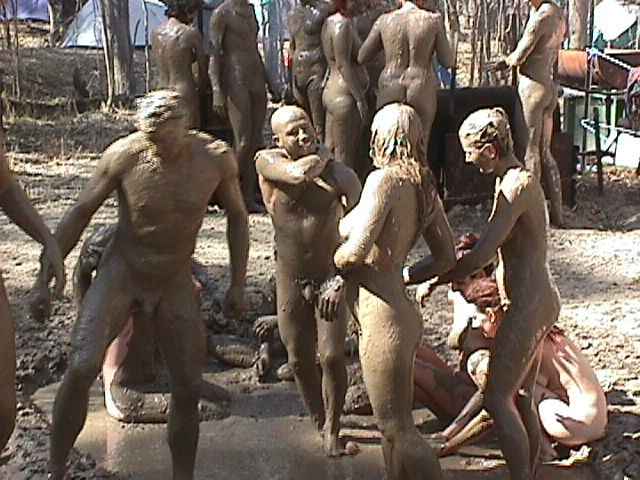
Extending this theory, it's easy to see why (pop)festivals go out of their way to feature mud. Even the first festival of festivals (Woodstock) saw revelers seek to unconsciously shock older generations with a mud bath.
Besides underlining their supposed street credibility, at the end of the day a mud bath is just plain fun. Do note that clothing was / is optional and often dispensed of, in favour of practicality while simultaneously increasing the 'shock' value (at least initially, now not so much more in current days ...).
The Burning Man festival plays out on a dry lake bed deep in Nevada, U.S.A.. Despite the hot spring (muds) of Trego nearby, revelers take the opportunity to enjoy a mud bath during the festival itself. Photo by Gorightly:
'mud_peopleThe attack of the naked mud people, Burning Man, 1997 or 98'.
Note:
Not under anti-society but with the summing up of festivals, in India the festival of Babba Jitto (Jhiri, Jammu) pays tribute to the liberator of the farming community. Besides a holy bath devotees also cover themselves with 'holy' mud (source).
Mud is different
Seems logical.
Mud is cheap.
Mud is everywhere, so a mud bath can be had virtually everywhere as long as it doesn't freeze. That said, there is a tendency for mud baths to take place in the summer or in warmer climes.
In reality there are not many naturally occurring hot mud baths. Nearly everywhere where there is hot mud, there's hot water and thus the latter is more desirable for consummation ...
That's not to say that taking a mud bath in a spa is cheap. Glen Ivy in California charges $85 while in the same state in Calistoga spa's charge about $65. Prices in Europe are no less cheaper ...
Muck around the world
Following is just a short overview of natural mud baths (excl. those spontaneous ones occurring after a rain shower) as well as whether or not these are thermal mud baths (gt: geothermal). Oddly many mud baths are also located on or near a beach.
So if worldwide available, they most certainly exist in Southeast Asia? Yes, they do.
Though hot springs have a certain following / touristic value, mud baths are yet to catch up in possibilities despite all what can be said in their favour.
As said Thap Ba (in Vietnam) is by far the most popular in Southeast Asia (even though the mud is resourced from elsewhere, the suggestion that there is both a hot spring and hot mud endures) and others spas and hot springs in the same country are catching up, for instance Binh Chau.
Outside of Vietnam there is the Phu Klon of Mae Hon Song province, Thailand which combines hot water and naturally occurring mud. Marketing wise they are mainly focused on the 'spa' crowd (as opposed to those who want to experience / have fun). At the lower end is the ad-hoc mud bath near one of Pai's hot springs.
The same focus on higher end tourists applies to the mud baths of Pinatubo, Philippines.
Then there are the mud 'volcanoes' on Malaysia's Pulau Tiga, an off-shore island off the state of Sabah; the islands high point for tourists is the experience of a mud bath.
Another hot item on the tourism trail. Malaysia's Tiga island mud volcanoes. By cephiroth.chin:
'Pulau_Tiga_27 Here you are: Transformed into Mud Man! Actually its adviseble not to jump inside the mud area, to avoid mud go into your eyes & mouth~~~'
Sarawak hosts Kampung Meritam's mud volcanoes (source). Here's an experience by Wilson Chin. More off the track is Bali's Singsing waterfall which should include a mud bath. Not when I was there.
More popular is the mud bath of Vang Viang (Lao) which probably is just a wallow of mud watered from the nearby Nam Song river; with the large amount of near drunk visitors and the lack of drainage there's probably a health issue here, but nevertheless popular. It's more for the rite of passage than any health aspect.
Are there any more mud baths in Southeast Asia?
Muddying the business Sensing both the increasing popularity and the untapped resources of mud bathing in Southeast Asia, one would expect this to be a growing trend both to expand the offers as well as appealing to a younger generation. Soaking in hot springs in Southeast Asia as well as worldwide is mostly associated with the elderly and as this blog entry witnesses, the young are often as eager, if not more so, to indulge a soak if dirty (and weird) business is included.
One aspect that might deter the popularization of mud baths, is that muddy baths require possibly even higher standards of hygiene, a fact which could give the whole sector (especially here in Southeast Asia) an impulse to improve standards (but a not much loved move away from naturally, the way Soaking in Southeast Asia approves of ...).
Certainly in Vietnam, I have seen some companies willing to get in on the business. Especially around Nha Trang, despite the proximity of Thap Ba, many high-end hotels are offering their 'own' mud treatments. Naturally they will be followers and though to a certain limit stand to profit from Thap Ba's popularity. On the other hand they'll miss most of the free publicity, why on earth would visitors sign up for an expensive clinically mud treatment when the real thing is just around the corner? Snobbery?
But think about it, Vietnam for instance has quite a few hot springs but usually they are at least 2-3 hours away from each other, so most probably no competition from each other.Another factor favouring the development is mud's cheapness.
Even more exciting is the recent event of new 'mud volcanoes' coming to life. Though Azerbaijan is struggling with it's mud volcano, in Ninh Thuan, Vietnam new mud volcanoes have occurred. Who know's, this might be a destination of the future. Do note that a mud volcano does not always offer an opportunity for a mud bath ...
That's not saying that all mud is good. Probably the worst example of mud gone bad is here in Southeast Asia where in Indonesia, the Lapindo mud lake stands for poor planning, poor regulation and implicit government involvement in avoiding offering adequate compensation to those affected.
Epilogue So quite an exciting business, might just warrant a blog of it's own ...
On a totally different aspect, I came across an article in the Sueddeutscher.de about Munchen's last mud bath. In the article it mentions how in 2009 the last public multiperson mud bath of 2 by 4 m of Munchen was to close. Decreasing numbers of visitors:
'"Wellness muss eher sauber und steril aussehen" - und nicht braun und schlammig'.
Which translates as wellness should be clean and sterile - not brown and muddy. Really. Soaking in Southeast Asia begs to differ. And increasing costs: Two truckloads of mud were required each week costing 400 Euro each. Not so dirt cheap!
Populous Thap Ba hot spring rates as one of Southeast Asia’s most popular hot springs. In Oct '09, Soaking in Southeast Asia compiled a Top 10 of most popular soaking sites based on references from internet sites such as tripadvisor, flickr, google and yahoo. The outcome saw Thap Ba ranked seventh.
So what factors would help in making a hot spring site popular? For one many people have to visit it, so close to major concentrations of persons.
Yes, Thap Ba is close to a large city, but so are Sembawang (Singapore) and Bentong (Kuala Lumpur). But not highly ranked.
Touristy area then.
Yes, Thap Ba is just outside Nha Trang, the number 4 destination in Vietnam. But other hot springs are also near popular tourist sites such as Hin Dad (Kanchanaburi), Pha Soet (Chiang Rai) and Klong Thom (Krabi). But not Top 10 material.
So it must be Thap Ba itself.
Many tourists recommend (see blog sites / tripadvisor) a visit to Thap Ba hot spring and though on occasion these authors will go out of their way to write down their negatives, it must be due to the shared positive experience that they feel compelled to share this on internet. Thus contributing to Thap Ba receiving even more fame, more visitors.
Also their feedback helps out with sites such as LP (mysteriously LP ranks Thap Ba as only the no. 5 thing 'to do in Nha Trang'), whereas tripadvisor ranks it as no. 1 of things to do in Nha Trang. This despite there being local competition from for instance a huge man made resort, Vinpearl Land, which includes the world’s longest over-the-sea cable car and the biggest wave pool in Southeast Asia (even though being next to the beach). Independently, in2vietnam.com alludes that Thap Ba is Vietnam's 'most famous' hot spring.
Access Located on the outskirts of Nha Trang, Khanh Hoa province, the hot spring of Thap Ba is easily accessible. After crossing the Cai river and 100m after passing Po Nagar Thap Ba tower one needs to take the road right.
Po Nagar is a Cham-culture ruin whose origin predates even Angkor; suggestions date it's origins back to the 7th century. A sight in itself, it’s a nice place to look around, view over the Cai river, but possibly not much has been left over of the original building.
Anyway, the small street off the major northern artery leading out of Nha Trang winds it’s way over a few hillocks through what could be described as Vietnam’s suburbia: freshly built narrow 2/3 story buildings interspersed with vacant lots. At the end of the road (2 km), beyond a street full of shops selling tourist knick-knacks, lies the entry to Thap Ba Hot Spring Center.
Late afternoon, there are still crowds willing to enter. The ticket office is the place where one needs to decide what treat(ment) one requires, even though it’s not so clear what the to be paid fee include.
Ummmm
Murky Ten $US lighter, I can enter the site, on my way to a mud bath (single), followed by a hot bath.However before that fun can start I need a drink and manage to sneak off to the restaurant, much to the annoyment of the counter ladies. Drinks are for afterwards (?). They really are organized here.
After lessening my thirst I return to the counter where (after showing my ticket) I’m given a towel and told to change, ‘men at back’. Behind the lockers are about 10 'tents' where the men are supposed to change.
Mud baths on terraces to the rear, blue and whiter changing tents for men. From flickr, by pinkpapper8
Thereafter I am sent up the hill, past big empty basins.I then hand my ticket to an attendee and are told to take a shower. After obliging, I am shown the first wooden tub which is filled with fluid warm mud in 10 seconds. Take a seat.
Well one can actually lie down: the tubs big enough for two. I have to admit, the mud bath is very appealing: it's warm and silky. I stayed in the mud for about as long as allowed; eventually the attendee tires and sends me on my way.
The tubs are shaded and are located above each other on terraces going up the eucalyptus clad hill. Though intended with view, the view itself is not really enchanting. The hill though is alive with soothing local music, unless of course you get all worked up, having to involuntarily listen to Vietnamese muzak.
'Mud bath, Nha Trang Bathing in mud at a natural hot spring in Nha Trang, Vietnam. The minerals are supposed to be really good for you, and despite being a bit sceptical about the actual health benefits, we went anyway because, let's face it, playing in mud is just fun!'
I also have first class seating overlooking the showers and can observe the trials and tribulations of rinsing after a mud bath. Especially women with full bathing suits are struggling. Once it’s my turn to shower I discover why: even after a 10 minute shower, a hot bath soak, swimming in the mineral water pool, sitting underneath a waterfall shower; still then my speedo’s contain a handful of sand/grit.
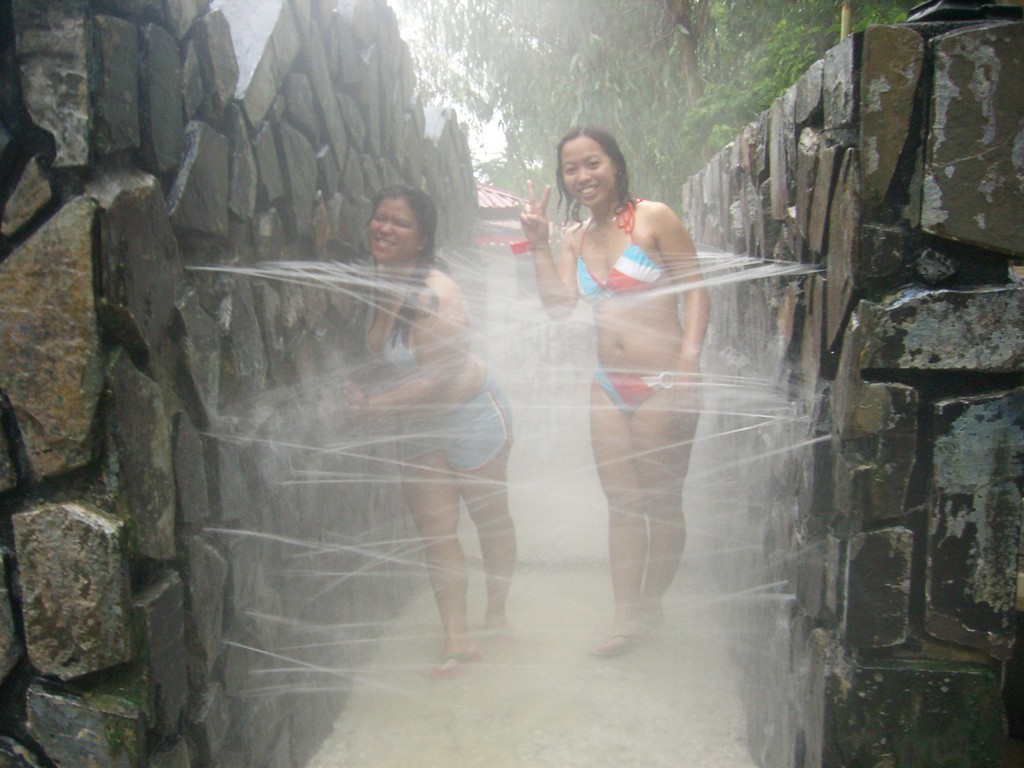
And clear Once one has believed to have rid oneself of most of the mud, it’s back down the hill, where another attendant tells you to go through the hydrotherapy walls. These walls are five meter in length, and water is spouted out from the wall with high pressure, as a way of massage. One can walk to and fro but this concept seems to have forgotten that many visitors who partake are foreigners, whose body mass is above belly-button height.
Directly behind the hydrotherapy walls are about 20 cement basins (some bigger than others, but even the smallest accommodates two persons easily; these are heart shaped …) which are filled up individually for you. Half an hour max here again and then the surplus paid part of the ticket comes to an end.
Beyond all this are two large hot water pools (not too hot), one free form deep pool, another less deep and circular. Using these pools can be done at leisure and independent of the mud part. And those who have paid up for mud treatments receive loungers to while away and recuperate ...
The larger pool
Secrets no more So have I found the secret to Thap Ba’s popularity?
Possibly not, but judging from the great numbers of visitors, many who make the impression of being regulars, the facilities would be high on the 'to do' list of many Nha Trang visitors.
The experience? Possibly a bit too routine for everybody, the treatments on offer though, are way below western prices and are enjoyable in themselves without the need for proof of additional health effects. It seems that a visit here has become a Nha Trang visit-must. Even though publications such as LP [1] hardly provide any form of lip service (is that possible with books?). It does mention that Thap Ba
‘is one of the most fun experiences on offer here [Nha Trang]’.
Sims [2] notes
‘It’s a must for Vietnamese tourists who swear by the healing power of the springs, though most tourists just get a kick out of taking a communal bath in a mud broth for the first time in their lives’.
Other positives I can take away from here are the ease of access and mostly clean facilities. Management of the therapeutic side are good, though the restaurants seem a bit dilapidated with at least the pizzeria having exceptional poor service.
Thap Ba management are well content with themselves: outside the entrance is a small building containing all the prizes/accolades the facilities have won!
However feeling intrigued by the many positive postings on (mud baths of) Thap Ba, I am planning on a future posting on exactly that, mud baths. In my research I found that much of the feedback concerning mud baths worldwide actually concerns Thap Ba. A google blog search of for instance "mud bath"+ "hot spring" reveals that nearly 1 in 5 links actually concern Nha Trang!
It also transpired that much of the global mud baths are spa treatments for mostly singular or duo consumption. Expensive, these mostly are directed at older audiences. Whereas the cheaper Thap Ba version for groups find many much younger (and possibly internet savvy) takers. Voila, the secret! (I also assume that as one of the first hot spring centers in Southeast Asia to offer a mud bath, that they also receive much 'free' publicity). The best? So could it improve? I think so. It seems sometimes a bit like an assembly line business with little or no personal touch. Having better showers or allowing nudity would also help, especially if promoting the wholesomeness of mud and water while simultaneously requiring bathing costumes (which in itself is very un-Southeastasian like).kyralove adds:
'Next is mud-bath! Hippy me is expecting a private bath, or at least a woman's section and a men's section, but all the baths are next to each other. Not that I care about being naked in front of others, but if I get so many stares with my clothes on, then no way does putting on a show for the local boys sound fun. Since it is late there is only one other couple in another tub... But ours is still not private at all. WTF? I have on a white bathing suit, no way am I getting it muddy! Who takes mud baths in their clothes? It's just wrong! Somehow I gracelessly maneuver out of my bathing suit under my skimpy towel and get into the warm mud. Ahhh... warm mineral mud under mountains and stars. Uh, oh, I float in this mud. It's harder than it sounds to keep my body completely submerged. It seems like as soon as I get comfortable, the mud starts disappearing. Oh no! They are draining the tub! I somehow manage to get my bathing suit back on, just in the nick of time (my towel has mysteriously vanished). So much for keeping my white bathing suit white....'
The lengths one goes to keep the whites white ...Going more upscale does enable more naturalness. Apparently privacy is for sale at Thap Ba. Under the name of V.I.P. Spa ('Secluded and deluxe recreation') one can have a private pool higher up the mountain, included with a villa. The price is just under US$ 100 p.p., prices dropping with more persons. This website adds
... service as soaking in mineral mud, massage with natural medicinal herbs, sauna – steam bath, private swimming pool and complete relaxation in a private room'.
The exclusivity is used as a major selling point, it’s seldom in the hot spring company's p.r. that one sees a pool full of mud bathers, though many pictures of a naked back of a female soaker (see this website for instance).
Sign outside the entrance. See top part of billboard for V.I.P. p.r. ....
And that while most guide books indicate that nakedness in Vietnam is strongly disapproved of. For instance LP[1]
‘totally inappropriate, even on beaches’.
Despite all the paintings and arts you'll experience when visiting Vietnam celebrating exactly that and many legends dedicated to bathing fairies (see for instance the legend of Hon Chong promotory, just outside of Nha Trang).
Where were we? Uh, yes. A step lower in price than Thap Ba's V.I.P. spa is the Tien Sa mineral water pool ('Enjoy your love from nature'), the privilege of one's own hot tub is less than US$ 50 p.p., again prices dropping to US$ 250 for 6 persons. From the photo's it seems very private between forest with it's own loungers next to the tub, not at all bad ...
Then there is also the possibility of a steambath and massage (US$ 11 p.p.).
So all in all, not too much to improve on ....
More info Thap Ba's p.r. also goes out of it's way to promote soaking and especially the source of it's waters. They are slightly salty which is
‘rich in Sodium Silicate Chloride’
and finds it’s source from 100m deep underground. Furthermore
‘The mineral water penetrates the skin, depositing NaCL and some other elements under the skin, cleansing and rejuvenating it as well, increasing the body immune system and capability of resisting inflammation’.
On mud:
‘Therapeutic mud bath and salty mineral water can help cure chronic rheumatism, gynecologic inflammation, bone tuberculosis. …The mineral mud in Thap Ba Hot Spring Center is an inorganic mud especially rich in Sodium Silicate Carbonate as well as some other micro-elements. These elements stimulate the nerves under the shin, creating reactions in the whole body through the cerebral center and the cortex. The stickiniess of the mineral cleanses the skin, leaving it finer and smoothier’.
It does not mention that the mud comes from 60 km away, the source though highlighting the (possible) significance of 'health tourism' in general for Vietnam by focusing on Thap Ba:
'Despite natural medicinal tourism being new to the country, Thap Ba received some 400,000 visitors last year, about 5 percent more than in 2007'.
'mineral water is pumped from a depth of 100 m directly from Vinh Phuong mineral mine 4 km from the centre. It is completely hygienic. Mud extracted from (Ninh Loc) Ninh Hoa experiences centrifuge in order to move away sedimentary mixtures such as sand, stones, gravel, etc for the softest mud. It is then heated for bath'.
So what is playing out is not so natural after all.
It also adds:
'The centre though a non-State enterprise and operating in a new field has soon perfected itself and become a springboard for the advance of the Khanh Hoa economy in general and tourism in particular. Its advent positively changes the living condition of residential areas with the most exceptional difficulties in socio-economy of its kind in Nha Trang, increases local budget collection and provides jobs to over 100 local labourers'.
The interesting article concludes with a research overview of the potentials of the local hot water. Anyway as a parting gift, let me assure you that Nha Trang is a nice place, it has a beautiful and bustling shoreline and many islands to explore, a great destination for a holiday. Inland are also some great places to discover such as the waterfalls of Ba Ho and Suoi Tien stream.
Getting there: Head north out of Nha Trang taking the inner bridges over the Cai river. After 100m past the Po Nagar ruins take a left and continue (2km) to the end. Soaking experience: A grand experience, must rank as one of the best I have visited. (Other greats are Tatopani (Nepal), Hamner and Turangi (New Zealand). Overall impression: Full marks, even though experienced with nature out of bounds.
Update [June 2012]
As could be expected when something has become so popular you will get the cheap rip-offs. Nha Trang is full of spa's which also let you experience the mud, but whether or not the mud is genuine is a mystery. The same could also be said for this mud bath. The only advantage it may have over all the others are the social aspect (big baths), the shared aspect (there are many others) and the fact that they have more to lose.
But losing may be well on the cards. A mid-2012 opening of I-resort looks set to drive Thap Ba out of the market. Placing itself slightly more upmarket, slick design and the avoidance of cheaper guests are set to draw in the more creditworthy locals as well as a significant portion of the well-heeled tourists. It's very neat website has quite a bit of promo material and the site located not even that far from it's competitor surely must be able to tempt potential visitors.
'We paid VND2 million (US$96) for a mud
bath, which is the rate for a family of two to four. We were given a hut
with wooden basins to pour mud and mineral hot water over ourselves.
There were also soft drinks, fruits, ginger tea, snacks, and massage for
the money.
The service is excellent with staff always available outside the hut, ready to meet any customer need'.
'We were driving around in search for the thap ba mud baths but saw
signs for another one and stumbled upon a fancier mud bath and mineral
water facility close to nha trang. A little bit of a drive but very
quiet surroundings. It was more expensive than thap ba but well designed
and affordable. We got a mud bath tub (had some salt and extra herbs or
something in the mud too) which included use of the mineral waterfalls
and swimming pools for 300,000 per person (inc. water, towels and a
locker). There is a restaurant and bar inside too and to our surprise
with very reasonably priced food and drink.
There is also a spa too but a little expensive for Vietnamese standards. Lots of Vietnamese people and Russians here too.
Overall a great mud bath experience in a clean, peaceful surrounding'.
More styleful photography of the resort can be found here.
Success may not be guaranteed, the company involved is mainly focussed on seafood ...
Notes: [1] Ray, N., Y.-M. Balasingamchow, I. Stewart (2010) Vietnam. 10th Edition. Lonely Planet, Footscray, Australia [2] Sims, A. (2010) Nha Trang Guide Book 2011-2012 Edition EBT Media, Nha Trang, Vietnam.
With this site I hope to get interest in the geological phenomenon known as hot springs. And enjoying them. Soaking. Here. In. Southeast Asia. In many countries visiting hot springs is a favourite past time, strange as it may sound in such steamy nations, hot springs tourism is well, er ... hot in Southeast Asia. I am trying to maintain this site with supplying first hand knowledge, trolling the net for other sources and hopefully contributions from other soakies. So if you ever feel the need to contribute just contact me,
jhdubbeldam@ hotmail.com
Soaking in Southeast Asia visited hot springs postings
Pasta & passion
-
*healingis_hotFosso Bianco & more termes of Italy pt 3 — the journey , what
fuels me to get to hot springs … lots of pasta 🍝 and a passion for
honoring ...
Torrent
-
*tea_for_taryn*
*There is a snug, shady corner of my heart reserved for skinny dipping on
top of waterfalls. The same cannot be said for torrential downpo...
Harness
-
*bethy_the_vt_hiker*
*The Jhinu Hot Spring ✨️*
*Amazing... I highly recommend visiting when you are in Nepal 🇳🇵*
As usual, quite little to share, especi...
Cooked
-
*kamshingwai*
*Cooked ♨️🇹🇭 #hotsprings#thailand*
A look at a couple of photo's popping up from the soaks of Siam.
Starting south-ish.
Above Taryn hot ...
Spa Scandinave Les Bains Vieux Montréal
-
When you enter Spa Scandinave Les Bains Vieux Montréal, it is a very
different Scandinave experience. Though the circuit is familiar, the
setting is not. I...
The Terme di Sirmione and its Miraculous Waters
-
Featuring Guest Blogger Sophia Knowles We are pleased to feature a guest
blog by Sophia Knowles, who presents our first article on the geothermal
waters of...
Seoul, Dongdaemoon - Haevitch (Havitz) Spa World
-
Guest reviewer: Cami
This spa is on the 12th floor of the Cerestar building in Dongdaemun, right
behind the Migliore building. Exit Dongdaemun station at...
Spring Dance Hot Tubs Virtual Showroom
-
Our owner Dan Sine was recently interviewed about our company during the
Suburban Home & Garden Show last month.
In this quick video he talks about the hot ...