Showing posts with label Mud. Show all posts

Sunday, 14 October 2012

Sulfur, Siam & self-indulgence

Not much self generated news this time, so let's go to the regional soakers press:
The Jakarta Post (12 Oct) has a feature article of the hot springs at the foot of Gunung Sibayak on Sumatra (Indonesia), previously highlighted on this site. The village of Semangat Gunung counts 9 commercial soaking sites and according to the article can 
'remove dandruff'. 
Also noteworthy: 
'Sulfur powder is obtained by sieving sulfur water after being laid exposed for one night. It is sold at the price of Rp10,000 (US$1.04) for three packs. Many tourists buy the powder. Sugiran, a tourist from Medan, was one of the visitors buying the powder. He said he had taken a sulfurous bath for the first time and was interested in applying the powder to heal his skin disorder. “The rash on my body will hopefully be cured by this powder,” added Sugiran while soaking in a pool'.
Bathing in Borneo
 The local Post reports (9 Sept): 
'The hot spring at Kpg Panchor Dayak along Kuching [Malaysia]- Serian road recorded 15,076 visitors in the first eight months of this year'.
That's 60 a day for recently improved springs. 
'The Mambong MP [Deputy Tourism Minister Datuk Dr James Dawos] advised the village chief to request for parking space from the local council and electricity to be connected to the area. He said his ministry was willing to help'.
Hmmm, lets not hope it's a road to ruin. 

A very neutral review of Southeast Asia's most popular hot spring, Poring, with the addition of this: 
'If you are shy to bath in public, you can pay a little more for the private room located in the cabin behind the hot spring. Each room can accommodate two people. Remember to bring your swimsuit as you are not allowed to get naked in public in a Muslim country...'. 
?

Thai Tales
Travel Thailand has an entry on Thasatorn hot spring, Suratthani, Thailand. Some nice pictures, other not much to add to the Soaking in Siam blog entry. Travel Thailand does have an entry on the hot spring of Samet, Chaiya, Suratthani: 
'At Tambon Samet in Amphoe Chaiya, Surat Thani Province. away from Amphoe Chaiya about 4 kilometers hot springs is holy water. consists of two small caves and two natural hot spring'
Again. nice photo's.

Sai Ngam hot spring, Pai, Mae Hong Son province, Thailand. 
Photo found on picasa site of Ka zu. Apparently this hot spring is a tourist destination waiting to be discovered with a few tourist bungalows present.


By the way, Soaking on Siam has once more an overview of press clippings on the newly opened Yunomori onsen, a natural hot spring bath house in the center of Bangkok. Most comment on how outlandish the Japanese bathing culture is towards the conservative Thai society (as well as that towards the anglo-saxon reporters backgrounds), though they note that many Thai join in. All glowing repotrys (not only literally ...). 
I have two questions, one about the source of the water and the need to keep the water sanitary. And the other weather this may prove to be a new trend in Siam soaking, set to be replicated by the copycats (I WISH)?

Meanwhile in the Phillippines, an individual is doing just that ... 
'It was deserted but not closed. I was the only guest that day. Perfect for skinny dipping which I did!' 
Looneyplanet visited the hot spring of Baslay on Negros. And enjoyed it, despite the absence of crowds. Or because there were none ...

Otherwise
An interesting side theme. Ahave, an Israeli cosmetics company has been accused of war crimes by mining Palestian-owned resources: mud. The company response: no comment. Report by Sydney Morning Herald (4 Sept. 2012). More info on the controversy on Wikipedia.

Geothermal news: this time it is the New York Times (Oct 1) which picks up on the discussion in Japan on whether or not to promote geothermal energy generation.
'Then came the Fukushima disaster.
In March, the government lifted its decades-old ban to allow geothermal projects in five new potential sites in national parks and monuments to go ahead, under strict oversight.
Tightly regulated or not, that decision has inevitably caused tension between conflicting local business interests, environmentalists and geothermal energy developers. In Yuzawa City, for example, existing and prospective geothermal power generation facilities typically are close to the hot spring resorts.
...
Mr. Sakaguchi, the researcher at the industrial science and technology institute, said he understood the concerns of Oyasu’s onsen innkeepers.
In two known cases outside Japan, geothermal power developments have caused hot springs to dry up, he noted. One such case was recorded in the 1970s in Steamboat Springs, Nevada, he said.
Still, “a clear case of geothermal development causing a hot spring to dry up has not occurred in Japan,” Mr. Sakaguchi added. “The technology to pick up underground movements and simulation technology has really improved in the last two decades, so the risk is much lower.”
It typically can take 20 years to develop a geothermal plant, if only because it takes time to earn the trust and cooperation of local people, Mr. Sakaguchi said'.
Elsewhere a review of Japan and renewables mentions this: 
'Even geothermal, touted as a vital energy investment in Japan given the country’s abundant hot springs, is facing a battle with local resorts – the Kusatsu Hot Spring Resort association, on Kyushu island, announced opposition to developing the clean energy for fear that the precious mineral hot springs would decrease in supply'.
Meanwhile other nations are less restricted by the soaking set. Vietnam announces a project to come online at the end of this year.
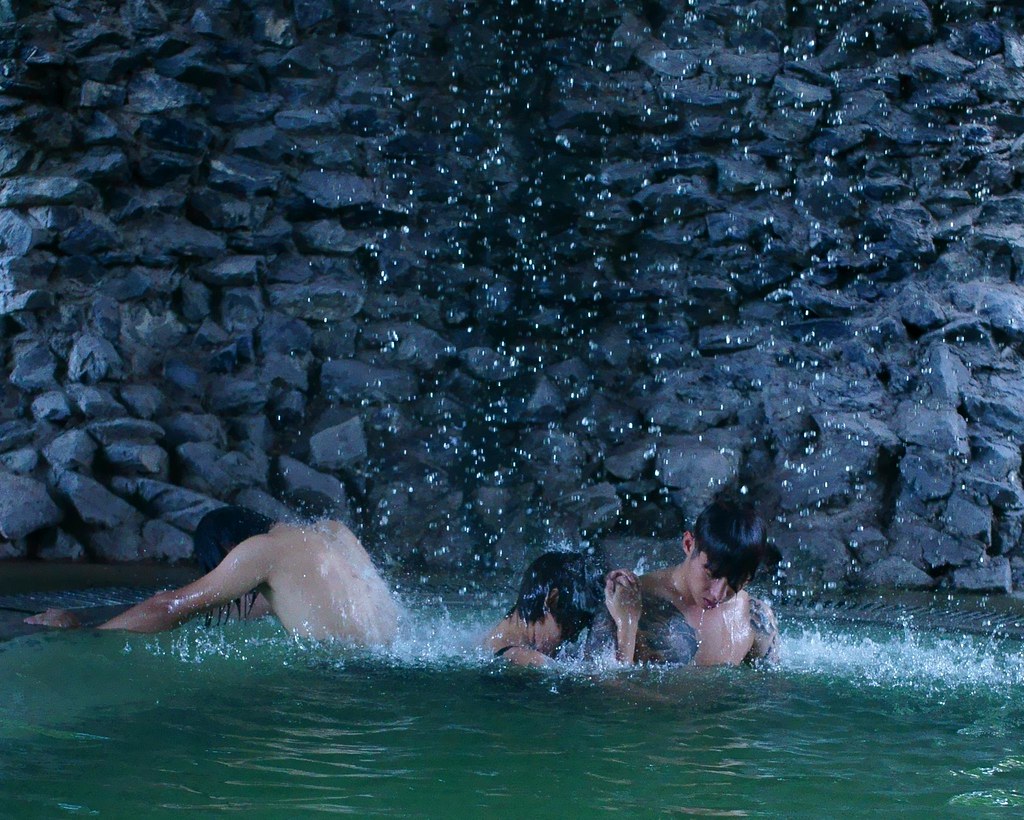

'Thai Drama,
Chiang mai
San Kamphaeng Hot Spring
Thailand

NEX 3 , SIGMA 30 , MEIKE box (water/dust/sand proof )'

Found on flickr, posted by setsunalee

Saturday, 21 April 2012

Concerning developments (mostly)


The Soaking family of blogs is expanding once more. Achievable or not, a blog focusing in Euro-soakers / soaking possibilities will need to take off, but the first step has been taken: European Natural Soaking Society. Herzlich wilkommen!

Trade-offs
More of the seemingly never ending discussion of geothermal energy generation versus soaking. Thinkgeoenergy.com (8 April) gives it's views of this Japanese debate: 
'It is no news to anyone having been to Japan, that there is a thriving bathing culture in the country and this paired with strong traditions. Bathing in those “onsen”, or hot springs, is very popular.
So it may not be surprising that onsen owners have a strong voice when it comes to concerns about geothermal development. A recent article in The Economist [April 7, original article] touches upon this subject. The reason for concern is simple, onsen owners fear that geothermal development for power generation could dry out the hot aquifers that fuel the hot springs.
But with the tremendous energy demand of the country, following last year’s tsunami and nuclear disaster at Fukushima and the move away from nuclear power, geothermal as a sensible energy choice is now harder to argue'. 
To sway the onsen conservatives the ambassador of Iceland to Japan is drafted in. 
'... he [Icelandic ambassador] points out the example of the “Blue Lagoon” in Iceland, as likely being the biggest onsen in the world. The geothermal field there not only fuels the spa but also a geothermal power and heat plant. .. maybe as a side note one can say that the plant existed first, while the initial “pond” or pool was an environmental accident. Today the Blue Lagoon is Iceland’s largest tourist attraction attracting nearly double the Icelandic population in visitors'. 
This is of course a true point and well worth considering. 

However at the base of the case are small scale hot springs which could loose their waters, while the generation side requires more concerted larger scale efforts. And if then the result is an extensive hot pool pond, will this then suffice local habits? Will for instance traditional naked bathing cultures be thrown overboard in favour of mass marketeering capitalist seeking short term strategies? 
At the heart of the debate should be Japanese naked communication versus modern day perosnalised (and selfish) culture. 

More on this debate, again thinkgeoenergy notes that Bloomberg predicts that 50% of the global finance for geothermal investment will flow to Asia. Let's hope they won't ruin too much ....

'The hot spring at Chae Son National Park'. 

19th December 2011 By Scorchamac

Regional
A short uploaded video of a newish hot spring near Berastagi, North Sumatra, Indonesia. 

An extensive blog on Selayang hot spring, Malaysia. Conclusion: 
'From my point of view, it is worth paying the entry fee [less than a $US] and get to use the natural hot spring for unlimited time and volume of water (as long as you are happy)! So, do visit there and have fun!'
Vietnam News reports (13 april 2012) that medical tourism needs enhanced promotion. Their readers respond.  Le Van Nhat, Vietnamese from Hanoi: 
'Last year I had a trip to the mountainous province of Son La. I was exhausted after a quite long journey from Ha Noi. Local people recommended that I should go to a natural hot spring at the nearby village to rest and restore my energy.
I decided to go there, dreaming of a relaxing time wallowing in hot water.
But I was totally disappointed.
The water was not hot as I expected and the bathroom was dirty with cobwebs. It seemed that the bathroom had not been cleaned for years. And there was no other tourist except for me.
I do not expect significant development of medical tourism in Viet Nam if things remain unchanged'. 
The dilemma of soaking in Southeast Asia: it's seldom that wild and natural is combined with sanitary. And the expectations of locals of a soaking Disney World. Then again if vexed by cobwebs then maybe one should stay at home.

More bad experiences, this from the Philippines: 
'Today I went to Dauin Hot Spring and Beach Resort, around 2 hours away from our place in Valencia. ... When I arrived, the pool with the hotspring water wasn't filled so they had to fill it up and it took them like the whole day. .... 
The water was ground water .... 
I spent something close to P500 ($12 US) for the afternoon stay, with the "hot spring" only 2-feet deep!'The upside: 'Still, it was a luxury for me as I was able to spend time with myself'. 
!

A mud bath in Nanjing, China, brings some strange customs to the fore. Laura the explorer
'I don’t have many pictures because they had a strict rule about photos.  It’s curious – the Chinese are fairly modest in public, but in private it’s completely different.  The only person wearing a bikini at this place was one of the teachers, and everyone walked around wrapped in a towel.  They don’t want pictures of people in bathing suits.  However, in the change room, people let it all hang out.  I don’t know about the men’s change room, but by now I think I’ve seen more naked Chinese women than naked Canadian women'.
Shanghaiist reports (Mnarch 21) on hot spring developments in Shanghai. No protecting natural soaking sites. No less than around 75$ million will be invested to create 
'... the city's first open-air hot spring resort hotel with a 12,000-square-meter man-made hot spring pool zone'. 
Hmmm, a good development? 

Hot soaks of the Himalaya has highlighted the plight of Gasa Tsachu, Bhutan. The newest development, a road may well be on the cards. 

The outlandish?
New fashions not yet to reach the shores of Southeast Asia: singing. Saunascape reports (13 April): 
'What do a Japanese pop group and a specialized bus in Finland have in common? They’re both all for singing in the sauna!
Rocket News from Japan tells us about OFR48, a new, all-female pop group made up entirely of workers at Ofuros, or urban Japanese bath houses. The OFR in their name even stands for ofuro.
The performances started as a way to make customers feel more willing to approach the staff of the bath houses: An awkward experience because the bath customers are naked. The clothed female workers serve both the men’s and women’s sides of the spa.
The performances began in the bath houses around Tokyo. They were so well received that the group has gone on to perform at larger venues. They plan to release their first single “Our Customers are Naked” in May. Their music video for this performance follows'.
 

After singing, another sort of weird event from Japan. Artist Mariko Sakaguchi manages to take photo's of herself bathing, in her own mobile tub in very unconventional locations, such as in peoples lounge area with the family watching TV, in a meeting room (with employees having a meeting).
Mariko explains
'I am making art works by using photography.
I am trying to cross the sense of private and public, and also now and past by taking bath in old style Japanese bathtub and stepping into photography by myself. You can see I take bath anywhere, It means the place you are seeing my works and also the place you are at now are not off-site.
The place where you are has possibilities to be the scene of my works.
You are not spectator, but party of my work, art.
I want to be a part of art with you all'.
The amusing part is that in every picture you see Mariko bathing you actually end up asking yourself, what are the others in the picture doing?

Final note, another video, this time from Greenland:

Monday, 13 June 2011

Another update, mid-June 2011

Soaking in Southeast Asia has slowly been gaining more popularity, the blog receives more than 40 visits per day and more than 4,500 page views per month, which is increasing month by month. The Himal blog is also seeing more traffic (despite no new entries; I'll be reworking and updating the original ones), but surprisingly Soaking in Siam is lagging behind. That despite for instance two new original blog entries from Phetchabun province, Phu Toei and Nam Rong.

Most popular entry on this site is the entry on art and hot springs though the more recent entry on mud is catching up; in the last 30 days this entry clocked up three times as many entries as the art entry, which itself just had more pageviews than other older blog entries. Considering the amount of time I put into the mud entry I am not at all disappointed.

Upcoming is less great news as I will be leaving the region in the foreseeable future, though more Thai soaks will be added before. As well as an overview of Thailands top soaks.

Fishy business once more
  • Apparently a never ending story. Travelfish Siem Reap blog has an entry on the fishy foot massage business. Though they also note the concern, they repeat how pleasurable it is:
    'Admittedly, it’s not completely unpleasant having your feet nibbled, though many would doubtless prefer the Princess Fergie school of toe-nibbling to having actual schools of fish perform the dirty deed. The sensitive among us clearly find the experience so earth-shatteringly, ooh, ticklish, that screams, shrieks and loud whoops are in order, causing numerous people to drop their beers with fright. Actually I made the last bit up, but to the screamers, do you have to? Really?'.
    The rash of fish massages is now spreading to the other haven of tourists, free of legalities, Phnom Penh.
  • Last month the Guardian had a feature on fish pedicures as it debates their increasing popularity and health issues:
    'Following the decision by more than a dozen states in the US to ban the pedicures over fears they could spread infections and disease, scientists from the Health Protection Agency have begun an investigation into potential risks. A spokesperson for the agency said that, while it did not expect to be enforcing a ban in the UK and believed the risk of catching an infection from a fish foot spa to be "very small", it was looking at publishing guidelines for the public'.
    The article continues and as always the case in Britain, protecting the fish may well be the single most important issue if a ban is imposed!
Beautiful blogs
  • Well, I pride myself on my ability to seek out obscure hot springs in what many would consider a wild goose chase. However a blog entry by Ben seems to encapsulate an even more determined spirit. On a hunch he seeks a zoak in Zhongdian, Yunnan, China. He was advised to find out a hardly known hot spring with magical properties. On his bike it took him no less than 5 days to find the place, each day filled with taking in the surroundings and having mini-adventures (and doubling back to Zhongdian). He eventually finds it, a small enclosure packed with mud and just a trickle of boiling hot water.
    'Concerning Nom’s therapeutic, secret mountaintop, cave-side hot spring bathing pool, there wasn’t, not even for a moment, a sense of being let down. Rather, it was a fitting cosmic reminder that beyond any doubt the search for this mud was the real reward, and never, no matter how nice the pool would have been, it wouldn’t have been anything more than me swimming in some hot water. It’s also I think perfectly fitting that both times I followed Nom’s advice to go seek out some amazing water, there wasn’t any water to behold. I mean, really, that’s something. Yet, in one manner I think he was right. I can only assume through some extreme-condensation that the water in this formerly brimming pool must have had some residual super-magic in it. While the extended exercise in the crisp mountain air I think has done my body good, and while this is just anecdotal, my new ability to read minds I think is worth noting, and cannot be solely attributed to cycling in the Himalaya. Though, to risk sounding less than humble, being a mind reader now isn’t really all that much of a change, as it seems China only has one thought on its mind: “You can’t use chopsticks.”'.
    As always the journey is worthier than the destination. Too often in modern days we are only concerned with the destination, overlooking the more valuable journey. If I would be in the habit of awarding annual prizes for Best Story on Soaking, Ben would have bagged this years prize easily ...

Geothermal energy, a hot item?
  • China is aggressively seeking to increase the importance of geothermal energy in meeting the countries seemingly insatiable demand for power. Could be worse.
  • No less then Pippa Middleton will help in promoting geothermal energy in the UK according to Think Geoenergy, though not known in which capacity ...
  • In Japan, a turn has taken place to geothermal power. An investment advice notes that despite Japan's volatile geothermality, power has not been developed as in other countries. Why not invest?
    'However, by and large its thermal regions have been transformed into onsen – hot spring resorts - which are a hugely significant phenomenon of Japanese culture. Many of the best resources are in national parks and in popular tourist spots. Indeed, reverence for hot springs is such that one geothermal energy expert declared that they are regarded as almost holy by the Japanese'.
The cultured
  • AsiaSpa has a feature article on onsens in Niseko, Japan. This Singapore edited, East Asia marketed magazine apparently acknowledges that spa in essence (and naturality) is a hot spring but as it focuses on the higher income generating minority of the regions public, it can't suggest a local soak. However Japanese soaks come with instructions, all matter of fact:
    'The most common mistake first-time visitors make is to enter the baths in swim suits, which are not allowed'.
    Well, as anyone visiting a Southeast Asian soak will contest (with exception of Vietnam), one would believe that swim suits are not allowed as well; everybody just soaks in their daily clothes! Other pointers: don't stare, don't be noisy, don't bring your own drinks. In other words if visiting a regional soak here, expect them to be noisy with visitors staring and drinking. And consider yourself lucky because it could be a lot worse ...
  • Tourists from China are spoiling weekend aways in Taiwan:
    'No work, no computers, just relaxing in the hot springs, taking a drive around, and eating. But the Chinese tourists staying at the resort almost spoiled it'.
    What a horror!
Hot trend?
  • Anyway, the region is trying it's best. Newcomer to cater to more demanding visitors is Alba Health Thermal Resort, next to Thanh Tan hot spring near Hue, Vietnam. Pictures are on Picasa. They claim to the first balneotherapy resort in Vietnam, balneotherapy referring to medicinal use as opposed to recreational use. Now why this distinction? If soaking recreationally, surely the medical benefits would also be included. Or is it simply an expensive term to discern itself from the hordes? Anyway, looks like a nice place to stay and I hope that they become a guiding light to others. As long as they don't move any more upmarket ...
  • Burilasai Hot Spring Resort and Spa, Mae-On, Thailand is another newcomer, at least in name. Not much info ... It mentions 'hot mineral', hopefully it means hot mineral water, because the pictures seem not to emphasize it's soaking qualities ... 269 friends on Facebook. One respondent on Agoda mentions the
    'spa is great'.
Tops
  • Webecoist start off with 13 natural swimming pools from around the world. Some hot, some not. Yangbajain (Tibet) and Blue Lagoon (Iceland) are the hottest, but neither is natural! Representing Southeast Asia are Tat Kuang Si waterfall in Lao and Mabinay spring in the Philippines.
  • Top diving equipment has it's Top 10 Unique Natural Springs of the Philippines. 1-10: Salinas Salt spring (not hot), Tangub HS, Malumpati (not), Hidden Valley HS, Timoga Cold Spring, Ardent HS, Tukuhan HS, Sto. Niño Cold Spring, Asin HS and Tiwi HS at no. 10. All
    'really worth visiting'.
  • Staying with the Philippines, there are also
    '6 Ways to Soak in Ardent Spring in Camiguin'.
    With crossed legs, folded knees, one leg folded, lying flat (legs inward or outward), floating in frog position! Ha! By tagabukid8705.
Finally, there's the new hot spring of Taal volcano, the Philippines (source). It's lake is increasing in heat and would qualify as a hot spring.

Saturday, 16 April 2011

Update Mid April 2011

In reality there's little to mention over the past 3 months, despite it being the best time of the year for soaking in Southeast Asia. Now the heat is on us and we can sit at home and soak in our own sweat.

This blog has been busy, adding entries on Lao and Vietnam as well as an extensive standard setting entry on global mud baths and another entry on the most popular soaks this side of the globe. Next month will see a few more entries in Soaking in Siam.

Though not exclusively Southeast Asian I would like to draw your attention to the following. The first is an entry on japansugoi, it focuses on hot springs on tv:
'Fuji TV’s popular onsen ジテレビの温泉番組 show is called “Lets go to the Onsen or Onsen ni Ikou!”. That program was so successful they decided to make an upgraded version called ” Let’s go to the onsen more! or Motto Onsen ni Ikou!” もっと温泉に行こう'!'
There's a long way to go for Southeast Asian soaks ...

Other big news from Germany's Focus magazine on New Zealands Hot Water Beach. A good write up (if you can read German)

From the blogosphere, a description of Ban Nam Ou, Lao on travelfish:
'Everything is shabby and funky but also crazy and cool'.

'Native laotians bathing in the hot springs south of Luang Prabang
I saw this incredible view out of the bus window, near Nan Keng on the highway between Vientiane ad Luang Prabang. (Geotagged picture, thats how I know), people bathing in steamy water - but my camera was tucked away and I didn't have time to catch it. Then 10 seconds later he bus stopped to let out someone who had to pee :) I grabbed my camera and ran back 200 meters and catched this picture, it was one of the rare minutes it didn't rain on the whole (11 hour!) bus trip back to Vientiane'.
Photo of Ban Nam Ou by Sunday Laks

Wednesday, 10 March 2010

Faux

After visiting Binh Chau hot spring in the south of Vietnam, I was astounded at the contrast of experience of soaking here and that in other Southeast Asian countries. Was I witnessing progress? Could what is achieved here, be only be done with communist autocratic government? Or are the Vietnamese so totally different?

The main swimming pool complete with faux rocks and cascades.

Vung Tau
But let's start at the beginning. Binh Chau is a hot spring located in Ba Ria province, about 150 km from Ho Chi Minh city (or as some say Saigon), a two and a half hour drive away.
Besides Ba Ria, Vung Tau is another large city in this province and the focal point of tourism; Vung Tau being the beach of Saigon.


From the point of Cap Saint Jacques, Vung Tau is essentially a major area of hotels and beach resorts stretching for about 10 km along the sea facing shore until an expansive coastal flood plain after which a number of smaller resorts dwindle as one continues along the coast north and eastwards.

On the Saigon side large scale industrialization has taken place.


One of these smaller northeastwards located resorts, Binh Chau is a reasonable sized town located 70 km from Vung Tau. As the number of resorts peter out here, so does the quality of the road. From Binh Chau one needs to drive 2-3 km inwards towards the hot spring site itself.

Claims to fame?
Once through the entrance area there is a massive development, wide avenues and big reception buildings. Our car is parked close to the entrance. A 200 m long road leads to an intersection where one can proceed onward by foot to more park -like area, accommodation and the springs proper. Go right and one goes to the soaking section.

The hot spring resort is run by an investment operation called Saigon-Binh Chau Tourist Joint Stock company which includes a local beach resort. Since the turn of the century facilities have been improved and
'in August 2003, the happiness and success of this investment are rewarded by the World Travel Organization’s recognition that Binh Chau Hot Spring is one of the 65 areas of sustainable ecotourism development of 47 nations around the world'.
Yes, that accolade looks good. But looked at it in more detail, reveals that Binh Chau was merely
'a compilation containing 65 case studies received from 47 countries about exemplary practices in small ecotourism businesses (SMEs)'.
I.e., a slap on one's own back rather than 'recognition'. As the publication is not freely available on the web, little insight can be given to the aforementioned claim.
It's also not clear exactly what the WTO understands as ecotourism, their website lacks any definition.


More possible future (investment) development around the Binh Chau includes a safari park and villa's, which might just throw a different light on the eco claim ...

The naming game: call it eco and it is?

Developing hot springs and protecting the environment
Aside from the eco claim, it's not totally clear, but there are a number of references putting Binh Chau hot springs as part of a larger protected area. Amongst these is
Lonely Planet which lists:
'Until about a decade ago there was wildlife in the area, including tigers and elephants, but it seems humans have nearly won the area over'.
Binh Chau's own web site refers to the ecological reserve:
'11.000 hectares of forest, known as Binh Chau - Phuoc Buu natural preservation zone'.
Note that Bin Chau hot springs site themselves are only 35 ha.


More info on the natural reserve can be found in this document from 1997. It contains a forewarning:
'Binh Chau hot springs is designed to suit the tastes of affluent Vietnamese tourists. The flower-lined walkways among hot springs, shady cabanas and a litter of bright painted stucco figures is pleasant and charming.
But, more concerning, the resort also holds a small zoo containing several rare species. Among other things, an eagle sulks in a purpose-built cage shaped like giant a spider's web and listless binturong (Arctitis binturong). It is illegal to keep the endangered binturong. I could not identify the eagle but several species of eagle and buzzard in Vietnam are on the IUCN Red List of Threatened Animals. Long-tailed macaques Macaca fascicularis, also on the IUCN Red List, were in two small cages. The centre-piece of this exhibit is a giant painted concrete structure resembling a coiled snake, strangling a rampant deer.
When I visited in December 1996, new structures were being added to the zoo complex.Clearly, this architecture enforces common perceptions of nature as mysterious and evil. 'Nature' - the Vietnamese word is 'nguyen', - carries a reproachful connotation of 'primitiveness'. Zoos of this character do nothing to show how precious is nature of itself. Nothing is here about the natural history of these species. Nothing to allow people to empatize with wildlife. Nothing to encourage them to protect their wild resources'.
It's therefore chilling to note the following announcement:
According to Management Board of Binh Chau - Phuoc Buu Natural Reserve, from the beginning to May, 2009, the reserve has attracted 20 tourism projects under ecological- tourism forms. Total investment area of these projects are about of 1,500ha'.
Soaking
To proceed to the soaking section one needs to purchase entrance tickets in an adjacent building.

This building incorporates changing facilities, showers and lockers, never seen a locker at a soaking site in Southeast Asia!

Beyond the entrance are two palm fringed pools against a backdrop of faux rocks stacked up 5-10 m. This tiled area is backed up by a free form 2 m wide pool, meant for kiddies, containing less warmer water.

In 1 corner are amenities while beyond the kiddies pools are places for mud treatment and VIP soaking rooms. On the other side a track extends into a swamp where there a number of other in-huts-enclosed-tubs, varying in size and thus price.


The main pool though is heated and goes to depths of more than a meter. The soaking experience is somewhat placid, late on a hot weekday most visitors are middle-aged Vietnamese, day visitor tourists already having left. The pool itself could do with some painting and the visible quality of the water could be better.

However, strikingly, almost all patrons are wearing bathing costumes, much in contrast to nearly all other soaking facilities in Southeast Asia. So much so that I wonder whether this is in Southeast Asia at all. It could be Europe or Australia. Canada or the states. I wonder whether this bathing custom is something Vietnamese or simply limited to these facilities.


The sights of Binh Chau: mud baths, hot pool, more mud baths, private pools and jacuzzi.

Throwing Mud
On offer are also mud baths or the opportunity to cover oneself in healing (?) mud.

Possibly this claim is true but what I find weird is why if it it so good, why the need to keep bathing clothes on. Especially women wearing a full one piece suit can be seen covering their suit in mud (below), can't see much health gains in that.

And though there are private enclosures, these are not meant for au naturel bathing. Inside photo's (above) disprove this as well as the fact that the material used allows for outside viewing.


Nguyen Pham's untitled muddy picture from Binh Chau.
Question is if mud equals health,
does this mean that females can not fully profit from the perceived health benefits?


An introductory youtube video on Binh Chau hot springs

Getting there: From Vung Tau head north / east along the coast until Binh Chau village. Take a left on the other side of the village followed by a right turn and after a km you'll arrive at the hot springs site.

Soaking experience: Certainly pleasant, considerable effort has been made to make soaking a worthwhile experience. Of the near 30 soaking experiences I have visited in Southeast Asia, this ranks highly amongst them even though the metamorphosis into a some what sterile soaking area comes at a loss of naturalness.

Overall impression: With in mind that this has been created to attract tourists, one could argue that this has been done tastefully. Certainly it could be a lot worse.


Part of the attraction park are the natural hot springs located away from the soaking pool itself.
It's said that they number more than 70.

Monday, 31 August 2009

Updates for August 2009

Looking for alternative energy it can occur to tap local hot springs. In the region there are already a number of countries with power plants derived from geothermal heat up and working.
Singapore is now looking into this as well. From the
Strait Times (15 August 2009):
'A hot spring tucked away in Sembawang might just hold the key to Singapore's untapped geothermal power potential, and at least one geologist is going full steam ahead on the idea'.
Co-incidentally, a recent
blog on Sembawang hot spring contained the following message:
'The authority should develop and make it a tourist attraction'.
Yes, why not? But it's not so bad as it is, mind you.
Then more is revealed on a comment to Temasek's finance strategy on
Todayonline:
'A professor of NTU [major uni. of Singapore] is confident that with a $26m investment, he can tap geothermal heat at the Sembawang hot spring or Pulau Ubin to generate electricity for 200,000 homes'.
That's 4 times as many homes as two weeks before! Progress.

The Malaysian state of Sabah is looking into the same subject, reports the Star:
'Deputy Chief Minister Datuk Peter Pang said the idea was to tap hot springs in the Adrassy forest in Tawau [Sabah] to generate some 100MW of electricity'.

But back to real soaking. Much of the soaking is to do with health benefits.
An interesting non-Southeast Asia article titled
'Clays, Muds and Dirt for Anti-aging Beauty'.
Written by Lorne Caplan it looks specifically into claims of anti-aging and mud. She clearly sets out that many skin care products containing mud can't stand up to what they claim. Lathering in mud, adds nothing it appears. Her final advice:
'We do know that therapeutic massage, when given frequently, provides a true stimulation to our immune system and lymphatic system. Or,simply roll around in the mud with your kids and you’ll find your hormones on fire in a good way. Whether you’re in Alaska, Thailand or your backyard'.
This throws the claim in a recent article on Phu Klon hot spring, Mae Hong Son province, Thailand into doubt:
'The results from the laboratory showed that the mineral contents of the mud are good for the skin and blood circulation. There are some minerals that are found in the Dead Sea mud and volcano lava mud'.
Elsewhere in Asia, there are a number of resorts offering a mud bath (see below). Not worth it now? Possibly, but isn't it just fun in the mud?

'Thap Ba mud baths in Nha Trang, Vietnam' (source).
In paradise (Bali?) there are problems with developing hot springs. The article relates to development taking place without proper permits and failure of the projects to materialize. Despite one project promoting alternative healing, it was believed that part of the project was to threaten a local hot spring's water supply.
Elsewhere, a major investment is taking place on north Sulawesi, Indonesia:
'Located in Bitung Hills, this natural 60 m waterfall is an ideal place to enjoy nature and fresh water pools at the base of the falls, just on the Beach next to the Waterfront Hotel is a Hot Spring. The plan is to connect the Hot Spring to the Hotel to develop a Beach-Spa Resort.'
What about the hot spring?


Blogs
Vietnam
  • Thap Ba proved to be nice place to frolic in the mud for traveling Peacecorps duo Carrienica:
    'The whole experience was fun since you're surrounded by more vietnamese tourists than foreigners. I loved seeing how the familes were interacting and how they all had fun playing in the water. I have to say that it was an experience I won't forget'.
    Fun indeed.
Indonesia
  • Want to know what Sari Alter hot spring looks like?
Malaysia
  • Poring, arguably one of Sabah states biggest tourist attractions fails to live up to it's fame. Here another disappointed blogger by the name of perutbesi:
    'I was expecting the natural hot springs like the ones I've experienced in Ipoh! All I saw were pools with warm water. Cis. Just like my own bathroom kinda experience. Cheap thrill!'
  • An extensive blog entry on Selayang hot spring, located not so far from KL. Is a trip there worth it?
    'To be honest with you, in general, Selayang Hot Spring has 'nothing to shout about' ... really. .... And while you are there, you can see all sort of antics and interesting behaviour of some of the bathers. Some of them can be downright funny though...but then again...of course...they have own reasons for behaving in such peculiar manners:).
    eSa had more laughs when reading a signboard:
    'Loosely translated: Please Take Note: To all visitors, kindly adhere to these guidelines>- do not place your feet in the pool- do not wash clothings in the pool- do not wear underwear while bathing!'
    Possibly the funny part is that no one adhere's to it, everyone has that days underwear and upperwear on. Yuck!
Vaneza provided me with this shot of the welcome words to Ardent hot spring on Camiguin, Philippines.
  • In my recent blog entry about visits to soaks in Thailand and Bali, it was mentioned that the springs were discovered / developed by Japanese. According to this site the Gadek spring was developed by the English. Hard to believe.
    'It was believed that local villagers discovered the hot spring in the forest after watching some English soldiers settled around the spring. After the war, visitors from far and wide discovered that the hot spring had strong healing elements unlike many that they had encountered before'.
Thailand
  • Dressing up maybe the norm for locals visiting natural hot springs in Southeast Asia, but surf to this photo of a number of soakers complete with life jackets in knee deep water in Umphang, Tak province!
Philippines
  • A great blog entry on Maquinit:
    'Everything seems right in place, the location of the pool, the mangroves even the scenic view around the area all conspires to make this a very unique place'.
  • To add, Marinduque hot spring on ... Marinduque island! Here a link to a German blog. There are actually two soaks on the island, Mainit and Malbog.
Related Posts with Thumbnails
Copyright 2009 © Soaking in Southeast Asia. All rights reserved.
No reproduction or republication without written permission.