Showing posts with label Europe. Show all posts

Friday, 6 November 2020

Obsession

Taking a cue from my own blogging, I decided to order in the first edition of Hamam magazine; as suggested in the previous post.

Recap: it's a new initiative, it's print only and it seeks the curious minds:

'A quarterly magazine that features essays, artist projects, photography, and interviews from contributors from all over the world. We think of bathing as a practice of letting go. We will explore many practices, but there’s no denying: we’re bathing obsessed'.

It's slogan: 
'The Magazine of letting go'

It's a hefty magazine (heavy quality paper 100+ pages) and outside the US not available everywhere. Thankfully, a book store in my crazy capital was also in the mail order business and forwarded my order in.

First impressions were that it's certainly neat; very high quality all round. Flicking through though it brought me back to the pre-internet days when a magazine was king. Maybe in the US it's still such, but over here internet is so ubiquitos, magazines are going out of business.

Contentwise there are articles on Victorian Turkish baths in the UK, Mongolian sky burials (stretching the definition of bathing a bit),  there are a couple of takes from the onsen photo reportage by Mark Edward Harris (below; The way of the Japanese bathing) and and there's a long article on the Saunatarian (SWEATERS OF THE WORLD, UNITE!). Other theme's dropped: US banya, Korean bath experience, Totto-na-tta (Japanese tuning), rewilding, James Mortimer, Palau Swimming Association, David Mason poetry and Urban bathing.


But what did I think, other than the presentation? 
Refreshing. 
Overall, I am very interested in what they are seeking to convey. Maybe not too keen on the photographic presentations, but there were a couple of surprises included. The article on sky burial stood out, I knew it still takes place sporadically in Tibet, but the description of actually witnessing the process in Mongolia was beautiful. 

The article by Jack Tsonis (aka the Saunatarian) was quite thought provoking. Jack (from the sauna barren Australia) takes a liking to sauna, such that his travails are noted with 1 city / 1 sauna motto. Not always possible of course, but what he describes as the moral of his story:
'... not to convince everybody to travel my way, or that every Saunatarian needs such zeal. Instead the point of my telling is to inspire others to their own kinds of creative travel, and to record for history what happened when one man said that he was going to sauna every place he visited'.
In fact I've been doing as such already. Being outside, being active, but also encouraging my body to rejuvenate through water immersion has brought me to soaking. And lately sauna-ing.

What also struck me as he describes his visits to 2 Berlin sauna complexes as how these are not in tone with what he associates as taking a sauna:
'The only downside to this whole situation was my deep and abiding unease about the opulence of these facilities,
...
which are completely inaccessible to the majority of the population in financial terms. This observation extends, by and large, to the entire global wellness sector, which preaches a message of well-being but is generally priced at the luxury end of the market. Put another way, wellness is like money: it doesn't trickle down. The dissonance here -between the message of the wellness sector and the practical realities of access- is deafening, and in need of significant critical theorization in coming years. The aim of such theorization would be to expand access to facilities of regeneration in all areas of human habitation'.
I would wholeheartedly agree. 
In western Europe (where I live) the smaller, often inner city commercial saunas are disappearing quickly, as on the one hand larger complexes in attractive settings are offering a full day of sauna fun, a mini holiday as opposed to a weekly routine of a couple of sweats. It means you need a car to visit these places, as too often than not, they're not reachable by other transport methods. Entrance is hefty, so you presume to make it worth by staying the whole day, but then enjoying a meal is making the pricing of your visit even higher. It's also a question of big money versus small-scale family run businesses, the ability of either to invest.

So the first issue was interesting enough, let's see if the can keep up the same qualities, especially content wise.

Thursday, 18 July 2013

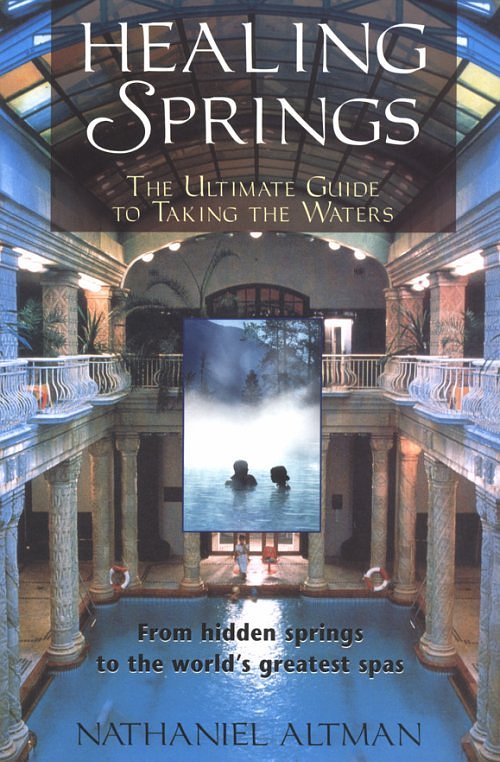
Publications: Healing Springs - The ultimate guide to taking the waters [?]


Non-existent
Soaking literature is far and few between. 

There are indeed many a hot spring guide book, in the US quite a few and in New Zealand as far as I know. Supposedly there will also be quite a few connoisseurs guides in Japanese.

But with instant internet, there's little or no need to publish these guides any more. We can all delve the info required with a swish and pointer or two. All up to date as well as the latest visitor who wishes to diss the place. The photo's are always there, explaining every nook or cranny. And even pre-buying an entrance fee to the fancier resorts becomes apparent. All the pre-visit pleasures.

This does mean that the enthusiast / upcoming soaking expert is depraved of an avenue to exhibit his or her expertise. In print. And who's not being printed does not exist. So goes the old adagium.

But beyond the world of lists and links there is surprisingly little info on what hot springs are and why so. Altman's now slowly dated Healing Springs wishes to link the two worlds and probably back in 2000 that might have worked. But nowadays a book a third filled with alist of potential soaking spots and a small collection of soaking picca's instantly seems out of place. And soakers in Southeast Asia need to note: we are not included! So much for our beloved soaking culture.

Best efforts to no avail? Krabi, Thailand's Klong Thom hot springs by Cholthicha Pornpan

Lost
But in the other two thirds, Altman has gone out of his way to seek to prove beyond doubt that soaking is indeed a healing process. 
Altman's expertise is in alternative healing (he's an hand analyst) and he seeks to combine natural waters with immediate health benefits. Mineral content is linked to disease remedies while diseases are linked to types of hot springs. It transpires that soaking isn't the only healing aspect, one needs to include drinking and inhaling mineral spring content. Emphasis is awarded to the Euro concept of taking the waters where states have enabled soaking industries to expand and medicalise the hot spring experience itself.
And that is where to me the healing aspect is lost.

Healing and hot springs is as much about inspiring and relaxing rather than solely something to heal. Altman does try though. There is a chapter on the ambiance of soaking. But describing this book as the ultimate? Even in 2000 that wouldn't have covered the content.

Though he admires the Euro soaking states, he's right in emphasizing that soaking nowadays is something we might be interested in; but gone are the days in which states could afford soakers to indulge for weeks on end. Better are the Japanese concept with ample bathing facilities which can afford daily experiences. Already this fits much more in with northern Europe's hang towards sauna. Or the old daily English bath.

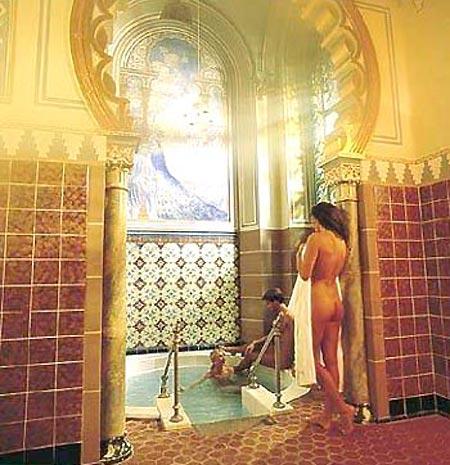
The author raves on about his Bad Wildbad experience, Germany. Unfortunately his own photo's are not available any more. The caption to this photo:
'A swimming fairy tale come true ... The classicist façade of the Graf-Eberhard-Bad (Count Eberhard Pool) looks rather unsophisticated in relation to what it contains. Behind the Florentine sandstone walls you will find oriental bathing splendour that is certainly unique in Europe.
This building, once threatened by decay, was restored with the help of significant financial backing, good planning and artistic effort to its original luxury as a bathing landscape, a dream from 1001 Nights. Today it is a modern temple of health with the refined feeling of the orient.
A grand architectonic effort thus succeeded in creating symbiosis between necessary modern form and an atmosphere of nostalgia. The Moorish Hall, the Princes' Baths and the Great Lords' Bath, where the statue of Venus by the Danish sculptor Bert Thorwaldsen can be seen, and above all the exclusive sauna landscape are part of the wonderful framework for a healthy visit. No resort visitor should miss this attraction: no one leaves without being impressed'.
Other aspects included are a nice historic overview where he notes that hot springs and human interest can be traced back for 600,000 years, but what with the lack of writing skills, use of mineral waters can be traced to Greek and Roman scripts as well as ample evidence in the form of archeological remains.

Altman does add a chapter on the preventive aspects of heated baths (leading to higher states of immunity) which assist in cleansing the body of toxins. We also learn that water pressure leads to increased flows of oxygen-rich blood. There is much more added to the list to the preventive powers of soaks, aspects of negative ions, micro-nutrients. You'll need to read for yourself.

So to sum up is Healing Springs a no buy? Well, I think the book cost me 0.14 cents which is about just above scrap value. The question is the book worth the transport costs? Hmm ...

Healing Springs has 4.8 stars at Amazon (4 reviews), while only 3 stars at good read (2 ratings).

Reference
Altman, N. (2000) Healing Springs - The ultimate guide to taking the waters. Healing Arts Press, Rochester, Vermont, United States of America.

Wednesday, 13 June 2012

Spotlight

Two entries already on European hot spring visits in the European Natural Soaking Society. More to follow.

Topical
Hot on the heels of the last update's weird and wacky hot spring and sauna experiences come's Estonia's sauna car! Follow the link and watch the clip.
I do not know if this applies to the sauna car, but in Japan you can visit a hot spring and earn airmiles!

Regional
Seldom do we see such good work in (re-)seeking hot springs in Southeast Asia, most prefer the over-trodden paths. However the blog entry 
'Unearthing Timor-Leste's Hidden Gems - Marobo's Natural Hot Springs 
by  Barry Greville-Eyres and Francisco Carlos de Araujo is a real gem by itself: 
'On a short descent we encountered ruins and remnants of what was supposedly spa or resort styled accommodation, at a picture-perfect location, surrounded by a labyrinth of ridges and valleys. Despite conflicting reports on the origins of the development - some sources attribute it to Japanese occupation forces during WWII (1942-1945) others to the Portuguese colonial occupation-era pre-dating WWII - its highly likely that local Timorese villages were instrumental in the construction of the associated infrastructure.
Much toil and backbreaking effort must have gone into the construction of the access road; distinguishable accommodation units; hundreds of metres of retaining walls; hot water diversion, distribution and drainage systems; the main bathing pool (approximately 25mx15m); an ablution facility and individual external mineral or mud baths.  Although the facility is now clearly abandoned, it still remains an important part of Timor-Leste's natural heritage and a potential drawcard for both domestic and international tourists'.
 It also lists a short overview of all Timor-Leste's hot springs. 

'A parting shot of Marobo's natural hot springs - 
yet another of Timor-Leste's hidden gems'.
Foreign control? Locals in Sabah state, Malaysia are worried that their natural wonders are being privatized. 
Always this never ending story: private ownership of public lands results in entrance fees / profiteering possibly exclusion of certain groups of persons (based on income) or public control by public organisations which (in Malaysia) don't seem to be interested in the public interests. The essence of the freemalaysiatoday article (7 June 2012):
'Ranau STAR division chief, Jalibin Paidi, said the transfer or takeover of the management of money-making Kinabalu Park or parts of it as well as the popular Poring Hot Spring near here had become a hot topic among people in Ranau and they want to know the truth'.
More worrying is the emphasis on foriegn control as if this makes non-public control worse ... 
Note also that the article mentions that all of this is rumour, hot air thus ...

The mud baths of Thap Ba (Nha Trang, Vietnam) now have a local competitor / imitator. Read more on the Thap Ba Soaking in Southeast Asia entry.
In the same area, Waterfalls of Southeast Asia reports that the famous Yangbay waterfall park, will soon expand, to include a (natural) hot spring ... 

Meanwhile in Los Baños, the Philippines, the gamble is on big-business tourism, so states inquirernews (30 May 2012): 
'The master plan also includes setting up a cable-car system along the Makiling terrain, rehabilitating the heritage sites in the town’s poblacion, and renovating the local spa and hot spring resorts'. 
More of the same thus?

Another entry on the Pinatubo hot springs:
'According to tour organizers, most of the resort’s clients are foreigners, with Koreans in the majority since it was developed by a Korean investor married to a Filipina. The resort also provides employment to indigenous Aetas, the original residents of the area, who were displaced during the volcano’s eruption.
With smoke billowing out from mountain crevices, natural pools and waterfalls sprouting from the dry earth, and oddly-shaped geologic formation, the terrain looks almost prehistoric.
It’s almost surreal to see modern amenities instead. Like in most developed resorts, there are several bathrooms and changing areas near the pools, with alert attendants handing out fresh towels to newly-arrived guests. Picnic huts, paved stairways and cement banisters made to look like wooden logs, have been carved from this mountain of stone and soil.
I dipped my foot gingerly into one of the hot pools and immediately retreated as the heat pierced through my skin. I moved to another pool where there were more people and found it relaxing in a feverish sort of way. Beads of sweat broke out on my forehead as my body slowly adjusted to the temperature. The heat of the pools really seeped in and soothed one’s aching muscles in no time'.
A great entry on an as-of-yet not-on-this-site-listed hot spring: Bogyah hot spring, neatly nestled in the Hapao rice terraces, Luzon, the Philippines. A great blog entry:
'When we got to Bogyah Hot Springs, there were locals relaxing in the hot spring. I did not mind, this was their place and I was happy that while dipping on the hot pool I get to know some bits and pieces of their life'. 
Note end line: 
'Let us not change Hungduan [where Bogyah is located] , let it change us'. Too ture.
Travelfish have added a section on the Dieng plateau, Java, Indonesia: 
'The main attractions in Dieng are the numerous temples and the geothermal area around Kawah Sikidang'.
Less local
More money being thrown around (or away?):
'GOCO Hospitality is working with Sanli Guo Yuan to develop the Xiangshan Hot Spring Wellness Center, a 6,000 sq,m. facility with an onsite natural hot spring, located 30 minutes outside Ningbo, China'. 
The cost will be only $US 25 million. For this: 
'The Xiangshan Hot Spring Wellness Center will offer exceptional wellness programs that are results-oriented and address the health concerns of the modern Chinese consumer—beauty enhancement, weight loss, detoxification, stress relief and ageing well. Benchmarked against leading thermal facilities internationally, Xiangshan will set a new standard in design aesthetics and service quality, seamlessly blending Western and Eastern wellness modalities'.
 Continuation of soaking vs geothermal energy dilemma:
'... opposition from local hot spring operators is stalling proposed large scale geothermal development in the Prefecture of Fukushima'. 
So reports the thinkgeoenergy.com last month. Seeing how the nuclear plant nearby which should be one of the most regulated industries went haywire, how is one top believe assurances from companies? Take for instance a recent entry on the soakersforum which mentions hot springs being sucked up ...

More  energetic activity in the region. $11.5 have been allocated to the Tawau, Sab ah, Malaysia project, no soaking opportunities? The Leyte, Luzon, Philippines geothermal plant will cash in (read privitize), with global energy prices at a remaining all-time high. Then there is news on Sulawesi (potential) and elsewhere on the Philippines (Kalinga).

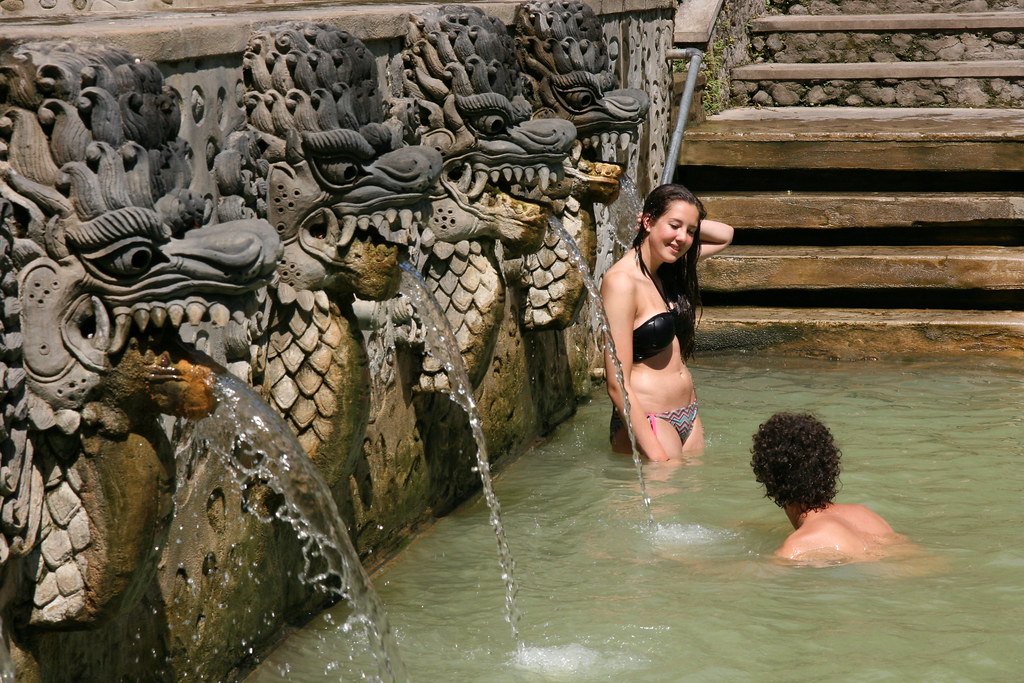
Banjar hot spring, Bali, Indonesia (source)

Saturday, 21 April 2012

Concerning developments (mostly)


The Soaking family of blogs is expanding once more. Achievable or not, a blog focusing in Euro-soakers / soaking possibilities will need to take off, but the first step has been taken: European Natural Soaking Society. Herzlich wilkommen!

Trade-offs
More of the seemingly never ending discussion of geothermal energy generation versus soaking. Thinkgeoenergy.com (8 April) gives it's views of this Japanese debate: 
'It is no news to anyone having been to Japan, that there is a thriving bathing culture in the country and this paired with strong traditions. Bathing in those “onsen”, or hot springs, is very popular.
So it may not be surprising that onsen owners have a strong voice when it comes to concerns about geothermal development. A recent article in The Economist [April 7, original article] touches upon this subject. The reason for concern is simple, onsen owners fear that geothermal development for power generation could dry out the hot aquifers that fuel the hot springs.
But with the tremendous energy demand of the country, following last year’s tsunami and nuclear disaster at Fukushima and the move away from nuclear power, geothermal as a sensible energy choice is now harder to argue'. 
To sway the onsen conservatives the ambassador of Iceland to Japan is drafted in. 
'... he [Icelandic ambassador] points out the example of the “Blue Lagoon” in Iceland, as likely being the biggest onsen in the world. The geothermal field there not only fuels the spa but also a geothermal power and heat plant. .. maybe as a side note one can say that the plant existed first, while the initial “pond” or pool was an environmental accident. Today the Blue Lagoon is Iceland’s largest tourist attraction attracting nearly double the Icelandic population in visitors'. 
This is of course a true point and well worth considering. 

However at the base of the case are small scale hot springs which could loose their waters, while the generation side requires more concerted larger scale efforts. And if then the result is an extensive hot pool pond, will this then suffice local habits? Will for instance traditional naked bathing cultures be thrown overboard in favour of mass marketeering capitalist seeking short term strategies? 
At the heart of the debate should be Japanese naked communication versus modern day perosnalised (and selfish) culture. 

More on this debate, again thinkgeoenergy notes that Bloomberg predicts that 50% of the global finance for geothermal investment will flow to Asia. Let's hope they won't ruin too much ....

'The hot spring at Chae Son National Park'. 

19th December 2011 By Scorchamac

Regional
A short uploaded video of a newish hot spring near Berastagi, North Sumatra, Indonesia. 

An extensive blog on Selayang hot spring, Malaysia. Conclusion: 
'From my point of view, it is worth paying the entry fee [less than a $US] and get to use the natural hot spring for unlimited time and volume of water (as long as you are happy)! So, do visit there and have fun!'
Vietnam News reports (13 april 2012) that medical tourism needs enhanced promotion. Their readers respond.  Le Van Nhat, Vietnamese from Hanoi: 
'Last year I had a trip to the mountainous province of Son La. I was exhausted after a quite long journey from Ha Noi. Local people recommended that I should go to a natural hot spring at the nearby village to rest and restore my energy.
I decided to go there, dreaming of a relaxing time wallowing in hot water.
But I was totally disappointed.
The water was not hot as I expected and the bathroom was dirty with cobwebs. It seemed that the bathroom had not been cleaned for years. And there was no other tourist except for me.
I do not expect significant development of medical tourism in Viet Nam if things remain unchanged'. 
The dilemma of soaking in Southeast Asia: it's seldom that wild and natural is combined with sanitary. And the expectations of locals of a soaking Disney World. Then again if vexed by cobwebs then maybe one should stay at home.

More bad experiences, this from the Philippines: 
'Today I went to Dauin Hot Spring and Beach Resort, around 2 hours away from our place in Valencia. ... When I arrived, the pool with the hotspring water wasn't filled so they had to fill it up and it took them like the whole day. .... 
The water was ground water .... 
I spent something close to P500 ($12 US) for the afternoon stay, with the "hot spring" only 2-feet deep!'The upside: 'Still, it was a luxury for me as I was able to spend time with myself'. 
!

A mud bath in Nanjing, China, brings some strange customs to the fore. Laura the explorer
'I don’t have many pictures because they had a strict rule about photos.  It’s curious – the Chinese are fairly modest in public, but in private it’s completely different.  The only person wearing a bikini at this place was one of the teachers, and everyone walked around wrapped in a towel.  They don’t want pictures of people in bathing suits.  However, in the change room, people let it all hang out.  I don’t know about the men’s change room, but by now I think I’ve seen more naked Chinese women than naked Canadian women'.
Shanghaiist reports (Mnarch 21) on hot spring developments in Shanghai. No protecting natural soaking sites. No less than around 75$ million will be invested to create 
'... the city's first open-air hot spring resort hotel with a 12,000-square-meter man-made hot spring pool zone'. 
Hmmm, a good development? 

Hot soaks of the Himalaya has highlighted the plight of Gasa Tsachu, Bhutan. The newest development, a road may well be on the cards. 

The outlandish?
New fashions not yet to reach the shores of Southeast Asia: singing. Saunascape reports (13 April): 
'What do a Japanese pop group and a specialized bus in Finland have in common? They’re both all for singing in the sauna!
Rocket News from Japan tells us about OFR48, a new, all-female pop group made up entirely of workers at Ofuros, or urban Japanese bath houses. The OFR in their name even stands for ofuro.
The performances started as a way to make customers feel more willing to approach the staff of the bath houses: An awkward experience because the bath customers are naked. The clothed female workers serve both the men’s and women’s sides of the spa.
The performances began in the bath houses around Tokyo. They were so well received that the group has gone on to perform at larger venues. They plan to release their first single “Our Customers are Naked” in May. Their music video for this performance follows'.
 

After singing, another sort of weird event from Japan. Artist Mariko Sakaguchi manages to take photo's of herself bathing, in her own mobile tub in very unconventional locations, such as in peoples lounge area with the family watching TV, in a meeting room (with employees having a meeting).
Mariko explains
'I am making art works by using photography.
I am trying to cross the sense of private and public, and also now and past by taking bath in old style Japanese bathtub and stepping into photography by myself. You can see I take bath anywhere, It means the place you are seeing my works and also the place you are at now are not off-site.
The place where you are has possibilities to be the scene of my works.
You are not spectator, but party of my work, art.
I want to be a part of art with you all'.
The amusing part is that in every picture you see Mariko bathing you actually end up asking yourself, what are the others in the picture doing?

Final note, another video, this time from Greenland:
Related Posts with Thumbnails
Copyright 2009 © Soaking in Southeast Asia. All rights reserved.
No reproduction or republication without written permission.