Showing posts with label Germany. Show all posts

Wednesday, 29 October 2014

Light bulbs


 Who doesn't emoji️ #hotsprings ? #dieng #java #indonesia #travel #nikon #nofilter #latergram
(source
Fine Line 
In the most recent posting on this blog, I presented a possible definition of a soaker:
Soaker: a person who enjoys and values (possibly through  maintaining the vicinity, but with reference to traditions and history) hot naturally occurring liquid which mostly is publicly accessibly / free of charge with a preference for natural bathing habits.
Though this may be the global definition, would it stand for Southeast Asia? 
If we exclude the most popular soaks of Southeast Asia, which tend to be micro Disneyworlds with little regard to soaking, soakers in Southeast Asia are mostly driven by potential health benefits. There are always entry fees to contend with, albeit mostly nominal. Dining is a quintessential part of the experience. Natural bathing habits are out (and with it hygiene!), though socialising is in ...
So a Southeast Asian soaker definition could be:
A person who enjoys and values the therapeutic qualities of hot naturally occurring liquid which is affordable and includes dining opportunities for the (extended) family / friends. 

Not so standard news
Probably the most striking bit of news the past two months concerning wellness came from Germany. What makes it more mind-boggling is how it has been disregarded by the mainstream news channels.
Bad PR for the wellness branch:
'In fast zwei Drittel der Pools von Wellnesshotels entspricht die Wasserqualität nicht den Hygienevorschriften'. 
So two-thirds of the (swimming) pools of wellness hotels fail hygiene rules. The results were taken from hotels in Germany and Austria and make poor reading. In general outdoor facilities were cleaner and using the facilities around lunch time was the advice, later and earlier gave worse results ...
If in Germany this was the result, one can only imagine how poor such facilities are in general as regards to hygiene ...
'A man was hospitalized after jumping into a hot spring on the northern Nevada desert to rescue a dog'. (source). 
No word on the condition of either jumper or dog.

Looking for a different soaking connection: mountain biking and hot springs.
'The Hot Springs Route is a brand new mountain biking route, the brainchild of Casey Greene, an avid rider and a cartographer for Adventure Cycling in Missoula, Mont. Casey came up with the idea after doing a 10-day bike tour across North Idaho and Montana when he and some friends biked to a different fire lookout tower every night. "At the end of the tour, I thought this whole concept of having a destination where you end up each night was kind of cool ... basically, destination mountain biking," Casey said.
The light bulb for the hot springs route went off when he was soaking at a hot springs in Pole Bridge, Mont. He was thinking that Idaho had the highest concentration of hot springs in North America, so why not try to connect the dots? He started evaluating the situation from looking at maps, plotting the hot springs, looking at connecting routes, and came up with a tentative route. Then he ground-proofed them to see if it would work. Last summer, he rode the whole route that's connected by dirt roads, all 517 miles of it, and he also logged a number of singletrack routes that add spice to the whole experience'.
What happens when you crash a drone in a hot spring? RT (Sep. 23) notes that:
'The German tourist who crashed a camera-equipped drone into a lake in Yellowstone National Park in July has agreed to a plea deal that would ban him from the park for one year, as well as unsupervised probation in his home country [yeah, right]'.  
But then 2 days later Reuters reports (Sep. 25):
'A Dutch tourist has been ordered to pay penalites of more than $3,000 for crashing a drone aircraft into a famous hot spring at Yellowstone National Park, a park spokesman said on Thursday'.
So how come the difference in sentencing?
 
Uncertainty about a Japanese onsen experience? Japan Realm has a guide (Sep. 24) on how to get naked with strangers. Apparently for normal non-Japanese this is a possible situation of pure terror. Embrace it, is the main advice ... 

A hot tub gondola? Yes, in Japan (source).

We've heard about the declining bathing culture in Japan (mostly non-hot spring sourced). So what to do with bath houses having been closed? Rocketnews24 (Oct. 2): 
'Japan has been going through something of a hot spring renaissance over the past decade, but at the same time, things are tough for Japan’s other traditional venues for communal bathing, sento, or public bathhouses. Despite a recent uptick in their number of foreign customers, most Japanese have a pretty lukewarm reaction to the prospect of taking a soak with others if the water isn’t heated by geothermal sources.
For the current generation, a hot bath drawn from the tap is no longer a luxury nor something that necessitates leaving home for, and so sento have been shutting down around the country. But rather than close their doors for good, a few have converted their bathing facilities into dining spaces and been reborn as stylishly retro sento cafes'.
Complete with 5 examples.

Onsenaddict (Oct.) has a top 5 of the best cascading hot spring massages.

Foreign Affairs need not always lead to a panacea for hot spring development. The NZ Herald (Oct. 27): 
'A master plan to turn the picturesque Waiwera thermal resort into an international destination with jobs and other economic benefits became bogged down in red tape'. 
That seems to be the case, but there were quite a few question marks concerning the investor which drew out the process. Money doesn't always pave the way.

Geothermal
A very good read. From thinkgeoenergy (Oct. 8) Alexander Richter let's us know how he started up the website and how he hopes to continue doing so. A very genuine article and thought provoking.

The Economist has a very upbeat article (Oct. 26) on geothermal energy in the USA. Despite being one of the cheapest means of power generation, subsidies to let this sector mature have been lagging. No word on double use (power & soaking) of generated steam though.

From Bandung.bisnis (Sep. 20) an article about developing the geothermal power development of Kamojang near Bandung (Java, Indonesia). At the same time they hope to develop the tourism potential. Thinkgeoenergy was a recent visit here (Oct. 27), no news of the tourism potential though.

Hotspring waterfall in #mountrinjani #lombok #indonesia #hotspring #waterfall
(source)

Not top notch
  • Indonesia
A great posting on Sumatra's answer to Turkey's Pamukkale (tripzilla, 22 Sept.):
'At a glance, Kawah Putih Tinggi Raja resembles the natural rock pools of Pamukkale, Turkey. “Kawah Putih” literally translates to “white crater” in Indonesian, and it is one of North Sumatra’s best kept secrets. Found in the village of Tinggi Raja in the Simalungun province, Kawah Putih is a natural hot spring that has hardened to form white terraces rich in calcium carbonate deposits.
It takes about 4 hours to drive from Medan to reach these “warm snow” terraces. Bear in mind that this location is not a typical tourist hotspot with top-notch facilities. It’s completely off the beaten path and the road leading to it is paved with huge uneven stones. If you don’t mind a super bumpy car ride, hiring a four-wheel drive is the way to go'. 
Unfortunately the springs are too hot to soak in, it's more a place for sightseeing ...

It's all Sumatra btw, in this update. Yahoo Singapore notes (Aug. 14) that Sumatra's capital Medan is highly underrated. One of the 16 reasons to visit:
'To soak off all that travel fatigue, I highly recommend a soak in one of the hot springs at the foot of Mount Sibayak. The warm sulphur water can relieve rheumatism and help you de-stress. The smell of bad eggs and the entrance fee of S$0.30 is a small price to pay for a spa experience surrounded by nature'.
Photo:

They do fail to tell prospective tourists that due to an eruption of the Sinabung volcano the area is covered in ash ...

Lonely Planet on Flores (Oct. 8): 
'Like a fiery dragon snaking out of the Komodo Sea, Flores boasts a sinuous highland landscape that is spiked with no less than fourteen active volcanoes (only Java and Sumatra have more). This is the heart of the ring of fire and volcanic activity is visible everywhere from the black sand beaches to the smouldering mountain peaks. Near the village of Moni, there is a pair of sacred thermal springs, one reserved as a bathing area for men, the other for women. After work the entire village frequently gather to bathe in the gigantic hot-tubs and chat happily about the pleasures of highland life'.
Not really natural, but the Australian Traveller names six of Ubud, Bali's best spa retreats.
  • Malaysia
An overview of 10 hot springs in Malaysia.

Another extensive photo review (Sep. 23) of Banjaran hot springs. So many photo's. But no people, let alone no soakers?

  • Philippines
Oi pre?! Nakayakap kaba skin? Wahahah @hi5ange emojiemojiemoji ayysoosss nmn! @simplyarmie @nvrheard emojiemoji @ #mtIsarogHotspring #hotspring #tripniprince #galaniprince #bicolandia #bicoliscool
'Just two hours away from the hustle and bustle of Iloilo City, the unassuming town of Anini-y offers a much-needed respite to weary travelers.  Rugged and bountiful, this 4th class municipality in Antique Province is home to some tourist attractions worth a visit'. 
And what are then the attractions? Yahoo Philippines (Oct. 5): 
'Siraan Hot Spring is a local favorite. Here, one can take a refreshing dip at any of the hot springs enclosed in bathtubs and pools. A mossy swimming pool with sulfuric water is the key feature of Siraan. The water flowing here is believed to be therapeutic; it is said to cure skin diseases like fungal infections and eczema as well as soothe muscle and body aches'.
  • Singapore
Experiencing an onsen. In Singapore. The concept of onsen bathing is slowly being introduced to the city elites of Southeast Asia. Albeit without the natural surroundings. And even the natural waters. Just the concept. The Evacomics has a blog entry (Sep. 23) on the experience of the Ikeda Spa in Singapore. Score: very impressed.
  • Thailand
#squaready #タイ#パーイ#温泉#hotspring#GoPro#GoPro#GoPro#水が茶色い 三ヶ月ぶりくらいにお湯浸かりました。のぼせた。
(Pai, source

Just out of our geographical scope, but a nice read nonetheless, how to soak in Taiwan. Ligeia describes (Sep. 7) her experiences at the Long Nai Tang Hot Springs:
'Wanting to include a hot springs experience in my day trip to Taipei’s Beitou district, I looked up places online and found an vast array of choices. Long Nai Tang Hot Springs seemed the most appealing as it was the oldest, dating back to 1896, and it had no website of its own. I only found it because a blogger had visited and wrote about his experience there using words like “local” and “authentic”. So, of course, I had to give it a try.
It is not the easiest place to find unless you can read Chinese. But the concierge at a hotel (that turned out to be right next door) pointed me in the right direction.
I was greeted by the most efficient older Chinese man, who responded to my “Ni hao” with “naked”. Clearly waiting for a response, I said, “naked is ok”. “Towel”, he continues. “I have my own towel”, I said pointing to my bag. “One hundred”, he replied holding out his hand. I paid the money and he said, “shoes” and pointed me towards the women’s section'.
Thus becomes easy communication. 

'Mateo Hot and Cold spring'
Sorsogan, Bicol, Philippines (Source)

Thursday, 18 July 2013

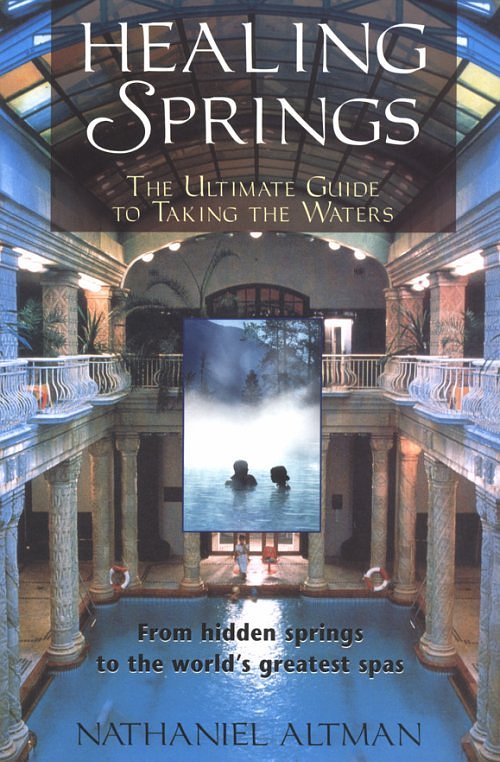
Publications: Healing Springs - The ultimate guide to taking the waters [?]


Non-existent
Soaking literature is far and few between. 

There are indeed many a hot spring guide book, in the US quite a few and in New Zealand as far as I know. Supposedly there will also be quite a few connoisseurs guides in Japanese.

But with instant internet, there's little or no need to publish these guides any more. We can all delve the info required with a swish and pointer or two. All up to date as well as the latest visitor who wishes to diss the place. The photo's are always there, explaining every nook or cranny. And even pre-buying an entrance fee to the fancier resorts becomes apparent. All the pre-visit pleasures.

This does mean that the enthusiast / upcoming soaking expert is depraved of an avenue to exhibit his or her expertise. In print. And who's not being printed does not exist. So goes the old adagium.

But beyond the world of lists and links there is surprisingly little info on what hot springs are and why so. Altman's now slowly dated Healing Springs wishes to link the two worlds and probably back in 2000 that might have worked. But nowadays a book a third filled with alist of potential soaking spots and a small collection of soaking picca's instantly seems out of place. And soakers in Southeast Asia need to note: we are not included! So much for our beloved soaking culture.

Best efforts to no avail? Krabi, Thailand's Klong Thom hot springs by Cholthicha Pornpan

Lost
But in the other two thirds, Altman has gone out of his way to seek to prove beyond doubt that soaking is indeed a healing process. 
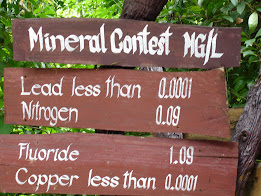
Altman's expertise is in alternative healing (he's an hand analyst) and he seeks to combine natural waters with immediate health benefits. Mineral content is linked to disease remedies while diseases are linked to types of hot springs. It transpires that soaking isn't the only healing aspect, one needs to include drinking and inhaling mineral spring content. Emphasis is awarded to the Euro concept of taking the waters where states have enabled soaking industries to expand and medicalise the hot spring experience itself.
And that is where to me the healing aspect is lost.

Healing and hot springs is as much about inspiring and relaxing rather than solely something to heal. Altman does try though. There is a chapter on the ambiance of soaking. But describing this book as the ultimate? Even in 2000 that wouldn't have covered the content.

Though he admires the Euro soaking states, he's right in emphasizing that soaking nowadays is something we might be interested in; but gone are the days in which states could afford soakers to indulge for weeks on end. Better are the Japanese concept with ample bathing facilities which can afford daily experiences. Already this fits much more in with northern Europe's hang towards sauna. Or the old daily English bath.

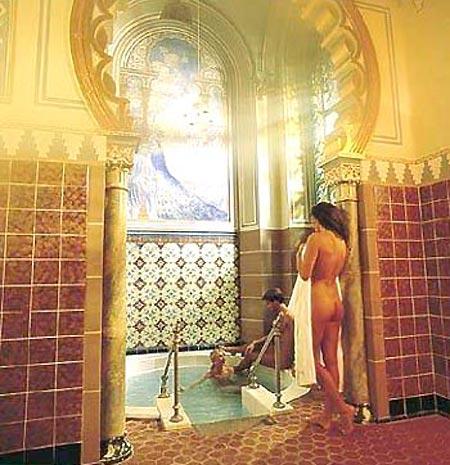
The author raves on about his Bad Wildbad experience, Germany. Unfortunately his own photo's are not available any more. The caption to this photo:
'A swimming fairy tale come true ... The classicist façade of the Graf-Eberhard-Bad (Count Eberhard Pool) looks rather unsophisticated in relation to what it contains. Behind the Florentine sandstone walls you will find oriental bathing splendour that is certainly unique in Europe.
This building, once threatened by decay, was restored with the help of significant financial backing, good planning and artistic effort to its original luxury as a bathing landscape, a dream from 1001 Nights. Today it is a modern temple of health with the refined feeling of the orient.
A grand architectonic effort thus succeeded in creating symbiosis between necessary modern form and an atmosphere of nostalgia. The Moorish Hall, the Princes' Baths and the Great Lords' Bath, where the statue of Venus by the Danish sculptor Bert Thorwaldsen can be seen, and above all the exclusive sauna landscape are part of the wonderful framework for a healthy visit. No resort visitor should miss this attraction: no one leaves without being impressed'.
Other aspects included are a nice historic overview where he notes that hot springs and human interest can be traced back for 600,000 years, but what with the lack of writing skills, use of mineral waters can be traced to Greek and Roman scripts as well as ample evidence in the form of archeological remains.

Altman does add a chapter on the preventive aspects of heated baths (leading to higher states of immunity) which assist in cleansing the body of toxins. We also learn that water pressure leads to increased flows of oxygen-rich blood. There is much more added to the list to the preventive powers of soaks, aspects of negative ions, micro-nutrients. You'll need to read for yourself.

So to sum up is Healing Springs a no buy? Well, I think the book cost me 0.14 cents which is about just above scrap value. The question is the book worth the transport costs? Hmm ...

Healing Springs has 4.8 stars at Amazon (4 reviews), while only 3 stars at good read (2 ratings).

Reference
Altman, N. (2000) Healing Springs - The ultimate guide to taking the waters. Healing Arts Press, Rochester, Vermont, United States of America.

Sunday, 15 August 2010

Dare to compare

Comparing 
Soaking in Southeast Asia and it’s sister / daughter sites focus mainly on countries within Asia where enjoying hot springs are less well-known practices and/or totally waiting to be discovered. In many cases these hot springs are under-developed or poorly developed.
Intending to seek out why in for instance Europe, soaking (and bathing) is very much a part of life, I was in the circumstance to visit a town known for it’s mineral waters while on business in Germany’s Harz region over the past summer. 

Bathing History 
Bad Lauterberg lies on the edge of the Harz, hemmed in by hills to the north, which shield the town from cooler winds. On the confluence of 3 streams, Lauterberg was known until the 19th century for mining, as was the whole of the Harz region. Wikipedia has a good entry on mining in the Harz. It was then discovered that water emanating from lower layers of the mountains also contained high concentrations of minerals which can be attributed to an improved health level if frequently bathed in. Such was the interest that gradually the Lauterberg economy shifted from relying on mining (and metal manufacturing) to relying on bathing and it’s associated culture to survive; it became one of Germany's oldest spa-towns (source). A few (up-scale) bathing places were created as well as the town undergoing development so as to make the bathers more happy, for instance the construction of promenades and parks. 

Bad 
Since the demise of mining, Lautenberg has been named Bad Lautenberg as in Germany much is gained by the term Bad. It is a government approved qualitative acknowledgment of being a place to bathe which can lead to an improved health status; a main reason why Germans are interested in ‘baden / kuren’ (and soaking). In the case of Bad Lautenberg, the bathing waters are natural, though unheated. In Germany there is little difference between the two, as unheated waters are heated for bathing and both forms (heated and unheated) can be regarded as having significant health properties. This is scientifically backed up. More famous bathing places such as Baden-Baden, Wiesbaden and Aachen do have natural hot waters. But not Bad Lautenberg. 

Soaking in Bad 
Bad Lautenberg possesses three locations for bathing. The choice falls on the Kirchberg Therme as it combines swimming pools with sauna without aiming at families, with the complete water circus of wave pools, slides, chutes and what have you. After all silence is golden ... 
Connected to the Kirchberg Medical Centre, the therme (or spa) is part of the overall facilities used by ‘patients’ and/or guests. The therme consists of a restaurant, a fitness centre, two indoor swimming basins and a sauna complex. Visiting on an early morning, most bathers were guests from the medical centre; use of the therme was free for these guests before 2 in the afternoon. The 2 modern free-form swimming basins were little used this morning (why?) and the cooler of the 2 pools surely could not be described as an attraction to me (too cold!). Much better was the clothesfree sauna complex which contained a variety of sauna’s, a steam room and an outside swimming pool with extensive sunning lawn. Somehow the larger swimming area required bathing clothes, possibly because the benefits of soaking should not be withheld from the less inhibited. However as said, the pools were mostly deserted whereas the sauna area was considerably populated by 20 or more patrons on that particular morning. Clearly most thought more highly of sauna use than of the possible advantages of the pool use; or couldn’t be bothered dressing up to use the pools.

A photo from the spa's own web site. In front the two pools while behind the rocks is the sauna garden ...

Your notes
Comparing to any experience in Southeast Asia is hardly possible. First of all there is Germany's love affair with hot springs, which dates back to at least the era of Roman occupation (Cooper-Erfurt & Cooper, 2009) Since, soaking modes in Germany have waxed and waned, but to Germans soaking or 'kuren' is a scientifically proven method of medicine. How important is this?
  • For instance the bible of Germany's spa's, Größchen's
    'Heilbäder und Kurorte in Deutschland. Conradi-Bäderkunde-Lexikon'
    counts more than 600 pages!
  • In 2006 nearly 6.5 million soakers were recorded (Erfurt-Cooper & Cooper, 2010); visits lasting multiple days .
One must also note that when taking a longer wellness treatment German health insurance will covers this. No wonder soaking is so important ... See also the following:
'Today, Germany has one of the most comprehensive spa cultures in Europe, with the support of the German federal health care system to boot! The German equivalent for spa is Heilbad or 'healing bath' or Kurort which literally mean 'cure place'. Any town in Germany can qualify and choose to use the prefix 'Bad' or bath before their town name i.e. Bad Soden. Those towns that qualify have met the strictest air and water quality standards and have been able to establish the necessary medical staff and infrastructure to cater to those seeking treatment. ... Once a Kur or cure therapy has been approved, a patient will be sent to a certified Kurort or spa where a patient will enjoy a holistic experience of exercise, nutrition, relaxation, communication and motivation custom-fitted by doctors and medical staff. The focus is to provide a Kur guest with the best possible natural environment to cure or prevent the further development of illnesses'.
Then there is the level of facilities to draw in the comparison. Concerning the emphasis on medical efficiency in Germany and German cultural pursuit of high standards, levels of hygiene are extremely high and are first most in thoughts of managers. Competition between facilities means that increasingly higher lay-outs are required and for the visitor this means the facilities are more and more luxurious and at the same time larger and more diverse. But other than these two aspects (medical culture / standards ) I believe there is little that would differ between soaking here in Southeast Asia and in Germany. In general soaks in both are mostly visited by locals, most patrons are slightly older and / or health conscious. Having such facilities in Southeast Asia could be possible, though the price differential would exclude most locals. So an in-between situation could be created. For instance hygiene is greatly lacking at 99.9% of Southeast Asia's soaking sites, but simple measures need not cost too much but can result in far better hygienic situation. My own preference? Well that would be a bit unfair. making a choice. The soaking culture in Southeast Asia is mostly non-existent and / or real foreign to myself whereas the experience above isn't ...
Related Posts with Thumbnails
Copyright 2009 © Soaking in Southeast Asia. All rights reserved.
No reproduction or republication without written permission.