Showing posts with label tourism. Show all posts

Sunday, 26 July 2015

Reclaim

Yes, I'll admit. 

This website as well as others I maintain are directly stimulating soaking in our earth's natural and naturally heated waters: there's little on earth that beats having an impromptu warm bath in natural water in the midst of nature.

But times being as they are, the few yet to be remodeled and commercialised hot springs are increasingly being threatened by the ever increasing swaths of tourists, who are seeking their fair share of bliss. 
At the same time we see that managing what's left of the planet's bounty is becoming more and more of a challenge, one we might be losing. 
Sadly, with more use, comes more abuse: contamination of the pure waters, filth surrounding the baths, erosion of the natural environment, non-social soaking behaviour, etc., etc.

So it comes as no surprise that in the past few months, in various countries around the globe, an assortment of users / governing organsations, owners and managers have seen fit to seek to change the way we might be able to enjoy soaking.

Fight
Exhibit A is the hot spring named Skinnydipper located in the state of Idaho, U.S.A. 

The abuse of the site has the managing organisation (Bureau of Land Management) putting forward  a proposal so as to eliminate soaking for once and always. KVTB (May 5):
'... dealing with litter, feces, drug use and break-ins in the area'.
Luckily at the last hour, users have organised themselves and hope to reach agreement enabling future use. Hopefully.
Idahostatesman (May 12):
'Nothing’s official yet. Tate Fischer, who manages the BLM office for most of southern Idaho, said he’s meeting with the agency’s upper-level management this week to discuss a compromise between users of the popular hot springs and the federal government'.

Read more here: http://www.idahostatesman.com/2015/05/12/3798444_aficionados-of-skinny-dipper-hot.html?rh=1#storylink=cpy
More info on the user cause here, a facebook site currently notching up nearly 9000 likes. Their latest message:
'To give everyone an update on where we are at right now:
The Department of Interior denied our petition for stay. What this means is that the closure order is in place and going forward. The BLM will need to follow their process for closure and we hope that before they take any action, our appeal will be granted.
So right now, cross your fingers and toes. We are still in this fight!'
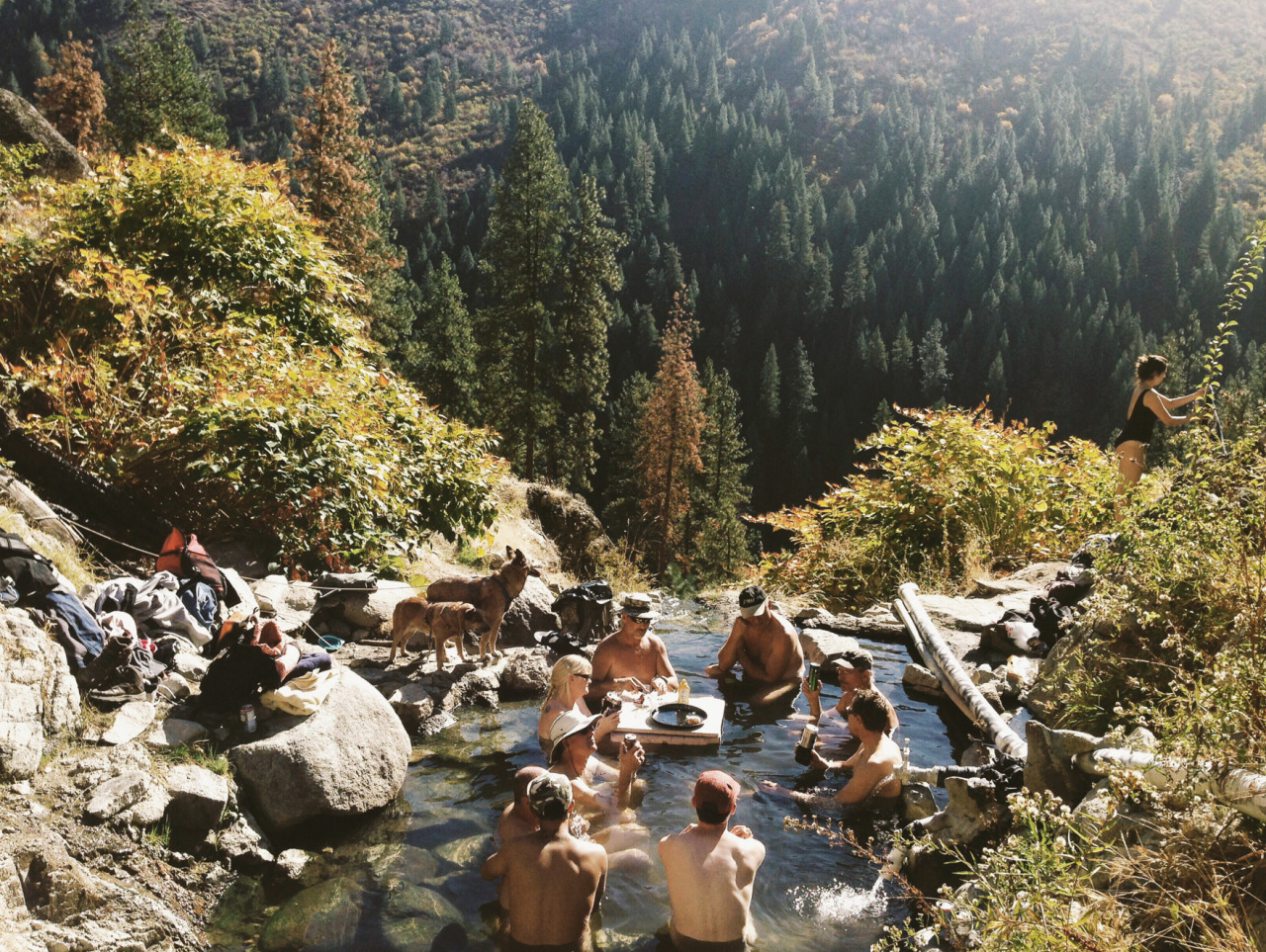
we hiked to a hot spring along the side of a mountain. the folk who maintain this hot spring just so happened to be having a sunday bbq. naked. so. that happened. when in idaho?
(Source: caseykaui)

Beauty
In a recent European Natural Soaking Society blog post there's more on the problems of Hrunalaug hot spring, one of Iceland's most iconic hot springs. 
The limited soaking site is unable to cope with the influx of the Iceland tourism boom and the owner has headaches enough without these.

The Grapevine.is (Jul.  5):
'The Hrunalaug hot spring has undergone so much damage from the sheer numbers of visitors it has received that the owners have considered bulldozing it over.
Helena Ei­ríks­dótt­ir, the daughter of the owner of the famed Hrunalaug hot spring, told MBL that her family simply cannot keep up with the number of visitors the spring receives. The spring is not just experiencing regular wear and tear, either; vandalism has also started to be a problem. People have also started camping on the site, despite numerous signs asking them not to'.
The Hrunalaug pool lies in the outskirts of the village Flúðir (Fludir), just over an hour's drive from Reykjavík. The pool combines beautiful nature with an ancient structure. The pool is located in a beautiful green gully, where the natural geothermal water collects into the pool.  The pool is actually split into two pools and the water streams out from the first pool in a little trickle of a river through an old turf-hut. There it collects again into another deeper but smaller pool at the front end of the hut. The hut is old and weary but can be used as changing facilities for guests who visit the pool. The hut has concrete walls and concrete floors, but the roof is made from corrugated iron and turf. Inside the cottage you will find a bench were you can put your clothes. The facility is primitive and raw but very interesting.
source tripcreator

As users are mostly tourists there's little scope for a user group being established to assist in management. With tourists outnumbering locals by far, I can't see locals taking the initiative and for tourist companies to practically assist there's too much scope for free riding from non-participation.
Thus the future use for soakers lies in the hands of the owners and their willingness to put up with antics and numbers. 
Icelandic law decrees unfettered access to nature and natural resources, destruction of the source is the only way owners can restrict access. 
Dilemma.
 
Elsewhere from the same blog we saw both an interview as well as a soaking review of terme Il Bullicame near the  town of Viterbo, Lazio (Italy). 

Here users are facing a doubled edged sword. 

On the one hand how to manage use, while at the same time lamenting the commercial exploitation of the source itself as waters are syphoned off to a neighbouring establishment. 

It's a much wider problem as legislation and governance seem to contradict itself resulting in a free-for-all; thus meaning commercial strength is the winner.

The fight itself is already protracted and it's yet to see what, if anything can emerge. Other than a Pyhrric victory ... 

A call to reclaim the hot spring at a recent protest
Tuscia Times (Jul. 25, 2015)

Cover up
Then closer to Southeast Asia, we were told the story of the Fudo no Yu onsen (Japan) where due to remoteness (and thus lax governance) abuse of the hot spring could take place. Here plays social change a large part as well. 
Tokioreporter (Jun. 2):
'Following a number of complaints regarding illicit behavior, the Shiobara Hot Springs Tourism Association announced on Monday on its Web site that one resort in Nasushiobara City has shut its doors
...
With an entry fee of 200 yen that was paid on an honor system, Fudo no Yu generally operated without managerial supervision.
Other reports concerned theft. 
Very Asian, the closing of the onsen was meant to avoid bad publicity ...

Safe to say the onsen has since reopened (see excerpt below) however with increased management it also saw the need to force a change in age old bathing habits; is this the future face of soaking in Japan?
Tokioreporter (Jul. 6):
'On August 1, the mixed-bathing Fudo no Yu onsen, located in Nasushiobara City, will begin accepting bathers during the day on weekends and holidays.
...
came to an agreement under two stipulations: A manager will be on hand to monitor the bathers, who will be required to cover their bodies with towels'.
Sacrilege? It beats me how forcing bathers to cover up will lead to positive changes. Certainly only the posting of a manager would be sufficient ...

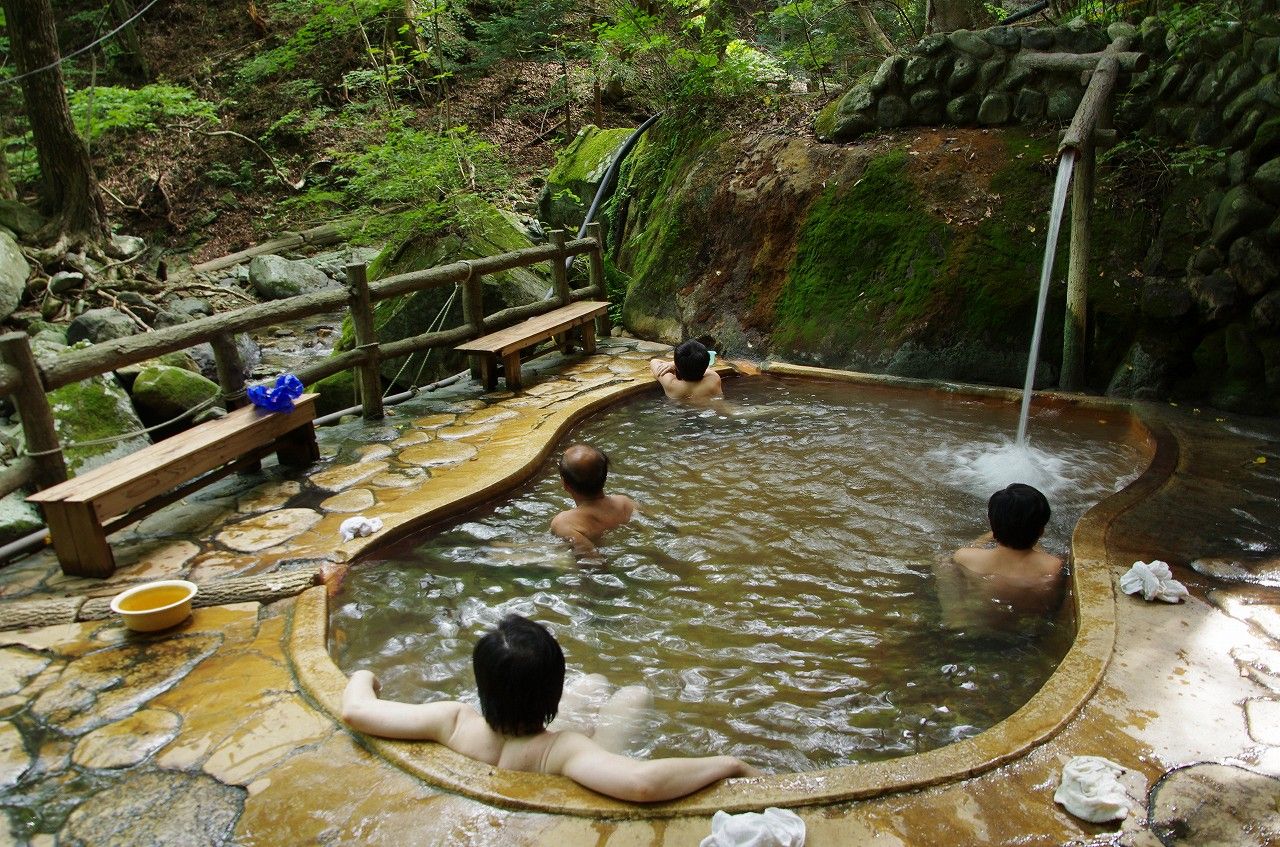
Fudo no yu onsen, source

Vocal
What's required is a need to know how managing naturally natural resources can be successful. Without caving into commercial interests. And with public interest at heart.

Are there any examples of such? 

It can't be overstated that public interests require public (read government) commitment. 
However, nowadays public entities worldwide are chronically underfunded to such an extent that they are increasingly getting caught in upholding the interests of the establishment. 
And if the public's interest require funding, the public's interest will stand little chance.

So it's up to us to bring about change. 
Each soak requires tailor made solutions, there are no blueprints. 
But what we share is a common, is an interest to safeguard the few unique publicly accessible natural soaking sites. 

At the very least our voices need to be heard!

Tuesday, 3 December 2013

Soaring skyward

'#throwback #sunday #hotspring #emeraldpool #aonang #bff'
Taken in Klongthom, Krabi, Thailand. Source

The northern hemisphere is slowly becoming colder; the time of year to seek the heat of mother earth herself.

It's also time to recap the year. 
Little original content has been added to this site itself; such is life. But the regular updates besides capturing some pan-Asian soaking highlights seems gradually evolving into a number of themes:
- geothermal power development versus local soaking rights
- excessive development of hot springs
- (traditional) bathing traditions
- innovative ways of using earth heat

On other related sites, this year have seen their own developments. The Himalaya site has seen a number of original posts reworked and kept up-to-date. In this and the Thailand site have seen a number of photo posts.

Most of the effort though, has been directed to the Europe site, with a good number of original posts culminating in an overview of supposedly Europe's most natural soaks. Possibly the European Natural Soaking Society may well become the flag-bearing site. My own time for long-distance travel is very limited and the few remaining really natural soaking sites remaining in Europe may well need my fullest attention ...

Fiesta
But back on subject. The hot spring season in North (and Southeast?) Asia is under way. 

With a couple photo's of models (or sexy girls as this website believes) chinatraveltips notes:
'The 6th China Huangshan Mountain international hot spring culture festival kicked off on November 18, 2013'.
Hot spring culture = couple of female models splashing? 
Another hot spring festival, this time in Fuzhou - Lianjiang, China. Originally from China Daily (Oct. 30). What does a festival look like: 
'The guests enjoyed dance and singing performances from Russia, Spain, Taiwan and Fuzhou, and also had the opportunity to relax at the hot springs at Gui’an Xishan resort hotel after the show'.
Southeast Asia lagging in this party (thankfully?)?

Follow the leader
The Jakarta Post (Nov. 6) describes the Philippines as an example to follow in the field of geothermal power:
'Indonesia does not have to look very far to find the best way to tap geothermal energy, which potentially is located in protected, remote forests.
As Indonesia struggles to find a balance between the development of geothermal resources, forest conservation, and development, the Philippines has shown how that can be achieved.
...
Agnes de Jesus, senior vice president for environment and external relations at the Energy Development Corporation — the Philippines’ largest geothermal power producer — recalled similar challenges in 1988 when the Philippine government decided to build geothermal power plants in the middle of Mount Apo Natural Park following the El Nino weather phenomenon that reduced hydropower generation.
The plan was highly controversial at that time, de Jesus said, citing the lack of legal basis to establish plants in a conservation area, which is also an ancestral domain for indigenous people.
“We conducted scientific surveys on the site to asses the environmental impact and held many consultations with stakeholders to explain about the project,” she said. It took four years for the project to start after securing approval from indigenous people and a presidential decree that granted exploitation permits in the forested area'.
The example is thus an example in the way government appeases investors. But with energy dependency as the winner.

More news (Indonesia-investments.com, Oct 22) for potential investors in Indonesia's geothermal power. A law is actually being drawn up concerning development of geothermal energy. This would be an improvement as currently geothermal power falls under mining laws.
Harking on this is an earlier article in the Jakarta Globe (Oct. 27). It explains the intricacies of a geothermal project in Lampung, Sumatra:
'Locals should be consulted on the development of the geothermal power plant being planned near Mount Rajabasa in South Lampung regency so that it will not spark controversy and be rejected by indigenous people living in the surrounding areas, a minister has said'.
A Turkish company has shown interest in geothermal power nearby (Republika, Oct. 26). And then the Jakarta Globe also reports (Oct. 7) on Japanese investment in Indonesia's geothermal power.
So it looks like geothermal power generation in Indonesia is gathering steam.
  
Meanwhile, the typhoon which struck so devastatingly central  Philippines, also affected the Leyte geothermal  power generation. This article (interaksyon, Nov. 19) mentions 4 power stations affected with capacity potential of over 600 MW. though since, some have been reactivated.
Coincident or not CNN's money has 3 minute highlight on exactly Leyte.

Culture II 
Over the past months Thailand has seen it's great public debate: are the many Chinese tourists a bane or boon?

It starts with this little knowledge. That the Chinese authorities are aware of their abroad citizens. And how they behave (as they are at home). The Bangkok Post (Oct. 3) :
'The National Tourism Administration publicised its 64-page Guidebook for Civilised Tourism - with illustrations to accompany its list of dos and don'ts - on its website ahead of a "Golden Week" public holiday that started on Tuesday. ...
It also urged them not to occupy public toilets for long periods of time or leave footprints on the toilet seat. Nor should they urinate in swimming pools'.
!!!! Nice.

The northern Thai city of Chiang Mai sees the brunt of of the Chinese influx; it forms the backdrop to a popular tv comedy in China. But the Lanna citizens are not all happy (Bangkok Post, Oct. 13):
'But despite the large sums of money these tourists bring, many local business owners complain about the travellers' uncouth behaviour _ spitting on the street, failing to flush the toilet, pushing in and any number of messy dining habits'. 
The article rolls out a complete gambit of every possible problem the Chinese are the source of. This involves the above but also low spending culture, BYO, poor driving, extensive haggling, etc. Thankfully no reports from local hot springs ... As of yet.

Than the Bangkok Post reports on October 25 on the nearly 100% increase in tourists from China. The arguments contra are for instance that the Chinese guests hardly spend any money as most of the souvenirs available in Thailand are made in China! Inappropriate behaviour is another argument. Example provided:
'I have some first-hand experience of Chinese manners. During a stay in a Pattaya hotel, I saw a group of Chinese tourists, who were walking back from the beach, stop by the hotel's swimming pool to wash  their feet. Needless to say, this upset the swimmers'.
Well, next year will probably see another flavour: Indians? Americans? Rwandi? What will the complaints be then?

And totally different. Japan thinks that soaking is passè. The answer (Reuters, Nov. 23) to keeping towns dependent on their hot springs is to open casinos!
'In contrast to the massive resorts of Las Vegas and Singapore, aspiring hosts outside the big cities are looking to the more compact facilities of Europe as a guide.
The German spa town of Baden-Baden, which also has casinos, is serving as a model for casino proponents in two traditional hot springs towns - Atami, in Shizuoka Prefecture, and Naruto, in southwestern Japan's Tokushima Prefecture'.
Asian affairs 
  • Indonesia
A blog features a beautiful look at the highlands of Bali. 
This includes a walk to Angseri hot spring. 
Source: heyitsksh.

Another find? Tinggi Raja, North Sumatra was visited by the Green family (Nov 7). Is it soakable? Possibly too hot!

Jeff Low has a photographic feature on Manggaruda, hot spring, Flores, Indonesia (Oct. 24). Here's just one of the photo's:


A good report (bygetupandleave, Sep. 11) on climbing Rinjani volcano, Lombok, Indonesia. Note the ability to take a soak after the climb near the crater rim. And the photo's:

The amazing hot spring!
  • Malaysia
An extensive report (The Star, Nov. 16) to the little disturbed forests of Ulu Meda in Kedah, Malaysia:
'How can a vacation ever be complete without a trip to the hotsprings? Indeed, after a five minute boat ride upstream, Hymeir led us into a place called Sira Ayer Hangat, which literally meant Hot Water Salt Lick. He guided us into a shallow stream, pointing out safe spots to step as certain spots had hot scalding water! Downstream, the hot spring water mixed with the cooler river to created a perfectly warm swimming area.
On a sandbar in the middle of the stream, steam rose from the ground. A wispy white substance coated the areas where hot water from a hidden spring wept straight from the sands into the surrounding stream'. 
Sira Ayer Hangat literally means ‘Hot Water Salt Lick’. It’s frequented by wildlife.
It continues:
'... once, a visiting government official saw the area and thought of turning it into a commercialised spa. Fortunately, this didn’t come to pass as it would not only have damaged the environment, but also would have driven the animals away. Besides, there were hot springs nearer towns outside the Ulu Muda conservation area'.
Hurrah!

Lest s
ome forget, the Borneo Post (Nov. 17) mentions the existence of a hot spring in it's own backyard, Panchor Dayak:
'There is one in our own backyard – Panchor Hot Spring, nestled in lush secondary jungle at Kampung Panchor Dayak, Mile 27, along the old Kuching-Serian Road.
Here, one can enjoy the invigorating effects of a natural hot spring without having to travel thousands of miles or paying a huge sum for it.
...
In terms of facilities, Panchor Hot Spring offers quite the minimaL. There is a main wooden structure housing a canteen, a sitting place, shower rooms as well as toilets. From here, a wooden plank walk leads to the pools with a natural ambiance.
What can be easily overlooked is perhaps is the totally green jungle backdrop where tropical animals and birds may sometimes be spotted.
During a recent visit, I spotted two different types of birds — a green-whitish one which winged down a tree but soared skyward almost instantly in one swift motion, and a blue-greyish pair which fluttered among some fallen branches towards the bushes, lingering long enough for their pictures to be taken'.
And then stated matter of factly:
'Fully aware of Panchor Hot Spring’s immense tourism potential, the government already has plans to develop the place into something bigger and better — with piped water and electricity, villas, hostels and barbecue facilities.
According to Jeffrey (Layut), work has already begun.
“You can see the trees have been felled to give way for the villas and other facilities. We hope the upgrading can be completed as soon as possible so that this place will be better equipped to draw more visitors,” he said'.
Government thinking: sod nature, bigger = better!
  • Philippines
Maquinit may sit high in Southeast Asia's popularity polls, but this visitor laments:
'The lack of shower is what prompted out friend Rupert that it is expensive, especially because no maintenance effort is needed for the water to fill thr pools. "Ni di sila nagbabayad ng NAWASA" added Rupert'.
  • Singapore
In Singapore off the beaten track? Ourbigexpatadventure reports on Singapores only hot spring source:
'It was an interesting and quirky adventure!'
Sembawang hot spring, Singapore. Enjoy? From instagram jeromekg
  • Vietnam
Vietnamplus lists the big 7 hot springs of northern Vietnam. In no particular following: Kim Boi, Than Thuy, My Lam, Ban Moong, Kenh Ga, Quang Hanh and Tien Lang.

Further afield
Bhutan. The hot springs of Dunmang are deteriorating, so reports BBS (Oct. 25). The report comes complete with a video of this beautiful hot spring. One problem: there is only 1 toilet. It apparently sees more and more visitors without any facilities available.

An upscale opening, the Angsana spa Tengchong in western Yunnan, China (Sep. 27).

A report from the end of last year. Chinese officials in the region of Inner Mongolia tired of the ever increasing amount of officials coming. So reports wantchinadaily:
'The end of the year is a peak time for officials to make inspection tours. A deputy head of a county in Inner Mongolia famous for its hot springs said he received 10 groups of guests in a single day. As a visit to the baths is considered a sine qua non, a local official paid eight visits to the baths with different groups. He was so exhausted that he decided to wait in the bath without getting up and putting on his clothes as he received the last groups for the day day'.
Slightly dated, even Lonely Planet is picking up the vibe from natural soaks. It has an article named Hot spring hunting in the Southwest USA. Most mentioned though are more upmarket soaks, though apparently Verde hot springs is known for it's remoteness and alfresco bathing! Yeah.

#bali #kintamani #batur #hotspring #lake #mountain
Enjoying Bali, source.

Wednesday, 13 June 2012

Spotlight

Two entries already on European hot spring visits in the European Natural Soaking Society. More to follow.

Topical
Hot on the heels of the last update's weird and wacky hot spring and sauna experiences come's Estonia's sauna car! Follow the link and watch the clip.
I do not know if this applies to the sauna car, but in Japan you can visit a hot spring and earn airmiles!

Regional
Seldom do we see such good work in (re-)seeking hot springs in Southeast Asia, most prefer the over-trodden paths. However the blog entry 
'Unearthing Timor-Leste's Hidden Gems - Marobo's Natural Hot Springs 
by  Barry Greville-Eyres and Francisco Carlos de Araujo is a real gem by itself: 
'On a short descent we encountered ruins and remnants of what was supposedly spa or resort styled accommodation, at a picture-perfect location, surrounded by a labyrinth of ridges and valleys. Despite conflicting reports on the origins of the development - some sources attribute it to Japanese occupation forces during WWII (1942-1945) others to the Portuguese colonial occupation-era pre-dating WWII - its highly likely that local Timorese villages were instrumental in the construction of the associated infrastructure.
Much toil and backbreaking effort must have gone into the construction of the access road; distinguishable accommodation units; hundreds of metres of retaining walls; hot water diversion, distribution and drainage systems; the main bathing pool (approximately 25mx15m); an ablution facility and individual external mineral or mud baths.  Although the facility is now clearly abandoned, it still remains an important part of Timor-Leste's natural heritage and a potential drawcard for both domestic and international tourists'.
 It also lists a short overview of all Timor-Leste's hot springs. 

'A parting shot of Marobo's natural hot springs - 
yet another of Timor-Leste's hidden gems'.
Foreign control? Locals in Sabah state, Malaysia are worried that their natural wonders are being privatized. 
Always this never ending story: private ownership of public lands results in entrance fees / profiteering possibly exclusion of certain groups of persons (based on income) or public control by public organisations which (in Malaysia) don't seem to be interested in the public interests. The essence of the freemalaysiatoday article (7 June 2012):
'Ranau STAR division chief, Jalibin Paidi, said the transfer or takeover of the management of money-making Kinabalu Park or parts of it as well as the popular Poring Hot Spring near here had become a hot topic among people in Ranau and they want to know the truth'.
More worrying is the emphasis on foriegn control as if this makes non-public control worse ... 
Note also that the article mentions that all of this is rumour, hot air thus ...

The mud baths of Thap Ba (Nha Trang, Vietnam) now have a local competitor / imitator. Read more on the Thap Ba Soaking in Southeast Asia entry.
In the same area, Waterfalls of Southeast Asia reports that the famous Yangbay waterfall park, will soon expand, to include a (natural) hot spring ... 

Meanwhile in Los Baños, the Philippines, the gamble is on big-business tourism, so states inquirernews (30 May 2012): 
'The master plan also includes setting up a cable-car system along the Makiling terrain, rehabilitating the heritage sites in the town’s poblacion, and renovating the local spa and hot spring resorts'. 
More of the same thus?

Another entry on the Pinatubo hot springs:
'According to tour organizers, most of the resort’s clients are foreigners, with Koreans in the majority since it was developed by a Korean investor married to a Filipina. The resort also provides employment to indigenous Aetas, the original residents of the area, who were displaced during the volcano’s eruption.
With smoke billowing out from mountain crevices, natural pools and waterfalls sprouting from the dry earth, and oddly-shaped geologic formation, the terrain looks almost prehistoric.
It’s almost surreal to see modern amenities instead. Like in most developed resorts, there are several bathrooms and changing areas near the pools, with alert attendants handing out fresh towels to newly-arrived guests. Picnic huts, paved stairways and cement banisters made to look like wooden logs, have been carved from this mountain of stone and soil.
I dipped my foot gingerly into one of the hot pools and immediately retreated as the heat pierced through my skin. I moved to another pool where there were more people and found it relaxing in a feverish sort of way. Beads of sweat broke out on my forehead as my body slowly adjusted to the temperature. The heat of the pools really seeped in and soothed one’s aching muscles in no time'.
A great entry on an as-of-yet not-on-this-site-listed hot spring: Bogyah hot spring, neatly nestled in the Hapao rice terraces, Luzon, the Philippines. A great blog entry:
'When we got to Bogyah Hot Springs, there were locals relaxing in the hot spring. I did not mind, this was their place and I was happy that while dipping on the hot pool I get to know some bits and pieces of their life'. 
Note end line: 
'Let us not change Hungduan [where Bogyah is located] , let it change us'. Too ture.
Travelfish have added a section on the Dieng plateau, Java, Indonesia: 
'The main attractions in Dieng are the numerous temples and the geothermal area around Kawah Sikidang'.
Less local
More money being thrown around (or away?):
'GOCO Hospitality is working with Sanli Guo Yuan to develop the Xiangshan Hot Spring Wellness Center, a 6,000 sq,m. facility with an onsite natural hot spring, located 30 minutes outside Ningbo, China'. 
The cost will be only $US 25 million. For this: 
'The Xiangshan Hot Spring Wellness Center will offer exceptional wellness programs that are results-oriented and address the health concerns of the modern Chinese consumer—beauty enhancement, weight loss, detoxification, stress relief and ageing well. Benchmarked against leading thermal facilities internationally, Xiangshan will set a new standard in design aesthetics and service quality, seamlessly blending Western and Eastern wellness modalities'.
 Continuation of soaking vs geothermal energy dilemma:
'... opposition from local hot spring operators is stalling proposed large scale geothermal development in the Prefecture of Fukushima'. 
So reports the thinkgeoenergy.com last month. Seeing how the nuclear plant nearby which should be one of the most regulated industries went haywire, how is one top believe assurances from companies? Take for instance a recent entry on the soakersforum which mentions hot springs being sucked up ...

More  energetic activity in the region. $11.5 have been allocated to the Tawau, Sab ah, Malaysia project, no soaking opportunities? The Leyte, Luzon, Philippines geothermal plant will cash in (read privitize), with global energy prices at a remaining all-time high. Then there is news on Sulawesi (potential) and elsewhere on the Philippines (Kalinga).

Banjar hot spring, Bali, Indonesia (source)

Thursday, 12 January 2012

The end?

With over 50 original postings and proving to be the premier destination for information on bathing in hot springs in Southeast Asia, it seems the posting below will possibly be the last original posting for the time-being.

Since a couple of months I have relocated to Europe and seem to have less and less time to pursue my own pursuits and passions, let's hope it won't last for that long ...

This site will remain and will constantly be updated, but let's say less regularly than before. Because as the soaking family has expanded way beyond what I had originally intended, keeping the blogs updated and interested will be very challenging. Even now avid follows are hoping I will chase down more natural soaks in Europe. Alas Europe has done it's best to tame nature such that soaking it the real sense can only take place in more remoter parts of the continent. Let's see!

Maybe it's also time to organize soakers and present to the policy makers and the development elite that hot springs are best enjoyed pristine. Considering the amounts of money poured into the geothermal advocacy, a small cash line to proponents of keeping the soaks as they were could lead to win-win situations.

Anyway that's just my thoughts, let's shift our focus to Thailand, to one of the best hot springs I have visited:


The town, néé the province of Ranong, is synonymous with hot springs. However this link is entirely focused on the existence of
Raksawarin hot spring, located not far from downtown Ranong. Developed and overdeveloped, this hot spring is ....

Read more in Soaking in Siam to see whether or not Porn Rang can be rated as one of Southeast Asia's best hot springs!

Saturday, 8 October 2011

Not so Samui?


Provincial bliss?

Surat Thani is a well established province for tourism, though the fact that all this tourism is concentrated on the boutique island resort of Samui and the full-moon party island of Phangan means that the mainland part of the province is often by-passed, neglected even.

Surat Thani town itself is ....

See Soaking in Siam for more.
Related Posts with Thumbnails
Copyright 2009 © Soaking in Southeast Asia. All rights reserved.
No reproduction or republication without written permission.