Showing posts with label Chiang Mai. Show all posts

Wednesday, 9 November 2022

Seek

Stay wild and free
Model by @rachel_loudy
•
Fyi tempat ini cocok banget buat list tempat liburan kalian saat tahun baru, tempatnya buat memanjakan badan dan pikiran karena disini kalian bisa berendam dengan air panas, kalau ada yang tahu tempatnya komen ya dibawah guys
What's there to share? Not much concerning the odd photographic evidence.
But some content.

Secret Retreats (Sep. 28) has a feature on Asian hot springs.
On Rinjani (Lombok, Indonesia):
'Take a trek to the emerald jungles of Mount Rinjani National Park to see Lombok’s wealth of waterfalls and then relax those tired muscles post trek with a soak in the island’s most famous hot spring, ‘Aik Kalak Pengkereman Jembangan’. Aik Kalak translates as boiling water and as the name suggests, it is a place where one can enjoy bathing in the warm, healing waters surrounded by nature. Aside from bathing, local people have long come to the site to perform rituals and seek blessings. Long considered a magical place, locals still today bring ritual items such as Keris (a dagger typically used in religious rituals) to the spring to wash and bless them and ensure their supernatural powers are intact. Legends have it that Sasak warriors, the Sasak are an ethnic group that calls Lombok home, would visit the spring to bathe after battles and the magical waters would heal battle wounds.
Aik Kalak Pengkereman Jembangan is located at about 2,000m elevation on the side of Mount Rinjani and in the late afternoon and evening the cooling air makes for a wonderful contrast to the steaming waters of the spring. The refreshing atmosphere of the stunning natural scenery on Mount Rinjani and the warm, healing waters of the hot spring are guaranteed to soothe and revive all who visit.
They also mention Pai (below), Sankamphaeng (both Thailand), Poring (Sabah, Malaysia) and Muang La (Laos). As witnessed from the above, their script writer is very much in form.

Thailand, February 2019.🍃🌞
Sometimes I feel like I forget to breathe. Not metaphorically speaking, but quite literally holding onto a breath I must remind myself to release.
Like there are so many tabs open in my brain I’m not present in the moment. I’ve never been an anxious person. But the last few years have been weird as hell and have brought on more anxiety and stress than ever before.
I’ve found comfort in my friends and family, holding them close, practicing yoga and meditation, being in nature, immersing myself in things that bring me joy and calmness. Finding beauty in the small things and focusing on how I can create a life of love, happiness and allow it to overflow to the collective. We all need more kindness in community as well as solitude; doing the inner work. I hope today brings you simply peace. 🙏🏼🦋💛
More Thai, more Pai.
Thailand Nomads has a 2022 review of Pai (Chiang Mai) most popular hot springs:
'Hot Springs are a treat to the eyes and souls of people who genuinely admire the beauty of nature.
The city of Pai has some really beautiful Hot Springs that you must check out on your visit here.
We have picked up the best ones for you in this blog'.
They note 4 local hot springs to enjoy.

Halved
Central Thailand. xyzasia (Sep. 14) looks at what's on offer around Khanchanaburi:
'The hot springs were the specific reason that I travelled to Kanchanaburi province. I’d been suffering some groin pain for nearly two months after a bad bout of Covid and couldn’t find any way to get rid of it. But when I spent a couple of days at a saline hot spring in Krabi in southern Thailand, I discovered that the pain had more than half disappeared.
...
Wat Wang Khanay Hot Spring
This very traditional public sulphur hot spring is located in a temple complex on the south-eastern side of Kanchanaburi city. It’s very conveniently located to the city – only about 15 km away – but it is unlikely to appeal to most international visitors. You’ll be invited to step into a large stainless-steel drum that looks like an industrial cooking vat after the attendant has filled it with hot water from the underground spring. There are several rows of the vats along one side of the temple courtyard'.
Continuing with Rock Valley hot springs:
'I had quite a long soak in the coffee pool, but it wasn’t my favourite. The next one was – the eucalyptus pool at No 13. This also claimed to help with blood circulation and skin detoxification, but I so loved the aroma. I could have soaked in this one all day. The temperature was probably only around 38-39°C so you can certainly spend longer in it if there are not too many other people at the hot spring.
That was the last pool that I spent much time in because No 14 was only straight mineral water at 38°C. It wasn’t labelled but I assume it was a ‘cooling down’ pool before the last pool which was labelled ‘normal temperature’. That is the largest of all the pools at the hot spring, but I didn’t get to try it because it was being cleaned on the day I was there'.
On to the south of Thailand.

Travel to Phang-nga 4 years ago 🥰
#travelthailand #phannga #thailand #hotsprings
The Nation (Jul. 13) has yet another story on the dual pricing structure of virtually everything in Thailand, but now with special reference to hot springs:
'A TikTok video posted by a Japanese tourist complaining about “inequality” at a Krabi hot spring after having to pay an entrance fee 10 times the amount locals are charged went viral overnight, with many netizens having their say on Tuesday. The man posted the video after he visited Klong Thom hot spring, where he was charged a 200-baht entry fee as opposed to 20 baht for Thai visitors.
“A Japanese [tourist] feels the inequality in Thailand. I had to pay 200 baht while Thais pay only 20 baht,” he complained'.
Earlier the same source (Mar. 3) reported on what seems like research on aforementioned Klong Thom:
“The number of hot springs known for their healing benefits has changed from time to time, but not all hot springs possess the properties to help alleviate physical and mental ailments. Thailand is blessed to have a remarkable and curative hot spring located in Klongtom district of Krabi province. Aside from its properties to treat poor mental health and unfavourable physical conditions, the hot spring is also unique for its naturally sparkling saline water.
The Klongtom Salt Hot Spring is considered one of the world’s five best hot springs with mineral saltwater following those previously found in Taiwan, Japan, Italy, and Malaysia.”
The above explanation was given by Dr Jiroch Sinthawanon, a former senior expert of the Office of Permanent Secretary, the Ministry of Public Health, when conducting a research study on hot springs in Thailand.
The publication, named “Safe and Healthy Hot Spring Bath”, was aimed at disseminating knowledge on the use of hot springs to create a good image where people can fully trust their benefits and safety, and maximise the standard of health tourism.
Jiroch added that “the temperature and minerals found in the Klongtom Salt Hot Spring are truly outstanding. The seawater seeps into the basement of the hot spring through rock layers to be filtered twice. As a result, the water retains only a light taste of salt unlike the strong salty taste of seawater as well as the smell of sulphur.”
The article also leads to significant info on a real estate project hopefully profiting from positive imagery, probably the reason for the article (and research; the author mentioned above is hardly mentioned on google):
'Wichai [Wichai Poolworaluk, president of Woraluk Property Plc, a leading real estate company in Thailand and a major developer of the Klongtom community in Krabi] said, “As a real-estate leader, we want to be the one to transform people’s concerns into happiness backed by our standardised and trusted management. This had initially inspired us to work on the development of the Klongtom Heritage project. Situated on a vast area of over 200 rai (32 hectares), ...'.
Luckily the locals are set to profit big:
'The local residents will be offered greater job opportunities and a chance to earn a higher income, while the ecosystem and environment will play a vital role in making the community grow in a sustainable way. This will help people to improve and reinvent themselves, getting ready to upgrade their life to national levels, he said'.

Luckily they'll not to be patronized. Oddly the Bangkok Post (Mar. 2) runs exact the same article.

Continuing southwards. The Star (Oct. 13) has 7 Malaysian hot springs to share:
'Most of the hot springs are small, but there are a handful that have been turned into proper resorts and parks'.
Just 45 mins from Kuching's city center
Lies an all natural hotspring
Which is reputed to cure diabetes, hypertension etc
Damn....doctors are gonna be out of jobs
I do so miss the good old days
When the responsibility and stress of work was manageable....
Maybe all I need is another long relaxing hot bath surrounded by lush greenery
#malaysiatrulyasia #malaysiatourism #nature #naturephotography #siasitoksarawak #raonraonsarawak #sarawaktravel #sarawaktourism #sarawakmoretodiscover #amazingborneo #borneo
Want
Free Malaysia Today notes (Dec. 21, 2021) that the onsen trend has reached Malaysia:
'Complete with warm lighting, a single-sized tub filled with hot water and imported salts, a shower area, and Urban Retreat’s very own line of toiletries at your disposal, you will want for nothing but some peace and quiet once the 45-minute session begins'.
It's a trend getting more and more traction in the area. Is it the culture (here fakely presented)? Is the not need to head to Japan for the experience? Do onsens balance out the hectic city life? I have no idea.

But here are some more snippets concerning onsen experience in the region.
Thaiger (Apr. 18) looks at the Japanese style onsen baths on offer in Bangkok:
'What if we tell you that you can have an authentic onsen experience right in the bustling city of Bangkok?
On Yunomori:
'The Onsen mineral water bath uses water from Kanchanaburi’s Wat Wangkanai [sounds familiar?], so enjoy the holistic benefits in the heart of Bangkok'.

VNexpress (Aug. 27) shares an overview of Japanese style hot spring resorts in the Danang region. It's not always clear how the waters are sourced. For instance:

'The resort has a heated swimming pool on the top floor of the 22-story building that allows visitors to admire the entire Da Nang Bay.
With a variety of minerals imported from Japan, guests can experience mineral bath services at shared baths or separate areas for men and women'.
Time to relax at Alba Hot Springs. Just a 15 minute drive from the resort!
More Vietnam.
Wellness Vietnam has an article (Feb. 15) named Best hot springs experience in Vietnam.
'There are more than 200 hot springs throughout Vietnam though only a handful have been developed and are safely accessible for public bathing. Our guide to the ‘Best Hot Springs Experience in Vietnam’ features six unique locations that combine wellness, adventure, and cultural immersion'.
A local insiders (Sep. 12) guide to Binh Chau hot spring (What to expect). It looks like the place has seen some heavy renovations since I was here.

Something from Myanmar. Mylocal passion (Apr. 1):
'Tanintharyi region also has natural hot springs and the water is warm and hot in every season. Tanintharyi hot springs are heated groundwater which is of high temperature water. Local people believe that the water of hot springs can be good for our body, relax our muscles and can heal neuralgia. I want to mention four popular natural hot springs among local people in the different areas of the Tanintharyi region'.
All still very rustic luckily.

Breached
Though times are a changing, but not yet in Singapore. At least where it concerns attitudes to bodyculture, which are yet to move forward and with this news snippet (Oct. 14) it doesn't look likely to change in the foreseeable future:
'The local edition of famed fashion magazine Vogue has repeatedly been found to be in breach of government content guidelines and, as a result, had its one-year permit revoked yesterday.
The magazine then reapplied for a new permit but was granted one lasting just six months.
In a Straits Times article, a spokesperson for the Ministry of Communications and Information (MCI) said that Vogue Singapore violated their content guidelines on four occasions within the past two years by including nudity and content that “promoted non-traditional families”.
The exact content that violated MCI’s standards has not been revealed. Although Vogue Singapore does not feature explicit nudity, Infocomm Media Development Authority’s content guidelines notes that semi-nude models with breasts or genitals covered by “hands, materials or objects” are also forbidden.
As for the part about content promoting “non-traditional” families? That is code for content that portrays queer or LGBTQ+ relationships in a positive light'.
Then finally some news from Quebec (Canada) ,not noted for it's geothermal highlights. LaPresse (Jun. 7):
'Un développement touristique incluant un lagon chauffé entre autres par la géothermie et la construction de 300 unités en partie chauffées et climatisées par l’énergie solaire doit prendre forme à 45 minutes de Québec, aux portes du Massif de Charlevoix. Développé en trois phases, l’environnement du GeoLAGON nécessitera un investissement privé de 300 millions'.
It's not clear from the article itself whether the lagoon's waters would be geothermally sourced or just geothermally heated. With all the geothermaility in Southeast Asia, it's quite astonishing that nothing has been done on a similar but somewhat smaller scale ...

Sudah lama sekali ada cita-cita main ke Dieng; baru tahun ini impian itu dapat teraih 💙💚💙💚// Enjoying colourful lakes, ancient temples, meditation caves, hydrangeas and volcanic hot springs in a place I’ve wanted to visit for ages and ages: the beautiful #dieng #plateau in #indonesia. #mountains #lakes #temple #hotsprings

Sunday, 8 March 2015

Liebe ♨

Namaste #hibokhibok #mambajao #camiguin #Philippines #lonesometraveler #hotspring #spring #meditation #yoga #waterfalls #nature #river #water #namaste #ardenthotspring #mount
Ardent hot spring, source.

A whirlwind tour by pictures through the region, how many countries featured?

#FotoRus #ESPA #hotspring #tabanan #holiday emojiemoji 
The Balinese baths of ..., source. 
#Amazing#holiday ... I love the #sun and the #goodweather ... Ich liebe die #Sonne und das gute Wetter ... #outdoor#hotspring#enjoy#travel#relax 
Banjaran, Perak, Malaysia; source


Flashing
That's three, back to the Philippines:
 
 Di ra gyud mo masakpan mangihi sa kaiinit sa tubig diri. #vsco #nature #hotspring #travelph #adventure #vscobeau #mountain #trek #cebu

T minus 2 days until #bikini all day errday emojiemojiemojiemojiemojiemojiemojiemoji #flashback #nhatrang #vietnam #thermalpool #vacay #2014 #theblackfloatythingismeanttobeThere
source 


Then another from Vietnam at the Yangbay waterfall, likewise near Nha Trang. I once visited this place but couldn't find the hot spring. Since though development has resulted in the construction of this pool:


#горячиеисточники #термальныеисточники #родоновыеванны #мояжизнь #длятелаидуши #экопарк #ЯнгБей #моревпечатлений #Природа #Вьетнам #thermalbaths #mylife #ecopark #YangBay #nature #Vietnam #travel #traveler #travelphoto
source


Thaistyle?
But first to the baths of Burma:

Hot spring
To be more precise South Burma, flickr member Jumbokedama

Vi prøvede varme kilder i dag! #hotsprings #norththai #thaibali2015emojiemoji
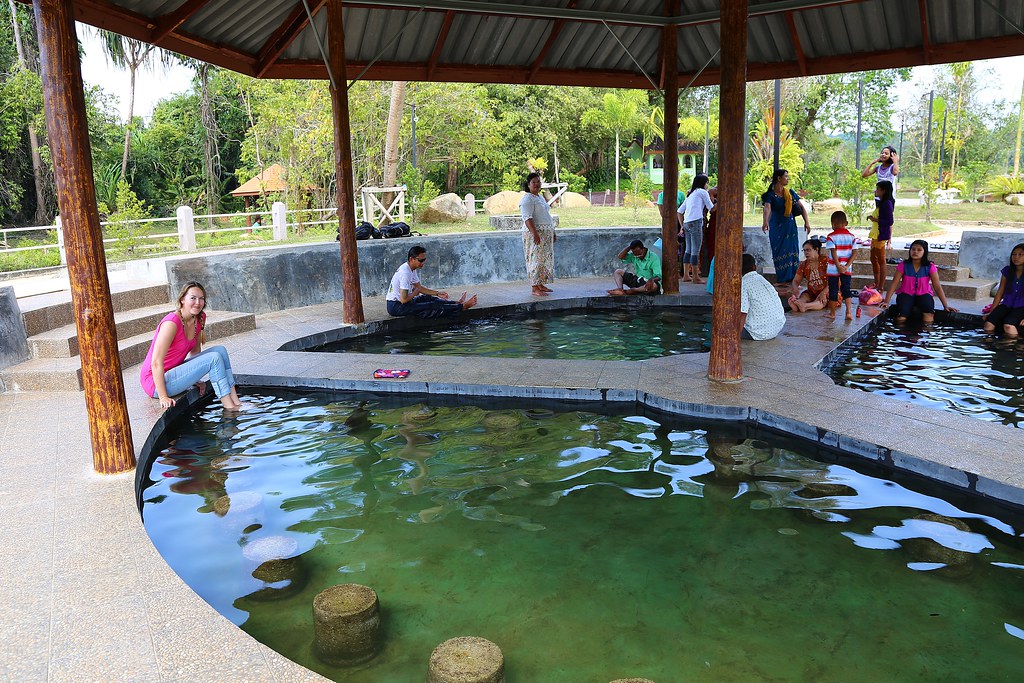
Not often pictured hot spring, at Pha Daeng National Park, Chiang Dao, Chiang Mai province, .... Thailand. source  


Hot #me #talailandia #rain #amazing #place #naturalhotwater #nature #holiday #thai #thaistyle #pai

Don't go chasing waterfalls just stick to the rivers and the lakes that you're used to @laratyssel #hotsprings #rinjani
Hot spring on Rinjani volcano, Lombok island, Indonesia. source

... six.

Tuesday, 3 December 2013

Soaring skyward

'#throwback #sunday #hotspring #emeraldpool #aonang #bff'
Taken in Klongthom, Krabi, Thailand. Source

The northern hemisphere is slowly becoming colder; the time of year to seek the heat of mother earth herself.

It's also time to recap the year. 
Little original content has been added to this site itself; such is life. But the regular updates besides capturing some pan-Asian soaking highlights seems gradually evolving into a number of themes:
- geothermal power development versus local soaking rights
- excessive development of hot springs
- (traditional) bathing traditions
- innovative ways of using earth heat

On other related sites, this year have seen their own developments. The Himalaya site has seen a number of original posts reworked and kept up-to-date. In this and the Thailand site have seen a number of photo posts.

Most of the effort though, has been directed to the Europe site, with a good number of original posts culminating in an overview of supposedly Europe's most natural soaks. Possibly the European Natural Soaking Society may well become the flag-bearing site. My own time for long-distance travel is very limited and the few remaining really natural soaking sites remaining in Europe may well need my fullest attention ...

Fiesta
But back on subject. The hot spring season in North (and Southeast?) Asia is under way. 

With a couple photo's of models (or sexy girls as this website believes) chinatraveltips notes:
'The 6th China Huangshan Mountain international hot spring culture festival kicked off on November 18, 2013'.
Hot spring culture = couple of female models splashing? 
Another hot spring festival, this time in Fuzhou - Lianjiang, China. Originally from China Daily (Oct. 30). What does a festival look like: 
'The guests enjoyed dance and singing performances from Russia, Spain, Taiwan and Fuzhou, and also had the opportunity to relax at the hot springs at Gui’an Xishan resort hotel after the show'.
Southeast Asia lagging in this party (thankfully?)?

Follow the leader
The Jakarta Post (Nov. 6) describes the Philippines as an example to follow in the field of geothermal power:
'Indonesia does not have to look very far to find the best way to tap geothermal energy, which potentially is located in protected, remote forests.
As Indonesia struggles to find a balance between the development of geothermal resources, forest conservation, and development, the Philippines has shown how that can be achieved.
...
Agnes de Jesus, senior vice president for environment and external relations at the Energy Development Corporation — the Philippines’ largest geothermal power producer — recalled similar challenges in 1988 when the Philippine government decided to build geothermal power plants in the middle of Mount Apo Natural Park following the El Nino weather phenomenon that reduced hydropower generation.
The plan was highly controversial at that time, de Jesus said, citing the lack of legal basis to establish plants in a conservation area, which is also an ancestral domain for indigenous people.
“We conducted scientific surveys on the site to asses the environmental impact and held many consultations with stakeholders to explain about the project,” she said. It took four years for the project to start after securing approval from indigenous people and a presidential decree that granted exploitation permits in the forested area'.
The example is thus an example in the way government appeases investors. But with energy dependency as the winner.

More news (Indonesia-investments.com, Oct 22) for potential investors in Indonesia's geothermal power. A law is actually being drawn up concerning development of geothermal energy. This would be an improvement as currently geothermal power falls under mining laws.
Harking on this is an earlier article in the Jakarta Globe (Oct. 27). It explains the intricacies of a geothermal project in Lampung, Sumatra:
'Locals should be consulted on the development of the geothermal power plant being planned near Mount Rajabasa in South Lampung regency so that it will not spark controversy and be rejected by indigenous people living in the surrounding areas, a minister has said'.
A Turkish company has shown interest in geothermal power nearby (Republika, Oct. 26). And then the Jakarta Globe also reports (Oct. 7) on Japanese investment in Indonesia's geothermal power.
So it looks like geothermal power generation in Indonesia is gathering steam.
  
Meanwhile, the typhoon which struck so devastatingly central  Philippines, also affected the Leyte geothermal  power generation. This article (interaksyon, Nov. 19) mentions 4 power stations affected with capacity potential of over 600 MW. though since, some have been reactivated.
Coincident or not CNN's money has 3 minute highlight on exactly Leyte.

Culture II 
Over the past months Thailand has seen it's great public debate: are the many Chinese tourists a bane or boon?

It starts with this little knowledge. That the Chinese authorities are aware of their abroad citizens. And how they behave (as they are at home). The Bangkok Post (Oct. 3) :
'The National Tourism Administration publicised its 64-page Guidebook for Civilised Tourism - with illustrations to accompany its list of dos and don'ts - on its website ahead of a "Golden Week" public holiday that started on Tuesday. ...
It also urged them not to occupy public toilets for long periods of time or leave footprints on the toilet seat. Nor should they urinate in swimming pools'.
!!!! Nice.

The northern Thai city of Chiang Mai sees the brunt of of the Chinese influx; it forms the backdrop to a popular tv comedy in China. But the Lanna citizens are not all happy (Bangkok Post, Oct. 13):
'But despite the large sums of money these tourists bring, many local business owners complain about the travellers' uncouth behaviour _ spitting on the street, failing to flush the toilet, pushing in and any number of messy dining habits'. 
The article rolls out a complete gambit of every possible problem the Chinese are the source of. This involves the above but also low spending culture, BYO, poor driving, extensive haggling, etc. Thankfully no reports from local hot springs ... As of yet.

Than the Bangkok Post reports on October 25 on the nearly 100% increase in tourists from China. The arguments contra are for instance that the Chinese guests hardly spend any money as most of the souvenirs available in Thailand are made in China! Inappropriate behaviour is another argument. Example provided:
'I have some first-hand experience of Chinese manners. During a stay in a Pattaya hotel, I saw a group of Chinese tourists, who were walking back from the beach, stop by the hotel's swimming pool to wash  their feet. Needless to say, this upset the swimmers'.
Well, next year will probably see another flavour: Indians? Americans? Rwandi? What will the complaints be then?

And totally different. Japan thinks that soaking is passè. The answer (Reuters, Nov. 23) to keeping towns dependent on their hot springs is to open casinos!
'In contrast to the massive resorts of Las Vegas and Singapore, aspiring hosts outside the big cities are looking to the more compact facilities of Europe as a guide.
The German spa town of Baden-Baden, which also has casinos, is serving as a model for casino proponents in two traditional hot springs towns - Atami, in Shizuoka Prefecture, and Naruto, in southwestern Japan's Tokushima Prefecture'.
Asian affairs 
  • Indonesia
A blog features a beautiful look at the highlands of Bali. 
This includes a walk to Angseri hot spring. 
Source: heyitsksh.

Another find? Tinggi Raja, North Sumatra was visited by the Green family (Nov 7). Is it soakable? Possibly too hot!

Jeff Low has a photographic feature on Manggaruda, hot spring, Flores, Indonesia (Oct. 24). Here's just one of the photo's:


A good report (bygetupandleave, Sep. 11) on climbing Rinjani volcano, Lombok, Indonesia. Note the ability to take a soak after the climb near the crater rim. And the photo's:

The amazing hot spring!
  • Malaysia
An extensive report (The Star, Nov. 16) to the little disturbed forests of Ulu Meda in Kedah, Malaysia:
'How can a vacation ever be complete without a trip to the hotsprings? Indeed, after a five minute boat ride upstream, Hymeir led us into a place called Sira Ayer Hangat, which literally meant Hot Water Salt Lick. He guided us into a shallow stream, pointing out safe spots to step as certain spots had hot scalding water! Downstream, the hot spring water mixed with the cooler river to created a perfectly warm swimming area.
On a sandbar in the middle of the stream, steam rose from the ground. A wispy white substance coated the areas where hot water from a hidden spring wept straight from the sands into the surrounding stream'. 
Sira Ayer Hangat literally means ‘Hot Water Salt Lick’. It’s frequented by wildlife.
It continues:
'... once, a visiting government official saw the area and thought of turning it into a commercialised spa. Fortunately, this didn’t come to pass as it would not only have damaged the environment, but also would have driven the animals away. Besides, there were hot springs nearer towns outside the Ulu Muda conservation area'.
Hurrah!

Lest s
ome forget, the Borneo Post (Nov. 17) mentions the existence of a hot spring in it's own backyard, Panchor Dayak:
'There is one in our own backyard – Panchor Hot Spring, nestled in lush secondary jungle at Kampung Panchor Dayak, Mile 27, along the old Kuching-Serian Road.
Here, one can enjoy the invigorating effects of a natural hot spring without having to travel thousands of miles or paying a huge sum for it.
...
In terms of facilities, Panchor Hot Spring offers quite the minimaL. There is a main wooden structure housing a canteen, a sitting place, shower rooms as well as toilets. From here, a wooden plank walk leads to the pools with a natural ambiance.
What can be easily overlooked is perhaps is the totally green jungle backdrop where tropical animals and birds may sometimes be spotted.
During a recent visit, I spotted two different types of birds — a green-whitish one which winged down a tree but soared skyward almost instantly in one swift motion, and a blue-greyish pair which fluttered among some fallen branches towards the bushes, lingering long enough for their pictures to be taken'.
And then stated matter of factly:
'Fully aware of Panchor Hot Spring’s immense tourism potential, the government already has plans to develop the place into something bigger and better — with piped water and electricity, villas, hostels and barbecue facilities.
According to Jeffrey (Layut), work has already begun.
“You can see the trees have been felled to give way for the villas and other facilities. We hope the upgrading can be completed as soon as possible so that this place will be better equipped to draw more visitors,” he said'.
Government thinking: sod nature, bigger = better!
  • Philippines
Maquinit may sit high in Southeast Asia's popularity polls, but this visitor laments:
'The lack of shower is what prompted out friend Rupert that it is expensive, especially because no maintenance effort is needed for the water to fill thr pools. "Ni di sila nagbabayad ng NAWASA" added Rupert'.
  • Singapore
In Singapore off the beaten track? Ourbigexpatadventure reports on Singapores only hot spring source:
'It was an interesting and quirky adventure!'
Sembawang hot spring, Singapore. Enjoy? From instagram jeromekg
  • Vietnam
Vietnamplus lists the big 7 hot springs of northern Vietnam. In no particular following: Kim Boi, Than Thuy, My Lam, Ban Moong, Kenh Ga, Quang Hanh and Tien Lang.

Further afield
Bhutan. The hot springs of Dunmang are deteriorating, so reports BBS (Oct. 25). The report comes complete with a video of this beautiful hot spring. One problem: there is only 1 toilet. It apparently sees more and more visitors without any facilities available.

An upscale opening, the Angsana spa Tengchong in western Yunnan, China (Sep. 27).

A report from the end of last year. Chinese officials in the region of Inner Mongolia tired of the ever increasing amount of officials coming. So reports wantchinadaily:
'The end of the year is a peak time for officials to make inspection tours. A deputy head of a county in Inner Mongolia famous for its hot springs said he received 10 groups of guests in a single day. As a visit to the baths is considered a sine qua non, a local official paid eight visits to the baths with different groups. He was so exhausted that he decided to wait in the bath without getting up and putting on his clothes as he received the last groups for the day day'.
Slightly dated, even Lonely Planet is picking up the vibe from natural soaks. It has an article named Hot spring hunting in the Southwest USA. Most mentioned though are more upmarket soaks, though apparently Verde hot springs is known for it's remoteness and alfresco bathing! Yeah.

#bali #kintamani #batur #hotspring #lake #mountain
Enjoying Bali, source.

Friday, 8 February 2008

From the Press III


Bangkok Post are well and truly in the 'cold' season frame of mind. This week's travel supplement (Horizons) includes a review of a stay in and near Fang hot springs, northern Thailand, Chiang Mai province:
'A national park mightn't be your first choice of destination when touring the North. but this one, about three hours (160km) by car from Chiang Mai city, has a lot to offer. For openers: In how many places, here or abroad, can you luxuriate in an open-air bathtub fed by water from a hot spring?

Once known as Mae Fang, this national park was renamed in May, 2006 to make it more readily identifiable with its biggest attraction: Doi Pha Hom Pok, which, at 2,285 metres above sea level, is the second highest peak in the Kingdom (after Doi Inthanon).

If you're anxious to get to the summit in time to see the sun rising over a sea of mist then it's best to camp at the base of the mountain for an early start. Otherwise you'll be a good deal more comfortable in the accommodation at park HQ, about an hour's drive from the campsite.


Each of the resort-standard wooden bungalows has two bedrooms, one with a double, the other with a single bed. There's air-conditioning and a TV in each plus a hot-water bathroom with a proper bath and a large balcony with table and chairs.
Unfortunately it is the same springs they highlighted two months ago. No wonder it is the most popular hot springs resort in the country! Soaking in Southeast Asia visited these springs in November.

Sorry about the quality of the pictures, they do come straight from the Bangkok Post site!

Wednesday, 7 November 2007

Pong Phra Bat: your local soak

Another 'unknown' hot springs, at least if you let internet be your guide. But Pong Phra Bat Hot Springs are certainly worth a visit, especially combined with the waterfall (with the same name) at the end of the road.

The hot water fountain, the pubic bath behind it

Pong Phra Bat Hot Springs (or alternatively Poang Phra Baht) are quite conveniently located, just north of Chiang Rai town's airport on a side road from the main highway north to Mae Sai which is located at the Burmese border. The trouble is you'll pass it, if you can't read Thai. But after locating the hot springs (the entrance is in a sharp right hand corner, close to local administration buildings), you'll probably fail to be impressed by the site (which is hardly natural nor 'park like') or the facilities consisting of two bathing buildings (one with a restaurant) and a small, roofed but not walled in, public swimming pool. And a fountain next to the parking area which signifies the springs; though hot water is bubbling up at various locations around the buildings. Between the two bathing buildings a stream passes which becomes warmer as it passes through the site.

The main bathing building, with restaurant

So if not impressed, why pay it a visit? Simply because developers have failed to take over the place; this way it keeps it's local charm, or it's appeal to the locals, who turn up every evening to soak for a half hour (privately for 20THB, in the public pool for 10 THB), then catch a bite, drink and go back home. As it is located between well-cultivated farmland, the locals (some farmers, but mostly workers from Chiang Rai) keep the springs going. If prices went up or up-scale facilities built, the locals probably would not come anymore and the situation would deteriorate soon after. Or, it would become a yuppy hideaway, now who wants that?


Getting There:
Take highway 1 north out of Chiang Rai, to the first village (Bandu) / turn off, past the airport. Take the access road along the highway and turn to your left, drive up this road for a km or so until you have a sharp right hand turn. Instead drive through the gate straight ahead of you with the pond on your left. For the Pong Phra Bat waterfall just continue on the paved road for another 5 km's until you come to the end parking. From there it's a 20 minute walk. No entrance fee required!

Soaking Experience: Again if you're willing to sign up for the cell-tub experience that's what you get. But if you remind yourself to take your swimmers with you (we forgot) you can enjoy the public pool, which at least gives you the opportunity to look around and breath fresh air.

The second bathing building has bigger cells, but the size of the baths remains more or less the same

Overall Impression: Not excellent, but above average: you want a neat soak, that's what you can get, followed by a bite. Quite literally, experience 'unseen Thailand'. And to make it more worthwhile visit the falls as well, to get some exercise.

Some additional (cryptic) information on Pong Phra Bat waterfall from the Thai National Park Authority:

'Pong Phra Bat waterfall: 14 kms far from the city of Chiangrai in the north along highway number 110 (Chiangrai-Mae Chan). An islet waterfall with the milky fluffy spray when fall down and clear water in the pleasant atmosphere which is encircling with the abundant of plants for relaxing. And enjoying the beauty of the nature'.

Fang

Fang geyser blowing

Fang hot springs rates, in Thailand, as one of it's most famous. The Thai language travel magazine 'Places and Prices' recent 'special issue' mentions Fang as well as Sankhampaeng, Pong Dued, Thapai Ranong and Jaeson as their top hot springs in the country.
After already visiting 3 of these aforementioned, as well as some others, I must agree that Fang certainly is worth a visit, though I haven't visited all thai hot springs (yet?) to be able to ascertain that it is one of the best! But what about its soaking qualities? Let's find out!

The hot springs are situated in Mae Fang National Park, where the park headquarters are also situated; so you have to pay the entrance fees, though oddly these were only 200 THB, which is roughly 10 $US. We came early in the morning with a slight drizzle coming down. We were also the only visitors at that moment. Supposedly round mid-day things get busier when tour groups on their way to Chiang Rai from Chiang Mai stop for some sightseeing.

One can park the car directly next to the hot springs 'park' which has been created around the hot springs. Through this park are a number of hot springs. Next to the car parking is a visitors center, though with little background on the hot springs; focusing on the whole of the national park, situated on a mountain range with Burma. At the back of the hot springs park one can see a large steel pipe which apparently carries hot steam to a geothermal power plant, just outside the national park.

Just one of the springs

The main highlight of the park is the geyser, which spouts every half hour for a couple of minutes.

From the Mae Fang National Park information folder:
'Hot Spring: A natural hot spring, produced by underground heat, emits water with a temperature of about 50-87 degrees C. Several hot springs can be found within the area of 10 rai, the biggest which can produce steam up to 30-40 meters in height'.
Despite using the hot springs for electricity generation purposes and simultaneously being a focal point for tourism, authorities have been able to maintain a naturalness to the area, as well as maintaining safety and providing tourists the opportunity to go along the various hot springs. No refuse and standards of maintenance were evidently high.

Mae Fang National Park Hot Springs Private Soaks: tasteful from the outside, prison-like on the inside.

The authorities have also put a considerable effort in providing bathing facilities. A raised walkway over /next to a pond provides access to private facilities, which can be rented. This kind of facilities I fail to understand. Why would anyone travel long distance to visit a natural wonder only to lock oneself in a cell which in western society would not even be a prison cell? It's also a phenomena that is not necessarily Thai or non-western. Last year, I visited New Zealand and on 1 occasion rented such a 'cell'. Though it looked like a good idea at the moment, we hardly used it. Yes, you can pursue your own dress code, but you exclude yourself from the surroundings: is it rainy, sunny, windy, are birds whistling, is the vegetation green, who are my neighbours, what's my son up to? No way of knowing. I personally would like to soak 'au naturel' whenever, where ever, but somehow world societal norms are set against this. Beats me why?
I have also been to a couple of hot springs in Nepal, oddly enough those not visited by foreigners were also the most relaxed on the dress code. Most visitors bathed in their underwear, with women mostly topless. As nearly everybody's underwear was threadbare, small, flat slate rocks were used, so as to make sure no one could look up your backside! Large communal pools, none of these small private facilities.
Why not make more tasteful, private facilities, partially open, screened off naturally if society so requires? Keeps everyone (including myself more or less happy).

I am digressing, yes. Well besides the small cells, there were also tasteful communal pools (see photo below) as well as steam sauna's. As the prudes had won again, these (both the pools and the sauna) were sex-disaggregated. As we were the only visitors we decided to flaunt these rules as tourists everywhere tend to. The water was only lukewarm, though not too cold, but hardly a hot soaking. If you need a massage, these kind of facilities are also provided, which altogether is not such a bad idea.

Public tubs: the men's tubs are well designed, allowing to soak the surroundings as well

Getting There: Fang Hot Springs are situated at the end of road number 4054, which originates from the Fang-Muang Chum 4017 road. The main turn off highway 107 (Chiang Mai - Mae Chan- Chiang Rai) is well signed, however the turn off to road 4054 (a couple of hundred meters from the main road) is less well signposted. In all it's about 10 km from Fang town. As it is on a dead end side road, there is absolutely no public transport.

Soaking Experience: see above. In general the soaks are good.

Overall Impression: very good, certainly well worth the label of being one of Thailand's best hot springs.

More info
  • From Thailand.com:
    'Fang Hot Spring
    The Fang Hot Springs are located at Ban Pin in Fang district, 163 km north of Chiang Mai city along the Chiang Mai Tha Ton Road (Highway No. 107). Turn left at km 153 for 11 km to Ban Pin.
    Fifty hot springs occupy a ten-acre forest setting. Three boil continuously with a strong smell of sulphur. Water temperatures at the springs range from 90° C to 100° C. Unfortunately, the ambience of the area is slightly spoiled by the pipes that have been placed to take off the hot water to feed the nearby geothermal power station'.
  • Concerning the geothermal station, in 'Case stories of small scale geothermal power plants' by Daniel N Schochet (2000) a presentation at the 'World Geothermal Congress' in 2000, the following refers to Fang:

    'The Fang geothermal resource, located in a rural agricultural setting near Chang Mai in north central Thailand, utilizes three free flowing wells producing approximately 500 liters/minute of hot water at 116 C. One binary OEC module, rated at 300 kW was installed in 1989 (See Figure 7). The OEC condenser is water cooled by a once through flow of river water. The project produces between 150 and 250 kW, with seasonal variations, with excess heat used for cold storage, crop drying and a spa. (Forte 1989)'.

Related Posts with Thumbnails
Copyright 2009 © Soaking in Southeast Asia. All rights reserved.
No reproduction or republication without written permission.