Showing posts with label Waterfalls. Show all posts

Monday, 9 November 2009

Updates for October 2009

A few changes on the site itself. I've created a mirror site dedicated especially for Thai soaking sites, aptly named Soaking in Siam, while at the same time I've added another blog site concerning Waterfalls in Southeast Asia. Though a soak is great, sometimes a cool soak can be just as invigorating. What's more, like where I live in Cambodia, there's only the 1 soak so visiting waterfalls makes sense, sort of. I'll leave the reader to decide on that ...

There have also been a couple of smaller changes as well on the site, most notably the linkwithin widget. It has instantly became one of the better referrers. See also the Top Posts. How the ranking works I don't know, but already 6 posts are graded at 10 (out of 10). By the time the whole top 10 is such rated I'll have to ditch this widget, doesn't add much.

News / Features
Roxanne
An interesting post by Roxanne Downer which is to be published in Spafinder titled
'Spa Customs around the World'.
Spafinder mentions its global reach but has only 3 hot spring spa's in Asia (out of 5,000), one of which is in Southeast Asia (
COMO Shambhala, Bali; which actually is not a hot spring spa ...).

Anyway Roxanne's article tackles the most anxiety causing issue, nudity apparently:
'Understandably, being undressed with someone you’ve just met can feel awkward. It certainly doesn’t help that customs regarding nudity at spas vary from country to country'.
If anything most people have problems being naked with people they know...
She then cites an Italian spa marketing manager who explains that it's due to Catholicism that nudity is a no-no in that country. Funny that in catholic France, Spain and Austria there are less qualms. Roxanne fails to guide us through on this the most anxious issue ....

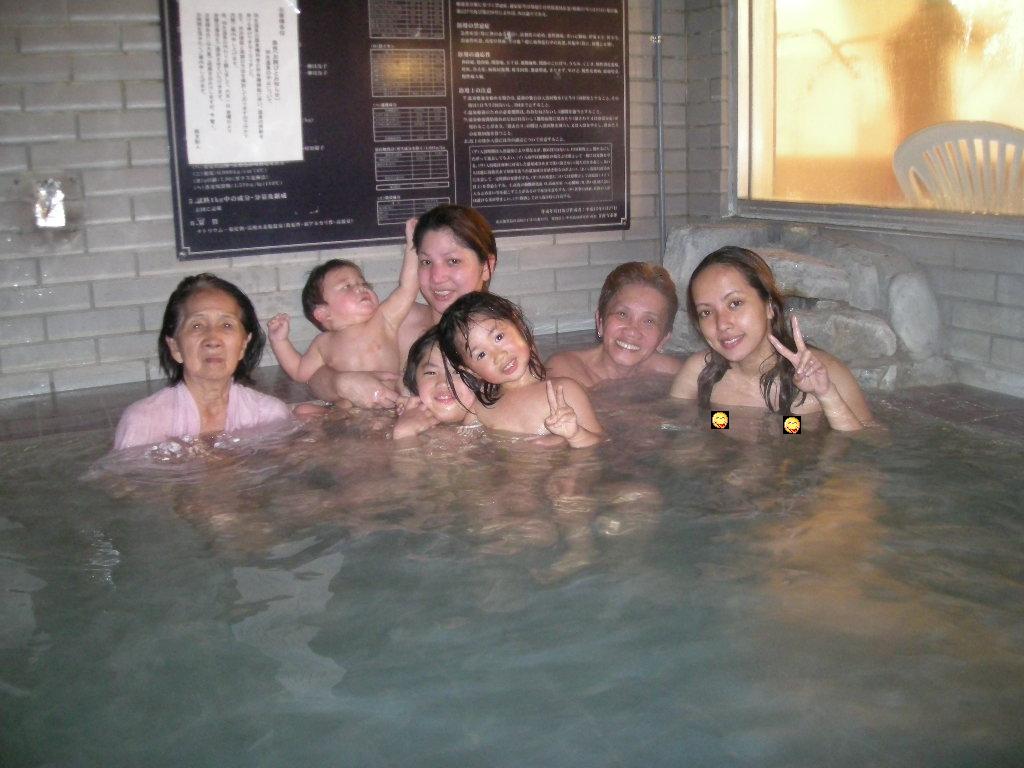
Filipino (and Catholic?) Jhayelle Schluter takes undoubtedly a for Roxanne confusing bath in Japan.

Then feel reassured as:
'take comfort in the knowledge that, in many locales, single-sex treatment areas or hours and same-gender therapists are the norm'.
That's probably the conservative American in her speaking.

She then highlights how soaking in Japan is besides a ritual practice a social one, though again she lacks to mention that nudity is de-rigeur, even co-ed ....

Finally she tackles the American issue of utmost importance, tipping, though again no real guidance ...


Anxiety in China?
More on the aforementioned most anxiety causing subject. And in relation to China where they claim that nakedness is a western undesirability.
A
good piece (from last year) in the China Daily by Raymond Zhou. He states:
'Is public nudity legal in China? I do not know. I have not heard of a law that legitimizes or forbids it, but it certainly goes against China's social mores. The puritanical constraints of Confucianism essentially put these matters off limit for rational debate. ...
Paradoxically, the Chinese society has long put up with social nudity. Someone told me of women in rural places, young and old, who in the old days did not bother to wear tops in the suffocating heat of summer. ...
In a country with more pressing issues to solve, naturism is something that concerns a tiny slice of social life. People who are into it should exercise common sense and refrain from creating a scene; they should visit secluded locations for their activities such as sun-bathing and swimming. While the public should be more open-minded, the gradual pace of social acceptance is the intangible rule that guides such things'.
The father of the nation, Mao, even was partial to a skinny dip:
'Mao took a liking to swimming naked [but not co-ed]'
(page 354,
Mao, a biograhy by Ross Terrill).

Unfortunately Mr. Zhou may have said it all when stressing the lack of conformity in social mores and reality. Take Singapore a largely Confucianism based society:
'A 19-year-old student, who was one of the women participating in a topless car wash, has been expelled from her college ...
The student ... said she had only two months to her graduation'.
Source.
Though I personally view the whole idea of car washing half naked as a particular form of sexual exploitation (and childish), why a woman would get kicked off a school for doing what a male can do without any second thoughts seems obnoxious.


Promoting soaking?
'Guangdong Provincial Tourism Bureau has announced that October 25 will be Guangdong Hot Spring Tourism Day'.
From
China Hospitality News.
Possibly there may be some understanding as to what a hot spring is:
'Guangdong is among the best provinces for hot spring operation, construction and services. It now has more than 300 hot springs that can be developed, 130 have already been developed, and 70 already in operation'.
That's a lot of hot springs.
This list nearly contains 1200 references to hot springs and Guangdong.
Wonder what they mean with 'developed'?


Developed
A possible answer comes from the Philippines.
'Millions of pesos in government funds and taxpayers’ money were spent on an infrastructure project aimed to boost the tourism industry in Tanjay City, Negros Oriental, but it has now turned into a “white elephant”, said incumbent officials of that city. ...
The officials are referring to the Mainit Spring Development project, where an unutilized swimming pool was built sometime in 2005. ....
However, as the project was well underway, it was discovered that the elevation of the swimming pool was way above the hot water source, and for still unclear reasons, the construction of the facility was stopped'.
Blogoshere
Malaysia

  • More Sungai Klah at Netmoirs from a Solemn Rover:
    'Here is some facts about Sungai Klah Hot Springs Park (SKHSP) or Taman Rekreasi Air Panas (TRAP) Sungai Klah. First of all, this place is a must visit especially if you are a local as this place was carefully managed by FELDA, the leading agency spearheading plantations and agro-tourism industry. This place was inaugurated in December 2003 (mentioned above) with the building cost of over RM6 million. SKHSP is reputed to be one of the best hot spring in Malaysia. The hot spring is located 200 ft. above sea level at the foothill of the biggest mountain range in malaysia, the Titiwangsa Range. You pay a tenner per person, and RM7 for senior citizen'. ...
    'We wondered around not much as most stalls and shops were closed. It was Monday and it is such a pity that this kind of place are only lively in the weekends. Good news for xenophobics, if you hate contact and being a crowded place, this place is good for you during the weekdays!'
Thailand
  • Pong Duet by Betty:
    'Pong Dueat is definitely not a world class attraction, but it is a beautiful, little-visited, quiet rest stop on the way to Pai. The hot springs must be a real attraction during the cold months, when mornings are positively chilly in the mountains. Also highly recommended if you want more scenery than concrete to go with your hot spring experience. ...
    As usual, Thai visitors were taking a dip all dressed up and we did not stick out'.
Vietnam
  • A write up on Binh Chau by Sarahelaine, the nation's southern most hot spring. Resort: quite expensive. Rooms: very clean. Hot springs: lovely. Massages: very nice. More on the trip there and back here.
Cambodia
  • Nyo Nyum August/September 2009 Edition of Cambodian Life . Click on photo above for full picture and text of Cambodia's only hot spring.
  • Yet again more info on Kampong Speu's hot spring this time from an updated guide to the province on Cambodia.com:
    'The country’s only hot springs are found in Kampong Speu at Phnom Te village. Known as Te Teuk Pous, it is well off the beaten track and is easy to miss. Its name is derived from the name of its founder Lady Te and Tuek Pos, which is Khmer for boiling water. There has been some development around the springs to create a pool to collect the hot water from the ground but the developer appears to have dropped plans to convert the area into a golf and spa resort [appears refers to leaving the place deserted ...]. Changing rooms, soaking tub and picnic tables have been built but otherwise, there are no other facilities, nor people in attendance The springs are sacred to the Suoy minority tribe that still uses the site for religious ceremonies. To the Suoy, healing spirits reside in the hot springs. Small archaeological finds suggest that Angkor kings would use the springs for their therapeutic properties and the area could have been part of an Angkorera burial site. The belief in the spring’s healing waters still prevail today as the Kampong Speu locals who make their way to Te Teuk Pous believe that it will cure them of afflictions'.
Co-incidence or not, two foto's highlighting the difficulties in dealing with English while visiting a hot spring in Southeast Asia:

Sunday, 9 August 2009

I Love?


Kanchanaburi
The province of Kanchanaburi is a well trodden piece of Thailands tourist path. Besides historical highlights (as in the Burma railway), it excels in natural highlights. In this, the Erawan waterfall meets most tourists expectations of a beautiful tropical waterfall paradise.

But there is much more nature to be discovered. Many more waterfalls and caves. So it may not be surprising that hiking and rafting are increasingly becoming popular pursuits, especially for the more wealthy middle class Bangkok citizens; Bangkok located not more than 2 hours drive from these delights.


Hin Dat hot spring
As said there are a couple of hot springs, non more well-known than that of Hin Dat (or Hindad / Hindard / Hindat / Hin Dad or formerly known as Kuimang; the name on the tickets though is Hindaad). Not only in Kanchanaburi, but Hin Dat rates as one of the more recognized names in hot springs in Thailand.


Located at a fair distance from Kanchanaburi town it's just a km off the near perfect highway 323 heading west. Judging from the ample space for parking, it surely is part of the main tourist road, even a number of coach parking spaces are available. Parking outside the main gate, a small fee was required to enter, though why nationals only get charged 10 Bt and foreigners four times that amount seems a bit weird; do foreigners get more value for money?

Beyond the gate is another parking area with many stalls around, for drinks, food, tourist nick-knacks, souvenirs and orchids / plants. Tickets get checked before a bridge. From the bridge one has a good overview of the hot spring pools themselves. This being a rainy Sunday afternoon around 3 o'clock, the sides of the two pools are lined with soakers, though not many are immersing themselves. Is the water too hot? Just a meter from the pools is a swift flowing stream; it having rained during the preceding days. The banks of the stream are also lined with people half in the water.

Sunday afternoon: packed soakers.

The soak
Leaving a visit for the air-raid shelters (!) for later, I precede to the changing rooms, which are not well-maintained, but probably serve their purpose. Then down to the showers. Oddly it are mostly visitors who are leaving who are using the showers; clearly cleanliness is not an issue.

Finding a dry spot to put my things down is quite a challenge, but once found it's off to find a spot on the side of the pool to adjust to the water. Of course there is still a place available: right next to the source, which is well over 40C apparently. After a couple of minutes I slide into the hotter of the two pools. After a nice soak, I get out and cool off in the stream.

The bank of the stream has been lined with steps of flagstones and though the river current is strong, it's a great pleasure to enjoy a natural cooling off. By the time I'm ready for a second round, the pools are starting to clear of their visitors, possibly having to return to the big smoke. But without the crowds, the soaks are even more enjoyable. A few more rounds follow and to top off a short massage is required. All 'n all a great soak.


Soaking Thai style.

After wrestling back from swimwear to clothing, I walk around the site that includes a number of private soaking bungalows, a temple and the aforementioned air-raid shelters which remained from the second World War. What better protection would you need when soaking?

Background
As stated above Hin Dat is a well-known soak, why remains a mystery. Possibly it's accessibility together with the beautiful location of springs next to swift running stream.

However most mentions of the hot spring concern tourist web sites mentioning the possibility of soaking.
Some credit the Japanese occupiers (during WW II) with finding and enhancing these springs:
'.. discovered beside a stream of cool water by Japanese troops during WWII and two cement wells were then constructed at the site'.
Both pools are still there. However there is also the following mention:
'This hot spring has a long history and has been with the local villagers for over 150 years'.
It does seem logical that the hot springs were there before the Second world war, why the Japanese get the credit for discovering them is beyond me. Though no doubt they did enhance and popularise them.

But it does seem that not much has changed since. The site has been enhanced with ample parking spaces, a bridge, changing rooms, toilets, ticket vending office and private pools. The latter though don't seem to be too popular, but they are located on the hill overlooking the site, without access to the stream and thus probably provide a less superior experience. They also cost the foreigner a foot or more, upto 1,000 Bt (~$US 30). Pay more, get less.

Other bloggers mention
  • AbsoluteBangkok.com:
    'Well, what else you need when you got large hot water tubs lined with natural stone - and a clean (!) fresh mountain stream two meters away to cool you down again. You could rent private bath tubs, but what would you need narrow walls and a roof for when the sky’s the limit?
    ...
    And don’t trust the name of the nearby Green World Hot Spring & Golf Resort. They have no access to the hot spring water, but talk about repairs and broken pipelines and … screw them.
    All they have is a rotten jacuzzi in the cellar. Go for the real thing at the public bath. The only thing to worry: I always wonder when visiting a public bath in Thailand why you won’t find cleaner toilets than in a Thai public bath. As nobody uses the toilets'.
  • Bluestar guesthouse:
    'the springs are a God send'.
  • caryn:
    'This one is rather simple, yet it attracts numerous tourist'.
  • andydaniels:
    'The springs were really nice, big pools that fit a lot of people and were deep'.
After four: quiet and serene.

Other information
There
is also a Hin Dat hot spring festival, each year in November:
'In the festival, there are booths of agricultural products and tourism exhibition of Amphoe Thong Pha Phum'.
The waters are said to have as a healing property for various ailments such as beriberi and rheumatism [1], holy water that can cure diseases [2] and gout [3].

There are two locations to stay overnight nearby: the above mentioned Green Valley which might be more appealing to golfers and the Phatad Valley Hot Springs resort, which actually is still a couple of kms away and has nothing to do with the hot springs!

Nearby are also the Pha Tad watertfalls, probably a great place for a swim. As it is a national park, entry is a hefty 100 Bt, unfortunately during my visit three was too much water to make a swim possible. This site has more info on Pha Tad which are only located some 10 km from Hin Dat.

Gushing waterfalls of PhaTad.

Furthermore it should be pointed out that the hot spring is open til 22.00, which means that a late nite soak and picnic are available. Always good to know in hot Thailand.

Then just a mention about the name, the official name is Hindad, however by far most internet links refer to it being Hin Dat. Can someone explain?

Getting There: Traveling from Kanchanaburi town, one only needs to continue on the main 323 highway towards the Burmese border. Past the entrance to Sai Yok National park, the well signposted hot springs are just off the main road at km marker 123.

Soaking Experience: The natural surroundings and the possibilty to cool down in the adjacent stream make Hin Dat are great place to soak. Also the possibility to stay until well into the night add to a great way to soak. The pools are deep, though the bottom is uneven.

Overall Impression: Positive. A great place to while away a few hours preferably on the day edges, as midday sees many visitors. The food stalls even have western food and the masseurs work full time, such is their appeal.
But I always have doubts about hygiene. Currently in Thailand you can sanitize you hands at every reception desk, though it's disputable whether the swine flu can be obtained over the counter. However without batting an eyelid, all soakers jump in in their already-worn clothing to soak; somehow missing out on the hygiene lessons. Outside of Southeast Asia though, customs (based on hygiene) determine that rigorous cleansing should take place before soaking ...


A you tube on Hin Dat?

Monday, 11 May 2009

Spa-ing and Soaking: Same-Same but Different?

One could state that soaking is an increasingly popular past time, not only here in Southeast Asia, but worldwide. But to be able to state this, one would need to know how many soaks there are and the number of visitors, i.e. back it up with some data. Which are not available.
But leaf through any travel related print and, sure, there will be an increasing amount of articles and more advertising on ... spa's. But is going to the spa, the same as taking a soak?

Soaks and soaks of sorts
Soaks, as I understand them, are soaks in natural waters. They become soaks as the waters are usually warm or hot. Looking for where these natural waters occur in the heated substance, one is looking for hot springs. So soaks are in their majority hot springs.
I say in majority, as here in Southeast Asia, we experience a prolonged period of hot weather. So hot, that shallow bodies of water warm up and could be considered as soaks. As could be the sea, which surprisingly sometimes fails to cool the swimmer.
During the heat, cooling down is often a better option and it's no secret that I enjoy waterfalls as much as or just as much as hot springs. One factor in their favour, is that there are many more waterfalls. Possibly because of their numbers, unnatural enhancements are less obvious to come across upon. And here in Southeast Asia if there's no road, no car park, no amount of food stalls, it can't be worth it ... But for me (and my family) that's just the attraction. What better way to unwind, cooling off naturally, in a natural environment, 'au naturel'?


April this year, Yak Loam Lake Ratanakiri province, Cambodia: the 'coolest' soak.

Define spa!
But I'm digressing. So are spa's not the same as soaks? The word spa, you'd be surprised to know, is actually a shorter version of the Russian word '
spasibo'. Which was the word Peter the Great used in 1717 when offered water, as he was sojourning nearby the town now known as Spa located in the Wallonian Ardennes.

Why they changed the name of the town remains a mystery, considering it had been used as a soaking site from the 14th century onwards. Anyway, such was the significance of this happening, that today the global relaxation industry is greatly dominated by the word. Though the word spa is largely eponymous with any place having a natural water source that is believed to possess special health-giving properties, in practice spa seems to have more in common with other wider themes such as health tourism or wellness rather than soaking itself. Massages, wraps, facials are all standard ingredients one can expect at a spa. What's more they have little or no relation to the existence of natural springs, be they warm or cold. And their health claims seem mostly unfounded. Spa's are nearly all located in or near urban areas where they can provide a 'retreat' from the outside world and/or on beaches where tourists may well be tempted off the beach to a, as naturally possible, property to indulge.

Exclusive
What all spa's have in common though is an emphasis on a different distinctness with a hope for attracting the well-heeled. The more exclusive the better. Especially here in Southeast Asia, spa's aim for the upper class.
AsiaSpa puts it like this:
'Targeted at wealthy professional women aged between 30 and 50, AsiaSpa invites its readers to step outside their everyday urban environment and escape to a tranquil world where body and mind are refreshed'.
Though I might have a weakness for the mag, for instance it includes issues such as this month (May 2009) a special: 'The Family Issue'. With articles such as 'how to... be a super parent' and 'yoga for fertility'! However it's commercial emphasis and pretension to highlight the distinct rather than the true natural , certainly doesn't endear itself.

This penchant for exclusiveness is in contrast to say northern Europe where thermal bathing is open to all. But class associations are made between town's. i.e. Harrington for the lower class, Royal Spa Leamington for the upper class. This is also evident in other European nations. Places such as Evian or Baden-Baden are known as places where the upper class hang out, so to say.
In Holland (and Germany) though, spa's as such are scarce and sauna's are there to give what is essentially is a spa experience, though with the emphasis on taking a sauna, with the possibility of other upgrades (wraps, massages) or extensions (sunbed). Significantly these are less distinctive for upper / lower class. And they emphasize social contact.

One could compare this culture very much akin to that of onsen and sento in Japan. Though a soak may be great, a soak with great (new) friends is even better.


This all seems quite in contrast to spa's, where relaxation is the mantra such that tranquility becomes all enveloping (see above quote). And to muffle away the odd a-natural sound here and there, they offer background sounds, a fast flowing stream, gentle waves, rustling leaves, etc.. Believing that socializing is again against human nature, rooms are parted and separated.
The most exclusive massage I had here in Phnom Penh was a joint massage, the joint being a door between the massage rooms which was opened, rather than a room where at least both of us would lie. Possibly by de-socializing the experience it becomes more exclusive: "Oh ,I had a plunge pool all to myself". And how long did it take to get bored?


So ..., not the same?
No, I believe. A spa for me, is there for the convenience of a cheap massage. In contrast seeking a soak is an undertaking, getting out, an expedition, a voyage of discovery, a search for the holy grail and a possible reward at the end. But, all -in-all a lot of fun and interest.

I mean, in Southeast Asia what makes some of the most exclusive spa's differ from each other?
Take Tamarind Springs on Thailand's isle of Samui. It goes all out to tempt the tourist off the beach and it certainly looks great.


Hmm, would you pay to experience this? Nature is a plenty in Thailand.
'Tamarind Springs Forest Spa, Samui is inspired by its superb location – its lush coconut groves gently sloping into a valley of huge granite boulders bordering the island’s jungly interior. Built out of love and respect for this unique landscape, every effort was made to fluidly integrate this Samui spa into the existing indigenous surroundings.
...

The magical forest surroundings will help you to completely unwind.
The Forest. At The Forest guests enjoy drifting between the fragrant herbal steam cave and cold water rock pools, snacks and refreshments in the tea sala, before their massage treatments in open air pavilions.'
Is this much more different than a soak? Possibly, because the customer is king, hygiene is high, quality is good. But most Thai soaks offer a massage and the waters are more inclined to have therapeutic qualities. Then again at Tamarind Springs you do get disposable underwear!

Over at Losari (Central Java) it's more of the same (massage), though they have a hamam and not a steam room. It claims:
'An oasis for tranquility and renewal'
Maybe?

Anantara at the so-called Golden Triangle:
'Whether you choose an exotic fruit peel or a signature four-hand massage, Anantara's spa therapists will tailor every treatment to ensure your relaxation. From the moment you step into the spa's three-storey mountainside reception room, you'll feel infused with a sense of calm'.

Anantara Spa: Enticing? What happened to the view?
But again a number of massages to choose from, possibly an extensive choice, just to make it exclusive. But nothing more than a typical hot spring, other than exclusiveness with a price to fit.

Again they are different but also similar. Soaks, now those are different! They are naturally tranquil. No need to blend in some background muzak. Now let's hope the developers don't impose themselves and make spa's out of those great soaks!

Monday, 11 August 2008

Elusive?

Elusive tranquility: the hot springs source reflects the palm oil trees nearby

Where am I?
How had I come to sitting at this table was a long story. Opposite me was the patriarch, his family crowded behind him. We were somewhere just above a stream in a palm oil plantation, somewhere north of KL, Malaysia's capital. He offered me some durian.
Obviously they don't see real tourists that much here, but that fact I had already established on this seemingly un-endless goose chase. On the other hand I knew I was near the hot springs; I had already asked a local laborer at this palm oil plantation twice, with differing answers but with the assurance that it was just one km away. But where?

Nearly there?
The first quest brought me to a five way crossroad of plantation tracks, all similar in size, none clearly indicating where they would end. My second effort, leading in a different direction, ended at an enclosure, surrounding a small stream. From the outside it was obvious that this area had been enhanced, so thinking that the hot springs must be here, I jumped the fence. Unfortunately once inside, the stream waters were cool. Some dams had been made and with the stream bed made of white sand, it certainly was a nice place for a picnic, but not what I was looking for.
At the far end of the enclosure I could see a motorcycle parked. I strolled over there, discovering a void in the fence and downstream, a young lady in a flowing and colorful dress was scooping up water out of the stream. I asked her for the directions and in excellent English she managed to communicate that
  • a. yes, she knew where the hot springs were,
  • b. they were not here,
  • c. she was useless in giving directions and
  • d. let's have a chat with her father, he knew the place.
So that was part of the story of getting here.

Where?
Hulu Tamu was the name of the hot spring I'd been on my way to. My info had narrowed down the search to the Hulu Selangor district, Selangor state. The day preceding, while looking for a good map in one of the un-endless shopping malls of Kuala Lumpur, I'd been able to find a map of Pahang state with an overview of Genting Highlands, showing a hot springs near Hulu Yam Baharu. Having pinpointed the hot springs on a map, it should not seem too difficult to find the place.
Hulu Yam Baharu is located just off state highway 1, north of Kuala Lumpur. About 30-35 km from the city center. After some weird procedures, the hotel enabled me to rent a car and this morning ten-ish I believe, I left the sprawl of high rises behind me.
And now, I was, what seemed to be the middle of a palm oil plantation, ever so near, but still not near enough, to see this my first hot spring of Malaysia.


Sungai Sendat
The trip up to Hulu Yam Baharu had gone brilliantly. On the map I also saw a named waterfall nearby so I decided to visit this as well; if only because it was sign posted.
The waterfalls of Sungai Sendat are relatively easy to find. Continue down the main street of Hulu Yam Baharu coming from the north and continue through a small neighbourhood ensuring you have the river on your right. After leaving the village the road becomes a little steeper and you'll be going through rubber and palm oil plantations. These give way to rainforest and the tar-sealed road turns into a dirt road. Eventually after about 3-4 km's beyond the village center, the road leads to a bridge, with a security gate across it. You can park here, I mean before the bridge.
Continue past a guard post and within 200m, you can see the main fall with a big pool in front.
At the moment of my visit, construction work was under way; they are looking into sprucing the site up, so it seems. It did look a bit desolate, but the enormous amounts of refuse were ample evidence of recent visitors, so clearly the customers must have been satisfied. It being a week day, evidently meant that I was the only visitor.
If you climb up above the main pool, there are a number of other deep pools and falls, a really beautiful area, now why on earth would visitors trash the place?

Sungai Sendat: a great place to trash?

AllMalaysia.info ignores this last issue and concentrates on describing the waterfalls as follows:
'Paddling, swimming, picnicking - if that sounds like fun to you, then head for the Sungai Sendat Waterfalls. The falls are surrounded by greenery and kissed by sunshine; truly a place for relaxing and rejuvenating yourself'.
Well, if the Sunday crowds turn up, you might be just unlucky.


Back on the road
Leaving the falls site, I asked the guardsman for the way to the hot springs, to which he replied, turn right in the village. That means the road to Genting Highlands. After taking this turn, 500m out of the Hulu Yam Baharu, I take another turn right leading to ... well somewhere (There's a sign to Amberstone Eco Resort).
I continue up the road for about 3 km's, but obviously it's not leading anywhere. After some hand and foot work, a local manages to communicate to me that I should return and turn right to the Bundoora Estate (or is it Bindoora?). It being a narrow lane with no side roads, the turn to Bundoora is obvious. There's even a sign post. Five hundred meters up this road and you are entering the palm oil estate. And that's where it gets tricky.


Made it
With some translation by his daughter, the man opposite me now knew where I wanted to go. Fortunately he did not ask why. He set off trying to explain where it was, but translating this proved tricky. "You with car?" "Um, ...yes?", I replied. "Well, let's go!"
With that, we crossed the stream back to where I had parked the car and he had parked his motorcycle. He jumped on the motorcycle and I followed in my Proton Wajah. We returned to the earlier five way cross road, roughly 1 km beyond the plantation entrance. I don't recall which of the five we took, probably the most left, it leads across a stream from where you should take the next track right. The road is rocky and the Wajah is (still) scratch free. Therefore, I park the car here and follow the motorcycle for another 50 m on foot.
It's all pretty obvious though, there's only 1 stream and the waters of which originate from the hot springs. My guide shuts his motor at a small, foot high dam in the stream. "Air Panas" and stretches his arm. I feel the water. It' hot alright. There's also some trash around, so this must be the place.

The source of Ulu Kalong: in the middle of a palm oil plantation

Ulu Kalong hot springs
I proceed to follow the stream to it's source. There's another small dam, 20 m upstream with an overgrown pool close by. A further 20-30 m upstream, I come upon the source itself. The water flowing from a caved in gap in a 50 cm high wall is hot. Very hot. The pool itself is very tranquil. No bubbling.
After taking a few pictures I return to where the motorcycle is parked. My guide has just finished soaking his feet, strips to his underwear and takes a full body soak in the 30 cm deep water. Having no underwear on and unwilling to cause offense, I limit myself to a foot soak, hoping my host might leave me alone sometime soon.
After 15 minutes, it's clear that that's not going to happen, so I thank my guide who takes this as a sign for ending his soak and our paths diverge. I to return to the hustle and bustle, he to return to his hut on the beautiful river.

A futile attempt at developing the springs? About 5 m out of the hot springs stream bed, a large bath tub has been constructed, but is now filled with earth and partially overgrown.

So what's it called?
I hoped that this was Hulu Tamu hot springs, but my informer mentions it as Ulu Kalong. My map refers to it being "hot spring". Well, that's not much help. What I should have done on forehand was to look more carefully on internet.

Wikipedia's entry on Ulu Yam, refers to no less than 3 (!) natural hot water pools (if only I had known). The pictures to Hulu Tamu hot springs certainly don't reflect what I visited. Kerling, another hot springs in the area, it's not either.

This description of an ANZAC day run describes the location correct and refers to it as Hulu Kalong and the springs to be called "Ladang Jasmin (Air Panas)"; the Air Panas translates as "hot water". The plantation company is referred to as Bindoora. And somehow that's all the info out there. And now this. Elusive no more?

Getting There: From Kuala Lumpur take the old road to Ipoh and turn off this road, roughly 30 km after leaving Kuala Lumpur, towards Hulu Yam Baharu. (or Ulu Yam Baru or any variations of this). Entering the village from the north, turn left in the center towards Genting Highlands and turn right, 500m up this road, well before the main road to Genting Highlands starts. Follow this lane for 2 km, turn left (signposted Bundoora Estate).
After entering the estate take the dirt road right, more or less straight on from where you are coming from. Stay on this main track for another 800m leaving an abandoned building ('No trespassers') on your left. You'll come upon a five way crossroad. Follow the track (left?) crossing the nearby stream and take the first track right, after the stream. From here it should be easy to see the stream originating from the hot springs.

Soaking Experience: Well, what it lacks in depth, it makes up in naturalness. And though, the surroundings point to quite a bit of rubbish, the waters themselves are clean.

It's clear: a soak is required. The main soaking area, about 50-60 m below the source.

Overall impression: Truly a find. Despite the small quantities of refuse, the area is very tranquil. It being a palm oil plantation one would not expect it to be so 'natural', but only little has been enhanced in the springs themselves. You could hear birds jibbering and jabbering and I managed to spot a Kingfisher proof enough of a worthy visit. Let's hope it stays like this!

Wednesday, 2 April 2008

Bo Klueng: End of the road


Worth it?
Besides Pong Krathing hot spring, Ratchaburi province has another hot springs site: Bo Klueng hot 'stream'. These springs are situated in the Suan Phueng area, a recently approved accessible area of Ratchaburi province quite near the Burmese border. It used to be off-limits to all but locals due to the Thai-Burmese border relations or lack of relations more probabbly.
The area is now seeing quite a lot of tourism related construction: due to the amount of natural attractions, it’s ease of access to Bangkok (two hours if you fail to take your foot off the accelerator), it’s slightly cooler climate (due to it’s higher elevation) and enchanting natural surroundings (or did I mention it already?). Recently finished are a number of resorts / restaurants with others set to open in the near future. Roadside stalls specialize in selling plants (esp. orchids) and ‘souvenirs from Myanmar’ the politically correct name for the politically incorrect country of Burma.

How to get there
From the town of Suan Phueng to the hot springs site of Bo Khlueng is a distance of roughly 15 km. The scenery changes markedly from gradual rolling hills to medium high mountains covered with (pristine?) forest and small valleys with swift flowing streams flowing between the remnants of valley forests and more recently planted fruit orchards.

The (re-)sources
Located just 1 km before the end of the road (a side road of highway no. 3087), a small car park is situated off the left before a small booth with barrier. After paying 5 Baht to a disinterested receptionist and taking a short stroll of 100 meter or so along a large pond, one comes to an intersection of paths.
Here are situated a number of restaurants. To the left is a large concrete lined pool (7 x 15m) which during my visit is empty and receiving a well-needed scrub from a number of hard working ladies. This pool, created by damming a stream, is situated at the end of this stream with an overflow to the previously mentioned pond. The water coming from the stream is warm. Some would say hot, but it is not too hot. When filled, this pool must be quite attractive as during its construction considerable effort had been made to retain a certain naturalness: huge boulders are located in and along the side of the pool. The water depth maintained would be about 1 meter.

Traveling all the way out here only to discover the main pool is getting a scrub.

From this pool I walk further upstream, the increasing heat evidence of becoming closer to the source of the hot stream or was it just the soaring mid-day heat? About 200 meter from the pool there are a number of streams coming from small holes in the red-hot rock bed of the stream, obviously the source of springs. These springs are also way too hot to be considered ‘bathable’.

The source of the intense heat: coming from between the rocks

Surprisingly for a Thai hot springs site, no one has come up with the innovative idea of cooking eggs in the springs; maybe it's more a northern Thai / Cambodian thing to do. But it also happens in Malaysia...., ah, it's possibly a long established tourist kind of custom, developed through generations of exposure to unattractive and boring hot springs ("I'm sure we can get hot water straight from the tap back home").

The hot water stream flowing downwards. Besides the water being hot, so are the rocks!

Back at the intersection, a small side path leads to an office-like structure which proves to be the entrance to a separate pool / bathing area. During the week (as now) use of these facilities is free, however during the weekend a fee of 80 Baht (by the time of publication nearly 3 $ US) is required, which local Thai residents might consider steep. It gives access to changing rooms, showers and a 5 meter round and shaded hot pool with a few loungers / chairs on its fringes.

And the non-natural soaking pond: actually not too bad for a dip during the cooler months or in the evening.

A cooler soak

An interesting side trip, is to take the footpath beyond and above the hot stream. It continues up and onwards ending near Pha Daeng (or Kao Chan?) waterfall. This waterfall lies in a wide but steep valley through which the river flows in a succession of waterfalls, though few are really spectacular. Maybe that changes during the rainy season but now at end of March, before the real drought onslaught, at best the waterfalls are just OK. Along the waterfall, going downhill, the path continues until it ends at a huge and empty car park. Possibly the emptiness is different with the weekend influx, but I can’t believe that Bangkokians will or have ever arrived in such numbers. Then again, near the car park is such an accumulation of refuse, that certainly must come from somewhere. Just near the car park are a couple of stalls.
The upper levels of the waterfall though are deliciously unpolluted and at that moment unvisited, great for an all-natural dip.

Pha Daeng or was it Kao Chan waterfall? Whatever, for late March it still made a pleasant dip.

Overnite
The day is drawing to an end and distant thunder is rumbling ever closer. Moving onwards to Kanchananburi, Ratchaburi’s northern provincial neighbour, seems a bit too far fetched and I decide to seek accommodation nearby; there is some choice to be had and the surroundings here are certainly crispier and more natural than a downtown Kanchanaburi hotel.
I drive back a couple of kilometers towards Suan Phueng, take a right turn and drive down to the reception of the Scenery.
"No, we are fully booked this evening",
says a receptionist, clad as a pristine nurse,
"but you’re welcome to tour the grounds".
She is very persuasive though not really um, ... real or genuine. As I start to wander further, she insists on leading the tour and asks me to hop on her golf cart which she uses to drive me along a duck pond with sparkling white spacious bungalows beyond it. At the end of the drive the artificial scenery gives way to a shaded forest along a 30-40 cm deep stretch of a river. Chairs are conveniently located in the stream as well as some swings, originating from the overhanging trees. What a beautiful place! But no rooms tonite.

My nurse advises me to stay at the near the entrance located, white washed Nagaya, which she assures me, has several rooms vacant this evening. After close inspection, I must say that it does miss the magic of the stream, but it does have a better backdrop / view than its neighbour. The rooms are quirky: each different and carrying names such as 'naked' and 'nude'. One might expect a clothing optional resort but, this being Thailand, the names are meant as a teaser, alas. Nagaya provides bikes, but the tracks beyond Nagaya are equally enjoyed on foot: following and crossing the river and meandering through fruit orchards, especially when the threatening thunderstorm finally unleashes itself, drenching me to the skin.

After this partially involuntary soaking, I change into drier clothes and head back over to the Scenery, as they are only resort within walking distance with a restaurant. It only now dawns on me that, there being no accommodation vacant at this resort, might have proven to be an advantage: on every tree a speaker has been mounted from which Frank S. is crooning. I manage to pass the reception without requiring the assistance of a golf cart to face the 100 meter stretch to the restaurant. Unfortunately, the restaurant sound system is not rigged to the tree sound system and though the meal is excellent the intermittent jazz / Sinatra takes away from the meal.

The Nagaya, something not so Thai. Pity of the pond. But still well worth a stay.

And there's more

After a good (non air-conditioned) sleep, I decide to discover more of the Suan Phueng area. Highway no. 6070 heads southwest from Suan Phueng towards the border with Burma. There might be a couple of waterfalls accessible, though the waterfall to Pachundara is blocked.
At Kaeng Som Maew / Queen Sirikit Forest Park (25 km from Suan Phueng, then a left side road for another 2.5 km) the waterfall is actually a rapid with a lot of opportunities for recreation (read picnic). Surprisingly, I only learnt after the visit that there is much more to be seen, it's a nature study center.

The Kaeng Som Maew rapids, lie near a nature study area with a royal hut.

However, Bo Wi waterfall (15 km from Suan Phueng, then in Bo Wi village a right hand turn before crossing the river, continue upstream for another km) is much more worth a visit. Located in a narrow valley this is again a multi-level (seven?) waterfall. Go up a couple of levels and on this week day, a pleasant skinny-dip can be had.

Objective met, time to return to the world, to Bangkok.

Bo Wi waterfall, great place to really cool off and spend a pleasant time in complete solitude (as you can see)

Discovering more
A bit of surfing on the i-net, has revealed more. As usual, there's a seemingly unending list of alternative names for the hot springs: Bor Klueng, Bo Khlung, Bo Klung, Bo Khlueng and probably many more variations; I settled on Bo Klueng as the first picture reveals (above this post entry): the fact that the place itself uses it.

There are some more visitors / sites who have posted their views / additional info:
  • Bangkokmum:
    'there are two springs at Bor Krueng , a cement pond located outside for all to see and a swimming pool higher up … we went for the swimming pool cuz it’s shallow enough for kids to waddle in … people there jump in wearing t-shirts and shorts so i looked a little over the top in my swimming suits … it was quite relaxing , just soaking in the hot water and watching butterflies fly by …'
  • Chomphrai reveals the history of the hot springs: prior to 1960 it was a mining area which explains why it is now private property. He / she also comments on butterflies and does more exploring nearby.
  • The official Tourism of Thailand site mentions the temperature of the water and adds a couple of good photo's.
  • On this travel agency site ('Thailand Travel Tours') they mention both Pha Daeng waterfalls ('riddled with leeches') as well as Bo Klueng ('nice place to relax').
  • Extensive information on, not only the direct surroundings of Bo Klueng / Suan Phueng, but the whole of Ratchaburi province is to be found on wikitravel.
    'In winter, in the morning, the hot stream will combine and form a terrific fog'.
    It also provides more info on the trail between the hot springs and the waterfall:
    'Route 2: Start from the office and walk along the waterfall, passing Bo Khlueng Hot Stream and turn back to the office, taking 3 hours'.
    It also mentions the nearby 'Natural Science Park' from which the trail originates. It also refers to the waterfalls as 'Kao Chan' rather than Pha Daeng.
  • Finally, a German language wiki mentions the waterfall (Kao Chan) having 9 levels.
Getting There: From Ratchaburi city, take highway no. 3087, just north of Ratchaburi on motorway no. 4. The 3087 bypasses the town of Chombung and after a gradual climb you'll find yourself in the town of Suan Phueng. Highway 6070 towards Bo Wi and Kaeng Som Maew / Queen Sirikit Forest Park is a left hand turn in town itself.
Bo Klueng however is a well signposted left turn, 5 km further out of Suan Pheung still on the same highway, 3087. The hot springs are about 10 km from this intersection, on your left.
The Pha Daeng / Kao Chan waterfalls are at the end of this road, 1 km beyond the hot springs.

Soaking Experience:
Tough luck for me, the natural (free) pond was being cleaned, which of course deserves a very positive review. The hot stream itself has been kept natural, but simply too hot for anything other than a burn. The artificial pool is not enticing enough, but in the cooler part of the year certainly worth a try, especially if you can avoid the more busier weekends / Thai holidays

Overall impression:
However, with the delicious natural setting and attractions around, Bo Klueng hot springs are certainly worth a very pleasant visit. Stay longer, it’s worth it!

Update here.

Wednesday, 7 November 2007

Pong Phra Bat: your local soak

Another 'unknown' hot springs, at least if you let internet be your guide. But Pong Phra Bat Hot Springs are certainly worth a visit, especially combined with the waterfall (with the same name) at the end of the road.

The hot water fountain, the pubic bath behind it

Pong Phra Bat Hot Springs (or alternatively Poang Phra Baht) are quite conveniently located, just north of Chiang Rai town's airport on a side road from the main highway north to Mae Sai which is located at the Burmese border. The trouble is you'll pass it, if you can't read Thai. But after locating the hot springs (the entrance is in a sharp right hand corner, close to local administration buildings), you'll probably fail to be impressed by the site (which is hardly natural nor 'park like') or the facilities consisting of two bathing buildings (one with a restaurant) and a small, roofed but not walled in, public swimming pool. And a fountain next to the parking area which signifies the springs; though hot water is bubbling up at various locations around the buildings. Between the two bathing buildings a stream passes which becomes warmer as it passes through the site.

The main bathing building, with restaurant

So if not impressed, why pay it a visit? Simply because developers have failed to take over the place; this way it keeps it's local charm, or it's appeal to the locals, who turn up every evening to soak for a half hour (privately for 20THB, in the public pool for 10 THB), then catch a bite, drink and go back home. As it is located between well-cultivated farmland, the locals (some farmers, but mostly workers from Chiang Rai) keep the springs going. If prices went up or up-scale facilities built, the locals probably would not come anymore and the situation would deteriorate soon after. Or, it would become a yuppy hideaway, now who wants that?


Getting There:
Take highway 1 north out of Chiang Rai, to the first village (Bandu) / turn off, past the airport. Take the access road along the highway and turn to your left, drive up this road for a km or so until you have a sharp right hand turn. Instead drive through the gate straight ahead of you with the pond on your left. For the Pong Phra Bat waterfall just continue on the paved road for another 5 km's until you come to the end parking. From there it's a 20 minute walk. No entrance fee required!

Soaking Experience: Again if you're willing to sign up for the cell-tub experience that's what you get. But if you remind yourself to take your swimmers with you (we forgot) you can enjoy the public pool, which at least gives you the opportunity to look around and breath fresh air.

The second bathing building has bigger cells, but the size of the baths remains more or less the same

Overall Impression: Not excellent, but above average: you want a neat soak, that's what you can get, followed by a bite. Quite literally, experience 'unseen Thailand'. And to make it more worthwhile visit the falls as well, to get some exercise.

Some additional (cryptic) information on Pong Phra Bat waterfall from the Thai National Park Authority:

'Pong Phra Bat waterfall: 14 kms far from the city of Chiangrai in the north along highway number 110 (Chiangrai-Mae Chan). An islet waterfall with the milky fluffy spray when fall down and clear water in the pleasant atmosphere which is encircling with the abundant of plants for relaxing. And enjoying the beauty of the nature'.

Tuesday, 6 November 2007

Huai Hin Fon Hot Springs: currently under development

This autumn, my family and I were once more in the pleasant circumstances to have both the time as well as to be to able to afford a short autumn (-ish) holiday in the north of Thailand. Traveling here in this time of the year is starting to become a family ritual; it’s our fourth time, I believe.

This year, the exact destination was Chiang Rai: never been there, it looks interesting from a landscape point of view (mountainous), a diverse population (many hill tribes), but still enough good roads and a few great places to stay. Added to these 'usual' circumstances is the beauty of the landscape which has just seen it’s annual monsoonal drenching come to an end (resulting in brilliant skies, crispy and starry nights) exuberant greenery and a vibrant agricultural setting with farmers harvesting the main season paddy crop and gearing up to sell their oranges.

The 'sala's' in the background, a spring in the foreground on the shore of the pond

And of course, a few hot springs can be visited. Our first real stop after picking up the car at Chiang Rai Airport is the hot spring of Huai Hin Fon. Situated on the main road from Mae Chan (located 40 km north of Chiang Rai) to Fang (north in Chiang Mai province), it could make an interesting stop. But unfortunately, the level of development is a mishmash. Besides the continuous spouting geyser from pipes on a concrete platform, there’s another continuous spouting geyser (from a set of pipes) just on a field nearby (see photo's). Both equally spectacular, but hardly highlighting the ‘nature’ or 'naturalness' of geothermal springs. Neither are they are an attractive man-made attraction. Between the two geysers is a small row of thatched local restaurants which double as karaoke bars. At least three of these had blaring music, which competed which that of their neighbours.

The main geyser, concreted in

A few springs had been walled in, some with cement walls (to about a meter high) others with concrete drainage pipes. To the non-sensitive cultural tourist this might seem sacrilege, but part of the thinking is that this way, at least it is clear where the hot spots are and by storing the hot water within a small walled-off area, one can easily use them for boiling eggs, which seems to be the number one reason why local tourists come to visit hot springs in Thailand in general or so it seems. Adding to the confusion of styles are a number of recently finished cement rest houses (sala’s), only one of which was offering services, but no bathing facilities.

Disturbingly, there was quite a lot of rubbish around, that does not enhance the site much.

Soaking? Well, that does not rank high here, we found two baths (see photo) at the back of the second, undeveloped geyser, but very fragile; besides there was not anyone around, offering or knowing what to offer. So a chance wasted?

The two bath's

Well, it was a hot day and we were there around lunch time so not ideal. We drove up the road a bit, took a side road to Huai Kaang Pa waterfall. Brilliant find, beautiful pools, deserted to say the least and refreshing.

Karien soaking in the cool water of Huai Kaang Pa waterfall

Getting there: The hot springs are located along the Mae Chan to Fang highway (Highway number 1089). It’s just a few kilometers (7.5 to be precise) from Mae Chan and is situated directly next to the road, on the south side. One of the geysers is so prominent, it’s hard to miss while driving pass.

The (piped) geyser in the field


Overall impression: If you are interested in visiting as many hot springs as you can, it’s easy to add this one to the list. Otherwise, as a destination, it rates poorly. Nothing to highlight.

Soaking experience: If your desperate, let's hope this (the soaking experience) changes in future.

Other links to these springs:
  • Joel John Barlows Chiang Rai information site refers to this being the Mae Chan hot spring.
  • The Chiang Mai / ChiangRai guide entry on hot springs in Chiang Rai province also refers to this spring as Mae Chan Hot Springs.
  • A geological reference [PDF-file]:
    'Mae Chan hot spring is located on the well jointed porphyritic [?] homblende [?]biotite granite, which is altered near the jot water discharge zone. ... There are three springs along Huai Pong Nam River 20 kilometers southwest of Mae Chan'.
  • Other reports are scarce to say the least. A Dutch tourist refers (in Dutch) to this hot spring site being 'disappointing'.
There are also some references to Mae Ka Chan (or Mae Khachan) hot springs which are another hot spring all together, though also located in northern Thailand.

More post script. The site tourism Chiangrai.com has a full page on hot springs with a brief description. As with John Joel Barlow's Chiang Rai guide, they report two hot spring sites on the road from Mae Chan, 2 km from each either. One of course Huai Hin Fon and another named Pah Tung hot springs. They also have small descriptions as well as photo's and oddly enough the photo's corresponding to both hot springs are very much similar to what we have visited, the less developed site being Pah Tung hot springs. Their description of Huai Hin Fon hot springs:
'It is about 7 kms. on the Mae Chan-Ta Thone road. There are 8 individual rooms with bath tubs [now all in disrepair] and 6 rooms without the tubs [the sala's?] .

The temperature of the hot spring is between 70-109 degrees celsius. It is situated amid scenic landscape with hydropathic rooms, a pond and a spa garden for those who wish to take a mineral bath for healing purposes'.
Their info on Pah Tung hot spring is very brief. Noris any info available on the internet, so on the basis on their pictures, we have visited both!

Related Posts with Thumbnails
Copyright 2009 © Soaking in Southeast Asia. All rights reserved.
No reproduction or republication without written permission.