Wow
In all honesty there's not much to distinguish visit's to some of Thailand's hot springs from each other. Sometimes well signposted, sometimes not at all. They are all are designated to 'wow' the visitors, attract more tourists and line the pockets of local entrepreneurs and governments.
See Soaking in Siam for more ....

Populous
Thap Ba hot spring rates as one of Southeast Asia’s most popular hot springs. In Oct '09, Soaking in Southeast Asia compiled a Top 10 of most popular soaking sites based on references from internet sites such as tripadvisor, flickr, google and yahoo. The outcome saw Thap Ba ranked seventh.
So what factors would help in making a hot spring site popular?
For one many people have to visit it, so close to major concentrations of persons.
- Yes, Thap Ba is close to a large city, but so are Sembawang (Singapore) and Bentong (Kuala Lumpur). But not highly ranked.
Touristy area then.
- Yes, Thap Ba is just outside Nha Trang, the number 4 destination in Vietnam. But other hot springs are also near popular tourist sites such as Hin Dad (Kanchanaburi), Pha Soet (Chiang Rai) and Klong Thom (Krabi). But not Top 10 material.
So it must be Thap Ba itself.
Many tourists recommend (see blog sites / tripadvisor) a visit to Thap Ba hot spring and though on occasion these authors will go out of their way to write down their negatives, it must be due to the shared positive experience that they feel compelled to share this on internet. Thus contributing to Thap Ba receiving even more fame, more visitors.
Also their feedback helps out with sites such as LP (mysteriously LP ranks Thap Ba as only the no. 5 thing 'to do in Nha Trang'), whereas tripadvisor ranks it as no. 1 of things to do in Nha Trang. This despite there being local competition from for instance a huge man made resort, Vinpearl Land, which includes the world’s longest over-the-sea cable car and the biggest wave pool in Southeast Asia (even though being next to the beach).
Independently, in2vietnam.com alludes that Thap Ba is Vietnam's 'most famous' hot spring.
Access
Located on the outskirts of Nha Trang, Khanh Hoa province, the hot spring of Thap Ba is easily accessible. After crossing the Cai river and 100m after passing Po Nagar Thap Ba tower one needs to take the road right.
Po Nagar is a Cham-culture ruin whose origin predates even Angkor; suggestions date it's origins back to the 7th century. A sight in itself, it’s a nice place to look around, view over the Cai river, but possibly not much has been left over of the original building.
Anyway, the small street off the major northern artery leading out of Nha Trang winds it’s way over a few hillocks through what could be described as Vietnam’s suburbia: freshly built narrow 2/3 story buildings interspersed with vacant lots. At the end of the road (2 km), beyond a street full of shops selling tourist knick-knacks, lies the entry to Thap Ba Hot Spring Center.
Late afternoon, there are still crowds willing to enter. The ticket office is the place where one needs to decide what treat(ment) one requires, even though it’s not so clear what the to be paid fee include.
 Ummmm
Ummmm
Murky
Ten $US lighter, I can enter the site, on my way to a mud bath (single), followed by a hot bath. However before that fun can start I need a drink and manage to sneak off to the restaurant, much to the annoyment of the counter ladies. Drinks are for afterwards (?). They really are organized here.
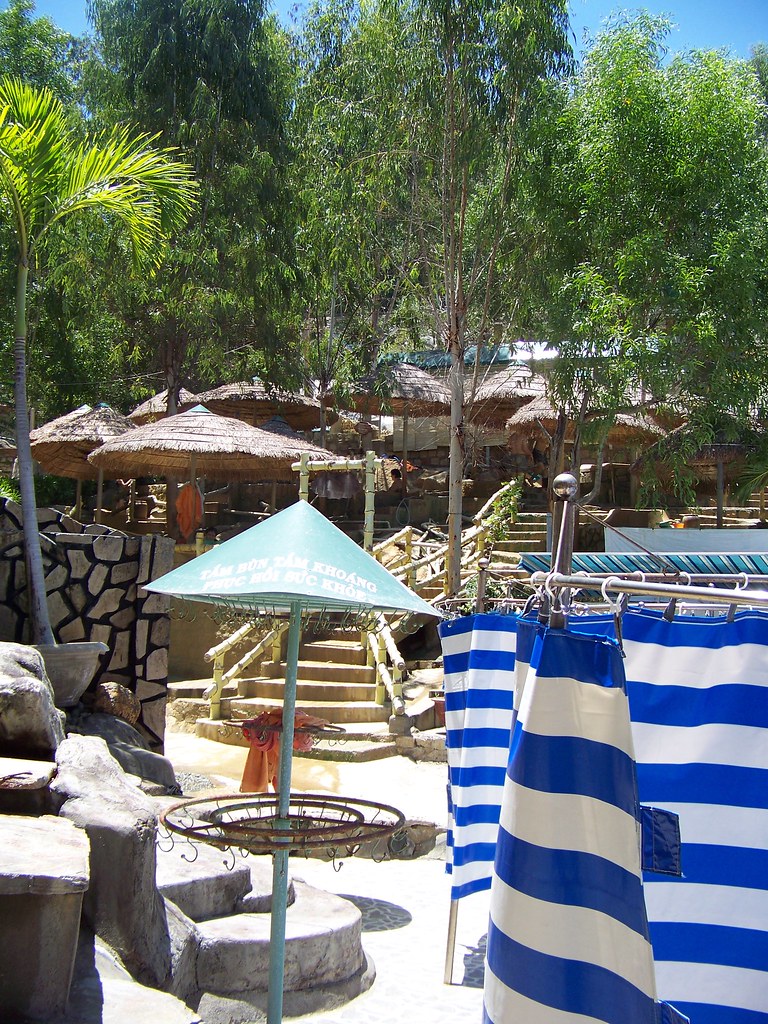
After lessening my thirst I return to the counter where (after showing my ticket) I’m given a towel and told to change, ‘men at back’. Behind the lockers are about 10 'tents' where the men are supposed to change.

'Asian Adventure 2008 152
Mud baths, Nha Trang, Vietnam'
Mud baths on terraces to the rear, blue and whiter changing tents for men.
From flickr, by pinkpapper8
Thereafter I am sent up the hill, past big empty basins. I then hand my ticket to an attendee and are told to take a shower. After obliging, I am shown the first wooden tub which is filled with fluid warm mud in 10 seconds. Take a seat.
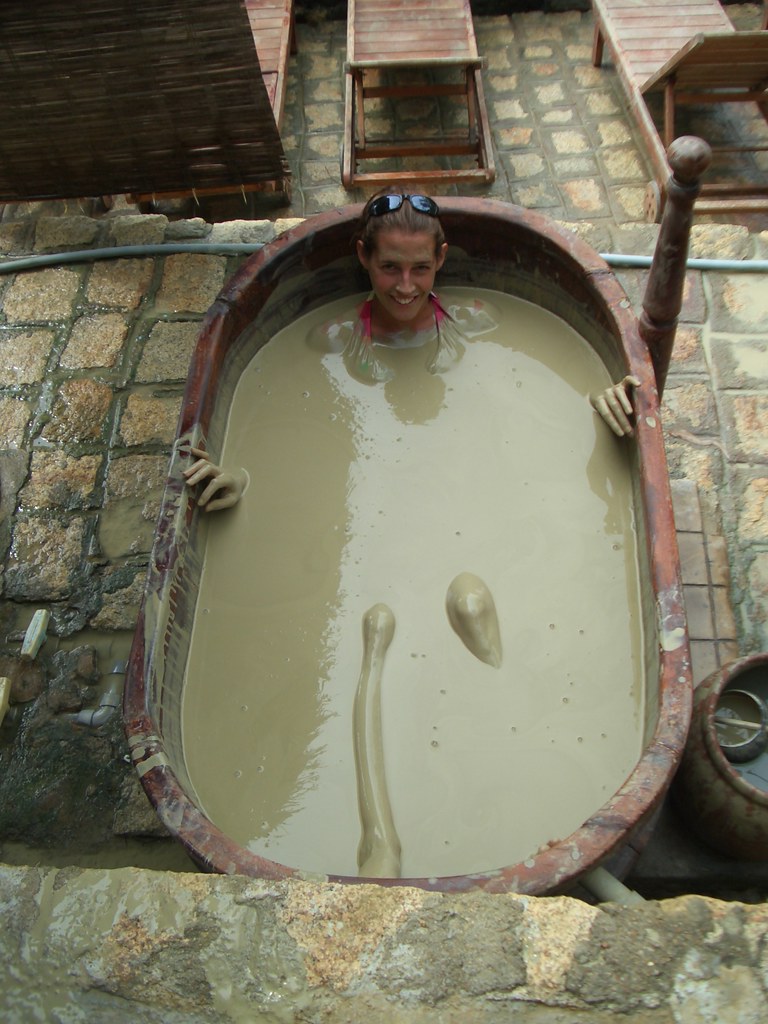
Well one can actually lie down: the tubs big enough for two. I have to admit, the mud bath is very appealing: it's warm and silky. I stayed in the mud for about as long as allowed; eventually the attendee tires and sends me on my way.
The tubs are shaded and are located above each other on terraces going up the eucalyptus clad hill. Though intended with view, the view itself is not really enchanting. The hill though is alive with soothing local music, unless of course you get all worked up, having to involuntarily listen to Vietnamese muzak.

'Mud bath, Nha Trang
Bathing in mud at a natural hot spring in Nha Trang, Vietnam. The minerals are supposed to be really good for you, and despite being a bit sceptical about the actual health benefits, we went anyway because, let's face it, playing in mud is just fun!'
Photo by birdandfrog
I also have first class seating overlooking the showers and can observe the trials and tribulations of rinsing after a mud bath. Especially women with full bathing suits are struggling.
Once it’s my turn to shower I discover why: even after a 10 minute shower, a hot bath soak, swimming in the mineral water pool, sitting underneath a waterfall shower; still then my speedo’s contain a handful of sand/grit.
And clear
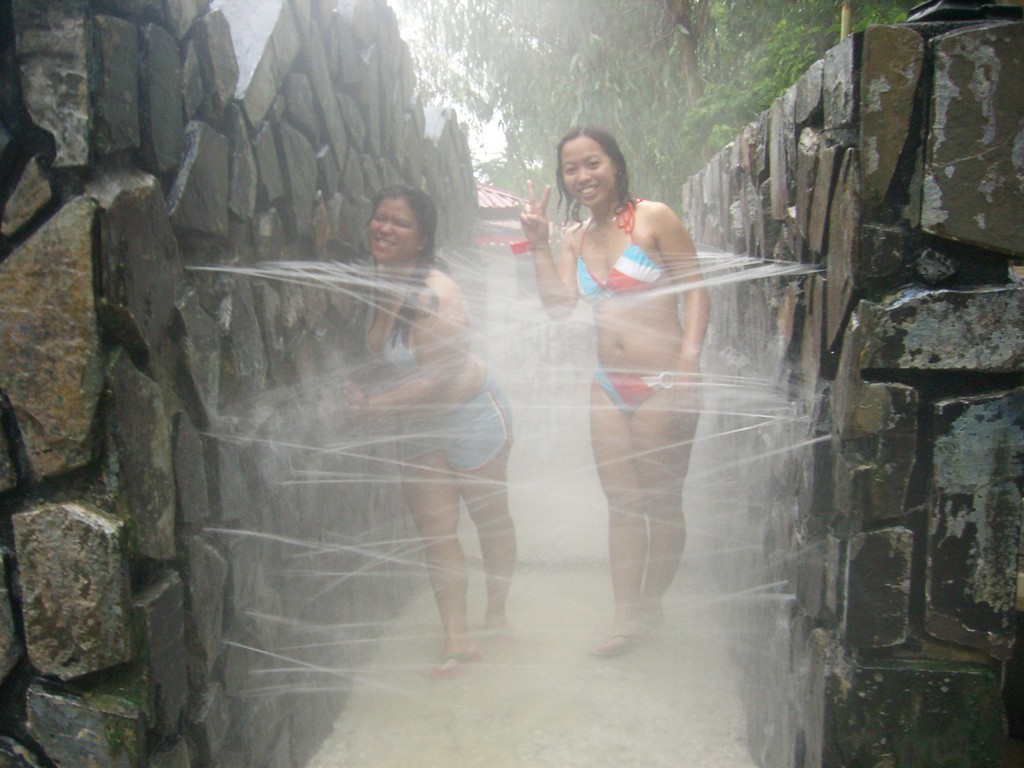
Once one has believed to have rid oneself of most of the mud, it’s back down the hill, where another attendant tells you to go through the hydrotherapy walls. These walls are five meter in length, and water is spouted out from the wall with high pressure, as a way of massage. One can walk to and fro but this concept seems to have forgotten that many visitors who partake are foreigners, whose body mass is above belly-button height.
Directly behind the hydrotherapy walls are about 20 cement basins (some bigger than others, but even the smallest accommodates two persons easily; these are heart shaped …) which are filled up individually for you. Half an hour max here again and then the surplus paid part of the ticket comes to an end.
Beyond all this are two large hot water pools (not too hot), one free form deep pool, another less deep and circular. Using these pools can be done at leisure and independent of the mud part. And those who have paid up for mud treatments receive loungers to while away and recuperate ...
 The larger pool
Secrets no more
So have I found the secret to Thap Ba’s popularity?
Possibly not, but judging from the great numbers of visitors, many who make the impression of being regulars, the facilities would be high on the 'to do' list of many Nha Trang visitors.
The experience? Possibly a bit too routine for everybody, the treatments on offer though, are way below western prices and are enjoyable in themselves without the need for proof of additional health effects. It seems that a visit here has become a Nha Trang visit-must. Even though publications such as LP [1] hardly provide any form of lip service (is that possible with books?). It does mention that Thap Ba
‘is one of the most fun experiences on offer here [Nha Trang]’.
Sims [2] notes
‘It’s a must for Vietnamese tourists who swear by the healing power of the springs, though most tourists just get a kick out of taking a communal bath in a mud broth for the first time in their lives’.
Other positives I can take away from here are the ease of access and mostly clean facilities. Management of the therapeutic side are good, though the restaurants seem a bit dilapidated with at least the pizzeria having exceptional poor service.
 Thap Ba management are well content with themselves: outside the entrance is a small building containing all the prizes/accolades the facilities have won!
However feeling intrigued by the many positive postings on (mud baths of) Thap Ba, I am planning on a future posting on exactly that, mud baths. In my research I found that much of the feedback concerning mud baths worldwide actually concerns Thap Ba. A google blog search of for instance "mud bath"+ "hot spring" reveals that nearly 1 in 5 links actually concern Nha Trang!
It also transpired that much of the global mud baths are spa treatments for mostly singular or duo consumption. Expensive, these mostly are directed at older audiences. Whereas the cheaper Thap Ba version for groups find many much younger (and possibly internet savvy) takers. Voila, the secret!
(I also assume that as one of the first hot spring centers in Southeast Asia to offer a mud bath, that they also receive much 'free' publicity).
The best?
So could it improve? I think so. It seems sometimes a bit like an assembly line business with little or no personal touch. Having better showers or allowing nudity would also help, especially if promoting the wholesomeness of mud and water while simultaneously requiring bathing costumes (which in itself is very un-Southeastasian like). kyralove adds:
'Next is mud-bath! Hippy me is expecting a private bath, or at least a woman's section and a men's section, but all the baths are next to each other. Not that I care about being naked in front of others, but if I get so many stares with my clothes on, then no way does putting on a show for the local boys sound fun. Since it is late there is only one other couple in another tub... But ours is still not private at all. WTF? I have on a white bathing suit, no way am I getting it muddy! Who takes mud baths in their clothes? It's just wrong!
Somehow I gracelessly maneuver out of my bathing suit under my skimpy towel and get into the warm mud. Ahhh... warm mineral mud under mountains and stars. Uh, oh, I float in this mud. It's harder than it sounds to keep my body completely submerged. It seems like as soon as I get comfortable, the mud starts disappearing. Oh no! They are draining the tub! I somehow manage to get my bathing suit back on, just in the nick of time (my towel has mysteriously vanished). So much for keeping my white bathing suit white....'
The lengths one goes to keep the whites white ...Going more upscale does enable more naturalness. Apparently privacy is for sale at Thap Ba. Under the name of V.I.P. Spa ('Secluded and deluxe recreation') one can have a private pool higher up the mountain, included with a villa. The price is just under US$ 100 p.p., prices dropping with more persons. This website adds
... service as soaking in mineral mud, massage with natural medicinal herbs, sauna – steam bath, private swimming pool and complete relaxation in a private room'.
The exclusivity is used as a major selling point, it’s seldom in the hot spring company's p.r. that one sees a pool full of mud bathers, though many pictures of a naked back of a female soaker (see this website for instance).
 Sign outside the entrance
.
See top part of billboard for V.I.P. p.r. ....
And that while most guide books indicate that nakedness in Vietnam is strongly disapproved of. For instance LP[1]
‘totally inappropriate, even on beaches’.
Despite all the paintings and arts you'll experience when visiting Vietnam celebrating exactly that and many legends dedicated to bathing fairies (see for instance the legend of Hon Chong promotory, just outside of Nha Trang).
Where were we? Uh, yes. A step lower in price than Thap Ba's V.I.P. spa is the Tien Sa mineral water pool ('Enjoy your love from nature'), the privilege of one's own hot tub is less than US$ 50 p.p., again prices dropping to US$ 250 for 6 persons. From the photo's it seems very private between forest with it's own loungers next to the tub, not at all bad ...
Then there is also the possibility of a steambath and massage (US$ 11 p.p.).
So all in all, not too much to improve on ....
More info
Thap Ba's p.r. also goes out of it's way to promote soaking and especially the source of it's waters. They are slightly salty which is
‘rich in Sodium Silicate Chloride’
and finds it’s source from 100m deep underground. Furthermore
‘The mineral water penetrates the skin, depositing NaCL and some other elements under the skin, cleansing and rejuvenating it as well, increasing the body immune system and capability of resisting inflammation’.
On mud:
‘Therapeutic mud bath and salty mineral water can help cure chronic rheumatism, gynecologic inflammation, bone tuberculosis.
…The mineral mud in Thap Ba Hot Spring Center is an inorganic mud especially rich in Sodium Silicate Carbonate as well as some other micro-elements. These elements stimulate the nerves under the shin, creating reactions in the whole body through the cerebral center and the cortex. The stickiniess of the mineral cleanses the skin, leaving it finer and smoothier’.
It does not mention that the mud comes from 60 km away, the source though highlighting the (possible) significance of 'health tourism' in general for Vietnam by focusing on Thap Ba:
'Despite natural medicinal tourism being new to the country, Thap Ba received some 400,000 visitors last year, about 5 percent more than in 2007'.
Then there is this document which adds more:
'mineral water is pumped from a depth of 100 m directly from Vinh Phuong mineral mine 4 km from the centre. It is completely hygienic. Mud extracted from (Ninh Loc) Ninh Hoa experiences centrifuge in order to move away sedimentary mixtures such as sand, stones, gravel, etc for the softest mud. It is then heated for bath'.
So what is playing out is not so natural after all.
It also adds:
'The centre though a non-State enterprise and operating in a new field has soon perfected itself and become a springboard for the advance of the Khanh Hoa economy in general and tourism in particular. Its advent positively changes the living condition of residential areas with the most exceptional difficulties in socio-economy of its kind in Nha Trang, increases local budget collection and provides jobs to over 100 local labourers'.
The interesting article concludes with a research overview of the potentials of the local hot water.
Anyway as a parting gift, let me assure you that Nha Trang is a nice place, it has a beautiful and bustling shoreline and many islands to explore, a great destination for a holiday. Inland are also some great places to discover such as the waterfalls of Ba Ho and Suoi Tien stream.
Getting there: Head north out of Nha Trang taking the inner bridges over the Cai river. After 100m past the Po Nagar ruins take a left and continue (2km) to the end.
Soaking experience: A grand experience, must rank as one of the best I have visited. (Other greats are Tatopani (Nepal), Hamner and Turangi (New Zealand).
Overall impression: Full marks, even though experienced with nature out of bounds.
Update [June 2012]
As could be expected when something has become so popular you will get the cheap rip-offs. Nha Trang is full of spa's which also let you experience the mud, but whether or not the mud is genuine is a mystery. The same could also be said for this mud bath. The only advantage it may have over all the others are the social aspect (big baths), the shared aspect (there are many others) and the fact that they have more to lose.
But losing may be well on the cards. A mid-2012 opening of I-resort looks set to drive Thap Ba out of the market. Placing itself slightly more upmarket, slick design and the avoidance of cheaper guests are set to draw in the more creditworthy locals as well as a significant portion of the well-heeled tourists. It's very neat website has quite a bit of promo material and the site located not even that far from it's competitor surely must be able to tempt potential visitors.
'We paid VND2 million (US$96) for a mud
bath, which is the rate for a family of two to four. We were given a hut
with wooden basins to pour mud and mineral hot water over ourselves.
There were also soft drinks, fruits, ginger tea, snacks, and massage for
the money.
The service is excellent with staff always available outside the hut, ready to meet any customer need'.
'We were driving around in search for the thap ba mud baths but saw
signs for another one and stumbled upon a fancier mud bath and mineral
water facility close to nha trang. A little bit of a drive but very
quiet surroundings. It was more expensive than thap ba but well designed
and affordable. We got a mud bath tub (had some salt and extra herbs or
something in the mud too) which included use of the mineral waterfalls
and swimming pools for 300,000 per person (inc. water, towels and a
locker). There is a restaurant and bar inside too and to our surprise
with very reasonably priced food and drink.
There is also a spa too but a little expensive for Vietnamese standards. Lots of Vietnamese people and Russians here too.
Overall a great mud bath experience in a clean, peaceful surrounding'.
More styleful photography of the resort can be found here.
Success may not be guaranteed, the company involved is mainly focussed on seafood ...
Notes:
[1] Ray, N., Y.-M. Balasingamchow, I. Stewart (2010) Vietnam. 10th Edition. Lonely Planet, Footscray, Australia
[2] Sims, A. (2010) Nha Trang Guide Book 2011-2012 Edition EBT Media, Nha Trang, Vietnam.

Lao lounging
North Laos is a great place to find hot springs. It's an intricate mix of various hill tribes with different customs and uses all blended into a lowland Lao culture where simplicity and timeliness are still in vogue. Add to this, historic settling and superb natural landscape.
In general there seem to be only a few hot springs in Laos, but I suspect that many are still waiting to be discovered. General access is still poor, but the surrounding Thai, Vietnamese and Yunnan mountain areas have many hot springs on offer, so why would Laos possess heaps of hot springs?
The mountainous province of Xieng Khouang contains 3 known hot springs, as far as I know. There is the hot spring of Ban Thak, which is still to be developed according to LP and which our guide assured us, was not worth it. the journey Especially in light of the big distance to get there via poor and tired roads. So we'll leave it for a next time.Besides hot springs, Xieng Khouang is an interesting province to visit. The capital of Phonsavan is a bit windswept, but it sits on a high plain allowing for a nicer and cooler clime than most places in Southeast Asia. There are the mysterious Plain of Jar sites to be visited, many different ethnic tribes, appallingly war-time scars and an outstanding natural surrounding (f.i. the waterfalls of Tad Lang and Tad Ka). Hot springs of Kham
On the road east of Muang Kham, in the direction of Vietnam, lie 2 quite accessible hot springs. Apparently everybody refers to these as Baw Noi (Bo Noi) and Baw Nyai (Bo Njai).
The hot spring Baw Noi (which translates as little hot spring) is just 3 km east of Muang Kham, a larger village in the north of the province.
My guide to this hot spring is the excellent A Guide to Xieng Khouang Mountain Province in Northern Laos [1] which includes the following: 'A little hot springs is located in Xang village, 3 km east of Muang Kham. It feeds into a stream just a few hundred meters off route 7. Note the limestone jar near the ticket office. In the village tai Dam women sell their weaving textiles; cross the river on a small bamboo bridge to visit the Phuan village and observe the women create the beautiful textiles. There is another hot spring nearby Nathong Village. Pass the village and follow for about 800 meters'.
It can be picked up in the informative provincial tourism office of Phonsavan, though large sections of the text appear on wikipedia and wikitravel.
Baw Noi
So, three kms out of Muang Kham, there is a smaller signboard indicating a turn is required if heading to Baw Noi.
One continues down this road towards the village of Xang. Or Xieng, according to this website. At the end of the road one goes through a gate to a wide enclosure. On the stream side of the enclosure is a wooden building with signboards referring to the spring, while on the right are a number of wooden buildings, the furthest away has a signboard indicating it's a guesthouse. But it could also be a school / office.
Entrance fee for visitors is 5,000 kip, about 0,60 $US. Interestingly the ticket refers the Nam Ounnoi tour, the river behind the enclosure.
 Welcome
From the ticket office it is a 100m walk along the river to a wading place across the river. Here is also the location of the hot spring. Located just above the waterline, the spring has a double cement wall defense against the 30m wide fast flowing stream. Contained within these confines is water with a temperature of nearly 60 degrees, way too hot for a soak. It is also only 20 cm shallow.
 Cemented. Thnx to 'GRANT ASSISTANCE OF THE MR JOHN 2000 BATH'.
 View from the spring; returning home.
Having read that there's another spring nearby I returned back to the ticket seller and asked. Yes there was, not so far away, she had been there once, but it was no place for visitors to go. Because.
The guesthouse owner came over and more talking ensued with me politely trying to push the issue. The discussion took a turn as we came to discuss about Jars and their existence. Yeah, there was a find site nearby, on the other side of the river and on all fours up the mountain. Two hours walk. I had read that there was a jar close to the ticket office. Same same?
Lots of discussion further, the guesthouse owner takes me to the edge of the enclosure and there's a partially broken Jar. We're getting there.
Eventually it was deduced that the hot spring I was asking about was overgrown, 100m stream upwards of the other spring. If I wanted to see it then the guesthouse owner would assist.
We all trudged off back to the river walked beyond the spring, along a field and then beelined to the bank of the river. The guesthouse owner said it was somewhere close with us trying not to get entangled in the weeds. Eventually he mentioned that he had (re-)found it. After scrambling there there was a small hole between the weeds where hot water (but a lot less hot than the more developed springs) streamed 2m along a small 20cm wide canal to the main stream. The smaller of the small hot spring. The black hole is 20 cm across.
We returned back to the original spring. In the meantime, the village is coming out to bathe, one women is soaking, fully clothed in the very hot spring. Wow!
Most though are just using the river to bathe in, with little regard to the presumed convention of shame and / or offending others. Wish I could move here.
We return to the ticket office and sit down, initially for a glass of water but soon we are tasting and testing all kinds of local fruits, not all palatable. A very nice place.Another highlight of the village is it's bamboo bridge, downstream. The annually rebuilt bridge is nothing special, but another great place to watch village life: kids jumping in the river, teenagers fishing. We are really playing the tourist.
 Worth it? Or not?Exploring the internet there is not so much information available, either in blog form or in photo's. That doesn't surprise me, the hot spring ticket seller said they often have only a couple of visitors each week and in the hot season none at all.One good overview is presented in a Japanese language blog entry. I've applied Google Translate and much of the written content is small talk but the photo's are good. And there's a short video.
Travelfish is downright condescending: 'Baw Nam Horn Noi is small and not worth a visit'.
Wikipedia Phonsavan's entry differs: 'Xang village is located near a small hot spring. An ideal spot for a small break. Across the river Phuan women demonstrate their weaving'.
There is a photo on travel pod, at a time of the year when there is more water in the river.Finally, there's LP's entry: 'Baw Noi (Little Spring) feeds into a stream just a few hundred meters off Rte 7, a couple of kilometers before Baw Nyai on the way from Muang Kham.You can sit in the stream where the hot spring water mixes with the cool stream water and 'adjust' the temperature by moving from one area to another'.
Getting There. Take the road north out of the provincial capital of Xieng Khouang, Phonsavan, all the way to district town of Muang Kham (55 km). Head out of town towards the Vietnamese border (Nong Hed) and after 3 km there's a clear (though small printed) signboard announcing the hot spring on your right.
Soaking Experience. Very rustic place not designed as a soaking experience. Well-intended but someone needs to put there thinking cap on.
Overall impression. The site is beautifully located, interesting and welcoming. If not for the hot springs the other attractions are more than enough reason to detour here. Just do it. Author and wife at Baw Noi.
[1] Creutz, S., J. Van Den Bergh (2009) A Guide to Xieng Khouang Mountain Province in Northern Laos. Lao National Tourism Authority, Vientiane, Laos.
 Cumpleng: warm or not?
When is a hot spring hot? A great question with many answers. Terminology varies on this. In Japan hot is above 42C, warm between 34 and 42C, tepid 25-34C and cold lower than 25C. This info is derived from Erfurt-Cooper and Cooper (2009), though they also present another full page of classifications and definitions on terminology from all over the world meaning there is always a possible positive way to describe a spring that’s less than hot.
Wikipedia acknowledges that there is no universally accepted definition. Definitions involve temperatures from as 'above air temperature' to 'above body temperature'.
The need for highlighting this definition is the fact that I visited two springs in the neighbourhood of Tawangmangu, Central Java, Indonesia that were definitely not hot nor very warm. Lukewarm, tepid?
 'Air Hangat Cumbleng Indah'
First visited was a spring in the tiny village of Cumpleng, 5 km southwest of Tawangmangu. A weary signboard (see photo above) has at some time in the past described this as 'Air Hangat' (translates as 'warm water' as opposed to 'air panas' which translates as 'hot water').
This past has meant that around the spring development has sprung up. Development in the form of channels, a fountain, a park, changing rooms and a number of open air shower cubicles. Visits probably dried up last century, though the waters still run out of one of run-down shower cubicles.
These waters are not hot, nor cool. Something inbetween. Taste of the water is neutral.
 What's this? These are the 4 falling down shower cubicles
which are connected with a pipe to the reservoir on the right.'has been managed well'.
It adds: 'Bathing is a source of water containing sulfur, iron, and other substances are efficacious cure skin diseases and rheumatism. A number of facilities located in this area is open and closed bathhouse, playground of children, and toilet'.
Emphasis on closed?
Going downhill with Suharto
We get back in the car and continue down the mountain along a small but well maintained road, through small villages, through plantations and along rice paddies. Then we pass a forested mount which house’s the last remains of Indonesia’s former president Suharto as well as those of the former rulers of the regency of Solo. Suharto's family having connections with the Solo regents, they share the same graveyard, Astana Giribangun, a magnet for pilgrims who wish to share Suharto's luck.
Not far beyond Astana Giribangun is another attraction near the village of Pablengan. A roadside compound hides the tourist attraction of Sapta Tirta, the seven waters.
Payment (3,000 INR’s, about 0,25$US) is accepted for entry and off we trudge to discover the seven waters, one of which may well prove to be a hot spring. There’s a soda spring, a spring whose level never ever changes, a spring with elixir, a spring which water assists constipation, a salt water spring, all within a few meters of each other. The small hot spring (also described as Air Hangat) is located in a small walled-in cement box. Getting to the water can only be undertaken one by one, but a pilgrim is already bathing and hands us the mandi for us to feel the temperature. It’s not so warm, nor cold.
 Not worth the wait?
On the same compound are two shower cubicles but that water is not hot either. Oh well, nothing earned, nothing lost.Sapta Tirta is well publicized on internet. Especially this blog entry by Annyong Haseyo gives a complete overview of the seven waters. The seven waters described (in Bahasa)
Cumpleng is also best accessed from the same Solo to Tawangmangu road, not too far before Tawangmangu on the south. Ask. It’s another 3 kms or so downhill before Cumpleng proper.
Soaking experience: can one soak in not hot water?
Overall impression: Only for die-hard geothermalists or others near to dying from boredom.
Notes:
[1] Erfurt-Cooper, P. & M. Cooper (2009) Health and Wellness Tourism. Spa and Hot Springs. Aspects of Tourism: 40. Channel View Publications, Bristol, United Kingdom.
Followers may have noted that most of my effort has been directed towards the Hot soaks of the Himalaya blog, which has detailed listings of many (if not most) hot springs in or near the Himalaya. I am still to include more, but from regions further away.It's also good to see that the number of visitors to that site is matching those to this site!On this blog site coming are more entries from a recent journey to Central and East Java, which I liked a lot. Also to be included is a report from a visit to a wellness center in Germany.Socialism
In actuality there's not much to be updated on. One of the premier spa resorts in Asia, the Banyan Tree gives some additional info concerning it's management culture. Ho Kwan Ping, the founder, reveals that challenging the authorities in the past has helped him shape the Banyan Tree now. He's a ‘Capitalist in his pocket and socialist in his heart’. A brand criterion: 'all swimming pools must be built in such a way that guests can skinny dip without being seen beyond the walls of the villa'. If the Banyan Tree got itself involved with hot springs, now there's a concept ... But despite the socialist talk, Banyan tree is totally focused on the free spending elite ...
Hot hippies?
A hot spring in pill form? 'You can re-create the hot springs in your own bath as I do'.
Suzy Cohen (who can be 'reached' at www.DearPharmacist.com) proposes adding all kinds of minerals to your bath, so as to gain the same benefits from a bath at home as you would from a soak in the 'wild'. Unfortunately it's not clear whether there is such a pill or that she proposes taking a whole bucketful of pills. Nonetheless I can imagine people being enticed by this. Does it already exist?Elsewhere she has to answer a queries about her Facebook page which includes a photo of her soaking in a Utah, USA hot spring: 'Q: This maybe personal, but are you sick? What is in the water that is so healing? I'm curious because around here, hot springs are for hippies only [!]'.
'A: Hippies? I am an Aquarian, so perhaps I qualify. The mere thought of hot springs brings a rush of peace into my body and a deep breath. I prefer undeveloped hot springs that are nestled deep in the woods or amidst a waterfall.
...
The waters contain minerals and sulfur compounds which go right through your skin to soothe aching muscles, ease joint pain, improve circulation, relieve skin irritations, boost immunity and ease breathing difficulties. Sulfur-based compounds help unstick dangerous pollutants. The experience can create harmony, because you are soaking up healing nutrients from ancient waters bubbling up from the Earth's core, and you absorb energy from the fresh air, the Earth, the trees and the sun'.
Not sick thus.
This last mentioned aspects fall much in line with a thread on soakersforum.com concerning 'spiritual aspects of soaking'. Unfortunately I have yet to come across any spirituality in soaking here in Southeast Asia other than that awarded to water in general.MalaysiaA previous link to a Malaysian language blog entry concerning Kunak hot spring has been changed. Apparently according to the new link the springs here are not only hot but salty as well.Caution must be applied though to this as of yet undeveloped hot spring: 'Fredolin [Sabah state Mineral and Geoscience Department senior geologist] advised visitors not to simply taste the hot water in order to avoid untoward incidents. “We are concerned that the water could contain toxic susbstances such as mercury and arsenic”, he added'.
Elsewhere there is a 'mud volcano' closeby. Can't resist posting this picture from Semuakonak, even though it's not a hot spring: Bhutan
- At the beginning of June it was reported that repairs to Bhutan's premier hot spring (required due to a flash flood) would involve the Japanese. Though in this more recent report, the Italians seem to have outbid the Japanese.
Philippines- The Daclan soaking vs. geothermal energy production quandry has once more delayed geothermailty as the local government favours local sentiment (should they do otherwise?) against geothermal energy according to this press clipping.
Indonesia- From the same source, more reports of favourite soaking haunts being developed to provide more energy.
China'If a man swims naked in a pond and there are no women there to see him is he acting immorally? A group of men in Yuxi who use a local reservoir as a nude swimming social club say the answer is "no".'
This shocking story (though not concerning a hot spring) uncovered by the blogoshere at the end of June. It concerns a small lake near Yuxi, Yunnan, where this tradition has just been found out. Apparently no outcry as of yet. 'Pundits such as Southern Daily columnist Ao Tianma say that the legality of nude swimming is open to interpretation. The law stipulates that public exposure must be flagrant in order to be a crime, and it is unclear if that label applies to such a secluded area.
...
For their part the One Hundred Birds [local swimming club] simply want the recent media attention to go away. A club member surnamed Yang was quoted as saying, "We just want to keep the place and go about our swimming quietly."
A great story nonetheless which literally reveals that bathing practices even in China are diverse. But also how internetisation (or may we also add, a form of cultural globalisation) is threatening this diversity and conditioning all non-mainstream practices to fit in with just the single line of thought. So much for the internet being a tool of power!
Copyright 2009 © Soaking in Southeast Asia. All rights reserved.
No reproduction or republication without written permission.