Showing posts with label bathing. Show all posts

Sunday, 12 October 2014

Publications: Hiking Hot Springs in the Pacific Northwest


Soaking attributes
Is there something as such? I mean soakology. A good description might be the science surrounding the act of soaking with reference to hot springs.
We would have to define hot (above 30 / body temperature/ hotter?) and what is soaking (probably the most difficult)? And how can it be a science?

Well the former does leave us shaking our heads. Do note that in Japan this is very different, however the science of taking a hot spring has still some way to come by in the western scientific literature. In the past I've noted about 2-3 books on soakology. But in all fairness listing a couple of hot springs after each other with their characteristics is hardly scientific. What's more this seems to be dying trend: listing on the internet is rendering all this obsolete.

So it does come as a surprise that a publisher has been found for what is essentially a list of ultimate natural hot springs which are located in the Pacific Northwest of North America (Oregon, Washington, Idaho and British Columbia) and have somehow failed to be "developed" due in part to problems of access and/or being on state land. Question mark. 
What's even more surprising is that the authors (Evie Litton and Sally Jackson) have turned this essential and entertaining item for hot spring hunting into what could be contrived a scientific listing of where and what, but also how. How soaking is done. I like it.

Though I call myself a soaker, I've yet to find out what distinguishes myself from those non-soakers. Collins notes on a soaker:
'a person or thing that soaks sb or sth else'.
With soak possibly referring to
'to take in (a liquid) by absorption'. 
Though there are some definitions of soak referring to getting drunk or heating up. Maybe a soaker is simply someone drunk on absorbing heated liquid!

In the blurb of the Hiking Hot Springs etc., the publisher notes that all hot springs covered in the guide are free of charge and on public land. So that are two characteristics of what a soaker seeks: free of charge with public access. But that would be specific to North America; in Japan other rules would have to apply and free, public accessible hot springs are few and far between in Europe. Asia-wide there would be more differences, while New Zealand differs yet again and then there's still Latin America and Africa which all have other characteristics. Add traditions, history?
Dames Litton & Jackson though note in the preface that the guide is dedicated to all those who
'... struggle patiently and often ingeniously to create and maintain soaking pools for everyone to enjoy and who value hot springs in a natural setting enough to pack out the trash left by others, ...'. 
So here they add more possible attributes of a soaker, this is getting complicated ...

What's more wherever I go in nature (beach, river, waterfall) I make an effort to carry more trash out than in. Does this mean I'm an ultra soaker? Or should this be characterised as common sense? And if so why is it not common? So a soaker focuses solely on hot springs. Hmmm.

The science of soakable skinnydipping
What the previously mentioned blurb of the guide fails to inform it's (potential) readers, is that the authors have gone to great lengths to describe the (un)dress code of the relevant hot springs. Aside from the fact that the publisher might have purposely missed this, it gives us certainly another possible attribute of the soaker: he/she prefers the undressed code. And here comes the science.

The authors have looked into what the swimwear code of each hot spring is. Of the 162 featured hot springs I've collated what the various advisory standards of dress are brought forward. There are 33 possibilities ranging from 
'swim wear is a must' 
or even 
'no nudes' 
to 
'swimsuit / birthday suit mix' 
to the ever clear
'mixed bag' 
to 
'swimwear: first come is first serve'
and ending with 
'swimwear is the least of your worries'.
The top 3 advisories were: 
  1. swimwear optional (17 out of 162),  
  2. keep swimwear handy (?) (15) and  
  3. jointly third with 10: swimwear required/essential, swimwear superfluous and the strangely advised swimwear is advised/vital/essential when standing up!?
In total, 38 advisories implied that whatever the correct amount of dress society requires you, that's what's needed. Meaning a hefty majority of soaks allows you to lower (literally?) your guard.

Interesting in the above, is that Canadian soaks and soaks in Idaho require more clothing. On the other hand, Idaho is the only featured state with the curious habit of 
'skinnydipping after dark' (5 counted) 
as well as the widely advised stand up / dress up rule mentioned above.

So now where are we? Soaker: a person who enjoys and values (possibly through  maintaining the vicinity, but with reference to traditions and history) hot naturally occurring liquid which mostly is publicly accessibly / free of charge with a preference for natural bathing habits

Still not me I think, but close enough.

Screened
But as said the guide is an enjoyable read, even though I'm not from that part of the globe. Who knows that could still happen. 
It's also a book of inspiration, there's still so many places we soakers can (still) enjoy. Hopefully the trashers amongst us, won't get their hands on this ....

Just flip the guide open. Let's read together. Page 217: Anderson hot spring, Idaho:
'A hot pool screened by trees in a creek canyon, near a dirt road. Keep swimwear handy'. 
It then comes with general characteristics and how to find the springs. A photo by Ms. Litton of a male soaker in his natural habitat and then a text box on how Sally lost a sandal but found another hot spring nearby.
I compared this to the Idahohotsprings page on Little Anderson:. Coincidence or not: the two descriptions don't line up. Anymore. Another question mark.

Others note some progress / lack of as compared to earlier editions (this is the fifth) especially when updating prior info: that goes to show that an internet listing does have it's own advantages. Maybe a website to keep the list up to date?

Reference:
Litton, E. & S. Jackson (2014) Hiking Hot Springs in the Pacific Northwest - A Guide to the Areas Best Backcountry Hot Springs. Falcon Guides, Globe Pequot Press, Guildford, Connecticut, U.S.A.

Sunday, 20 October 2013

Publications: Cathedrals of the Flesh


Alexia Brue's 2003 first touch at a fully fledged book takes us by the hand and explores her own introduction to Europe's public bathing culture. Public, intimate (or not) she gives us a good insight into why we (used to?) value collective bathing.

Initially, Alexia sets out on an adventure to literally soak up what the makings are of a perfect setting for a bathhouse which may be located in New York city. Starting off in a Parisian steam bath, she becomes accustomed to and acquainted with the Istanbuli hammam, the Russian banya (both traditional and upmarket) and the Finnish love of everything sauna. The insights into their bathing folklore are complimented by a thoroughly readable journey into each countries culture and an increasingly in-depth revelation into the author herself as she jots down what would make her search for the holy grail perfect.

Interspersed by a personal historical account into Greek and Roman bathing, the journey ends in the soakers heaven of Japan, where she visits the tradional sento as well as what she hoped for: the most paradise-like onsen. 
On a hopeful note we take notice of her talk with one of New York's bathhouse owners. Will she have accomplished the mission she set out on?

It comes as no surprise that the author's journey has evolved and Alexia Brue is now regarded as an expert on wellness issues. Together with a colleague journalist she has been running the Well+Good NYC website ("Your healthiest relationship"), a premier source of info (million hits per month!) on wellness for New Yorkers.

A must read for soakers? This would be a giving a bit too much importance to this book, but all-in-all it's very easy to read, enjoyable and certainly entices readers to jump in and enjoy a thorough public bath. Forget the everyday worries and just immerse oneself. 

The book includes a resource guide which acts as an intro to entice followers of the flesh cathedrals, be they seekers of man-(or better said woman-)made public baths or naturally occurring hot springs.

Readers reviews have sought to tend to award five stars, as I would. Amazon readers give it 4.4 stars, Goodreads comes to 3.72 stars, while Google's books comes to just a shade short of 4 stars.

Hotsprung has her own review in which she emphasizes the insight she gets as well as the sense of adventure Cathedrals of the Flesh evokes.

Soakers worldwide should note that this book does not look into hot springs exclusively, but more into heat, water and bathing. 

And as would be expected there are no Southeast Asian connections ...

Reference:
Brue, A. (2003) Cathedrals of the Flesh - My search for the perfect bath. Bloomsbury, London, United Kingdom.

Thursday, 21 October 2010

Update October 2010

In the ever expanding soaking related blogs concerning Thailand, Southeast Asia and the mainland Asia more has been added.
Visits to hot springs in Indonesia (Songgoriti, Cangar, Parang Wedang, Cumbleng/Saptatirta and Thailand (Mae Kasa and Mae Klong).
In depth features on now nearly all hot springs in the Himal (added Afghanistan, India's Northeast) Uzbekistan, Kazakhstan and Turkmenistan Guanxi/Guizhou and Mongolia) and north of that.
And the addition of a Tumblr photo site, just to celebrate soaking. Called Spirit of Soaking it compiles photo's from all over the world of people enjoying a hot soak as naturally as possible.

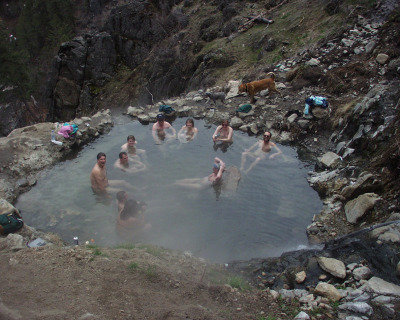
Just one of today's entries to Spirit of Soaking: Skinnydipper hot springs, Idaho, USA.

Art
Many of Southeast Asia's soaking sites are replicable and certainly not inspiring. Often it's the natural setting that makes them more likeable.
However that may not need to be the case always. An example of thinking out of the box came via this
article on Naoshima sento (bathhouse), Miyanoura Japan. Residents in Miyanoura, Japan can now soak in their bathhouse which doubles as a work of art itself.

Naoshima bathhouse exterior

More art. Jennifer West makes films. Two and a half minutes long. One film from 2007 is entitled: 'Naked Deep Creek Hot Springs Film'. Not posted on Youtube?

Avoiding face
Despite some places in Asia where bathing naked is the custom, when entertaining guests from here, not always is this practice commonplace / accepted.
Alan Eagle:
'When night falls during the Canadian summer, vacationers often peel off their clothes and jump in the water for a refreshing dip. It's partly to feel naughty, but mostly to feel free of society's burdens, gliding through the water like happy wild animals.
Recently a friend and I visited the beach at Beidaihe, and after a few late night drinks, decided it was time for a skinny dip. We invited some other friends to join in, but there were no takers. In fact, our Chinese friends seemed absolutely scandalized.
This puzzles me. I peeled off my clothes steps from the water, in the dark, where no one had a chance to see me au naturel. I think you could say the act was quite modest.
Especially as the tight Speedos favored by Chinese men leave no detail to the imagination. You can easily take the full measure of a man with a quick glance - something impossible to do with the baggy bathers preferred by Westerners.
(This is in contrast to the modest one-piece swimsuits with attached dresses and built-in falsies favored by Chinese women.)
So I'm not sure by what standard my midnight swim would be calculated as immodest. At any rate, I don't care because I enjoy shocking people'.
Talking about swimming naked, CNNGo has nothing better to do than list
'7 sexy skinny dips - Seven spots in Asia where clothing is just a chore'.
China, Sri Lanka, Thailand; all are places where going au naturel is fine. But strangely they are all exclusive resorts where the privacy you might want comes at a gigantic price, the cheapest quote 373 $US, most above $600. Surely the are other secluded places where the same effect can be achieved at no cost at all?


Malaysia
A slightly delayed update on Banjaran hot spring, near Ipoh. Since opening it has been getting good feedback and winning awards. Pity though that the price makes it exclusive. Nice for photo opts, not so for soaking ... the Star signs out as follows:
'The Banjaran experience calms your mind, energises your body and gives you a healthy glow, but since it is a plush retreat, expect a dent in your wallet . . . but worth every sen'.


Thailand
A new resort in Thailand's upcoming destination of Krabi. Scheduled for a January 2011 opening, Natthawaree is a hot spring resort and spa located at Ban Phueng, south of Krabi town. Forty four rooms (source) and many pools though the website says 77 rooms, so let's just see.
It's located near all other Krabi hot springs, might just be worthwhile visiting there this November ...


Singapore
More info on the history of Singapore's only public hot spring Sembawang. A very thorough article.

People gather around the hot springs
'People gather around the hot springs. Kawah Domas, Mount Tangkuban Perahu'
by Ripi

Monday, 20 September 2010

Hot? And cold?

Cumpleng: warm or not?

When is a hot spring hot?

A great question with many answers. Terminology varies on this. In Japan hot is above 42C, warm between 34 and 42C, tepid 25-34C and cold lower than 25C. This info is derived from Erfurt-Cooper and Cooper (2009), though they also present another full page of classifications and definitions on terminology from all over the world meaning there is always a possible positive way to describe a spring that’s less than hot.
Wikipedia
acknowledges that there is no universally accepted definition. Definitions involve temperatures from as 'above air temperature' to 'above body temperature'.

The need for highlighting this definition is the fact that I visited two springs in the neighbourhood of Tawangmangu, Central Java, Indonesia that were definitely not hot nor very warm. Lukewarm, tepid?


'Air Hangat Cumbleng Indah'

Managed well
First visited was a spring in the tiny village of Cumpleng, 5 km southwest of Tawangmangu. A weary signboard (see photo above) has at some time in the past described this as 'Air Hangat' (translates as 'warm water' as opposed to 'air panas' which translates as 'hot water').

This past has meant that around the spring development has sprung up. Development in the form of channels, a fountain, a park, changing rooms and a number of open air shower cubicles. Visits probably dried up last century, though the waters still run out of one of run-down shower cubicles.
These waters are not hot, nor cool. Something inbetween. Taste of the water is neutral.


What's this? These are the 4 falling down shower cubicles
which are connected with a pipe to the reservoir on the right.


There's not much additional info on the internet though this site suggests the site
'has been managed well'.
It adds:
'Bathing is a source of water containing sulfur, iron, and other substances are efficacious cure skin diseases and rheumatism. A number of facilities located in this area is open and closed bathhouse, playground of children, and toilet'.
Emphasis on closed?

Going downhill with Suharto
We get back in the car and continue down the mountain along a small but well maintained road, through small villages, through plantations and along rice paddies. Then we pass a forested mount which house’s the last remains of Indonesia’s former president Suharto as well as those of the former rulers of the regency of Solo. Suharto's family having connections with the Solo regents, they share the same graveyard, Astana Giribangun, a magnet for pilgrims who wish to share Suharto's luck.

Not far beyond Astana Giribangun is another attraction near the village of Pablengan.
A roadside compound hides the tourist attraction of Sapta Tirta, the seven waters.
Payment (3,000 INR’s, about 0,25$US) is accepted for entry and off we trudge to discover the seven waters, one of which may well prove to be a hot spring. There’s a soda spring, a spring whose level never ever changes, a spring with elixir, a spring which water assists constipation, a salt water spring, all within a few meters of each other. The small hot spring (also described as Air Hangat) is located in a small walled-in cement box. Getting to the water can only be undertaken one by one, but a pilgrim is already bathing and hands us the mandi for us to feel the temperature. It’s not so warm, nor cold.

Not worth the wait?

On the same compound are two shower cubicles but that water is not hot either. Oh well, nothing earned, nothing lost.

Sapta Tirta is well publicized on internet. Especially this blog entry by Annyong Haseyo gives a complete overview of the seven waters.

The seven waters described (in Bahasa)

Getting there: Sapta Tirta is not too hard to find, there’s a very important looking road heading off the main Solo to Tawangmangu road towards Astana Giribangun, don’t enter though but continue for another 2 kms I think.
Cumpleng is also best accessed from the same Solo to Tawangmangu road, not too far before Tawangmangu on the south. Ask. It’s another 3 kms or so downhill before Cumpleng proper.


Soaking experience
: can one soak in not hot water?


Overall impression
: Only for die-hard geothermalists or others near to dying from boredom.


Notes:

[1] Erfurt-Cooper, P. & M. Cooper (2009) Health and Wellness Tourism. Spa and Hot Springs. Aspects of Tourism: 40. Channel View Publications, Bristol, United Kingdom.

Monday, 6 September 2010

Smoking hot


What now?
As with Songgoriti hot spring, Cangar hot spring can most easily be accessed from Batu city (East Java, above Malang). However public transport fails to make it this far up the mountain. From Batu one takes a minibus as high up the mountain as possible but at least in the direction of Sumber Brantas, which lies beyond Selecta. At the end point don’t walk. It’s still a long way up (and down).

Hiring an ojek (motorcycle with driver) seems to be the best option to continue. From here one continues up the mountain, passing apple orchards and potato fields. Eventually one passes the mountain pass and the road descends steeply.

Cangar
At the bottom of this descent are a number of competing parking areas all providing access to the hot springs.
Entry is 3,000 INR (~2,75$US). From the ticket office (photo above), a trail heads down and across a small stream. Beyond the bridge are the hot spring(s?) themselves. Amenities consist of toilets and changing cubicles, 2 each for either gender.

Unfortunately one needs a long wait to be able to use these at best makeshift changing rooms, which at 1,000 INR are still not worth it.


The hot springs themselves consist of two large kidney shaped, half meter deep basins which on this Saturday (July 2010) are lined with soakers. Otherwise there is another larger cooler pool and an area where women can bathe, though this is half open to observation so why these separate facilities are required is beyond me.

The direct vicinity of the pools are far from clean, all kinds of refuse are just disbursed of with little regard to the entire situation. Most bathers are fully clothed, even males, another of this odd situations, what would men have under their singlets / shirts that need covering?


Positively, most women lay off their headscarves for the soak (see photo above), which begs the question why wear them in the first place?


Obviously I am the only foreigner and the only person with swimmers on. Though the waters are sufficiently hot, I have my doubts about the hygiene. As is common throughout Java (and Indonesia?) smoking seems to be a habit difficult to shake: many soakers while soaking are still smoking! Smoking hot?


Sharing opinions
It's not only my own opinion. Take this
blogger for instance:
'Hey, you know what my first impression of Cangar was? DIRTY!! ... No need to change into swim suit, just wear our clothes (everyone do that, why shouldn't us), and enjoy the spring'.
The former answering partially my aforementioned queries (not).


The area around Batu is well-known for it's mild climate and this is already a major draw for the many tourists who visit Batu during the weekend.

Nearby Cangar are caves used by the Japanese during their occupation of the Indonesia isles.
The entry on Cangar by eastjava.com describes slightly more details of these caves. Little info on the history of the hot spring itself.

On the way up from Batu, one can also visit the Selecta pool (an open air pool built by the Dutch and fed by spring water) and the Coban Talun waterfall.


Getting there: From Batu head for Selecta (north) and continue up the road and over the mountain pass. It’s at the end of the steep descent. In total it should be slightly over 20 km from Batu depending on where you start.

Soaking experience
: That’s a difficult one. The pools are great, flagstone lined with a gravel bed. Water temperature is good. But my fellow soakers could do with a tip or on hygiene …


Overall impression: Despite the misgivings of the soak itself and the lack of changing facilities, the air is crisp and cool meaning a hot soak is just what’s needed. The direct surroundings are also heavily wooded and management of the site is evident (though lacking).

Tuesday, 10 August 2010

Eagle cries


Volcanic or not?
Though one associates volcanoes with hot springs, in reality this is not always the case. On Java, Indonesia, there are many (distinct and active) volcanoes. This though hardly implies there are many hot springs.
That said the hot springs there are, are close to volcanoes, Java virtually being an island of volcanoes.

On the very distant slopes before the Lawu volcano mountain becomes part of the riverine plain surrounding Solo city, lies the hot spring of Bayanan. Coming from the northern plain city of Sragen (itself 30 km from northeast of Solo) after 15 km and just beyond the village of Sambirejo, the paddy fields give way to small hillocks covered in teak.

Past
Located in this area, the hot spring of Bayanan is located 2 km beyond the village of the same name on a recently laid asphalt road. With the parking area also covered with the same new surface, it’s a disappointment to see that whatever constituted the recreation area of this hot spring, it’s features are now clinging on to dear life. Private warungs (shop stalls selling everything and doubling as restaurants) seem ok, but the public facilities for which further up the road 2,000 INR was paid (~0,20 $US), are gradually deteriorating.

Despite this, on this Saturday morning, a number of youthful (and very silent, or were they just shy?) couples were occupying the few and far between seating areas. Two small kids were the only ones active; their efforts were focused on throwing bucketfuls of water to the encaged eagle which had little choice than to accept this fate as just one of those days. It was one of those places.

The soak?
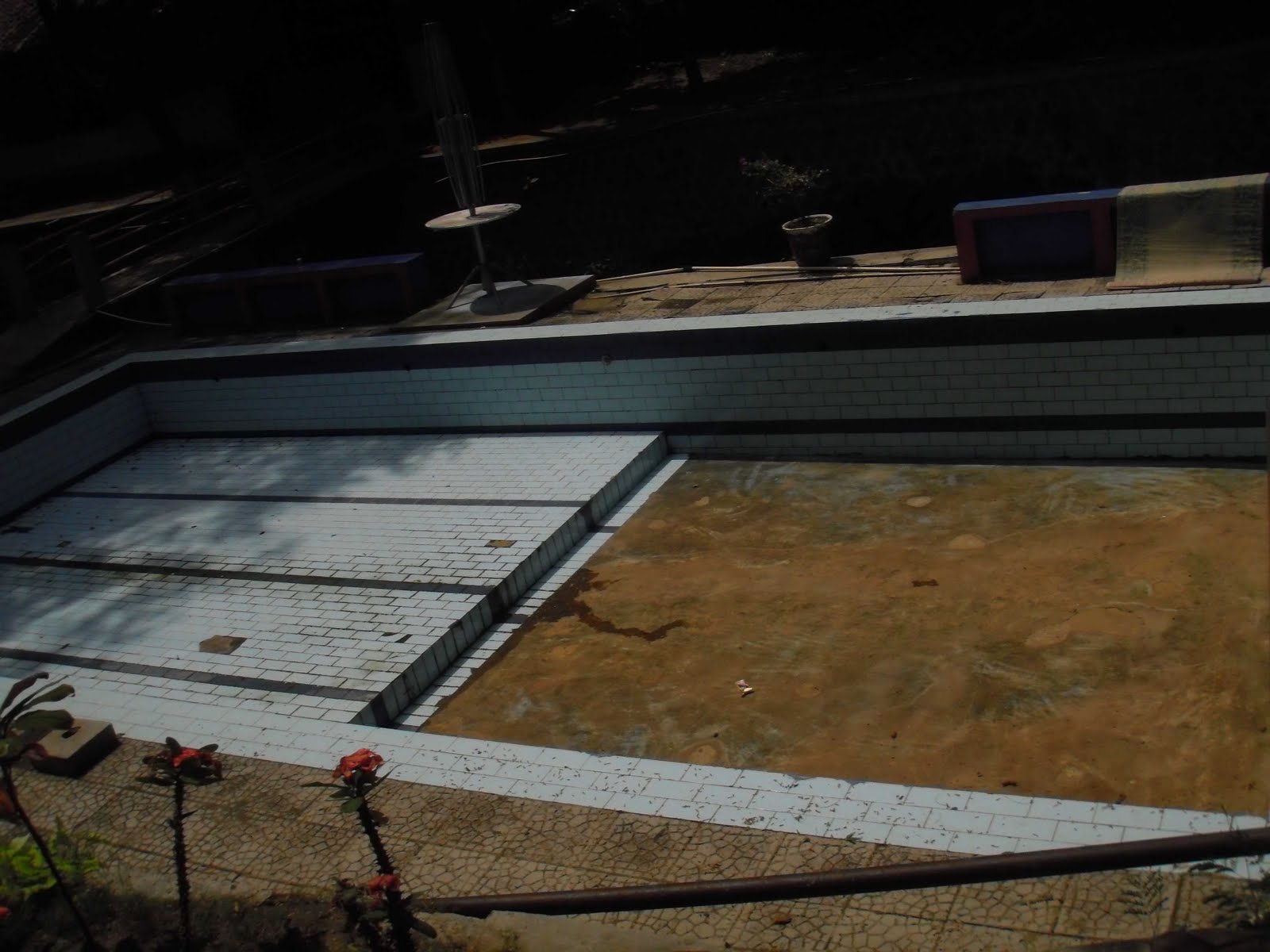
Soaking might have taking place in earlier days in a larger swimming pool, but possibly as this was the drier season, the pool was empty.
Beyond the pool is a cemented enclosure which had to be the source. The small view of it’s interior revealed only a reflection, which has to be attributed to a water surface.
Continuing, thick water pipes lead to a number of bathing cubicles which in contrast to the rest of the area, have been maintained. Inside are a bath tub and enough space to change.
It looks clean, so a soak can be enjoyed, why else come here. After the soak, it’s another 2 hour journey to cover the 50 km back to Solo. In just two hours.


Other sources
The
local government website of Sragen regency has extensive info on the Bayanan hot spring recreation zone. Which includes all info on how to get here and photo's from better times.
'Through scientific research was known that hot water and the substance that were contained inside it was suspected came from the touch magma (geothermal) that touched the source very deep ground water and to was felt in the surface as the source of hot water. Hot exact water in his source + 44 0 C, and after until the surface in the bath to + 36 0 C, in accordance with the temperature of the human body, so as to will be felt was glad and comfortable to bath. Investigation that was done by the Balai Penyelidikan Dan Pengembangan Teknologi Kegunungapian Yogyakarta showed the existence of many elements/the chemical compound that was contained in the Bayanan Hot Water Bathing Place including the sulphur (Sulphur)'.
Tourists are to be persuaded by this text. A selection:
'Bayanan hot spa is considered to have many advantages in curing many kinds of diseases, such as f rheumatism, itch, and so an. Many visitors coming to this place have proven that the hot spa in Bayanan is really curable. Besides curing several diseases mentioned above, this hot spa can also decrease cholesterol level in blood, revitalize our body and muscles, relieve the tiredness, and keep us young'.
A video perhaps?


Getting there: Sragen is closest major town, conveniently found on the main highway from Solo to Surabaya. Train also passes through here. Getting to Bayanan might mean finding some kind of deal with either a small microbus or an ojek (motorcycle). Bayanan is well known, not far from Sambirejo.
Soaking experience: The water was hot, but not too hot (see above). The bath was clean. The cubicle was dark.
Overall impression: Not really worth all the trouble to get out here. Cheap though.

Saturday, 10 January 2009

Angseri, a green paradise?

Below beyond the rice paddies next to the river are a number of huts which might be the green paradise of Angseri hot springs.

And now ... a green paradise(?)
Taking a cue from the discussion from the previous posting on Toya Bungkah hot springs, the visit to Angseri hot spring should be completely different. My source of information,
nomad4ever.com describes it as follow:
'Imagine a green paradise nestled between lush rice paddies with small streams and creeks of water coming from everywhere. Need some privacy in a closed cabin to relax and enjoy the hot waters without any outside interference?
Welcome to Angseri Hot Springs!'
Well, this description is very enticing as well as what follows on their posting of their visits to this hot springs. I'd imagined it as distinctly local, non-commercial and very natural. Arguably I only used the search terms Angseri + "hot springs" which hardly gives two pages of references (that's not even 20), a couple of which were to the story above, two even to my own site!

However I must contend that there is much about Angseri and hot springs to be found, just not in English. This site gives a comprehensive review of the soakings site of Angseri, while yogamaharini has some photo's. These guys like showing off their girlfriends at the place. And for more photo's either see my own flickr site as well as the aforementioned nomad4ever.

But I was still imagining a "green paradise".

Next door
It started off well. In the regional town of Bedugul, roughly halfway between Bali's south and north coasts, I had asked directions while ordering a coffee. Our waitress who ominously knew from heart that it was just down the road (2 km) and 100m up a side road. Could that possibly be a green paradise?


The directions differed from what I had deduced from the previously mentioned web site. Still she seemed very certain of herself, so without any doubts we trundled off back from where we came, only to discover that the 2 km was in fact 10 km. The short side road, dipped straight down into a valley followed by an equally steep ascent. The by then rutted road met up with a nice two lane road coming straight from Bedugul! Where I had started off!

At this t-junction there was a clear sign with hot springs and some 10-15 minutes later we took the turn off through the village of Angseri. The road got worse as we climbed out of the village and finally in the forest, the road dropped all the way back down to a bridge around which a makeshift parking area had been created.

Who said paradise?
So far from civilization this must be a paradise ..., if not for the number of cars on the parking area. After parking in some deep mud, we paid the low entrance fee and followed an irrigation channel which headed for the nearby rice paddies. As we were staying on the same height as the irrigation ditch, the river had dropped away dramatically and after following the recently cemented staircase down, we also were next to the river.

Canteen

Left of us was a canteen, in front an oval not so deep pool (for kiddies and mothers) while to the right was a path that passed through a number of huts and ended at the rock face next to a 5 m high waterfall. If it weren't for the many people wandering around, this would be nice, but it was holiday season. No foreign tourists by the way.

The huts were a collection of toilets, changing cubicles and 4 huts for more or less private soaking. More or less, as the huts were made of bamboo and to avoid outsiders looking in, plastic wallpaper had been used on the inside. Which was a bit flimsy. All these huts were taken and a nice line stood outside the changing hut.

Taking the waters

For me, this line was no problem: I am getting good at changing under a towel, possibly more persons should perfect this technique. After changing, I set off in the direction of the waterfall where the main pool was to be found.

A great looking pool next to the thundering waterfall, it was inhabited by some bored youths of the male kind. Being bored, they were very actively pursuing other avenues of entertainment: cartwheels diving into the pool being the most popular, as well as smoking which seems at odds with hot springs promoting health issues.


There seemed little regard as to where the ashes were going and little semblance of relaxation (but maybe I'm being an old fart), so the soak itself was not so comfortable. Once two Indonesian girls joined the pool, the shouting lessened but the acts of machismo crescended.


I took an awkward shower under the waterfall, awkward because the waterfall comes straight down on slippery and naturally uneven rocks.

Developed versus paradise?
So how much better was this site? It was tastefully (and cheaply) enhanced, acknowledging that the natural surroundings are a part of the attraction of the site. The waters were a bit tepid. But arguably the waters were not very clean nor hygienic, both of which seem to be the essential requirements of a public bathing spot. The aforementioned site (nomad4ever) did mention cleaning of the main pool, so some thought has been put into keeping the site clean, but much more could be attained.


The question then arises, why this not happening. Is it ignorance? Or is it something culturally? Signs of the times ("we want more") Or unwillingness?

Would a private company be in a better position to achieve this? I doubt it. So a public entity should just as well be able to achieve a site of both naturalness with high regards to health and hygiene standards. Would this cost more? Yes, but not much more.

As said the site is not often visited, probably I was unlucky to visit during the main holiday time. So is it acceptable for standards then to drop,? Neither I, nor other outside visitors would agree, but clearly the local youth have different ideas.

I certainly believe that the site can attract many more visitors. Why not? It's not too far from many other attractions and it's natural surroundings make it a great catch. Then again, why do we always need more?

Certainly a great way to relax if you can put up with the crowd. In the foreground the main soaking pool, the waterfall is behind.


Getting there: From Bedugal market crossroads, head down the left lane, rather than the right lane heading to the 'Botanical gardens'. Continue following this ( for 5 km) until you reach a t-junction with a clear sign indicating Angseri to the right. From here it's possible 10 km before a right turn to Angseri village. This is basically a one lane road, so continue driving onwards leading to a forest. Possibly park on the hill top, before the drop. The entrance is where the road crosses the next river.

Selamat Datang (welcome) di Air Panas (hot springs) Alam Angseri

Soaking experience: With a lot lesser people I might have been a joy, however with an over-influx of soakers the joys also dissipated.

There is certainly lots of scope for a pleasant soaking experience, both due to the natural surroundings as well as the large pools / private pools and accessible waterfall. On any other day outside the Indonesian holiday calender I would be great, but better to avoid and/or arrive early otherwise.

Overall impression: With the tasteful, yet unobtrusive improvements, it certainly was very nice. Then again it's not a green paradise. But still one of the best I've visited. Who know's? Next time I'm in Bali, I'll have to verify my findings ....

A more recent blog entry mentions

'hygiene looks very good'.
Yeah if you are blind! And while you at it, why do those photo's look so familiar? At least two of them I took myself!

Related Posts with Thumbnails
Copyright 2009 © Soaking in Southeast Asia. All rights reserved.
No reproduction or republication without written permission.