A repost from Soaking in Siam.
Recipe for SuccessOne of the few really developed hot spring resorts in Southeast Asia goes by the name of Hotspring Beach Resort & Spa. Located in Phang Nga province just half an hour north of Phuket airport, Southern Thailand, one would expect that this professionally run resort (***** stars it claims) to be a grand success:- Spa and wellness are increasingly popular tourist destinations,
- Phuket airport is serviced from major destinations in the region as well as a selected few outside the region,
- the area is slowly becoming a popular alternative for Phuket itself, especially with the largely undisturbed back country and
- the fact that it's more than evident that considerable funding had been poured in to ensure a success.
But is it? The AnswerComing from the north, the obvious grand entrance is passed, as the resort sign is aimed for northbound traffic (coming from the airport). After a couple of minutes I turned around and this time went into the grand entrance with an absurd large driveway. That said, shaded parking space is at a premium.
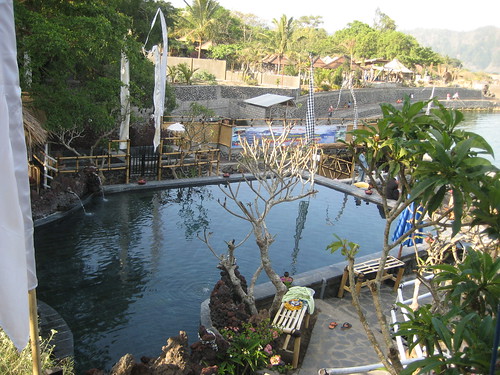
But eventually after finding a spot and I'm looking around what to do, the (under-employed?) receptionist is already underway to see if I'm really going to be a client. I'm informed that the entrance to the bathing facilities is 500 Baht (about $15) which includes a free drink / snack and a towel. Not too bad. They even have locker rooms, but as I'm getting older I'm getting better at the towel changing thing.From the reception one crosses the main free form swimming pool. At the end of this pool are two large, circular pools, to the left the warm pool, to the right the hot pool. Both pools seem slightly under maintained, but a sip of water reveals that the springs water is laden with minerals. Or sea water? The day is hot so maybe the hot pool is worth skipping, though the warm pool is too tepid. The swimming pool looks great, unfortunately it's heavily chlorinated.Not many other guests / visitors are lounging about. The whole afternoon doesn't reveal many others. It's Phuket's main tourist season, so where are the guests?I order my drink and snack, service is not too bad. Read a little, bath a little.Seeing, it's a hot spring beach resort, I go in search of the beach. I'm already forewarned not to swim as it's too dangerous. Actually the resort is located on a lagoon entrance to the sea, so you'll have a lot of current. They have built a long pier which also holds a non-functioning restaurant, but as the tide is out I can take the steps to the sand below and continue for another 300 meters to the windswept and empty beach.It's a long walk back and I'm in need of a drink. Nothing better than some tea. Deliriously I'm replied with 'we don't do that'. Fair enough. I won't disturb the staff anymore, take another soak and leave. The swimming pool
.
'The one and only natural mineral hotspring beach resort and Spa in Thailand',
though the website mixes the one and only up to make it: 'The only and one natural ...'.
Concerning the hot spring: 'The hot spring source was found in this piece of land about 40 years ago. The water was originally sprung out about 3.5 m above the ground. However, due to the land development, a concrete wall was made to cover the spring which reduces its height to 1-1.5 m at the present day.
Out natural hot spring mineral water has many health benefits, such as:
- cleanses and beautifies your skin
- eases and soothes tired or aching muscles and joints
- eases tension and de-stress with the comfortable water temperature (approx. 45 °C)
- provides more effective massage by deep heating the muscles prior to your treatment
Furthermore, the elements dissolve in the water are thought to have therapeutic value, for instance:
- Calcium is vital for bone structures and aiding in the function of muscular tissues.
- Iron enables red blood cells to carry oxygen around the body, which is vital for the formation of the hemoglobin'.
 Bare breasted fountain.
It comes as a surprise that there is hardly any info about the hot springs pre-resort. Wikitravel ignores the resort name and refers to the hot spring being Ban Bo Dan: 'The water of the natural hot springs are laden with minerals such as sodium and calcium, which are believed to relieve rheumatism, numbness, and help lessen the tension of both body and mind, as well as being beneficial to your complexion and hair. Mineral baths are available daily'.
Ban Bo Dan is possibly the former name, before the resort was built. The resort also seems to have been under management of Dusit Hotels. At least this site mentions the hotel as Dusit Hotspring Beach Resort and Spa, though Dusit fails to mention this in their business history.
This site reveals more history: 'In March 2002 the luxury Hotspring Beach Resort & Spa has been build',
while also maintaining the sentence 40 years before, so now more like 50 years ago. Others put the date of construction in 2004.  More Opinions
As it's a overnight stayable resort, there are a quite a few reviews of guests' stays from accommodating sites. In general they are widely differing in experiences. But it seems it's all about the expectations you have:
- Yes, the resort is very big and spacious, as are the rooms.
- However there are no nearby facilities (including beach) meaning that you are totally dependent on what the hotel offers.
And that's where it the main problems seem to be.
Elsewhere some note that the facilities themselves are outdated (2007), lack of maintenance (2009), facilities getting old (2009). I would have to agree. At the edges Figurativly, the resort was becoming ragged and tattered. The pier for instance looked decidedly unused, piles of used towels were left for hours at a stretch, leaves were not cleared out of the pool, the communal toilet was dirty.Though most visitors like the hot spring pools themselves. That said it comes as a surprise (as this is the only hot spring resort in Southern Thailand) that he hot springs are just mentioned as one of the many facilities: i.e. no wifi, beach too far away, airport transfer too expensive but good hot spring pool, staff a bit slow, towels too thick. Who's the odd one out? (a.: there are two!) Source: KrAtAi
 More photo's from Stephen and Kate.
Reposted from Soaking in Siam, a visit I made the other month, to Phang Nga province in southern Thailand.
Off the trail
Despite it's presence to the nearby tourist center of Phuket (and Khao Lak), Kapong hot spring seems to be well off the tourist trail. That said the lazy environs of Kapong are altogether located in what one would suspect another world, one without tourists. The main hot spring area. Sandbagged and ready for a soak.
The spring itself is located at the start of the pond.
Kapong (or Ka-pong) hot spring is otherwise known (probably locally) as Plai Phu. Located in the district of Kapong in Phang Nga province, in the south of the country it's just a 2 hour drive from the hub of Phuket's hot tourist spot (Patong) or just 1 hour from Khao Lak. The town itself seems very laid back and for a district head quarter not much seems to be going on. Economic activity revolve around rubber planting with evidence of recent palm oil plantations slowly attributing to local economic significance. Furthermore, mostly small villages located between quite heavily forested mountains. The parking area with a market stall. Some other housing (unused) behind.
There is quite a bit of parking space on gravel belong side the Le stream. Behind between the trees there are a number of bungalows and other structures which seem unused. Downstream one sees (a now cut off from the main stream) side channel with some huts and a number of port-a-loos besides. The side channel has been blocked with a dozen or so sand bags creating a half meter deep pool which is warmish. Go to the far end of the channel and the water is definitely hot. Nearby in the main stream, are a number of springs in the river bed which are hot and the main stream itself heats up. Merge between the hot stream (left) and the main cold stream (right).
A great place to soak up the heat especially now while the weather is cooler. But alas the main area is totally devoid of trees so during the day having a soak without getting a heat stroke is not possible so it seems. Possibly that's why the place is so deserted. What I like is that though enhanced one can see that the site has remained mostly natural. I can also imagine that come sun down this is a great place to hang out and around.Out There
From the internet one does not become more knowledge, so it seems.
- This site mentions water temperatures of 65 degrees Celsius.
- A foreigner (presumably English: the_wibblywobblies notes a word of caution:
'On departure we stopped off at a Hot Spring near Kapong. Our 5 year old inadvertently stepped into the small pool of extremely hot natural mineral water and suffered 2nd degree burns to her feet. We are planning to have a warning sign erected there but in the meantime please be careful'.
There's no danger sign and there were some certainly very hot pools. If this were somewhere else in the western world there would be big fences around it and no bathing facilities at all.
- Wikitravel's otherwise excellent Thailand entries fails to note the existence of the hot springs in Kapong (as laid down on the Phang Nga provincial page) though does mention the surrounding waterfalls.
- Finally PhangNgacity.org though is more explanatory:
'Some of the hot springs spring up in a very cold stream that flows from the mountain. It is marked by arranged-cobble stones. On the level besides the stream there are concrete wells 2 meters high, with steps up and down 3-4 wells connecting altogether, in the area of 200 square meters to contain hot spring water that bobbed up. Nowadays (2007) these hot spring have lower bob ups, which may be caused by changes underground'.
The site also has some (better?) photo's. That includes a picture of stone structures which just might have been some soaking facilities in the past.
 Did I mention forested hills?
Well opposite the soak site they are doing their best to correct this impression. 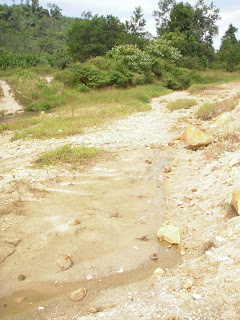 Lots of smaller springs around the river bed.
 The main spring
.
 The main pond with the port-a-loo's and market stalls.
Adding to the family of blogs is Hot Soaks of the Himalaya, a long (term?) journey up the valleys and across the vast plains of Himalaya. Just one entry so far, on Bhutan entitled 'Of Tsachu's', a tsachu being a hot spring.
Furthermore two visits have been paid to hot springs in Southern Thailand, postings to follow.
When one looks at the analysis of referrers one sometimes finds that Soaking in Southeast Asia pops up in the strangest places. A Google web search for 'Indonesia Banjar hot springs bikini photos' puts this site in the second place. But why on earth would someone being using those search terms?
News/FeaturesAsiaspa (Nov./Dec. 2009) goes green for it's latest issue. That's besides features on both Hanoi as well as Lao. Funny that focusing on the green thing but not mentioning green or 'natural' water. Though they do emphasize cleanliness of a spa, something you seldom see in the natural soaks of Southeast Asia.In How to travel Green: 'Modest dress is important for many cultures and this is something many western travellers do not follow'.
Sounds a lot like the blame the west attitude. Funny though when you leaf through the Mag you'll discover that advertisements for resorts in Southeast Asia focus more on non-modest (10) vs. modest (8; assuming bikini is modest). In pictures with articles the count is even 10 vs 4. So much for being modest, but possibly aforementioned being modest meant outside of the spa?
Furthermore a good article by Laura Miller on a visit to Beitou, Taiwan. Very forthright: 'There is something quite delicious about being naked outdoors. And although I'll admit to a slight exhibitionist streak, I'd challenge anyone not enjoy reclining nude in a marble pool of steamy healing water with trees and discrete screens ensuing total privacy from the opposite sex [so not exhibitionist?]. While skinny dipping is illicitly thrilling, hot spring nudity is actually recommended and deeply relaxing - especially under a blue sky or starry night'.
That said, her name does sound western ....
From further away in Asia:
- The arrival of the Beaujolais Noveau 2009 is a reason for Japanese soakers to indulge:
'The Hakone Kowakien Yunessun spa resort celebrated the annual uncorking of the seasonal drop by having a sommelier pour a few bottles into an open-air hot spring bath as holiday-makers enjoyed soaking themselves. It was the fourth annual bath using the produce of the French winery Laboure Roi at the spa, which also offers baths with green tea, coffee and sake'.
What exactly are the benefits of soaking in wine tainted mineral water?
- And then a manga introduces the 'hot spring goddess' as reported by A NEET Life. Unfortunately Mr. NEET Life was expecting a naked Goddess because that's the way you soak in Japan.
'As you can see, right up my alley. My expectations of a series where the main character (who happens to be a cute girl with divine powers, for better or worse) never wears any clothes turned out to be a little high, unfortunately, but that's (also unfortunately) to be expected. But I'm totally down with the red letter philosophy above. Think about it. A nature god(dess) living at a hot spring. Where do clothes even fit into that? Oh, but of course, for the sake of modesty, we must go out of the way to clothe the naked. Even (or especially?) the divinely naked.
...
And worst of all, it offends my sense of spirituality. A God loses her majesty if she runs around naked? [quoting the manga] All I have to say about that is - she's a God, and this is a hot spring, so what's wrong with being naked!? Far as I'm concerned, a God gains majesty by running around naked. Partaking in nudity is spiritually fulfilling, not morally degenerate.'
- China is also experiencing 'a wave of hot spring festivals' this autumn.
From blogs:
Thailand - A year old write up in the Nation on Bo Klueng, Ratchaburi:
'Bo Klueng is a prime example of a poorly managed private tourist spot. The property owner has built a restaurant right next the hot spring to allow diners to watch those frolicking in the man-made pond into which the hot spring flows. Naturally, the focus is more on selling food and drink than maintaining the site, and the Bt5 admission fee is augmented by a Bt30 charge (Bt10 for children) for a dip in the pond. The water, which looks none too clean, is usually packed with children. And about 100 metres away, a sign is details the quality, which at pH8.02, seems more alkaline that it should be and not that hot at 56 degrees Celsius'.
I, for my part, admit that it's far from fantastic but did notice that they clean the pond and that it is still one of Thailand's best hot spring sites. Goes to show how good Thailand's soaks are. Possibly might visit there again next month.
- Another forum entry chips in on the above discussion so it seems:
'It certainly isn't the hot springs [of Pai, which attract tourists]. Until recently it was 300 baht for Farangs [foreigners] to go in and as a result the place was deserted. I think it is 100 baht now and still very quiet'.
Vietnam - Tours to Binh Chau hot springs are back on offer. But only for the elderly ...
Indonesia
- Are there new hot spring pools in Kintamani, Bali? Bertrandom has the photo's (see below). But what is the place called?

Malaysia - A previous unrecorded hot spring in Perak: Pengkalan Hulu. Motormouth from Ipoh has an extensive blog entry on this hot spring. A place to visit? Kavetha adds:
'The hot springs at air panas used to really nice until they decided to built that dirty canal and ugly chalets. There were 2 extremely hot pools which had railings around them, one big pool of warm water for swimming and a few more other little pools….. and for anyone who wanted a cold dip, they could just go to the river flowing nearby'.
Author's reply: 'Chalets aside, they’re all orange-y now. But that canal looks too murky lah …. We did not touch the waters'.
A few changes on the site itself. I've created a mirror site dedicated especially for Thai soaking sites, aptly named Soaking in Siam, while at the same time I've added another blog site concerning Waterfalls in Southeast Asia. Though a soak is great, sometimes a cool soak can be just as invigorating. What's more, like where I live in Cambodia, there's only the 1 soak so visiting waterfalls makes sense, sort of. I'll leave the reader to decide on that ...
There have also been a couple of smaller changes as well on the site, most notably the linkwithin widget. It has instantly became one of the better referrers. See also the Top Posts. How the ranking works I don't know, but already 6 posts are graded at 10 (out of 10). By the time the whole top 10 is such rated I'll have to ditch this widget, doesn't add much.
News / Features
Roxanne
An interesting post by Roxanne Downer which is to be published in Spafinder titled 'Spa Customs around the World'.
Spafinder mentions its global reach but has only 3 hot spring spa's in Asia (out of 5,000), one of which is in Southeast Asia (COMO Shambhala, Bali; which actually is not a hot spring spa ...).
Anyway Roxanne's article tackles the most anxiety causing issue, nudity apparently: 'Understandably, being undressed with someone you’ve just met can feel awkward. It certainly doesn’t help that customs regarding nudity at spas vary from country to country'.
If anything most people have problems being naked with people they know...
She then cites an Italian spa marketing manager who explains that it's due to Catholicism that nudity is a no-no in that country. Funny that in catholic France, Spain and Austria there are less qualms. Roxanne fails to guide us through on this the most anxious issue ....
 Filipino (and Catholic?) Jhayelle Schluter takes undoubtedly a for Roxanne confusing bath in Japan.
 Then feel reassured as: 'take comfort in the knowledge that, in many locales, single-sex treatment areas or hours and same-gender therapists are the norm'.
That's probably the conservative American in her speaking.
She then highlights how soaking in Japan is besides a ritual practice a social one, though again she lacks to mention that nudity is de-rigeur, even co-ed ....
Finally she tackles the American issue of utmost importance, tipping, though again no real guidance ...
Anxiety in China?
More on the aforementioned most anxiety causing subject. And in relation to China where they claim that nakedness is a western undesirability.
A good piece (from last year) in the China Daily by Raymond Zhou. He states:
'Is public nudity legal in China? I do not know. I have not heard of a law that legitimizes or forbids it, but it certainly goes against China's social mores. The puritanical constraints of Confucianism essentially put these matters off limit for rational debate. ...
Paradoxically, the Chinese society has long put up with social nudity. Someone told me of women in rural places, young and old, who in the old days did not bother to wear tops in the suffocating heat of summer. ...
In a country with more pressing issues to solve, naturism is something that concerns a tiny slice of social life. People who are into it should exercise common sense and refrain from creating a scene; they should visit secluded locations for their activities such as sun-bathing and swimming. While the public should be more open-minded, the gradual pace of social acceptance is the intangible rule that guides such things'.
The father of the nation, Mao, even was partial to a skinny dip: 'Mao took a liking to swimming naked [but not co-ed]'
(page 354, Mao, a biograhy by Ross Terrill).
Unfortunately Mr. Zhou may have said it all when stressing the lack of conformity in social mores and reality. Take Singapore a largely Confucianism based society: 'A 19-year-old student, who was one of the women participating in a topless car wash, has been expelled from her college ...
The student ... said she had only two months to her graduation'.
Source.
Though I personally view the whole idea of car washing half naked as a particular form of sexual exploitation (and childish), why a woman would get kicked off a school for doing what a male can do without any second thoughts seems obnoxious.
Promoting soaking?
'Guangdong Provincial Tourism Bureau has announced that October 25 will be Guangdong Hot Spring Tourism Day'.
From China Hospitality News.
Possibly there may be some understanding as to what a hot spring is: 'Guangdong is among the best provinces for hot spring operation, construction and services. It now has more than 300 hot springs that can be developed, 130 have already been developed, and 70 already in operation'.
That's a lot of hot springs. This list nearly contains 1200 references to hot springs and Guangdong.
Wonder what they mean with 'developed'?DevelopedA possible answer comes from the Philippines.
'Millions of pesos in government funds and taxpayers’ money were spent on an infrastructure project aimed to boost the tourism industry in Tanjay City, Negros Oriental, but it has now turned into a “white elephant”, said incumbent officials of that city. ...
The officials are referring to the Mainit Spring Development project, where an unutilized swimming pool was built sometime in 2005. ....
However, as the project was well underway, it was discovered that the elevation of the swimming pool was way above the hot water source, and for still unclear reasons, the construction of the facility was stopped'.
Blogoshere
Malaysia
- More Sungai Klah at Netmoirs from a Solemn Rover:
'Here is some facts about Sungai Klah Hot Springs Park (SKHSP) or Taman Rekreasi Air Panas (TRAP) Sungai Klah. First of all, this place is a must visit especially if you are a local as this place was carefully managed by FELDA, the leading agency spearheading plantations and agro-tourism industry. This place was inaugurated in December 2003 (mentioned above) with the building cost of over RM6 million. SKHSP is reputed to be one of the best hot spring in Malaysia. The hot spring is located 200 ft. above sea level at the foothill of the biggest mountain range in malaysia, the Titiwangsa Range. You pay a tenner per person, and RM7 for senior citizen'. ...
'We wondered around not much as most stalls and shops were closed. It was Monday and it is such a pity that this kind of place are only lively in the weekends. Good news for xenophobics, if you hate contact and being a crowded place, this place is good for you during the weekdays!'
Thailand
- Pong Duet by Betty:
'Pong Dueat is definitely not a world class attraction, but it is a beautiful, little-visited, quiet rest stop on the way to Pai. The hot springs must be a real attraction during the cold months, when mornings are positively chilly in the mountains. Also highly recommended if you want more scenery than concrete to go with your hot spring experience. ...
As usual, Thai visitors were taking a dip all dressed up and we did not stick out'.
- A write up on Binh Chau by Sarahelaine, the nation's southern most hot spring. Resort: quite expensive. Rooms: very clean. Hot springs: lovely. Massages: very nice. More on the trip there and back here.
Cambodia
 Nyo Nyum August/September 2009 Edition of Cambodian Life . Click on photo above for full picture and text of Cambodia's only hot spring.
- Yet again more info on Kampong Speu's hot spring this time from an updated guide to the province on Cambodia.com:
'The country’s only hot springs are found in Kampong Speu at Phnom Te village. Known as Te Teuk Pous, it is well off the beaten track and is easy to miss. Its name is derived from the name of its founder Lady Te and Tuek Pos, which is Khmer for boiling water. There has been some development around the springs to create a pool to collect the hot water from the ground but the developer appears to have dropped plans to convert the area into a golf and spa resort [appears refers to leaving the place deserted ...]. Changing rooms, soaking tub and picnic tables have been built but otherwise, there are no other facilities, nor people in attendance The springs are sacred to the Suoy minority tribe that still uses the site for religious ceremonies. To the Suoy, healing spirits reside in the hot springs. Small archaeological finds suggest that Angkor kings would use the springs for their therapeutic properties and the area could have been part of an Angkorera burial site. The belief in the spring’s healing waters still prevail today as the Kampong Speu locals who make their way to Te Teuk Pous believe that it will cure them of afflictions'.
Co-incidence or not, two foto's highlighting the difficulties in dealing with English while visiting a hot spring in Southeast Asia:
Putting together a list of hot springs and making a top 10 of this or that seems to be a popular thing to do. However quite often these lists add nothing and are based on nothing.
Lifeinthefastlane.ca has put together a list with 12 most astonishing hot springs in the world. The list has no references and seems at random. But not. Most are from North America, 4 from Japan and 3 from Iceland. Forgotten is the South Pacific, Southeast Asia and South America.
World's Top 5 hot springs by Virtualtourism.com, even selected Sankampaeng, Thailand as it number 5; due to it hot springs cooking area
(!). Not really remarkable, cooking at hot springs in Southeast Asia is a number one past time.Then there's a recent list on the 15 hottest springs in the world by sumberair, which surprisingly contains 17 listings. Though hottest seems an objective criteria the list once again seems arbitrary. Temperatures are not used for selection the list seems at random with bias once again towards North America.I thought that putting a list together of Southeast Asia's most popular hot springs would not be too difficult. I have a hunch, but I used hits from Google search, flickr photo's, Technocrati and tripadvisor.com's Asia forum to arrive at a score for each hot spring. The result: - Poring, Malaysia
- Sungai Klah, Malaysia
- Ardent, Philippines
- Fang, Thailand
- Banjar, Indonesia
- Maquinit, Philippines
- Thap Ba, Vietnam
- Pangururan, Indonesia
- Rinjani, Indonesia
- Tambun, Malaysia
Falling just outside the Top 10 were Asin and Mainit, Philippines and Binh Chau, Vietnam.
Though arrived at through repeatable measurement, it has to be acknowledged that there is considerable bias in the results.
- English is the main language in some countries and counts especially for Malaysia and Philippines.
- Income and thus internet use once again counts in favour of Malaysia.
- Names for hot springs are sometimes fluid, especially in Thai, where one can have many different versions for the same hot spring. In Vietnam and the Philippines this is less the case.
- Due to changes in ownership, hot springs change name which does not favour a large number of hits. See for instance Toya Bungkah, which was previously known as Kintamani, a much more often used name. And would have made the top 10.
- Internet is disproportionally skewed towards English. Vietnam sees relatively more non-English speaking tourists.
- Some hot springs carry easy names referring to larger places, such as Fang or regions. Banjar for instance, would have been third instead of fifth if Lovina (the name for the region) would have been used.
That said, Poring has repeatedly been mentioned on this site already as propably the most popular hot springs site in Southeast Asia, which was also the outcome. Sungai Klah is also well known for being popular. Surprises are Rinjani and Pangururan in Indonesia. Pangururan I have visited myself and it was not busy ...
Now, have I chosen the right method to ascertain popularity?
Copyright 2009 © Soaking in Southeast Asia. All rights reserved.
No reproduction or republication without written permission.

 The swimming pool.
 Bare breasted fountain.