Lao lounging
North Laos is a great place to find hot springs. It's an intricate mix of various hill tribes with different customs and uses all blended into a lowland Lao culture where simplicity and timeliness are still in vogue. Add to this, historic settling and superb natural landscape.
In general there seem to be only a few hot springs in Laos, but I suspect that many are still waiting to be discovered. General access is still poor, but the surrounding Thai, Vietnamese and Yunnan mountain areas have many hot springs on offer, so why would Laos possess heaps of hot springs?
The mountainous province of Xieng Khouang contains 3 known hot springs, as far as I know. There is the hot spring of Ban Thak, which is still to be developed according to LP and which our guide assured us, was not worth it. the journey Especially in light of the big distance to get there via poor and tired roads. So we'll leave it for a next time.Besides hot springs, Xieng Khouang is an interesting province to visit. The capital of Phonsavan is a bit windswept, but it sits on a high plain allowing for a nicer and cooler clime than most places in Southeast Asia. There are the mysterious Plain of Jar sites to be visited, many different ethnic tribes, appallingly war-time scars and an outstanding natural surrounding (f.i. the waterfalls of Tad Lang and Tad Ka). Hot springs of Kham
On the road east of Muang Kham, in the direction of Vietnam, lie 2 quite accessible hot springs. Apparently everybody refers to these as Baw Noi (Bo Noi) and Baw Nyai (Bo Njai).
The hot spring Baw Noi (which translates as little hot spring) is just 3 km east of Muang Kham, a larger village in the north of the province.
My guide to this hot spring is the excellent A Guide to Xieng Khouang Mountain Province in Northern Laos [1] which includes the following: 'A little hot springs is located in Xang village, 3 km east of Muang Kham. It feeds into a stream just a few hundred meters off route 7. Note the limestone jar near the ticket office. In the village tai Dam women sell their weaving textiles; cross the river on a small bamboo bridge to visit the Phuan village and observe the women create the beautiful textiles. There is another hot spring nearby Nathong Village. Pass the village and follow for about 800 meters'.
It can be picked up in the informative provincial tourism office of Phonsavan, though large sections of the text appear on wikipedia and wikitravel.
Baw Noi
So, three kms out of Muang Kham, there is a smaller signboard indicating a turn is required if heading to Baw Noi.
One continues down this road towards the village of Xang. Or Xieng, according to this website. At the end of the road one goes through a gate to a wide enclosure. On the stream side of the enclosure is a wooden building with signboards referring to the spring, while on the right are a number of wooden buildings, the furthest away has a signboard indicating it's a guesthouse. But it could also be a school / office.
Entrance fee for visitors is 5,000 kip, about 0,60 $US. Interestingly the ticket refers the Nam Ounnoi tour, the river behind the enclosure.
 Welcome
From the ticket office it is a 100m walk along the river to a wading place across the river. Here is also the location of the hot spring. Located just above the waterline, the spring has a double cement wall defense against the 30m wide fast flowing stream. Contained within these confines is water with a temperature of nearly 60 degrees, way too hot for a soak. It is also only 20 cm shallow.
 Cemented. Thnx to 'GRANT ASSISTANCE OF THE MR JOHN 2000 BATH'.
 View from the spring; returning home.
Having read that there's another spring nearby I returned back to the ticket seller and asked. Yes there was, not so far away, she had been there once, but it was no place for visitors to go. Because.
The guesthouse owner came over and more talking ensued with me politely trying to push the issue. The discussion took a turn as we came to discuss about Jars and their existence. Yeah, there was a find site nearby, on the other side of the river and on all fours up the mountain. Two hours walk. I had read that there was a jar close to the ticket office. Same same?
Lots of discussion further, the guesthouse owner takes me to the edge of the enclosure and there's a partially broken Jar. We're getting there.
Eventually it was deduced that the hot spring I was asking about was overgrown, 100m stream upwards of the other spring. If I wanted to see it then the guesthouse owner would assist.
We all trudged off back to the river walked beyond the spring, along a field and then beelined to the bank of the river. The guesthouse owner said it was somewhere close with us trying not to get entangled in the weeds. Eventually he mentioned that he had (re-)found it. After scrambling there there was a small hole between the weeds where hot water (but a lot less hot than the more developed springs) streamed 2m along a small 20cm wide canal to the main stream. The smaller of the small hot spring. The black hole is 20 cm across.
We returned back to the original spring. In the meantime, the village is coming out to bathe, one women is soaking, fully clothed in the very hot spring. Wow!
Most though are just using the river to bathe in, with little regard to the presumed convention of shame and / or offending others. Wish I could move here.
We return to the ticket office and sit down, initially for a glass of water but soon we are tasting and testing all kinds of local fruits, not all palatable. A very nice place.Another highlight of the village is it's bamboo bridge, downstream. The annually rebuilt bridge is nothing special, but another great place to watch village life: kids jumping in the river, teenagers fishing. We are really playing the tourist.
 Worth it? Or not?Exploring the internet there is not so much information available, either in blog form or in photo's. That doesn't surprise me, the hot spring ticket seller said they often have only a couple of visitors each week and in the hot season none at all.One good overview is presented in a Japanese language blog entry. I've applied Google Translate and much of the written content is small talk but the photo's are good. And there's a short video.
Travelfish is downright condescending: 'Baw Nam Horn Noi is small and not worth a visit'.
Wikipedia Phonsavan's entry differs: 'Xang village is located near a small hot spring. An ideal spot for a small break. Across the river Phuan women demonstrate their weaving'.
There is a photo on travel pod, at a time of the year when there is more water in the river.Finally, there's LP's entry: 'Baw Noi (Little Spring) feeds into a stream just a few hundred meters off Rte 7, a couple of kilometers before Baw Nyai on the way from Muang Kham.You can sit in the stream where the hot spring water mixes with the cool stream water and 'adjust' the temperature by moving from one area to another'.
Getting There. Take the road north out of the provincial capital of Xieng Khouang, Phonsavan, all the way to district town of Muang Kham (55 km). Head out of town towards the Vietnamese border (Nong Hed) and after 3 km there's a clear (though small printed) signboard announcing the hot spring on your right.
Soaking Experience. Very rustic place not designed as a soaking experience. Well-intended but someone needs to put there thinking cap on.
Overall impression. The site is beautifully located, interesting and welcoming. If not for the hot springs the other attractions are more than enough reason to detour here. Just do it. Author and wife at Baw Noi.
[1] Creutz, S., J. Van Den Bergh (2009) A Guide to Xieng Khouang Mountain Province in Northern Laos. Lao National Tourism Authority, Vientiane, Laos.
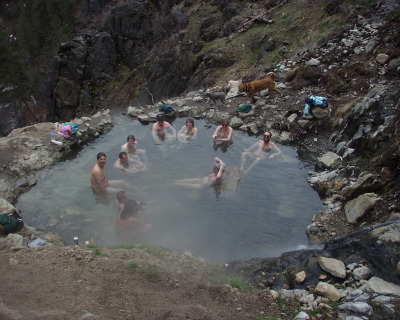
In the ever expanding soaking related blogs concerning Thailand, Southeast Asia and the mainland Asia more has been added.Visits to hot springs in Indonesia (Songgoriti, Cangar, Parang Wedang, Cumbleng/Saptatirta and Thailand (Mae Kasa and Mae Klong).In depth features on now nearly all hot springs in the Himal (added Afghanistan, India's Northeast) Uzbekistan, Kazakhstan and Turkmenistan Guanxi/Guizhou and Mongolia) and north of that.And the addition of a Tumblr photo site, just to celebrate soaking. Called Spirit of Soaking it compiles photo's from all over the world of people enjoying a hot soak as naturally as possible. Just one of today's entries to Spirit of Soaking: Skinnydipper hot springs, Idaho, USA.
Many of Southeast Asia's soaking sites are replicable and certainly not inspiring. Often it's the natural setting that makes them more likeable.
However that may not need to be the case always. An example of thinking out of the box came via this article on Naoshima sento (bathhouse), Miyanoura Japan. Residents in Miyanoura, Japan can now soak in their bathhouse which doubles as a work of art itself. Naoshima bathhouse exterior
Despite some places in Asia where bathing naked is the custom, when entertaining guests from here, not always is this practice commonplace / accepted. Alan Eagle: 'When night falls during the Canadian summer, vacationers often peel off their clothes and jump in the water for a refreshing dip. It's partly to feel naughty, but mostly to feel free of society's burdens, gliding through the water like happy wild animals.
Recently a friend and I visited the beach at Beidaihe, and after a few late night drinks, decided it was time for a skinny dip. We invited some other friends to join in, but there were no takers. In fact, our Chinese friends seemed absolutely scandalized.
This puzzles me. I peeled off my clothes steps from the water, in the dark, where no one had a chance to see me au naturel. I think you could say the act was quite modest.
Especially as the tight Speedos favored by Chinese men leave no detail to the imagination. You can easily take the full measure of a man with a quick glance - something impossible to do with the baggy bathers preferred by Westerners.
(This is in contrast to the modest one-piece swimsuits with attached dresses and built-in falsies favored by Chinese women.)
So I'm not sure by what standard my midnight swim would be calculated as immodest. At any rate, I don't care because I enjoy shocking people'.
Talking about swimming naked, CNNGo has nothing better to do than list'7 sexy skinny dips - Seven spots in Asia where clothing is just a chore'.
China, Sri Lanka, Thailand; all are places where going au naturel is fine. But strangely they are all exclusive resorts where the privacy you might want comes at a gigantic price, the cheapest quote 373 $US, most above $600. Surely the are other secluded places where the same effect can be achieved at no cost at all?MalaysiaA slightly delayed update on Banjaran hot spring, near Ipoh. Since opening it has been getting good feedback and winning awards. Pity though that the price makes it exclusive. Nice for photo opts, not so for soaking ... the Star signs out as follows:
'The Banjaran experience calms your mind, energises your body and gives you a healthy glow, but since it is a plush retreat, expect a dent in your wallet . . . but worth every sen'.
ThailandA new resort in Thailand's upcoming destination of Krabi. Scheduled for a January 2011 opening, Natthawaree is a hot spring resort and spa located at Ban Phueng, south of Krabi town. Forty four rooms (source) and many pools though the website says 77 rooms, so let's just see.
It's located near all other Krabi hot springs, might just be worthwhile visiting there this November ...SingaporeMore info on the history of Singapore's only public hot spring Sembawang. A very thorough article.'People gather around the hot springs. Kawah Domas, Mount Tangkuban Perahu'
 Cumpleng: warm or not?
When is a hot spring hot? A great question with many answers. Terminology varies on this. In Japan hot is above 42C, warm between 34 and 42C, tepid 25-34C and cold lower than 25C. This info is derived from Erfurt-Cooper and Cooper (2009), though they also present another full page of classifications and definitions on terminology from all over the world meaning there is always a possible positive way to describe a spring that’s less than hot.
Wikipedia acknowledges that there is no universally accepted definition. Definitions involve temperatures from as 'above air temperature' to 'above body temperature'.
The need for highlighting this definition is the fact that I visited two springs in the neighbourhood of Tawangmangu, Central Java, Indonesia that were definitely not hot nor very warm. Lukewarm, tepid?
 'Air Hangat Cumbleng Indah'
First visited was a spring in the tiny village of Cumpleng, 5 km southwest of Tawangmangu. A weary signboard (see photo above) has at some time in the past described this as 'Air Hangat' (translates as 'warm water' as opposed to 'air panas' which translates as 'hot water').
This past has meant that around the spring development has sprung up. Development in the form of channels, a fountain, a park, changing rooms and a number of open air shower cubicles. Visits probably dried up last century, though the waters still run out of one of run-down shower cubicles.
These waters are not hot, nor cool. Something inbetween. Taste of the water is neutral.
 What's this? These are the 4 falling down shower cubicles
which are connected with a pipe to the reservoir on the right.'has been managed well'.
It adds: 'Bathing is a source of water containing sulfur, iron, and other substances are efficacious cure skin diseases and rheumatism. A number of facilities located in this area is open and closed bathhouse, playground of children, and toilet'.
Emphasis on closed?
Going downhill with Suharto
We get back in the car and continue down the mountain along a small but well maintained road, through small villages, through plantations and along rice paddies. Then we pass a forested mount which house’s the last remains of Indonesia’s former president Suharto as well as those of the former rulers of the regency of Solo. Suharto's family having connections with the Solo regents, they share the same graveyard, Astana Giribangun, a magnet for pilgrims who wish to share Suharto's luck.
Not far beyond Astana Giribangun is another attraction near the village of Pablengan. A roadside compound hides the tourist attraction of Sapta Tirta, the seven waters.
Payment (3,000 INR’s, about 0,25$US) is accepted for entry and off we trudge to discover the seven waters, one of which may well prove to be a hot spring. There’s a soda spring, a spring whose level never ever changes, a spring with elixir, a spring which water assists constipation, a salt water spring, all within a few meters of each other. The small hot spring (also described as Air Hangat) is located in a small walled-in cement box. Getting to the water can only be undertaken one by one, but a pilgrim is already bathing and hands us the mandi for us to feel the temperature. It’s not so warm, nor cold.
 Not worth the wait?
On the same compound are two shower cubicles but that water is not hot either. Oh well, nothing earned, nothing lost.Sapta Tirta is well publicized on internet. Especially this blog entry by Annyong Haseyo gives a complete overview of the seven waters. The seven waters described (in Bahasa)
Cumpleng is also best accessed from the same Solo to Tawangmangu road, not too far before Tawangmangu on the south. Ask. It’s another 3 kms or so downhill before Cumpleng proper.
Soaking experience: can one soak in not hot water?
Overall impression: Only for die-hard geothermalists or others near to dying from boredom.
Notes:
[1] Erfurt-Cooper, P. & M. Cooper (2009) Health and Wellness Tourism. Spa and Hot Springs. Aspects of Tourism: 40. Channel View Publications, Bristol, United Kingdom.
A feature article in Phnom Penh Post's September 11/12, 2010 weekend supplement, 7D, highlights Tei Teuk Pous, Cambodia's only known hot water spring. Since my visit (two and a half years ago) nothing seems to have changed. Better background info, though the bottom line is that it still not really worth a visit ...  The article (poorly scanned) but readible. Just open in new tab.
 What now?
As with Songgoriti hot spring, Cangar hot spring can most easily be accessed from Batu city (East Java, above Malang). However public transport fails to make it this far up the mountain. From Batu one takes a minibus as high up the mountain as possible but at least in the direction of Sumber Brantas, which lies beyond Selecta. At the end point don’t walk. It’s still a long way up (and down).
Hiring an ojek (motorcycle with driver) seems to be the best option to continue. From here one continues up the mountain, passing apple orchards and potato fields. Eventually one passes the mountain pass and the road descends steeply.
Cangar
At the bottom of this descent are a number of competing parking areas all providing access to the hot springs. Entry is 3,000 INR (~2,75$US). From the ticket office (photo above), a trail heads down and across a small stream. Beyond the bridge are the hot spring(s?) themselves. Amenities consist of toilets and changing cubicles, 2 each for either gender.
Unfortunately one needs a long wait to be able to use these at best makeshift changing rooms, which at 1,000 INR are still not worth it.
The hot springs themselves consist of two large kidney shaped, half meter deep basins which on this Saturday (July 2010) are lined with soakers. Otherwise there is another larger cooler pool and an area where women can bathe, though this is half open to observation so why these separate facilities are required is beyond me.
The direct vicinity of the pools are far from clean, all kinds of refuse are just disbursed of with little regard to the entire situation. Most bathers are fully clothed, even males, another of this odd situations, what would men have under their singlets / shirts that need covering?

Positively, most women lay off their headscarves for the soak (see photo above), which begs the question why wear them in the first place?
Obviously I am the only foreigner and the only person with swimmers on. Though the waters are sufficiently hot, I have my doubts about the hygiene. As is common throughout Java (and Indonesia?) smoking seems to be a habit difficult to shake: many soakers while soaking are still smoking! Smoking hot?Sharing opinions
It's not only my own opinion. Take this blogger for instance: 'Hey, you know what my first impression of Cangar was? DIRTY!! ... No need to change into swim suit, just wear our clothes (everyone do that, why shouldn't us), and enjoy the spring'.
The former answering partially my aforementioned queries (not).The area around Batu is well-known for it's mild climate and this is already a major draw for the many tourists who visit Batu during the weekend.
Nearby Cangar are caves used by the Japanese during their occupation of the Indonesia isles. The entry on Cangar by eastjava.com describes slightly more details of these caves. Little info on the history of the hot spring itself.
On the way up from Batu, one can also visit the Selecta pool (an open air pool built by the Dutch and fed by spring water) and the Coban Talun waterfall.Getting there: From Batu head for Selecta (north) and continue up the road and over the mountain pass. It’s at the end of the steep descent. In total it should be slightly over 20 km from Batu depending on where you start.
Soaking experience: That’s a difficult one. The pools are great, flagstone lined with a gravel bed. Water temperature is good. But my fellow soakers could do with a tip or on hygiene …Overall impression: Despite the misgivings of the soak itself and the lack of changing facilities, the air is crisp and cool meaning a hot soak is just what’s needed. The direct surroundings are also heavily wooded and management of the site is evident (though lacking).
Copyright 2009 © Soaking in Southeast Asia. All rights reserved.
No reproduction or republication without written permission.

 Welcome
 Cemented. Thnx to 'GRANT ASSISTANCE OF THE MR JOHN 2000 BATH'.
 View from the spring; returning home.
 The smaller of the small hot spring. The black hole is 20 cm across.

 Author and wife at Baw Noi.