Wednesday, 5 August 2009

Huh?

Follow the signboards
Saw a sign along the road in Namtok town, Kanchanaburi province. It indicated a left turn to go to Wang Krachae hot spring. It was only 4 kms which was fine, couldn't be too much of search.

It turns out Wang Krachae was also the name of the sub-district. Went past the sub-district office, completed the 4 km, only to find another sign, slightly different to the first one which was placed along the 323 highway, headed for Burma. A right turn this time was required to get to 'Wangkrajae hot spring'. Distance was 3 km. Fine again, getting closer.

The road then slowly deteriorated as well as it got steeper and nearer to the mountainside. Finally the hot spring! But it was eerily silent.
A large car park area was obvious. There were also some small sturdy buildings and the contours of a pool. But much was overgrown.

Where's the hot water?
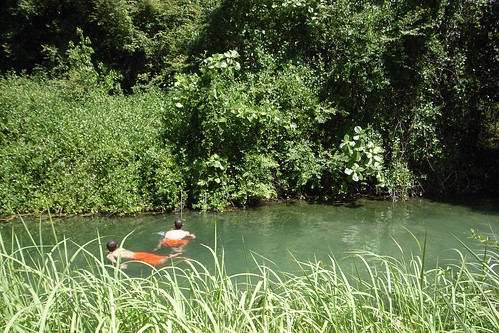
Getting out of the car disturbed a sunning rat snake; the only sign of life. It slithered away in the direction of two pools. Delicately I went up to the two pools. The greenish water in both of the pools was cool. The two buildings were open and revealed facilities (toilets), both of which could be described to be in a reasonable state of affairs. Looking further around revealed a temple-like structure, in disrepair.

Wang Krachae's not so hot spring: beware of snakes!

Then finally a smaller roofed structure proved to be the hot spring. The source was clear and was hot. However no outlet, so where does the water go? For sure not to the pools. There was also no one around to ask. Will it remain a mystery?

Looks like it, internet is of no help. Only one site, by a Japanese soaker has been able to put a slight mention of Wang Krachae hot spring up on the internet. However translated it reveals less than I discovered:
'Without I find a signboard called "WANGKRACHAEHOTSPRING" along terminal / Nam Toku Station outskirts of the train, R323 on the way and I listen considerably and turned around, but I am good, and understanding it'.
????

Provincial soaks
Prior to heading off for Kanchanaburi, I'd looked into more detail concerning the hot spring sites of the province.

The previously posted Rock Valley I failed to find out about on forehand. Hindad (next blog post) though, is very well-known and a highlight of Kanchanaburi province, so it seems. Others I obtained from a Thai language hot springs list (starts at KC 01 and continues on next page) These are: Toong Chang, Pong Rong (twice (!), but in different locations, one in Sai Yok district, the other in Nong Prue; Pong Rong translates as hot water), Kao Pang (or Khao Pang, otherwise known as Sai Yok Noi waterfall) and Don Lamyai.

Then there are two apparently in Sri Nagarindra in National Park:
'Huai Mae Kamin: there are 2 hot springs, suitable for bathing'.
I've tried to put up links to these two, but Thailands Department of National Parks website somehow fails to be linked deeply. Find your own way around our site, it seems to imply. Which is a great loss to them. Fancy putting all that information on internet and making it near impossible to find, nor to link to! Oh well, I suppose they have their reasons. Unseen Thailand indeed!

The source itself revealed: a roof, four walls, hot water inside and a fence structure.
But what happened? And where does the water go?

But none of these sources revealed Wang Krachae hot spring. Obviously it had seen better times and not so long ago either. But what had changed lately? Does anyone have some answer?

Monday, 3 August 2009

Updates for July 2009

I'll not bore too many of you, out there. As you can see there are a couple of original postings added / being added to the blog from a recent sojourn near Kanchanaburi, to the west of Thailand's capital of Bangkok.
Again I'm astounded that there are more hot springs than thought but despite the Thailand promoting it's 'unseen' side, there's too often difficulties in accessing these unseen places, while simultaneously there are places with loads of signboards which turn out to be decrepit sites, long beyond use.

From the press there is not too much going on. China, not being in Southeast Asia, does though provide some original news:

First of all there's the case of a fish spa, with ferocious fish. Though still to catch on elsewhere (and not always deemed safe, see blog entry 'Updates for May 09'), fish which tend to eat dead skin off soakers and as such, add an extra spa treatment. These fish succeeded in biting where you would not believe them to be:
'The man, .... sat in the water for half an hour without realizing the special fish were nibbling on his special parts instead of the dead skin. The manager of the club saw the man bleeding as he stepped out of the water and rushed him to a nearby hospital'.
The China Daily article (9 July 2009) does not mention what exactly was the damage. He was refused financial compensation as the manager mentioned that
'it was mandatory to keep pants on during treatments in the club'.
Some questions remain. If the fish are supposed to devour dead skin, what on earth were they doing there? If it was mandatory to have bathers on, why was the soaker naked?

The naked issue brings me to the next piece of press. Singapore's Strait Times (23 July 2009) mentions how soaking naked is a hot topic in China:
'Hangzhou - A naturist swimming resort to be open Saturday has ignited heated discussion in China where public nudity is still taboo'.
It appears that a hot sporing site was wanting to create two different pools, one for the ladies, one for gents and that bathing au naturel would be de-rigeur.
'Naturism has its root in western culture as Europeans were eager for self-expression after the Renaissance, which has little to do with the Chinese culture, said a column in Qilu Evening News in the eastern Shandong Province.'A naked pool is totally unacceptable in Chinese tradition and social customs. China need not to be in line with international practice in this regard,' the column concluded'.
Well, the Strait Times simply agrees by the looks. But is it the case? Surely in times bygone bathing naked in China was common (see link, scroll to Huaquing hot spring). In last months updates, there was precise the issue of soaking half-naked in China, which outside the developed eastern part seems still to take place. Even in the east, China does not seem so closed as it's rulers would like: '
'The naturist pools also have supporters. A survey by Zhejiang Online, a major portal Web site of Zhejiang province, showed that more than 40 per cent of the netizens said 'yes' to the naturist resort while 30 per cent regarded it unseemly and immoral'.
So 40% yes, 30% unsure, 30% against. Well, those against would need not to visit, so marketing wise it's should be ok, socially it seems ok, but ... those in say have other ideas, sadly.

And then there's giving the west the fault, surely Japan's bathing culture can't be categorized as western?

According to the
Shanghai Daily (27 July 2009):
'A naturist swimming resort in Zhejiang Province was told its patrons must wear swimsuits the night before it opened as the authority described its business as "indecent."'
Bummer. It shows just how much Asian rulers are behind in times, a point which I have raised on other occasions when it comes to skinny dipping in Southeast Asia.
A 23 July 2009
article from the same Strait Times, but describing an author's onsen experience:
'In contrast, I and two other girls from Singapore tittered nervously before eventually dropping our robes. Thankfully, no one stared and we quickly grew comfortable walking around in a crowd of women. After a while, we even ventured outdoors to try the outdoor hot spring or rotemburo. Here, water gurgled down a tiny waterfall and into smoking pools under the sky and trees. Lying lazily in the hot water with the cold night air buffeting my upturned face and the sounds of rustling leaves and soft laughter, I could not remember why I had ever felt awkward. We emerged rosy, glowing and wonderfully relaxed'.
Back home in Singapore, this would be an obscenity even if done in one's own house! In the coming updates I'll illustrate that simple nakedness and soaking need not be immoral.
More on this article from China from Asianaturist and Cat's Chat.


More though, there actually already is a bathing area in China which allows nudity:
'A nudist bathhouse at a resort in Hongya, Sichuan Province, reopened Saturday, six years after closing due to pressure from local campaigners, the Sichuan Daily reported Sunday. The facility is at the Yuping Mountain Scenic Area and provides separate bathing for men and women. Security guards patrol the area and the taking of photographs is forbidden, Li Jun, manager of the resort, said.
...
“In foreign countries nudist bathhouses are usually opened by groups of like-minded people, but in China they always have a commercial purpose and attract a lot of pubic attention,” he said.
Apparently it was shut down after a year ... Actually it's unclear either way ... Anyway it concerns waterfalls, not a hot spring! In the Yuping Mountains ...

Blogging then:
I've weeded through all the searches and hardly found anything, but some photo's.

Philippines
Lisa Felipe from the Philippines enjoying a naked ('really') hot tub on Bohol(?).
  • Some beautiful pictures from Mainit hot spring made by hradcranska.
  • Coron, a picture of non-naked immorality?

Indonesia

From Dylulena's flickr account the photo was taken last month:
'Indonesia, North Sulawesi, not too far from Tondano lake. I arrived there with the afternoon light .. Couldn't start shooting before my soul were fulfilled. There's a natural hot springs pond as green as the rice fields around it, naturally divided for men and women... Villagers keep coming there regularly just for the afternoon bath.. The view was unforgettable and will be always on my mind'.
  • More info available on Suban hot spring (South Sumatra) here, looks good.
Thailand
  • Suan Mokkh, Chaiya: not for men, not for women, but for monks. Photo by witpim.

Sorry, nothing from Malaysia ...

Saturday, 1 August 2009

Dr Fish?

Jaws VI?

Kanchanaburi
Out west from Thailand's capital city, Kanachanaburi province is famous for it's waterfalls and it's history, though it's role in the Second World War is one of notoriety as indentured labour by locals and foreign captives were used to construct a railroad to Burma under 'hellish' circumstances.

Less well-known is that Kanachananburi hosts 5 hot springs. There's Hindad, the most famous and another 4 of which I failed to gather much information, despite them being listed. Not on the list is Rock Valley, it's yet to have a Thai name. I'm unsure whether 'Rock Valley' hot springs counts as a hot spring though (see below).

But seeing it prominently sign-posted, the car swerved off the road and uopthe valley in search of this not so Thai-named hot springs.


Rocky Valley
It quickly became apparent that the owners had gone out of their way to attract customers. Despite it being about 10 km off the main highway, at every twist and turn, small signs, some more clearer marked than others, showed the way. In the end it was a well-travelled 1 km dirt road, which to lead to the site.

Perched on the Kwai Noi River, most visitors come from upstream resorts by boat. As the day was drawing to a near, the reception provided an ad-hoc service, explaining that it would be 1 hour before the site would close and it would cost 500 Bt (~$US 15). That sounded steep, but a quick tour showed prime pools simply waiting for a late customer.


There were a number of pools laid out along each other, using local rocks with some cement walls and floors. Here was defintly an enhanced resort! Plants had been added, a high screen to protect the bathers from the sun and all with a view of the river.

The soak
So 500 Bt poorer, I was proivided with a towel and a locker key and a pair of local style bathing pants. The changing facilities were extensive and certainly encouraged a cleansing shower before the soak. After hitching the pants up and making sure that they stayed there, it was time to test the waters. I had been forewarned not to try the hottest option, but a more cooler variant. This was a 36-38C pool which was large with a number of coves. These could be used if you might have problems with the throngs of fellow soakers, but there were none. In two corners of these coves, showers and waterfalls had been created.

Dr Fish pool, for real.

The hotter pool was 40-42C and was hot without being too hot. Again the pool was very tastefully landscaped. Next up was the 'Dr Fish' pool: a foot deep pool packed with small tilapia. These fish went into a feeding frenzy once my feet stood still long enough. But the ensuing laughs didn't help to keep my feet still; eventually my feet must have become less tatstier or I got immune to the feeling of hundreds of nibling fish jaws.

After this hilarious soak, a hottish herbal bath followed, not-so natural any more. Herbs enhacing the qualitiy of the water are tumeric, kaffir lime, casumunar, lemon grass, tamarind, Acacia, pandusus, rose and ilang-ilang. And then a final dip in the cool pool with view of the river. That was about all avaialable in the alloted one hour.

Background
Officially called Rock Valley Hot Spring and Fish Spa, it's part of the River Kwai Village Hotel, located on the other side but still a few km's up stream. The hotel boasts being the first up-river jungle style resort in Kanchanaburi province but by now there are many more, both shores dotted with various types of resorts.

The hot spring has it's own web-site, which gives a good introduction, but fails to give correct indications of location, while also the price is not mentioned. Another hotel web site already mentioned that the price was 450 Bt, which seems a bit unfair then to charge the independent tourist a surcharge just for the sake of it.

However the web-site (and other information made available) does prominently promote itself; mention is even made of the spa in a Bangkok Post article ( March 1, 2009) Info obtained also indicates what standards the waters adhere to, independently verifierd by the Thai Department of ScienceService, IQA Laboratory company which states
that the waters are safe and can be used for soaking.
What's more, the need to used sanctioned soakwear means that efforts are in place to at least keep the water from being contaminated, no fully dressed nor are swimmers allowed, only what they provide, a unicum in Thailand I believe.


It is unclear though, whether these are waters obtained are from natural springs. There are no sulphorous smells and the spa itself mentions that the waters are obtained from 20-30m down, where it has a temperature of 58-60 degrees.

The info obtained reveals that the scaly nibblers are "Tilapia gangsters', which
nibble deteriorating skin cells or exfoliate skin, thus stimulating better blood circulation.
Oddly though there is little to none other info outside of Thai websites and You Tube vid's.


Getting There: Rock Valley is located up the main 323 highway from Kanchanaburi town to the Burmese border. Just beyond the turn-off for Sai-Yok district a clear sign will tell you when to turn left. It takes a right and a left turn before crossing the Kwai Noi river. On the other side, you turn right and follow the river upstream for 9 km's when you cross a small stream and make a sharp turn to your left. The entrance road is 500m up from here on your right. The spa is a km down this good track.

Soaking Experience: It's a great soak, well adapted to regular users, though supposedly the well-heeled ones. Pity is that there is no big bassin, nor more private facilities; however the different bassins provide for a good and varied experience. There's also a drinking and eating facility. And it's also possible to take a massage. Friendly and helpful staff.

Overall Impression: Best soaking spa in Thailand? Could be: the pools are in nice settings, have been naturally enhanced. There is variation in the number of pools and what they are intended for. Beautiful setting.

One of the coves of the not-so-hot pool, with a 'shower'.

Thursday, 2 July 2009

Updates for June 2009

Once more an update on developments on hot springs in Southeast-Asia, to start with news.

From
Asialife guide Phnom Penh, June 2009 issue. A trip to Lao provided with the following description of hot springs:
'Two hot springs lie close to Phonsavanh. The larger one is the village of Hom, some 50 kilometres out of town. The springs themselves (open 7am to 5pm, 10,000 kip), consist of a large, fenced off sulphurous mud-pond and a few concrete bath houses. Of little appeal in themselves, the setting is quite idyllic. Apparently the bungalows are popular with locals at the weekend.

Of far greater appeal are the smaller springs near the village of Sam (open 7am to 5pm, 5,000 kip). Set on the Tay River, the flow from the springs mingles with the natural current of the river, providing hot and cold running water al fresco. Watch locals come to wash their clothes, while soothing your aching bones. The only problem with this place is that the last half a kilometre is on a bumpy track that, according to our guide, can become inaccessible in the rainy season'.
Complete with picture.

The only other newsworthy fact I could come across was that of Philippines and Korean
econmic cooperation:
'In Taal, another Korean group tried—almost succeeded—in putting up a hot-spring spa right at the foot of the active Taal Volcano. The group bribed its way to get official permission to build. Construction of the facility was nearly finished when the people of Taal woke up to what the group was doing, and protested. The national government, invoking the project’s lack of an environmental compliance certificate, stopped it dead on its tracks'.
Not all that positive picture of Korean investment.

Spa culture.
This web page explains the origins of the word jacuzzi and it's relations to hot tubs, spa and soaking in general.

Another
list, this time of popular spa towns on this planet. Surprisingly none in Southeast Asia. Many from the States and Japan. How Australia makes the mark (and Rotorua doesn't) seems an entirely different mystery.

More lists,
iconic geothermal hot spring designs of the world. No idea why they made this list.

Crazy things (or not?):
'Imported from Japan, each NIHON NO MEITO Hot Springs bath salt variety recreates the experience of a famous hot spring in Japan. They are full of minerals, and will improve your sense of well being, not smother you in bubbles!'
Soakersforum.com adds more hot springs on the big screen, the list is upto nine. More art:
'Bathing is something of an art in Japan, and not to be confused with mere cleansing. There are rules of etiquette, which you gradually learn from copying others'.
This is from a Thai newspaper, the Nation, from a couple of years ago. How do you spot the Thai in a Japanese onsen?
'Women place small towels on their head, not over their genitals, when they walk to the pool, though I found myself dangling the towel strategically just the same'.
FahThai, Bangkok Airways in-flight magazine (July 2009 issue) adds:
'To newbies it might seem that one wrongly placed towel is all it takes to be a bull in a hot and steamy china shop. ... Do not wear a bathing suit; this implies that the areas under the suit have been left unwashed. '.

From blogs:

Lao
  • From crazyguyonabike.com: Bor Nam Ou, near Kasi. The site mentions:
    'This could be their unofficial web page'.
    It then goes on with descriptions of many a visitor. Funny, I must have past this location at least 6-10 times without noticing it was there. The reviews are not fabulous, but good none the less.
Indonesia
  • Sari Alter. Another insight in to differing dress culture:
    'Jennifer was the only girl in a bathing suit and Ivan was the only guy not wearing a shirt'.
  • A guide to Belulang hot spring on Bali. Click on the photo, which leads to more photo's.
Philippines
  • A photo report on Mambukal and typed out by nomad4ever.
  • Pasyahan? It's definitely in the Philippines, but where? Near Asin?
Malaysia
  • More on the Ana Rais hot spring, including a couple of photo's and map.
  • Sungai Klah. Nurul Aqilah gives an overview of a visit. What is a foot reflexogy walk?
    'Here, hot water flows over the reflexology stone pebbles. Walking over the pebbles was a strange sensation as you not only feel the pain, you also feel warm at your feet. Nevertheless, we quite enjoy the walk over the pebbles'.
    Alifebe adds more photo's, especially on how to cook an egg.
  • Poring hot spring, more photo's, no comments included. More commentary is Danielctw.
    'Well, being in the hot spring, unlike the hot spring I had in Sungai Klah, this one is a bit too modern to my liking. Imagine getting hot water from taps. Rather this place in Sabah is more like a bath tub where you can turn the tap and hot water flows out. Kinda spoil the fun for me though'.
Thailand
  • Mostly photo's from Bentong hot spring in South Thailand.

Sunday, 31 May 2009

Cliff hanger

Cliff hanger? Of the many issues concerned with soaking in general, clothing or the lack of this seems to be an ever returning issue. And a divider between the communities who adhere to the principle the less the better (purists?), whereas others see bathing as an obscenity and if public bathing is essential (for health reasons) then preferably fully clothed (the prudists).

'A group of Mosuo women and tourists bathing in the famous hot springs of Yongning, Yunnan province, China. August 2007'.
Pure?


What brought me to this subject was a photo in the April issue of the international National Geographic magazine. Due to copyright and so forth I can't post the photo nor give the exact location but only the link to the photo slide show. About half way through you'll come across the photo. It's caption is
'Lisu women bathe in thermal pools to celebrate the coming of spring. A proposed dam would drown this site, one of the valley's few remaining public baths. Developers have turned other springs into tourist resorts'.
This caption and photo sums up all what's wrong with soaks in Southeast Asia. (even though it's China, but Yunnan is a bit inbetween the two!) The soaks are disappearing or are being sold out, often to get rich quick schemes. The caption also seems unrelated, all the persons doing here is having a bath, but by the looks of this you could say it's a celebration of sorts.

But aside of this there was a response on racialicious.com to this photo and is as follows:
'there was an article about a town in Western China that’s dubbed itself Shangri-La, there was a picture of topless women bathing in a hot spring spa. It was, as is almost always the case with NG, [National Geographic] a nicely framed photo, but I immediately questioned whether they would have shown a picture like that of a group of women in say, Iceland, or Wyoming. I think not. To me, it was a glaring double-standard and strong evidence of othering. Naked “other” breasts in NG are practically a cliche'.
Double standards (besides being racist one could also state that it is sexist) or not the photo itself does raise some issues concerning bathing rituals, worldwide and in Southeast Asia. Here at Soaking in Southeast Asia, we've waded into this debate briefly; on a few occasions just getting our toes wet so to say:
  • March 29, 2009 (Thai comment on Japanese onsen customs):
    'One inhibition for most Thai and even some Westerners, is the going naked part. But once you overcome it, the rest is easy and enjoyable. Keep in mind that you can use a little tower to cover your private part when out of the water. Sure enough the Japanese themselves do so too’.
  • February 28, 2009 (on Nepal and Rules of Chinese traditional hot spring bathes - Taiwan):
    'most bathed in their underwear'
    and
    ''Requiring every person to soak only in their birthday suits seems to be a sanitary issue".
  • January 14, 2009 (Japan):
    'In fact, I found I really enjoyed talking with the other bathers--maybe I too could get hooked on mixed bathing'.
    and
    'Are there any hot springs in Southeast Asia where bathing au-naturel and co-ed is practiced? No? Well, who know's there might be business opportunity here ....'
  • January 11, 2009:
  • 'Issues I often come across when debating hygiene standards of various hot springs sites in Southeast Asia, are those of various standards of dress. In my belief (which seems logic) the more clothing worn during bathing, the more unhygienic. So au-naturel bathing should be encouraged. But not in conservative Southeast Asia; both Buddhists as well as Muslim frown on any state of undress. Though Hindu Bali seems more relaxed on this issue, those in charge still feel compelled to signpost that bathers are being strictly forbidden to take to the waters starkers. Thus many are actually fully clad. ... I for one certainly understand it's not everybodies cup of tea (bathing au-naturel) but a certain degree of tolerance is all that's needed. It's sad to see age old traditions of tolerance of body and body acceptance eroded by narrow minded politicians clamoring for the moral high ground'.
  • November 6, 2007 (concerns soaking in Thailand):
    'Last year, I visited New Zealand and on 1 occasion rented such a 'cell'. Though it looked like a good idea at the moment, we hardly used it. Yes, you can pursue your own dress code, but you exclude yourself from the surroundings: is it rainy, sunny, windy, are birds whistling, is the vegetation green, who are my neighbours, what's my son up to? No way of knowing. I personally would like to soak 'au naturel' whenever, where ever, but somehow world societal norms are set against this. Beats me why?'
Nudity sells. The global community seems to be obsessed with this, a case in point are the photo's I put up on my flickr site; even a hint of skin results in much higher number of views. Most photo's count are anywhere between 0 and 20 views. But somehow this poorly taken photo rakes in more than 1500 views. Or this one on my waterfall photo's site which raked up more than 500. Or 200 plus for this? Or 200 for this. Before the month is done, these may well have doubled, just due to this posting!

Simply captioned 'Ardent Hot spring': the bare neccesities of soaking in Southeast Asia?

But back on subject. The not so established public hot bathing rituals of Southeast Asia require without exception a minimum of a bathers, though the more, the better it seems. Bali might be an exception but even there there are signs at hot springs asking all to wear bathing gear. In English and Bahasa, the former somehow implying that soaking clothed is not customary.

Not always to be avoided:
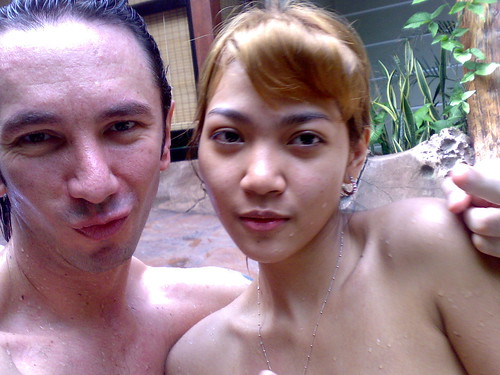
'Jessy and Me at Sunkei in Malaysia...staying at luxury villa ..Hot Springs....Peaceful...Quiet....
SUCH A gREAT tIME IN the outdoor private Jacuzzi....nice ya...'
In bigger soak sites especially in Thailand and Malaysia, on offer are a couple of cubicles which might imply that yes, we understand that bathers are not for all, so if you insist, go ahead use these cubicles. However it seems that they might mean the opposite. Shy, not to worry, you can lock the door. But au-naturel en public? Non!

In Singapore it's even a crime, as it's
considered obscene!
'The pair of undergraduates who sauntered through Holland Village in the buff in January have paid for their prank. They were fined $2,000 each on Thursday, the maximum fine for an obscene act'.
However Asian culture differs, not only in Bali. The prior mentioned sign shows that just outside Southeast Asia's borders standards differ. And a little farther afield in Japan standards are completely the opposite much to the chargrijn of US visitors!
On the other side Japanese nudity is so common, it's strange to them that tourists make their way to Japan just for the opportunity to enjoy the soaks as the locals do:
'Yoshio Ono, president of Osenkaku, which manages Takaragawa Onsen, explains that there had been many foreign customers from before, such as Philippe Troussier, former coach to the Japanese national soccer team. “However, the number of foreign customers has increased from late last year, and there are weekdays when over 70% of our guests are from overseas. They’re well-mannered too,” he says'.
Though some local visitors are dumbstruck:
'“This is about the only place where you can have a close encounter with naked blond-haired women. It appears that the hair on the head may be blond but the color below could be different.”
Here's a report from a naturist in Japan, but most blogs on onsen's just simply ignore the nudity issue: it's a non-issue!

Part of the taking the moral high ground within Asia is due to development. The further away from development, the less the likelihood that mores suggest a certain dress code.

In historical tense bathing more or less au-naturel was the way to go. But as stated elsewhere in this blog, affluency meant the need to distinguish oneselves, what better that to show off wearing expensive clothes?

But possibly times are a-changing. For instance, the emphasis of the spa industry on naturalness might imply bathing au-naturel to be trendy. It could catch on! The above example from Japan clearly shows that there's a market for soaking purists. And other examples from the region seem to imply that being uptight is only for the rich and possibly powerful. What better way to express power than to order everyone around. Me? Just give me an option, is that to much to ask for?

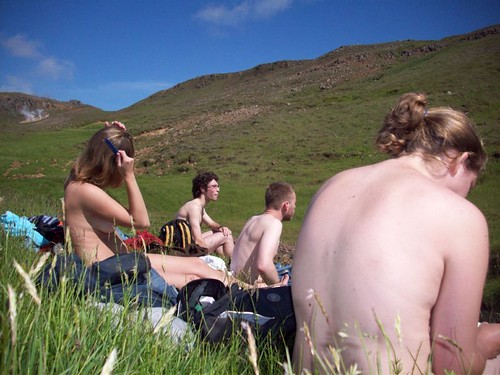
Photo caption:
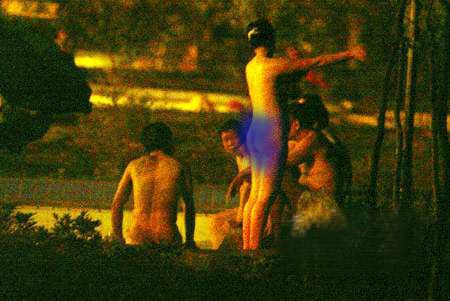
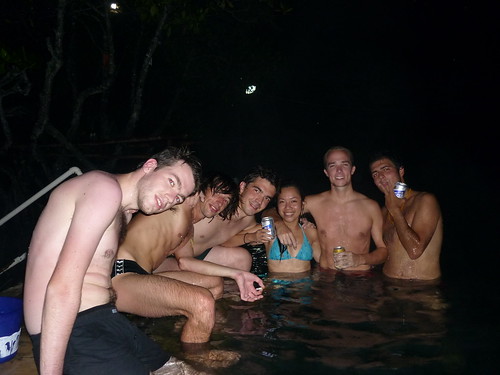
'after bathing in the hot river [in Iceland]. we tried re-enacting the cover of the new sigur ros album, but there wasn't any road with a guard rail to jump over. i met this people just a few hours before, but if you can jump into a river naked with them, why not? (never mind the amused/embarrassed looks of passers-by)'.
Is this just pure natural fun?
]


Related Posts with Thumbnails
Copyright 2009 © Soaking in Southeast Asia. All rights reserved.
No reproduction or republication without written permission.