In the ever expanding soaking related blogs concerning Thailand, Southeast Asia and the mainland Asia more has been added.Visits to hot springs in Indonesia (Songgoriti, Cangar, Parang Wedang, Cumbleng/Saptatirta and Thailand (Mae Kasa and Mae Klong).In depth features on now nearly all hot springs in the Himal (added Afghanistan, India's Northeast) Uzbekistan, Kazakhstan and Turkmenistan Guanxi/Guizhou and Mongolia) and north of that.And the addition of a Tumblr photo site, just to celebrate soaking. Called Spirit of Soaking it compiles photo's from all over the world of people enjoying a hot soak as naturally as possible. Just one of today's entries to Spirit of Soaking: Skinnydipper hot springs, Idaho, USA.
Many of Southeast Asia's soaking sites are replicable and certainly not inspiring. Often it's the natural setting that makes them more likeable.
However that may not need to be the case always. An example of thinking out of the box came via this article on Naoshima sento (bathhouse), Miyanoura Japan. Residents in Miyanoura, Japan can now soak in their bathhouse which doubles as a work of art itself. Naoshima bathhouse exterior
Despite some places in Asia where bathing naked is the custom, when entertaining guests from here, not always is this practice commonplace / accepted. Alan Eagle: 'When night falls during the Canadian summer, vacationers often peel off their clothes and jump in the water for a refreshing dip. It's partly to feel naughty, but mostly to feel free of society's burdens, gliding through the water like happy wild animals.
Recently a friend and I visited the beach at Beidaihe, and after a few late night drinks, decided it was time for a skinny dip. We invited some other friends to join in, but there were no takers. In fact, our Chinese friends seemed absolutely scandalized.
This puzzles me. I peeled off my clothes steps from the water, in the dark, where no one had a chance to see me au naturel. I think you could say the act was quite modest.
Especially as the tight Speedos favored by Chinese men leave no detail to the imagination. You can easily take the full measure of a man with a quick glance - something impossible to do with the baggy bathers preferred by Westerners.
(This is in contrast to the modest one-piece swimsuits with attached dresses and built-in falsies favored by Chinese women.)
So I'm not sure by what standard my midnight swim would be calculated as immodest. At any rate, I don't care because I enjoy shocking people'.
Talking about swimming naked, CNNGo has nothing better to do than list'7 sexy skinny dips - Seven spots in Asia where clothing is just a chore'.
China, Sri Lanka, Thailand; all are places where going au naturel is fine. But strangely they are all exclusive resorts where the privacy you might want comes at a gigantic price, the cheapest quote 373 $US, most above $600. Surely the are other secluded places where the same effect can be achieved at no cost at all?MalaysiaA slightly delayed update on Banjaran hot spring, near Ipoh. Since opening it has been getting good feedback and winning awards. Pity though that the price makes it exclusive. Nice for photo opts, not so for soaking ... the Star signs out as follows:
'The Banjaran experience calms your mind, energises your body and gives you a healthy glow, but since it is a plush retreat, expect a dent in your wallet . . . but worth every sen'.
ThailandA new resort in Thailand's upcoming destination of Krabi. Scheduled for a January 2011 opening, Natthawaree is a hot spring resort and spa located at Ban Phueng, south of Krabi town. Forty four rooms (source) and many pools though the website says 77 rooms, so let's just see.
It's located near all other Krabi hot springs, might just be worthwhile visiting there this November ...SingaporeMore info on the history of Singapore's only public hot spring Sembawang. A very thorough article.'People gather around the hot springs. Kawah Domas, Mount Tangkuban Perahu'
 Cumpleng: warm or not?
When is a hot spring hot? A great question with many answers. Terminology varies on this. In Japan hot is above 42C, warm between 34 and 42C, tepid 25-34C and cold lower than 25C. This info is derived from Erfurt-Cooper and Cooper (2009), though they also present another full page of classifications and definitions on terminology from all over the world meaning there is always a possible positive way to describe a spring that’s less than hot.
Wikipedia acknowledges that there is no universally accepted definition. Definitions involve temperatures from as 'above air temperature' to 'above body temperature'.
The need for highlighting this definition is the fact that I visited two springs in the neighbourhood of Tawangmangu, Central Java, Indonesia that were definitely not hot nor very warm. Lukewarm, tepid?
 'Air Hangat Cumbleng Indah'
First visited was a spring in the tiny village of Cumpleng, 5 km southwest of Tawangmangu. A weary signboard (see photo above) has at some time in the past described this as 'Air Hangat' (translates as 'warm water' as opposed to 'air panas' which translates as 'hot water').
This past has meant that around the spring development has sprung up. Development in the form of channels, a fountain, a park, changing rooms and a number of open air shower cubicles. Visits probably dried up last century, though the waters still run out of one of run-down shower cubicles.
These waters are not hot, nor cool. Something inbetween. Taste of the water is neutral.
 What's this? These are the 4 falling down shower cubicles
which are connected with a pipe to the reservoir on the right.'has been managed well'.
It adds: 'Bathing is a source of water containing sulfur, iron, and other substances are efficacious cure skin diseases and rheumatism. A number of facilities located in this area is open and closed bathhouse, playground of children, and toilet'.
Emphasis on closed?
Going downhill with Suharto
We get back in the car and continue down the mountain along a small but well maintained road, through small villages, through plantations and along rice paddies. Then we pass a forested mount which house’s the last remains of Indonesia’s former president Suharto as well as those of the former rulers of the regency of Solo. Suharto's family having connections with the Solo regents, they share the same graveyard, Astana Giribangun, a magnet for pilgrims who wish to share Suharto's luck.
Not far beyond Astana Giribangun is another attraction near the village of Pablengan. A roadside compound hides the tourist attraction of Sapta Tirta, the seven waters.
Payment (3,000 INR’s, about 0,25$US) is accepted for entry and off we trudge to discover the seven waters, one of which may well prove to be a hot spring. There’s a soda spring, a spring whose level never ever changes, a spring with elixir, a spring which water assists constipation, a salt water spring, all within a few meters of each other. The small hot spring (also described as Air Hangat) is located in a small walled-in cement box. Getting to the water can only be undertaken one by one, but a pilgrim is already bathing and hands us the mandi for us to feel the temperature. It’s not so warm, nor cold.
 Not worth the wait?
On the same compound are two shower cubicles but that water is not hot either. Oh well, nothing earned, nothing lost.Sapta Tirta is well publicized on internet. Especially this blog entry by Annyong Haseyo gives a complete overview of the seven waters. The seven waters described (in Bahasa)
Cumpleng is also best accessed from the same Solo to Tawangmangu road, not too far before Tawangmangu on the south. Ask. It’s another 3 kms or so downhill before Cumpleng proper.
Soaking experience: can one soak in not hot water?
Overall impression: Only for die-hard geothermalists or others near to dying from boredom.
Notes:
[1] Erfurt-Cooper, P. & M. Cooper (2009) Health and Wellness Tourism. Spa and Hot Springs. Aspects of Tourism: 40. Channel View Publications, Bristol, United Kingdom.
A feature article in Phnom Penh Post's September 11/12, 2010 weekend supplement, 7D, highlights Tei Teuk Pous, Cambodia's only known hot water spring. Since my visit (two and a half years ago) nothing seems to have changed. Better background info, though the bottom line is that it still not really worth a visit ...  The article (poorly scanned) but readible. Just open in new tab.
 What now?
 As with Songgoriti hot spring, Cangar hot spring can most easily be accessed from Batu city (East Java, above Malang). However public transport fails to make it this far up the mountain. From Batu one takes a minibus as high up the mountain as possible but at least in the direction of Sumber Brantas, which lies beyond Selecta. At the end point don’t walk. It’s still a long way up (and down).
Hiring an ojek (motorcycle with driver) seems to be the best option to continue. From here one continues up the mountain, passing apple orchards and potato fields. Eventually one passes the mountain pass and the road descends steeply.
Cangar
At the bottom of this descent are a number of competing parking areas all providing access to the hot springs. Entry is 3,000 INR (~2,75$US). From the ticket office (photo above), a trail heads down and across a small stream. Beyond the bridge are the hot spring(s?) themselves. Amenities consist of toilets and changing cubicles, 2 each for either gender.
Unfortunately one needs a long wait to be able to use these at best makeshift changing rooms, which at 1,000 INR are still not worth it.
The hot springs themselves consist of two large kidney shaped, half meter deep basins which on this Saturday (July 2010) are lined with soakers. Otherwise there is another larger cooler pool and an area where women can bathe, though this is half open to observation so why these separate facilities are required is beyond me.
The direct vicinity of the pools are far from clean, all kinds of refuse are just disbursed of with little regard to the entire situation. Most bathers are fully clothed, even males, another of this odd situations, what would men have under their singlets / shirts that need covering?

Positively, most women lay off their headscarves for the soak (see photo above), which begs the question why wear them in the first place?
Obviously I am the only foreigner and the only person with swimmers on. Though the waters are sufficiently hot, I have my doubts about the hygiene. As is common throughout Java (and Indonesia?) smoking seems to be a habit difficult to shake: many soakers while soaking are still smoking! Smoking hot?Sharing opinions
It's not only my own opinion. Take this blogger for instance: 'Hey, you know what my first impression of Cangar was? DIRTY!! ... No need to change into swim suit, just wear our clothes (everyone do that, why shouldn't us), and enjoy the spring'.
The former answering partially my aforementioned queries (not).The area around Batu is well-known for it's mild climate and this is already a major draw for the many tourists who visit Batu during the weekend.
Nearby Cangar are caves used by the Japanese during their occupation of the Indonesia isles. The entry on Cangar by eastjava.com describes slightly more details of these caves. Little info on the history of the hot spring itself.
On the way up from Batu, one can also visit the Selecta pool (an open air pool built by the Dutch and fed by spring water) and the Coban Talun waterfall.Getting there: From Batu head for Selecta (north) and continue up the road and over the mountain pass. It’s at the end of the steep descent. In total it should be slightly over 20 km from Batu depending on where you start.
Soaking experience: That’s a difficult one. The pools are great, flagstone lined with a gravel bed. Water temperature is good. But my fellow soakers could do with a tip or on hygiene …Overall impression: Despite the misgivings of the soak itself and the lack of changing facilities, the air is crisp and cool meaning a hot soak is just what’s needed. The direct surroundings are also heavily wooded and management of the site is evident (though lacking).

Surprise visit to Paris
Sometimes hot springs are surprises. The hot spring of Parang Wedang, the only hot spring in Yogyakarta province, is one of such.
Parang Wedang can be found in the village of Parangkusumo, which in reality is just part of the seaside town of Parangtritis, which the locals refer to as Paris! Though I stated that Parangtritis is a seaside town one should not conjure images of a blinding white beach swayed with gentle waves, everyone hanging out under the coconut trees.
Instead it’s a wide windswept black sand beach between the mouth of a river and huge cliffs to the east. Behind the 200m wide beach strip, a strip of houses whose main cause is to assist visitors in sheltering from the wind. Where the waves are crashing on the shore there are a couple of stalls along the high tide mark, catering (and providing shade) to the visitors. Risk-takers try getting into the surf but know when enough is enough; the beach is full with signboards advising against swimming. Motorcyclists and quads thunder up and down the beach overtaking the horsedrawn carts.
Mythical Paris
One would hardly expect that Parangtritis is the place of myths, but the opposite is the case. Author Barrie Lie-Birchall who has an often copied (and plagiarized) travel article titled ‘Parangtritis – a beach not too far’ which itself is unfortunately undated, but I suspect is from as far back as 2002. ‘Parangtritis is steeped in Javanese mysticism and culture. It is believed there is a south axis connecting Mount Merapi, the Kraton and Parangtritis Beach. According to legend, the Queen of the South Seas - Kanjeng Ratu Kidul together with her confident Nyai Loro Kidul reign over the Southern seas and all within it. It is said that any person wearing clothing coloured green will be lured into the sea by the Queen and to their fate - a superstition firmly entrenched in the minds of all Javanese; even as far North as Jakarta. It is the legend of Parangtritis that entrances all who listen - according to the legend, Kanjeng Ratu Kidul was at one time wed to Panembahan Senopati, a ruler of the mighty Mataram kingdom and enjoyed his company on occasions. The Western section of Parangtritis beach - Parangkusumo Beach - is believed to have been the meeting place between the two mighty rulers; that of the sea and of the land.
It is also at Parangkusumo Beach where the ceremony of 'Labuhan' is performed, coinciding with the inaugural commemoration of Sri Sultan Haamengku Buwono X. Each year, on the 30th day of the Javanese month of 'Rejeb', offerings are given to Kanjeng Ratu Kidul. These offerings, in the ceremony of Labuhan, consist of fingernail cuttings and hair of the Sultan of Yogyakarta, food and clothing - all cast into the sea in the hope that the Sultan and the people of Yogyakarta will have continuous peace and prosperity. The same ceremony is held on top of Mount Merapi and Lawu.
According to legend, volcanic activity also occurred at Parangkusumo Beach. This resulted in a formation of rocks supposedly where the Sultan of Yogyakarta and Kajeng Ratu Kidul met to discuss the well-being of the people of Yogyakarta - and of their love for each other. Upon this formation of rock was built a small rest house’.
This does add an additional dimension to an otherwise non-descript wind-swept village, though other than the annual celebration myths are just that.Pottering aroundApart from the attraction of the mythical mystery there are other attractions in Parangtritis such as a well-perched resort and good fishing in front of it.
Then there are caves in the cliffs beyond Paris, most notably a peculiar located meditation cave:
‘How about Langse cave, according to the legend, this is the place of Nyai Loro Kidul. And the cave often visited by Sultan of Mataram. It would be a challenged to reach the cave, situated high up 400 meters on the cliffs. The nature stairs exist from some stones and roots. Once in the cave you can take a bath in one of the room. The water comes from the springs of the cave, cold and it consist high sulfur to make your tired body very relaxed. After doing some bath you can do meditation. The silence of the cave can help you that. You will only hear the sound of the south sea '(source).
Hot Spring
And then there is of course the hot spring. Heading back out of town towards Yogyakarta from Parangtritis, after 1 km one sees the well-signposted ‘Sumber Air Panas - Parang Wedang’. It lies at the foot of a small hill on the land side of the road.
Through the small entrance in the wall one believes to have arrived at a temple complex. On this weekday ( July 2010) everything is serene and the few people there seem more to be annoyed by our visit. We nose around, to see whether we are in the correct place. This is at once all too obvious by the existence of the many cells, each with a blocked pipe sticking out of the wall. All these cubicles are situated around a large pond which most probably is the hot spring itself.
For a meager price (4,000 INR, 0,35$US) one rents an as best described as rudimentary cubicle, takes out the blockage and using the mandi one continues to bathe oneself, no real soaking just a rinse.
There’s a small stall with a couple of biscuits and soda’s.
More info
The water is hot (guess-estimate 40 C) and saltish. This source adds: ‘Parangwedang is a hot spring that is rich of mineral (the mostly elements are Na, Cl, and Mg). Uniquely, the sulfur element, the most common content of spring, is not found there’.
This site oddly enough has the exact dimensions: ‘Parangwedang well is a warm mineral water resource of 1140 square meter .There you may find a reservoir of 9 m length and 8 m width,6 warm water bathrooms and other 6 fresh water bathrooms’ [see photo below].

The aforementioned Barrie also ventured to take a soak here: ‘A mineral hot spring, named Parang Wedang, with continuous flowing water attracts visitors who bathe there because it is believed to have healing properties for skin ailments - although not in need of it, I found the water to be soothing and pleasant. Small change rooms or lidos are available for those wishing to bathe in private. The pool, as I was told, was found by Sri Sultan Hamengku Buwono VII. He found it his duty to care for the pool. Many locals believe the place to be a sacred site - many meditate there and congregate to discuss matters of importance affecting their village’.
Which sort of goes some way as to why I would call the atmosphere temple-like.
Another unknown aspect which a website provides is as follows: ‘In the yard, we can see some sawo kecik trees’.
From wikipedia: 'Sawo Kecik: This ugly fruit called Sawo Kecik- or small sawo- Manilkara Kauki . The taste is very watery sweet . Long time ago this sawo kecik only owned by the royal families but now you can find them everywhere. Mostly Javanese families planted them in the front yard . Some people believe that it will bring some lucks. Whether it is true or not , i like this fruit so much !!!
Overnite
If desperate one can stay overnite at Parangtritis, especially the resort east of town is fabulously located. But otherwise Yogyakarta is one of Indonesia’s main tourist towns, what with the Borobodur, Merapi volcano and the city having it’s own palace.
 Soaking experience?
Getting there: From Yogyakarta buses leave for Parangtritis quite regularly, best to be picked up from Parangtritis street with. The journey to Parangtritis (less than 30 km) takes an hour and you can sit upright in this local bus!Soaking experience: As stated it was more of rinse than a soak. Pity a good soak was not possible; the natural salty-nish would result in a special soak. Cubicles were poorly maintained, unhygienic (?).Overall experience: If heading for Parangtritis add a visit to Parang Wedang on your way back, to wash off the sand and seawater. Otherwise the setting was sort of special but not necessarily something for soaking.
Copyright 2009 © Soaking in Southeast Asia. All rights reserved.
No reproduction or republication without written permission.

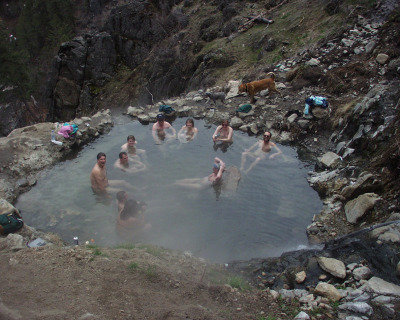 Just one of today's entries to Spirit of Soaking: Skinnydipper hot springs, Idaho, USA.
  Naoshima bathhouse exterior