Sunday, 31 May 2009

Cliff hanger

Cliff hanger? Of the many issues concerned with soaking in general, clothing or the lack of this seems to be an ever returning issue. And a divider between the communities who adhere to the principle the less the better (purists?), whereas others see bathing as an obscenity and if public bathing is essential (for health reasons) then preferably fully clothed (the prudists).

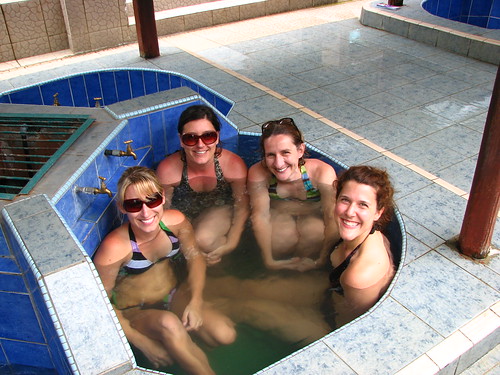
'A group of Mosuo women and tourists bathing in the famous hot springs of Yongning, Yunnan province, China. August 2007'.
Pure?


What brought me to this subject was a photo in the April issue of the international National Geographic magazine. Due to copyright and so forth I can't post the photo nor give the exact location but only the link to the photo slide show. About half way through you'll come across the photo. It's caption is
'Lisu women bathe in thermal pools to celebrate the coming of spring. A proposed dam would drown this site, one of the valley's few remaining public baths. Developers have turned other springs into tourist resorts'.
This caption and photo sums up all what's wrong with soaks in Southeast Asia. (even though it's China, but Yunnan is a bit inbetween the two!) The soaks are disappearing or are being sold out, often to get rich quick schemes. The caption also seems unrelated, all the persons doing here is having a bath, but by the looks of this you could say it's a celebration of sorts.

But aside of this there was a response on racialicious.com to this photo and is as follows:
'there was an article about a town in Western China that’s dubbed itself Shangri-La, there was a picture of topless women bathing in a hot spring spa. It was, as is almost always the case with NG, [National Geographic] a nicely framed photo, but I immediately questioned whether they would have shown a picture like that of a group of women in say, Iceland, or Wyoming. I think not. To me, it was a glaring double-standard and strong evidence of othering. Naked “other” breasts in NG are practically a cliche'.
Double standards (besides being racist one could also state that it is sexist) or not the photo itself does raise some issues concerning bathing rituals, worldwide and in Southeast Asia. Here at Soaking in Southeast Asia, we've waded into this debate briefly; on a few occasions just getting our toes wet so to say:
  • March 29, 2009 (Thai comment on Japanese onsen customs):
    'One inhibition for most Thai and even some Westerners, is the going naked part. But once you overcome it, the rest is easy and enjoyable. Keep in mind that you can use a little tower to cover your private part when out of the water. Sure enough the Japanese themselves do so too’.
  • February 28, 2009 (on Nepal and Rules of Chinese traditional hot spring bathes - Taiwan):
    'most bathed in their underwear'
    and
    ''Requiring every person to soak only in their birthday suits seems to be a sanitary issue".
  • January 14, 2009 (Japan):
    'In fact, I found I really enjoyed talking with the other bathers--maybe I too could get hooked on mixed bathing'.
    and
    'Are there any hot springs in Southeast Asia where bathing au-naturel and co-ed is practiced? No? Well, who know's there might be business opportunity here ....'
  • January 11, 2009:
  • 'Issues I often come across when debating hygiene standards of various hot springs sites in Southeast Asia, are those of various standards of dress. In my belief (which seems logic) the more clothing worn during bathing, the more unhygienic. So au-naturel bathing should be encouraged. But not in conservative Southeast Asia; both Buddhists as well as Muslim frown on any state of undress. Though Hindu Bali seems more relaxed on this issue, those in charge still feel compelled to signpost that bathers are being strictly forbidden to take to the waters starkers. Thus many are actually fully clad. ... I for one certainly understand it's not everybodies cup of tea (bathing au-naturel) but a certain degree of tolerance is all that's needed. It's sad to see age old traditions of tolerance of body and body acceptance eroded by narrow minded politicians clamoring for the moral high ground'.
  • November 6, 2007 (concerns soaking in Thailand):
    'Last year, I visited New Zealand and on 1 occasion rented such a 'cell'. Though it looked like a good idea at the moment, we hardly used it. Yes, you can pursue your own dress code, but you exclude yourself from the surroundings: is it rainy, sunny, windy, are birds whistling, is the vegetation green, who are my neighbours, what's my son up to? No way of knowing. I personally would like to soak 'au naturel' whenever, where ever, but somehow world societal norms are set against this. Beats me why?'
Nudity sells. The global community seems to be obsessed with this, a case in point are the photo's I put up on my flickr site; even a hint of skin results in much higher number of views. Most photo's count are anywhere between 0 and 20 views. But somehow this poorly taken photo rakes in more than 1500 views. Or this one on my waterfall photo's site which raked up more than 500. Or 200 plus for this? Or 200 for this. Before the month is done, these may well have doubled, just due to this posting!

Simply captioned 'Ardent Hot spring': the bare neccesities of soaking in Southeast Asia?

But back on subject. The not so established public hot bathing rituals of Southeast Asia require without exception a minimum of a bathers, though the more, the better it seems. Bali might be an exception but even there there are signs at hot springs asking all to wear bathing gear. In English and Bahasa, the former somehow implying that soaking clothed is not customary.
Not always to be avoided:
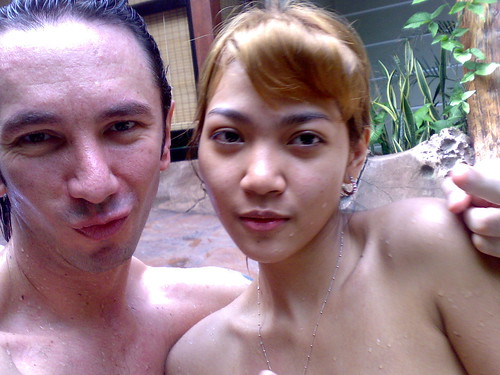
'Jessy and Me at Sunkei in Malaysia...staying at luxury villa ..Hot Springs....Peaceful...Quiet....
SUCH A gREAT tIME IN the outdoor private Jacuzzi....nice ya...'
In bigger soak sites especially in Thailand and Malaysia, on offer are a couple of cubicles which might imply that yes, we understand that bathers are not for all, so if you insist, go ahead use these cubicles. However it seems that they might mean the opposite. Shy, not to worry, you can lock the door. But au-naturel en public? Non!

In Singapore it's even a crime, as it's
considered obscene!
'The pair of undergraduates who sauntered through Holland Village in the buff in January have paid for their prank. They were fined $2,000 each on Thursday, the maximum fine for an obscene act'.
However Asian culture differs, not only in Bali. The prior mentioned sign shows that just outside Southeast Asia's borders standards differ. And a little farther afield in Japan standards are completely the opposite much to the chargrijn of US visitors!
On the other side Japanese nudity is so common, it's strange to them that tourists make their way to Japan just for the opportunity to enjoy the soaks as the locals do:
'Yoshio Ono, president of Osenkaku, which manages Takaragawa Onsen, explains that there had been many foreign customers from before, such as Philippe Troussier, former coach to the Japanese national soccer team. “However, the number of foreign customers has increased from late last year, and there are weekdays when over 70% of our guests are from overseas. They’re well-mannered too,” he says'.
Though some local visitors are dumbstruck:
'“This is about the only place where you can have a close encounter with naked blond-haired women. It appears that the hair on the head may be blond but the color below could be different.”
Here's a report from a naturist in Japan, but most blogs on onsen's just simply ignore the nudity issue: it's a non-issue!

Part of the taking the moral high ground within Asia is due to development. The further away from development, the less the likelihood that mores suggest a certain dress code.

In historical tense bathing more or less au-naturel was the way to go. But as stated elsewhere in this blog, affluency meant the need to distinguish oneselves, what better that to show off wearing expensive clothes?

But possibly times are a-changing. For instance, the emphasis of the spa industry on naturalness might imply bathing au-naturel to be trendy. It could catch on! The above example from Japan clearly shows that there's a market for soaking purists. And other examples from the region seem to imply that being uptight is only for the rich and possibly powerful. What better way to express power than to order everyone around. Me? Just give me an option, is that to much to ask for?
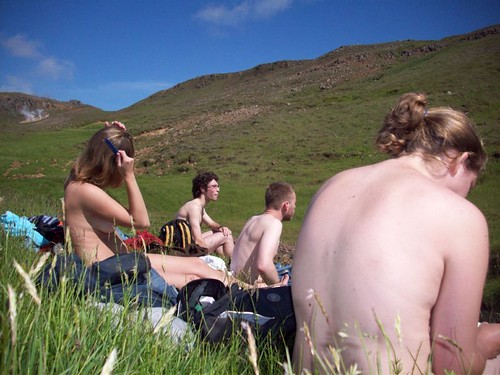
Photo caption:
'after bathing in the hot river [in Iceland]. we tried re-enacting the cover of the new sigur ros album, but there wasn't any road with a guard rail to jump over. i met this people just a few hours before, but if you can jump into a river naked with them, why not? (never mind the amused/embarrassed looks of passers-by)'.
Is this just pure natural fun?
]


Saturday, 30 May 2009

May 2009 Updates

I would have liked to give you all the news on hot springs in Southeast Asia but there is none! So I'll once more guide the reader to ithe more nteresting blog entries. And to some other issues.

One of these issues was the most recent posting on spa's. Interesting is that I defined a spa as
'any place having a natural water source that is believed to possess special health-giving properties'.
One of the world's most authoritative voices of the spa industry, Intelligent Spas refers to spa as
'a business offering water-based treatments practiced by qualified personnel in a professional, relaxing and healing environment' This definition was developed to support the original meaning of spa being "healing through water". Water-based treatments may include body wraps, body scrubs, baths, etc.'
End of definition. One aspect which I seemed to have omitted is the professionality whereas I concentrate soaking on in natural waters, preferably without somebody telling me what to do. Then again I suppose a spa might just be cleaner than a soak.

On the art and hot springs theme of a couple of months back, the soakersforum actually now has a thread on hot springs in movies which actually answers which hot spring was featured in the Easy Rider film. Concerning Easy Rider ,Taos the town near the mentioned hot spring, actually will celebrate 40 years after the film came out. There have been other films with hot springs featured but whether these are viewable or not is entirely different question. Have any Southeast Asian hot springs been in films?

But before I get into the specifics of each nations blog entries on hot springsthe folowing: a common phenomena becoming ever so popular in the spa industry are fish tanks where you can let the fish tickle your feet while at the same time letting them eat your dead skin cells.
Life's Happenings describes this in some detail how it not only is healthy:
'After a spa session with the 'fish doctors', they eventually need to see a real medical doctor as their legs had turned reddish, itchy and blotchy'.
He also provides a link to no less than the
Wall Street Journal which has a story on banning these fish spas (in 14 states they've been outlawed! Poor fish).


More weird 'spa business': Onsen hot spring powder?
'this powder changes hot water at your home into Japanese onsen hot spring. instant onsen at home!'
Your own foul smelling hot 'spring' @ home! Well, it's forest scent.ed Is this odd or not?


So now on to the blogs:

Malaysia
  • Revealed the hot spring of Changkat Jering near Taiping, Perak. Zest-zipper:
    'One might ask, “Is it worthwhile doing so?” For me I did not notice any significant changes in me after dipping in the hot spring for a couple of times. I was told that frequent submersion in the hot water would render me impotent to father a child. How far this is true is yet to be proven, either by me or by the scientists.
    As for my wife, in her own testimony, she claimed that soaking in the hot spring was very effective in reducing her weight from 72 kilograms to 65 kilograms over a number of weeks. Reduction in her body weight has lessened the burden on her knees considerably. The other benefit that she has reaped was a sound sleep in the evening after a dip in the hot-spring water during the day.

  • Poring. Jenni on the run reports:
    'By the sound of “Poring Hot Spring” might seemed like a spa, but at first sight, the thought of my mind was “like that only ah?”. It’s like any local waterfall with picnics around & kids running about. U can opt to soak ur body or only legs. Since we weren’t “equipped”, we went legs only instead. U could see steam from the water surface.I had my doubts about the water being “spring”. It might actually just be water being boiled somewhere. Anyway, It took me sometime to get accustomed to the hot water. Make that 20mins. By the time I got out of the water, my legs was lobster red, ready to be eaten'.
This is what Poring spring looks like. Cosy!?
  • Fuzzydandelion reports on Selayang:
    'The place and its facilities is quite good. Spacious parking space, the bathrooms/toilets are well kept, abundance of food stalls with some other shops that offer traditional treatment services like reflexology and leech therapy which I did not really paid much attention to it. The place even offered pails for rent for the ones who did not bring their own buckets. So don't forget to bring your own'.
    Bucket? Or leeches?

Vietnam
  • Phu Ninh is a lake in the central Vietnamese province of Quanh Nam:
    'In the afternoon, you can visit a hot spring where water of more than 70 degrees Celsius whooshes up from the depths of Phu Ninh, then look for a “wild island” to pitch a tent and cook your fish'.
    Which fish?
Philippines

  • A mention is made (by mistressblogger) of one resort in Laguna, Agua Caliente where
    'they charge only 70 pesos for night swimming, and you can already enjoy their big pool with real hot flowing spring water. Where the hot spring water is coming out, I allowed to massage my back and my scalp, but at first I thought I got scalded because of the water's very high temperature'.
  • Balat Island has a (big) hot spring added to the list. It's ancient uses:
    'it was used by local folks to dress chicken and pigs before being cooked. The smaller spring on the other hand was utilized as a natural facial spa before but nobody from our group was daring enough to try putting the hot mud on the face'.
Thailand

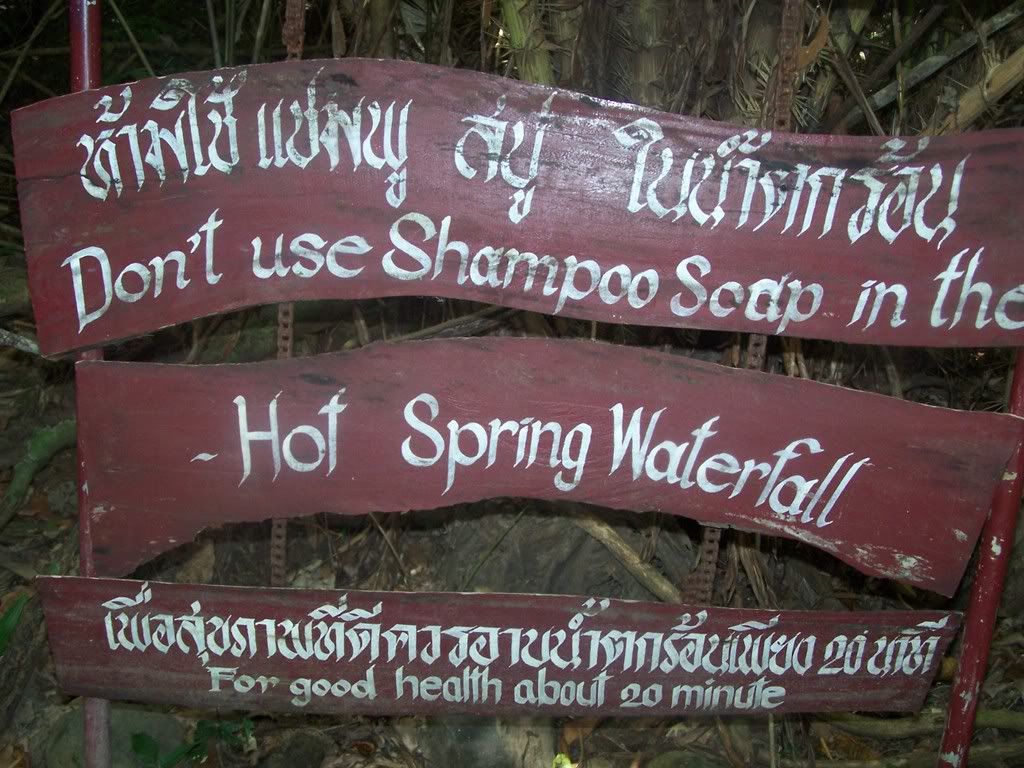
Vavijo has a couple of photo's on photobucket. Don't use shampoo!
Obviously in Thailand, but where? Krabi?


Arrh, there too many blog posts coming out. Next month I'm only going to just highlight a few special ones!

Monday, 11 May 2009

Spa-ing and Soaking: Same-Same but Different?

One could state that soaking is an increasingly popular past time, not only here in Southeast Asia, but worldwide. But to be able to state this, one would need to know how many soaks there are and the number of visitors, i.e. back it up with some data. Which are not available.
But leaf through any travel related print and, sure, there will be an increasing amount of articles and more advertising on ... spa's. But is going to the spa, the same as taking a soak?

Soaks and soaks of sorts
Soaks, as I understand them, are soaks in natural waters. They become soaks as the waters are usually warm or hot. Looking for where these natural waters occur in the heated substance, one is looking for hot springs. So soaks are in their majority hot springs.
I say in majority, as here in Southeast Asia, we experience a prolonged period of hot weather. So hot, that shallow bodies of water warm up and could be considered as soaks. As could be the sea, which surprisingly sometimes fails to cool the swimmer.
During the heat, cooling down is often a better option and it's no secret that I enjoy waterfalls as much as or just as much as hot springs. One factor in their favour, is that there are many more waterfalls. Possibly because of their numbers, unnatural enhancements are less obvious to come across upon. And here in Southeast Asia if there's no road, no car park, no amount of food stalls, it can't be worth it ... But for me (and my family) that's just the attraction. What better way to unwind, cooling off naturally, in a natural environment, 'au naturel'?


April this year, Yak Loam Lake Ratanakiri province, Cambodia: the 'coolest' soak.

Define spa!
But I'm digressing. So are spa's not the same as soaks? The word spa, you'd be surprised to know, is actually a shorter version of the Russian word '
spasibo'. Which was the word Peter the Great used in 1717 when offered water, as he was sojourning nearby the town now known as Spa located in the Wallonian Ardennes.

Why they changed the name of the town remains a mystery, considering it had been used as a soaking site from the 14th century onwards. Anyway, such was the significance of this happening, that today the global relaxation industry is greatly dominated by the word. Though the word spa is largely eponymous with any place having a natural water source that is believed to possess special health-giving properties, in practice spa seems to have more in common with other wider themes such as health tourism or wellness rather than soaking itself. Massages, wraps, facials are all standard ingredients one can expect at a spa. What's more they have little or no relation to the existence of natural springs, be they warm or cold. And their health claims seem mostly unfounded. Spa's are nearly all located in or near urban areas where they can provide a 'retreat' from the outside world and/or on beaches where tourists may well be tempted off the beach to a, as naturally possible, property to indulge.

Exclusive
What all spa's have in common though is an emphasis on a different distinctness with a hope for attracting the well-heeled. The more exclusive the better. Especially here in Southeast Asia, spa's aim for the upper class.
AsiaSpa puts it like this:
'Targeted at wealthy professional women aged between 30 and 50, AsiaSpa invites its readers to step outside their everyday urban environment and escape to a tranquil world where body and mind are refreshed'.
Though I might have a weakness for the mag, for instance it includes issues such as this month (May 2009) a special: 'The Family Issue'. With articles such as 'how to... be a super parent' and 'yoga for fertility'! However it's commercial emphasis and pretension to highlight the distinct rather than the true natural , certainly doesn't endear itself.

This penchant for exclusiveness is in contrast to say northern Europe where thermal bathing is open to all. But class associations are made between town's. i.e. Harrington for the lower class, Royal Spa Leamington for the upper class. This is also evident in other European nations. Places such as Evian or Baden-Baden are known as places where the upper class hang out, so to say.
In Holland (and Germany) though, spa's as such are scarce and sauna's are there to give what is essentially is a spa experience, though with the emphasis on taking a sauna, with the possibility of other upgrades (wraps, massages) or extensions (sunbed). Significantly these are less distinctive for upper / lower class. And they emphasize social contact.

One could compare this culture very much akin to that of onsen and sento in Japan. Though a soak may be great, a soak with great (new) friends is even better.


This all seems quite in contrast to spa's, where relaxation is the mantra such that tranquility becomes all enveloping (see above quote). And to muffle away the odd a-natural sound here and there, they offer background sounds, a fast flowing stream, gentle waves, rustling leaves, etc.. Believing that socializing is again against human nature, rooms are parted and separated.
The most exclusive massage I had here in Phnom Penh was a joint massage, the joint being a door between the massage rooms which was opened, rather than a room where at least both of us would lie. Possibly by de-socializing the experience it becomes more exclusive: "Oh ,I had a plunge pool all to myself". And how long did it take to get bored?


So ..., not the same?
No, I believe. A spa for me, is there for the convenience of a cheap massage. In contrast seeking a soak is an undertaking, getting out, an expedition, a voyage of discovery, a search for the holy grail and a possible reward at the end. But, all -in-all a lot of fun and interest.

I mean, in Southeast Asia what makes some of the most exclusive spa's differ from each other?
Take Tamarind Springs on Thailand's isle of Samui. It goes all out to tempt the tourist off the beach and it certainly looks great.


Hmm, would you pay to experience this? Nature is a plenty in Thailand.
'Tamarind Springs Forest Spa, Samui is inspired by its superb location – its lush coconut groves gently sloping into a valley of huge granite boulders bordering the island’s jungly interior. Built out of love and respect for this unique landscape, every effort was made to fluidly integrate this Samui spa into the existing indigenous surroundings.
...

The magical forest surroundings will help you to completely unwind.
The Forest. At The Forest guests enjoy drifting between the fragrant herbal steam cave and cold water rock pools, snacks and refreshments in the tea sala, before their massage treatments in open air pavilions.'
Is this much more different than a soak? Possibly, because the customer is king, hygiene is high, quality is good. But most Thai soaks offer a massage and the waters are more inclined to have therapeutic qualities. Then again at Tamarind Springs you do get disposable underwear!

Over at Losari (Central Java) it's more of the same (massage), though they have a hamam and not a steam room. It claims:
'An oasis for tranquility and renewal'
Maybe?

Anantara at the so-called Golden Triangle:
'Whether you choose an exotic fruit peel or a signature four-hand massage, Anantara's spa therapists will tailor every treatment to ensure your relaxation. From the moment you step into the spa's three-storey mountainside reception room, you'll feel infused with a sense of calm'.

Anantara Spa: Enticing? What happened to the view?
But again a number of massages to choose from, possibly an extensive choice, just to make it exclusive. But nothing more than a typical hot spring, other than exclusiveness with a price to fit.

Again they are different but also similar. Soaks, now those are different! They are naturally tranquil. No need to blend in some background muzak. Now let's hope the developers don't impose themselves and make spa's out of those great soaks!

Thursday, 30 April 2009

Update for April 2009

As usual there is hardly any news to comment on. Then again if you mention hot springs in your national budget, as Thailand is doing, then this is important! Then again, it's only a mention.

Furthermore a news story from the Philippines:
'The Department of Tourism (DOT) has plans to develop the Mt. Kanlaon as Philippines’ newest eco-tourism site'.
Newest eco-tourism site? Probably what they mean is the newest developed eco-tourism site. Is that not a contradiction? Unfortunately the report does not mention what is planned. The relevance:
'The volcano has three hot springs on its slopes: Mambucal Hot Springs on the northwest, Bucalan Hot Spring, Bungol Hot Spring'.
Blog reports then. More soaks added to the lists. A consistent theme in many of the highlighted are comments on the clothing etiquette.

Malaysia
  • Naturally, Poring is mentioned oft in blogs on Malaysia. Experiences are far short of what is expected, as Diane points out:
    'It is poky little bath tubs that you stand in, and wait forever to the water to fill. For some reason taking a bath in public rather than chillin in a natural rock pool was not appealing to me. It was also holiday season so it was full of school kids running around'.
  • Jasin hot springs? A not yet included hot springs in Malacca state. Why not? Because!
    'This hot springs is also known as Taman Rekreasi Air Panas Jasin was built on the historic site of Natural Hot Springs Pool which was first opened on May 1884'.
    Woops! Does not look too bad. More info
    here as well. Is this not Gadek hot springs?
  • More question marks: Lubuk Timah, found here. Question mark no more.
  • Not more misses! After so much research I thought I had almost all Malaysian hot springs covered. It's not a volcanic actively country, so there can't be that many. But yet again. This time it's Ulu Legong in Kedah state. For a report visit this blog posting by Ed and Cher:
    'The place is actually opened 24 hours. Now, have you ever heard of a recreation park most visited after midnight??? Well this is just the place. There were tons and tons of people here hanging around the pool, swimming, camping and just lepaking around'.
    Lepaking? Gathering, researching and / or hanging out are the quick interpretations. Learning more every day. Any roads the site has many photo's and even a video.
    And believe it or not, but there's another blog from the same place. From aeiween with photo's and a short comment:
    'Because after i tried it my whole body's skin really feel soft and smooth! HoHo~ :)'.
  • Another disappointed soaker? Jelajah xplorer visited Kerling hot springs. Besides a number of good photo's, he has the briefest of comments on the soaks themselves:
    'The place is not well manage and the so called hot spring does not fit the profile of a hot spring'.
  • Jabing Aura though was not so disappointed with Annah Rais hot springs in Sarawak:
    'The place, to our surprise was well kept and clean. The unpolluted mountain air felt so refreshing, the stream water beside the hot spring was really cool, calm and welcoming.
    A caption to one of his photo's:
    'A view of the Hot Spring. Look at the clear water!!!'
Vietnam
  • What is with mud and Vietnam? Binh Chau have the mud bath. Alia in Korea describes a day at Binh Chau.
    "Our tour guide drove us over, but didn't mention that the hot springs was a bathing suit-necessary activity".
    ...
    An employee put a few bags of prepackaged mud and some scented oil in a bucket, and we just had to rub it on our skin and wait a little while for it to dry, while walking around outside'.
    She obviously had a good time, but was surprised by this:
    'was reminded how modest Americans are when some woman (I think most of the other foreign tourists that day were German) came into the bathroom and got naked to change without bothering to go into a stall. There was even a window in the restroom door, but she obviously wasn't concerned. It's funny to get little peeks of how other people and other cultures operate'.
    Hilarious?
  • National hot spot with mud are the Thap Ba springs near Nha Trang:
    'We had a mud bath in these mud pits, then layed in hot mineral water, and swam in mineral waterfalls. The water was very hot, but after your skin felt so good. It was really fun to splash around in the mud, and swim in the pools. The whole process was very unique including high pressure jets to wash all the mud off'.
    Such was
    Traveling Tami's experience.
  • In the town of Tu Le, Yen Bai province, things are less upmarket:
    'Thai ethnic people in the town bath in natural hot springs. In the afternoon, normally from 5pm, they come to the hot water pool next to the Nam Cuom spring, taking off their clothes and enjoying the hot water and natural surroundings'.
    Another miss on the list! [and now corrected]

  • More from northern Vietnam. While trekking in and around Sapa, NMCutler visited an unnamed hot spring:
    'The hot spring, unfortunately, was disappointing in scope but very, very nice at the same time'.
    ?
Singapore
  • Singapore, having only two hot springs, one of which is off-limits, means the other, Sembawang, gets blogged quite often. See here a good (photo) report by ygblog4. He reminiscences a past visit:
    'what we saw were some kampong houses around a stream and some puddles. quite a number of kampong folks were around the spring, some washing their clothes and some cooking their eggs, like what we did today'.
    He also sheds some light (and a photo) on the area before authorities sanitized the soak:
    'the place is open from 7.00 a.m. to 7.00 p.m. every day. the scene today is a far cry from what we witnessed in 2006 when the place was packed throughout the day, regardless of weekday or weekend. before they cemented the place and put all those retrictions in place, you could cycle or even drive and park right next to the hot spring'.
    That's progress. But considering the reports from sites in neighbouring Malaysia, it's either a privatized money maker or a dump (or both).
Thailand
  • More strange customs concerning clothing and soaking. This unnamed blog entry from Pai:
    'And we went to Pai Hot spring. It’s a wonderful natural hot spring and it is a major public service for thai and foriegners for a bath or a long soak (with clothes on) :). It’s Thailand so customs in hot spring is quite different than somewhere else. Local people who bathe in this hot springs always keep themselves covered with clothes or thai skirt (a simple skirt somewhat like a tube skirt / sarong). If you want to do local thai spa, just only bring one blanket and sit next to the pool! It works!! The Others hot pools can make an boiled eggs, the temperature is about 80 celcious!!'
Philippines
  • Maquinit hot springs on Palawan. Zoechairein reports:
    'The hot water came from a spring in the mountain and it’s naturally hot and salty! The discoverer of this hot spring initiated to create a pool that will gather the hot water at the foot of the mountain'.
  • Though I have some of my own tough experiences finding hot springs, finding Baslay hot springs on Negros proved nearly insurmountable for Stupidlyperfect [what's in a name?]:
    The ride did not go smoothly and safe as what I’ve expected. While we were on our way up on the super rocky and bumpy road under the pouring rain, the habal-habal [moto-taxi] slid for two times.
    ...
    After the two slight accidents, we decided to walk the remaining part of the road leading to the entrance of the hot springs. And the walk was not a joke. I am already running out of breath in trekking the right-angled rocky road as the raindrops mixed my sweat.
    ...
    After the descending and ascending walk on the 400 concrete steps to the hot springs, we finally reached the spot.
    ...
    As soon as I dipped myself on the pool, I realized that it is not bad after all'.
    Who said soaking was no fun? Another hot springs to list.
    And would believe it, there's another blogger who made it there! Optimistic Dora describes her travels in getting to Baslay hot springs.
    'It is almost 10kms from the proper Dauin. It may sound just a short distance, but 3kms of this is what you need to walk to reach the spring, because of a bumpy road. The motorcycle cannot anymore resist to the roads, so we need to walk.
    ...
    Finally, we find it. But the misery of walking did not end there. We need to pass the thousand steps of their developed ladder in going down to the hot spring and the river near to it'.
    And oddly she ends her story such:
    'Until now, the clothes I wore in bathing in the spring still smells sulfur and that would remind me of Baslay hot spring'.
  • Asin hot springs, an easier find, a more pleasant experience?
    'It was a crowded Sunday so I got bummed out because the all the pools seem congested'.
    Courtesy of My shoeboxjournals.
  • Mateo hot springs:
    'The Mateo Hot Springs resort turned out to be a dump. The room cost 1000 pesos for a very basic room with its own bathroom. No facilities open for even a cup of coffee. So we were tired after a very long day and no food or drink with us. Got frustrated with the owner that she wouldn't even make us a drink. The hot springs were open and so we went for a relaxing soak to ease away the stresses of the day'.
    Jeff Brad's world travels.

Monday, 30 March 2009

Updates for March 2009

News on Southeast Asian hot springs is sparse. One possible exception is a report in the travel section of the Bangkok Post. Despite all the travel writings currently focusing on home tourism, one of the Posts reporters has had a probably all-expenses paid trip to Japan and reports on the attractions.
On the 5
th of March a photo report on Sendai was published. A caption to an innocent picture reads:
‘There are numerous areas boasting onsen (hot springs) in the Tohoku region. Many onsen bathhouses have both indoor and outdoor pools. In the latter, you can also relish the beautiful scenery as well as fresh cool air while relaxing in the warm mineral rich water. One inhibition for most Thai and even some Westerners, is the going naked part. But once you overcome it, the rest is easy and enjoyable. Keep in mind that you can use a little tower to cover your private part when out of the water. Sure enough the Japanese themselves do so too’.
Well, if this inhibition was so easy to conquer, why isn’t it practiced in Thailand proper?
More southeast Asia focused, an article from Vietnam. On so-called health tourism. Though in reality there's no news, just a report that if one wants to wallow around in mud, Thap Ba, near Nga Trang, South Vietnam is the place to go.
And what is a first hand experience like? From Kate's blog:
'We spent the afternoon at a hot springs resort about 10 minutes outside of town. There was a 7 step regiment for optimal health benefits from this mud bath/mineral soak wonderland. We were ushered into a tub with a Vietnamese couple which was full of cool liquid mud the consistency of a chocolate shake. A somewhat awkward 15 minute soak in this small muddy bathtub with another couple involved all of us pouring pails of mud over our arms, chests, and backs. Most local people were in shorts and tank tops and we quickly figured out why. The mud got well trapped in our suits, especially between the layers of the lining and the outside, and made us both a muddy, saggy, bloated mess! In this goopy state, we were instructed to sit in the sun for 10 minutes before rinsing. The ground and rocks were so hot from the super-charged sun we were forced to hop from foot to foot to not burn our feet. Quite a sight. After a thorough mineral shower rinse, we were hustled into a 3 foot wide channel of rocks which sprayed water at you from all sides - imagine car wash meets leaky dam. After the pressure wash, we were pointed towards larger mineral hot tubs to soak with more strangers. After that, on to the big, but still hot, soaking pool. Keep in mind that it's a good 85-90 degrees out so at this point, we were not only pretty pruney but quite thoroughly cooked. We cut short our 7 steps to mineral-induced health and headed home feeling silky smooth with just a few pockets of mud in our ears.'
More blog reports:
Malaysia
Yet again quite a few postings, but somehow most seem disappointed ....
  • Poring:
    ‘It was a good thing that the pool of springs closed at a much later time, 7.30PM. The hot springs were set up like a huge public bathing area, Japanese style. Some pools fit more than 6 people, while some were built for just one person to submerge into. The smell of sulfur was strong, and the water was extremely hot, but it was so inviting after hiking unexpectedly in the jungle. After the first dip, you could just laze in the water forever'.
  • Sungai Klah. Huge amount of photo's here. And here. And here.
  • Some shots of Bentong hot springs by Budleee Rants. His rant: '
    ... it was a hot spring pool. An abandoned and unkempt one that is. The facilities are nice, but there was no one to maintain it. As a result, the place was unkempt and the pool was full of algae and other free living parasites'.
  • Kerling hot springs. eXtreMesh has visited these springs:
    'Place was well maintained and the river was clean and cool to dip into. Well when it comes to the hot spring, there is nothing much to be expressed about. The hot spring is a pool with not very hot water, i managed to get in the water and even dance, but did not feel the heat that much. I also noticed that the pool was not that clean and rather slippery to stand in it'.
    Recommendable? Author comments:
    'Even i was disappointed with the place as i reached there'.
Philippines
  • Camaguin, ardent or not?
    'After the falls, we went to one of the island's hot springs. And man, that truly was a heavenly experience. As I settled my ass and the rest of my body in the lovely 40°C water (that's 104°F to you Americans) I swear it felt almost like having an orgasm. Sweeet! I could hardly keep from moaning because it felt so damn good. I credit the hot springs for the lack of muscle soreness the next day. Sitting there, watching the mist rising from the water and being immersed in wet warmth was simply spectacular'.
    Would anyone be surprised that this was posted by I Am Woman, See Me blog?
Thailand
  • A short impression by Phil and Julia of Pai hot springs:
    'Stepping in the water meant feet and ankles turned instantly lobster red.I couldn’t get more than my bum in the water and even that was a bit of a mission.'
  • Thaisticky rice has another short impression of the nearby Pong Duet hot spring:
    'At the bathing area they had a couple of nice looking hot spring swimming pools as well as private cabins or if you preferred you could just dangle your feet in the natural hot spring stream. As it was just after mid day and the day was already a scorcher the last thing I felt like doing was jumping in an even hotter bath of water so I gave the bathing a miss ...'.
    The soak season in Indochina has passed apparently. So much for health reasons for soaking!
  • Andy is still at it, this time from south Thailand, Ranong:
    'They [the hot springs] were really nice, and free because they are government owned. It was all paved and tile but the pools were good temperatures (controlled by valves) and there were a lot of locals there. Some locals told me stories of how the spring water had saved peoples lives. I don't know if I believe the stories but I do believe hot springs in general have good health benefits. The girl at my guest house said I shouldn't walk at night to the springs because its a little out of town and its dangerous, but I did stay until past dark. So I figured I'd test my luck, but I met some nice thai people before I left and they gave me a ride back to the guest house. It didn't seem dangerous but I guess in a boarder town there is more danger than in other parts of thailand'.
Indonesia
  • Blogs are an easy way of getting information out there without all the hassles of signing up, etc., etc. So easy, that commercial companies in Indonesia use them to plug their tour programmes. But sometimes they are not as appealing as the author may well think! On Banyuwedang hot springs, Bali:
    'Flights Banyuwedang from the hot springs that appear on the beach.... Because the uterus sulfur high enough, hot water is widely held even up to the island this summer because the water can cure some diseases, especially skin disease. ... here is hot water that contains sulfur which is located along the coastal region is supported with a rare population so quiet atmosphere can be created.'
    (?)
  • Tangkahan in northern Sumatra (Aceh) is an area of wilderness and is managed as an ecotourism site. Some of the attractions are hot springs. This extensive report of the area mentions 2 hot springs.
Others
On Thaivisa forum: Umphang (or as this site refers to Mae Klong) ‘
The hot spring itself is amazingly not ruined. Thais have a nasty habit of concreting, paving, and tiling over hot springs, removing all sense of any natural aesthetic and completely defeating the purpose of the hot spring (they call it "progress" and "development;" you might as well soak in a tub with a hot water heater). This hot spring is just a natural pool with a rock/dirt floor located a few meters from the river. So you can soak hot and then go jump in the cold! There is even a small tributary hot spring just at the river's edge where you can lay in both hot and cold simultaneously!’

Related Posts with Thumbnails
Copyright 2009 © Soaking in Southeast Asia. All rights reserved.
No reproduction or republication without written permission.