Yes, I agree it has been conspicuously silent on this site for the past 2 months. No that doesn't mean that a stream of blog entries is on it's way ...More probably the followers will have noticed that there has been lots of flesh added to the bones otherwise known as Hot springs of the Himalaya. This month (April) just 3 postings, March 4 postings. In all there are now specific links to 160+ hot springs. Research has been done on much more, all very time consuming, but the (temporary) end is near ...
A Facebook page has been added. No, it's not even running lukewarm ...
Anyways, any other news?
That's besides the World Geothermal Congress, see previous posting. Well, harking back on the geothermality is this article from Indonesia which was originally published in the Jakarta Globe (23 April, 2010). It of course deplores Indonesia's lack to provide power despite all that energty being available under their own noses, so to speak. Commenting on a project in Garut:
'“People I speak to think it’s related to Lapindo [the uncontained mud flow near Surabaya],” said Erfan Hutagaol, head of the Energy Ministry’s geothermal business effort section, referring to the mudflow disaster in East Java. “And there are those who are already using geothermal for tourism purposes, such as natural hot springs. And they’re afraid the hot springs will disappear if we develop geothermal energy.”'
So that's not the case? An aspect which seems to be waylayed:
'An estimated 42 percent of Indonesia’s potential geothermal reserves are located within protected or conservation forests, the latter of which is off limits to geothermal production according to 1999 forestry law'.
Dr Fishdiscussion on Khmer 440 forum concerning the antics of fish 'spa's' in Siem Reap, Cambodia. As Cambodia is another home of pirated goods it's no wonder that the fish in these fish spa's are not original ones, at least that's the allegations. But heh, where else can you get a 20 minute Dr Fish session for $3 complete with a free can of beer? (see photo's). Bangkok Post (25 March 2010) puts in it's 2 cents. They spoke with the owner of Cafe DeSpa ($8 for 30 min, no drinks included) who uses a Japanese system of drainage to ensure sanitary conditions, something less obvious in Siem Reap even though I've yet to hear complaints from there. The article concludes:
'It seems the fish spa business is now under a cloud of suspicion. Hygiene is of course a big problem, while some outlets don't use the right kind of fish, but Garra Rufa [nibbling fish from Turkey] lookalikes like the Chin Chin fish [fish from China, when not juvenile they have teeth!] which can wound customers. Only time will tell if fish spas are here to stay, or are just a trend that comes and goes'.
Blogs / news from Southeast Asia (sort of):
Malaysia
An entry on mysabah.com on 'sulphorous' hottish springs near Tawau, Sabah. Located in the forest just 3 hours walk (this link says 1 hour) from Tawau Hills Park. But reporter didn't find the springs. Walked back, talked with ranger and set out the next day to find the springs, which he estimates to be 25-30 degrees; in his words they are not hot. Great posting, including pictures.
Vietnam
Five million $ set up aside to spruce up Giang Son hot spring.
Philippines
We like to think that all Southeast Asians are adverse to any risky behavior in or near water, but that's not the case. For instance at Sadanga, Luzon. A nice blog entry by banayan on communal bathing:
'Though there are other hot springs in Mountain province, like that in Mainit, Bontoc, Sadanga’s set-up is unique. Even before the cisterns were built and enclosed, the males were already separated from the females – each has their own place to take their baths though these places are near each other. Though it was a common sight to see naked person of the opposite sex taking a bath, no records of malice or rape was ever done. But, decency took place and the bathing cisterns were enclosed. Yet, inside the enclosed bathrooms, all young and old females, take their clothes off, sit down and start splashing themselves with the hot spring water – splashes which very soon become pours'.
Even more un-Southeast Asian:
'A proposal rejected by the local people was that this public bathing place be developed and enclosed so those who’ll come will enter for a fee. Such a proposal was taken as something absurd but the local people clearly understand that once that happens, they, the locals, cannot freely enter the place. And, so it was rejected'.
'The renewable arm of Philippine National Oil Company (PNOC) has secured a geothermal exploration contract to develop a 40-megawatt (MW) project for Luzon.According to Energy Assistant Secretary Mario Marasigan the project would have an estimated US$120 million investment which would cover 20 MW for the Mainit-Sadanga and 20 MW Buguias-Tinoc geothermal projects'.
'If you are looking for luxury, beware. Pong Phrabat Natural Springs is run down and in dire need of an investor who can turn the place into a world-class destination for SPA fans all over the world'.
Her score card:
'Water: 10 Tiaras; Privacy: 8 Tiaras; Tubs: 4 Tiaras; Service: 2 Tiaras; Ambience/Design: 1 Tiara; Massage: 1 Tiara (based on the French lady’s review); Cost: 10 Tiaras'.
A new hot spring resort in Krabi province? Natthawaree hot spring apparently.
Timor
A sign of life, a recent picture of Marobo hot spring.
Bhutan
I know, I know, that's not Southeast Asia, still worthwhile news. Last year the hot spring of Gasaexperienced a wash up damaging the hot spring infrastructure. Now the Japanese are coming ... to giveadvice:
'“We want to reconstruct the tsachu as soon as possible and we’d like to work together with Japan, considering the same culture of hot springs in Japan,” Lyonpo [Bhutanese Home Minister(!)] said, during his meeting with a team from Arima hot springs in Japan, who visited Gasa tsachu to explore the possibility of reconstruction'.
Yes it's possible this is the good news, might cost a bit ...
Nepal
'People taking dip at hot-water spring in Singh VDC of Myagdi district.
People believe that bath at the spring cures several illnesses'.
Photo by Ghanshyam Khadka published by eKantipur.More gawkers than soakers ...
Prominent in the news is the World Geothermal Congress (WGC) currently being held in Bali, Indonesia. Though we would expect that soaking and tourism would function in this, it seems to be all about generating power (literally and figuratively?). No less than Indonesia's president has vowed to make the country the world's geothermal power leader by 2025. That's if other countries don't pre-empt him.
But what about making Indonesia the world's number 1 destination for soaking? Currently it are countries as diverse as Japan, Costa Rica, Hungary, New Zealand and Iceland (the Blue Lagoon, Iceland's no. 1 tourist destination?) who make soaking a priority in their intentions to draw foreign tourists. Not so in Southeast Asia.
And by the looks of the WGC programme not much seems to change. Tourism is just a small side session and even the day-programmes on offer for the participants fail to include at least 1 visit to a Balinese hot spring. Maybe the majority of the participants are only interested in wallowing in wealth in the prospect of the $$$ which will arrive once the geo is harnessed.
What is on offer are a number of presentations, three of the ten on Iceland. There is a paper on the Indian Himal by the Arya's:
'Need of the hour is to come up with simple but effective solutions to renovate these geothermal resources and judiciously use it in our day to day life'.
If you have following the Hot springs of the Himalaya blog it seems that management is lacking, especially in the face of a tourism onslaught in the better accessible area's of the Indian Himal.
Chow Weng Sum presents an overview of the hot springs in the Malaya Peninsula (Malaysia) which hardly delves into any soaking aspects. Interesting he and his co-authors mention after sampling mineral water:
'Only two of these hot springs [of a possible 60?] meet all the requirements for drinking and mineral water'.
Furthermore the call to harness the sites for power generation.
In the poster session a poster by Charles Davidson, an Australian with a passion for soaking. The poster focuses on himself and how taking a leaf from the Japanese soaking tradition has tried (and succeeded) to undertake the same on the Mornington Peninsula of the Australian state of Victoria, the undertaking aptly called Peninsula Hot Springs. In this Google Doc an extensive overview of how Charles became Australia's premier soaker (?).
Finally there is a presentation by Patricia Erfurt-Cooper who is becoming the soak guru in the scientific world. With co-authoring 2 books on geothermal tourism in the last 2 years she is certainly the person to lift tapping-the-thermal-waters to a more prominent position, the question is whether her message would intrigue participants. The abstract certainly intrigued and the order to Amazon is underway for 2009's
'Health and Wellness Tourism: Spas and hot springs'.
And then there is this years
'Volcano and Geothermal Tourism'
edited by Ms. Erfurt-Cooper, which draws on world wide experiences, though not exclusively focusing on soaking. Might have to save up some money before ordering this ...
After visiting Binh Chau hot spring in the south of Vietnam, I was astounded at the contrast of experience of soaking here and that in other Southeast Asian countries. Was I witnessing progress? Could what is achieved here, be only be done with communist autocratic government? Or are the Vietnamese so totally different?
The main swimming pool complete with faux rocks and cascades.
Vung Tau But let's start at the beginning. Binh Chau is a hot spring located in Ba Ria province, about 150 km from Ho Chi Minh city (or as some say Saigon), a two and a half hour drive away. Besides Ba Ria, Vung Tau is another large city in this province and the focal point of tourism; Vung Tau being the beach of Saigon. From the point of Cap Saint Jacques, Vung Tau is essentially a major area of hotels and beach resorts stretching for about 10 km along the sea facing shore until an expansive coastal flood plain after which a number of smaller resorts dwindle as one continues along the coast north and eastwards. On the Saigon side large scale industrialization has taken place.
One of these smaller northeastwards located resorts, Binh Chau is a reasonable sized town located 70 km from Vung Tau. As the number of resorts peter out here, so does the quality of the road. From Binh Chau one needs to drive 2-3 km inwards towards the hot spring site itself.
Claims to fame? Once through the entrance area there is a massive development, wide avenues and big reception buildings. Our car is parked close to the entrance. A 200 m long road leads to an intersection where one can proceed onward by foot to more park -like area, accommodation and the springs proper. Go right and one goes to the soaking section.
The hot spring resort is run by an investment operation called Saigon-Binh Chau Tourist Joint Stock company which includes a local beach resort. Since the turn of the century facilities have been improved and
'in August 2003, the happiness and success of this investment are rewarded by the World Travel Organization’s recognition that Binh Chau Hot Spring is one of the 65 areas of sustainable ecotourism development of 47 nations around the world'.
Yes, that accolade looks good. But looked at it in more detail, reveals that Binh Chau was merely
'a compilation containing 65 case studies received from 47 countries about exemplary practices in small ecotourism businesses (SMEs)'.
I.e., a slap on one's own back rather than 'recognition'. As the publication is not freely available on the web, little insight can be given to the aforementioned claim. It's also not clear exactly what the WTO understands as ecotourism, their website lacks any definition.
More possible future (investment) development around the Binh Chau includes a safari park and villa's, which might just throw a different light on the eco claim ...
The naming game: call it eco and it is?
Developing hot springs and protecting the environment Aside from the eco claim, it's not totally clear, but there are a number of references putting Binh Chau hot springs as part of a larger protected area. Amongst these is Lonely Planet which lists:
'Until about a decade ago there was wildlife in the area, including tigers and elephants, but it seems humans have nearly won the area over'.
Binh Chau's own web site refers to the ecological reserve:
'11.000 hectares of forest, known as Binh Chau - Phuoc Buu natural preservation zone'.
Note that Bin Chau hot springs site themselves are only 35 ha.
More info on the natural reserve can be found in this document from 1997. It contains a forewarning:
'Binh Chau hot springs is designed to suit the tastes of affluent Vietnamese tourists. The flower-lined walkways among hot springs, shady cabanas and a litter of bright painted stucco figures is pleasant and charming.
But, more concerning, the resort also holds a small zoo containing several rare species. Among other things, an eagle sulks in a purpose-built cage shaped like giant a spider's web and listless binturong (Arctitis binturong). It is illegal to keep the endangered binturong. I could not identify the eagle but several species of eagle and buzzard in Vietnam are on the IUCN Red List of Threatened Animals. Long-tailed macaques Macaca fascicularis, also on the IUCN Red List, were in two small cages. The centre-piece of this exhibit is a giant painted concrete structure resembling a coiled snake, strangling a rampant deer. When I visited in December 1996, new structures were being added to the zoo complex.Clearly, this architecture enforces common perceptions of nature as mysterious and evil. 'Nature' - the Vietnamese word is 'nguyen', - carries a reproachful connotation of 'primitiveness'. Zoos of this character do nothing to show how precious is nature of itself. Nothing is here about the natural history of these species. Nothing to allow people to empatize with wildlife. Nothing to encourage them to protect their wild resources'.
It's therefore chilling to note the following announcement:
According to Management Board of Binh Chau - Phuoc Buu Natural Reserve, from the beginning to May, 2009, the reserve has attracted 20 tourism projects under ecological- tourism forms. Total investment area of these projects are about of 1,500ha'.
Soaking To proceed to the soaking section one needs to purchase entrance tickets in an adjacent building.
This building incorporates changing facilities, showers and lockers, never seen a locker at a soaking site in Southeast Asia!
Beyond the entrance are two palm fringed pools against a backdrop of faux rocks stacked up 5-10 m. This tiled area is backed up by a free form 2 m wide pool, meant for kiddies, containing less warmer water.
In 1 corner are amenities while beyond the kiddies pools are places for mud treatment and VIP soaking rooms. On the other side a track extends into a swamp where there a number of other in-huts-enclosed-tubs, varying in size and thus price.
The main pool though is heated and goes to depths of more than a meter. The soaking experience is somewhat placid, late on a hot weekday most visitors are middle-aged Vietnamese, day visitor tourists already having left. The pool itself could do with some painting and the visible quality of the water could be better.
However, strikingly, almost all patrons are wearing bathing costumes, much in contrast to nearly all other soaking facilities in Southeast Asia. So much so that I wonder whether this is in Southeast Asia at all. It could be Europe or Australia. Canada or the states. I wonder whether this bathing custom is something Vietnamese or simply limited to these facilities.
The sights of Binh Chau: mud baths, hot pool, more mud baths, private pools and jacuzzi.
Throwing Mud On offer are also mud baths or the opportunity to cover oneself in healing (?) mud.
Possibly this claim is true but what I find weird is why if it it so good, why the need to keep bathing clothes on. Especially women wearing a full one piece suit can be seen covering their suit in mud (below), can't see much health gains in that.
And though there are private enclosures, these are not meant for au naturel bathing. Inside photo's (above) disprove this as well as the fact that the material used allows for outside viewing.
Nguyen Pham's untitled muddy picture from Binh Chau. Question is if mud equals health, does this mean that females can not fully profit from the perceived health benefits?
An introductory youtube video on Binh Chau hot springs
Getting there: From Vung Tau head north / east along the coast until Binh Chau village. Take a left on the other side of the village followed by a right turn and after a km you'll arrive at the hot springs site.
Soaking experience: Certainly pleasant, considerable effort has been made to make soaking a worthwhile experience. Of the near 30 soaking experiences I have visited in Southeast Asia, this ranks highly amongst them even though the metamorphosis into a some what sterile soaking area comes at a loss of naturalness.
Overall impression: With in mind that this has been created to attract tourists, one could argue that this has been done tastefully. Certainly it could be a lot worse.
Part of the attraction park are the natural hot springs located away from the soaking pool itself. It's said that they number more than 70.
Still can't shake off the need to post updates though I hope they will get shorter in length as we proceed through this year.On the Hot soaks of the Himal site additions have included many hot springs of Tibet or better said Tibet Autonomous Region. I am currently in the processing of tying up some loose ends and looking to head where from here.
On this site our first Vietnamese addition, Binh Chau should hit the site soon.
News Malaysia gives a new meaning to soaking? The Banjaran by Sunway describes itself as a 'Hot springs retreat'. Much effort has been put into this newly opened resort, though it seems that it's intent is to cream off the very rich. No kids are allowed. And though this Tripadvisor thread has some positive feedback, the feeling lingers that they just might be asking too much from the market. Already Agoda were discounting this by half to just US$ 529! A bargain! Frog and Princess have some pics.
Others
Development of hot springs in Southeast Asia has often come about by Japanese during WW II. However Hulu Langat in Malaysia is now referred to as the Korean hot spring, so writes Hoteden:
'For some unknown and strange reasons, almost like storylines of those 'weird' yet wonderful Korean horror films, the hot spring of Sungai Serai in Hulu Langat, Selangor seems to be a 'popular joint' for Koreans living in and around Kuala Lumpur'.
Many things seem to shock Singaporeans. What about this:
'This woman was seen filling many pails to the brim with water from the Sembawang hot spring, and using the 'free' water to wash her clothes. She did it even though there was a sign that stated “不要在这里洗衣服” (Do not wash your clothes here)'.
The horror. I dare not say it, but there are also photo's. Safe for work? In Singapore? Umm ....
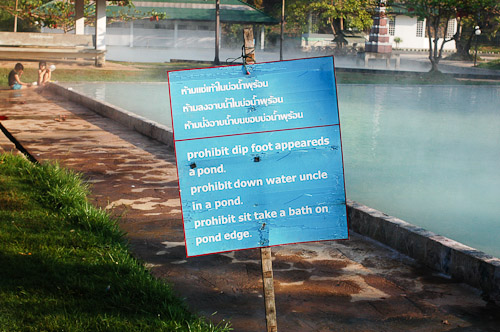
'A sign at Pha Bong Hot Spring, 12km from Mae Hong Son'.
Despite my intention to stem the flow of self typed updates, there were quite a few worthwhile articles on internet to warrant yet again another monthly update.
The Soaking Blogs During the past months I have been updating the links list. Some links have gone dead, mostly those of government sites and/or geocities sites which have ceased to exist. I've tried to replace some links, though others remain (dead) as the alternatives were non-English sites or links to PDF files which I feel reluctant to link to. Other links have altogether disappeared, but I'll maintain these in the listing, I've seen that with the growth in internet they can reappear again.
In all there are / were 376 links, one third of which come from Indonesia. Others with many links are Thailand (94) and the Philippines (69).
First hand visits now account for 28 of these links, over half of which are from Thailand. Maps have been added to give a (rough) idea of where they are located as Google Maps coverage of Southeast Asia is not yet up to standard whereby one can directly pinpoint the correct location.
On the Himalaya site more (descriptive) links have been added on soaks in Nepal, India and Tibet.
Southeastasian Soaking News Vietnam's Binh Chau hot spring, already one of the country's better developed hot springs, is set to be turned into a massive development site:
'The Kim To Trading and Service Co., Ltd late last week started work on its Binh Chau Hot Spring Villa project in southern Ba Ria –Vung Tau Province with a total investment capital of VND470 billion (US$254.5 million)'.
That last amount has the decimal in the wrong place, it's only US$ 25.5 million! Included are shopping facilities ...
Phuket, Thailand is adding attractions which it's visitors are supposed to love. Despite Phuket already being Southeast Asia's premier tourist destination, nothing is complete without a water park. So Phuket see's two water parks opening up for bizniz in the coming months (source). Surprisingly Splash Jungle includes a hot spring pool (natural or not?) which serves as an 'escape for parents'.And a wave pool, located just a few hundred meters from the beach!
In Malaysia, Sabah is all set to add another tourist trap in the form of a hot spring park in Tawau. Already possessing one of Southeast Asia's most sought out soaks (Poring; beware though, most visitors are quite disappointed), government and bizniz seem to think that more of the same is required. Apparently because not so many folk visited the natural springs development more development was needed so as to make the general public aware of the benefits of hot spring soaking. Tough luck for those nature lovers .... The 16+ ha park-like setting contrasts with the previous natural setting. Luckily the developers will also concentrate on ensuring that visitors enjoy fresh air.
Soaking Gone Crazy Yes, so it seems. From travelpod.com a (slightly delayed) report from 10,000 students gone soaking in Xianning, Hubei, China:
'A total of 10,012 students bathed simultaneously in the city's seven hot springs, setting a new Guinness World Record'.
Last month I highlighted the weird ways of soaking in Japan, unaware that all all this can be experienced in just one onsen in Hakone, Yunessun. Coffee and wine for instance. And:
'From there it got even crazier: Green Tea bath, Sake bath, Black Tea bath, and then a Japanese Traditional Bath. That one was super cool because it had literally 50 floating half-grapefruits in it, along with a ton of other fruit and lemons and citrus... just floating in it?! This is apparently a very traditional bath style and it rocked'.
Asian Soaking Etiquette Onsensoaker has a revealing post on wani's (Japanese crocodiles) who are making bathing uncomfortable for female soakers in Japan's (hot spring) baths. Trouble is that the more uncomfortable one is, the less females participate. This in turn means that the wani's have less to focus on, leaving the remaining victims who do soak, even more uncomfortable. Time for societies to change? At least the government should start opening the 'hunting season' for the wani's without giving too much coverage to the subject. As soon as the media pick up on this they have to picture it in black / white terms because they believe their public will otherwise not understand the issue at hand. To be continued.
Malaysian soaker in Korea experiences some awkwardness despite the absence of wani's:
'I kept looking at the floor so that I didn't have to see any...er...interesting things'.
In Hin Dat, Thailand a blogger believes it's all Russia's fault for the poor pool spring water quality:
'bus hordes of Russians were unloaded and headed straight for the pools. But … not a single specimen of the pallid northerners headed for the toilets. Well, a few minutes after dozens of Russians took over the pools a strange subtle odor seemed to emerge from beneath. Not the kind of sulphur smell. But an acrid, distinct urine-like smell. In an instant we were out of the water heading straight for the showers. Must have missed a similar busload the other day … Russians arrive there every day by the busloads, we were afterwards told'.
With this site I hope to get interest in the geological phenomenon known as hot springs. And enjoying them. Soaking. Here. In. Southeast Asia. In many countries visiting hot springs is a favourite past time, strange as it may sound in such steamy nations, hot springs tourism is well, er ... hot in Southeast Asia. I am trying to maintain this site with supplying first hand knowledge, trolling the net for other sources and hopefully contributions from other soakies. So if you ever feel the need to contribute just contact me,
jhdubbeldam@ hotmail.com
Soaking in Southeast Asia visited hot springs postings
Torrent
-
*tea_for_taryn*
*There is a snug, shady corner of my heart reserved for skinny dipping on
top of waterfalls. The same cannot be said for torrential downpo...
Harness
-
*bethy_the_vt_hiker*
*The Jhinu Hot Spring ✨️*
*Amazing... I highly recommend visiting when you are in Nepal 🇳🇵*
As usual, quite little to share, especi...
Cooked
-
*kamshingwai*
*Cooked ♨️🇹🇭 #hotsprings#thailand*
A look at a couple of photo's popping up from the soaks of Siam.
Starting south-ish.
Above Taryn hot ...
Spa Scandinave Les Bains Vieux Montréal
-
When you enter Spa Scandinave Les Bains Vieux Montréal, it is a very
different Scandinave experience. Though the circuit is familiar, the
setting is not. I...
The Terme di Sirmione and its Miraculous Waters
-
Featuring Guest Blogger Sophia Knowles We are pleased to feature a guest
blog by Sophia Knowles, who presents our first article on the geothermal
waters of...
Seoul, Dongdaemoon - Haevitch (Havitz) Spa World
-
Guest reviewer: Cami
This spa is on the 12th floor of the Cerestar building in Dongdaemun, right
behind the Migliore building. Exit Dongdaemun station at...
Spring Dance Hot Tubs Virtual Showroom
-
Our owner Dan Sine was recently interviewed about our company during the
Suburban Home & Garden Show last month.
In this quick video he talks about the hot ...