Batu city, located 25 km west of Malang, East Java is due to the natural surroundings and it’s climate a magnet for Indonesian tourism. (see also Batu's entry on wikitravel) Considering that potatoes and apples grow here, a hot soak is also a worthy pursuit.
The village of Songgoriti lies 5 km west of Batu. It is at the end of a narrowing valley just before the watershed divide. Songgoriti is well-known for it’s natural swimming pool (Tirtanirwana, but not for it's mineral water), it’s small touristy market and the developed hot spring. It also has good access to Cobanrundo waterfall just beyond the surrounding hill.However just 300m up from the market is the Air Panas Songgoriti complex (named Pa Pa?), which seems to be a resort with overnight staying possibilities as well as place accustomed just for visiting for the hot water. The source of the hot springs itself is not obvious, but there is an kidney shaped smallish pool and indoor bath tubs (15,000 INR; with jacuzzi facilities 25,000 INR (~2,75$US)) available for rent. That seems to be it. The facilities do look well kept and there is the added attraction of an ancient Hindu statue in the front garden. Not so many visitors though.
 The Air Panas Songgoriti hot spring complex. In front garden, ancient Hindu statue.
I opt out of a soak, at least until I have explored the surroundings in more detail. Just beyond the resort boundary a makeshift sign calls out once more 'Sumber Air Panas Belerang' (see lead photo), belerang implying sulphur. Down a few steps and one is besides a small stream with next to the stream a few cement protected springs. A couple of men are bathing by using the water from these bubbling springs as a mandi, i.e. they are throwing the water over themselves using a small bucket. The water itself is not as hot as one would expect. The bubbles are most probably formed by soda. The men wholeheartedly ask me to join in bathing. To my surprise one of the men is showering au-natural. I am compelled to join him. One of the springs. Sand bags protect it from wash outs. Note mandi's on the edge.
Enjoying the springs costs just 1,000 INRs (~0,10$US) which is collected in an honesty box, below the stairs.
Eastjava.com entry on Songgoriti with more info on the ancient statues. Another source adds: 'This old temple is located in Songgoriti tourism area and often visited by many tourists. Supo Temple is a heritage temple of mojopahit and believed by society around as place to wash heirloom thousands years ago'.
Getting there: From Batu (20 km west from Malang) head further west to Songgoriti. From the Songgoriti market it is 300m upstream, both places are on your left. Can’t be missed.Soaking experience: The hot spring resort looked well cared and maintained and certainly a soak is worthwhile here. Nearer the source(s) a real soak can not be had but a dunking, which has it’s merits as well. Beautiful surroundings as well, not locked in. Overall impression: Both the resort as well as the wild soaking area are well recommended. At least by this website …
 The main building: more happy soakers.
Comparing
Soaking in Southeast Asia and it’s sister / daughter sites focus mainly on countries within Asia where enjoying hot springs are less well-known practices and/or totally waiting to be discovered. In many cases these hot springs are under-developed or poorly developed.
Intending to seek out why in for instance Europe, soaking (and bathing) is very much a part of life, I was in the circumstance to visit a town known for it’s mineral waters while on business in Germany’s Harz region over the past summer.
Bathing History
Bad Lauterberg lies on the edge of the Harz, hemmed in by hills to the north, which shield the town from cooler winds. On the confluence of 3 streams, Lauterberg was known until the 19th century for mining, as was the whole of the Harz region. Wikipedia has a good entry on mining in the Harz.
It was then discovered that water emanating from lower layers of the mountains also contained high concentrations of minerals which can be attributed to an improved health level if frequently bathed in. Such was the interest that gradually the Lauterberg economy shifted from relying on mining (and metal manufacturing) to relying on bathing and it’s associated culture to survive; it became one of Germany's oldest spa-towns (source).
A few (up-scale) bathing places were created as well as the town undergoing development so as to make the bathers more happy, for instance the construction of promenades and parks.
Bad
Since the demise of mining, Lautenberg has been named Bad Lautenberg as in Germany much is gained by the term Bad. It is a government approved qualitative acknowledgment of being a place to bathe which can lead to an improved health status; a main reason why Germans are interested in ‘baden / kuren’ (and soaking).
In the case of Bad Lautenberg, the bathing waters are natural, though unheated. In Germany there is little difference between the two, as unheated waters are heated for bathing and both forms (heated and unheated) can be regarded as having significant health properties. This is scientifically backed up.
More famous bathing places such as Baden-Baden, Wiesbaden and Aachen do have natural hot waters. But not Bad Lautenberg.
Soaking in Bad
Bad Lautenberg possesses three locations for bathing. The choice falls on the Kirchberg Therme as it combines swimming pools with sauna without aiming at families, with the complete water circus of wave pools, slides, chutes and what have you. After all silence is golden ...
Connected to the Kirchberg Medical Centre, the therme (or spa) is part of the overall facilities used by ‘patients’ and/or guests. The therme consists of a restaurant, a fitness centre, two indoor swimming basins and a sauna complex.
Visiting on an early morning, most bathers were guests from the medical centre; use of the therme was free for these guests before 2 in the afternoon. The 2 modern free-form swimming basins were little used this morning (why?) and the cooler of the 2 pools surely could not be described as an attraction to me (too cold!).
Much better was the clothesfree sauna complex which contained a variety of sauna’s, a steam room and an outside swimming pool with extensive sunning lawn.
Somehow the larger swimming area required bathing clothes, possibly because the benefits of soaking should not be withheld from the less inhibited. However as said, the pools were mostly deserted whereas the sauna area was considerably populated by 20 or more patrons on that particular morning. Clearly most thought more highly of sauna use than of the possible advantages of the pool use; or couldn’t be bothered dressing up to use the pools.  A photo from the spa's own web site.
In front the two pools while behind the rocks is the sauna garden ...
A photo from the spa's own web site.
In front the two pools while behind the rocks is the sauna garden ...
Your notesComparing to any experience in Southeast Asia is hardly possible.
First of all there is Germany's love affair with hot springs, which dates back to at least the era of Roman occupation (Cooper-Erfurt & Cooper, 2009) Since, soaking modes in Germany have waxed and waned, but to Germans soaking or 'kuren' is a scientifically proven method of medicine.
How important is this? - For instance the bible of Germany's spa's, Größchen's
'Heilbäder und Kurorte in Deutschland. Conradi-Bäderkunde-Lexikon'
counts more than 600 pages!
- In 2006 nearly 6.5 million soakers were recorded (Erfurt-Cooper & Cooper, 2010); visits lasting multiple days .
One must also note that when taking a longer wellness treatment German health insurance will covers this. No wonder soaking is so important ... See also the following: 'Today, Germany has one of the most comprehensive spa cultures in Europe, with the support of the German federal health care system to boot! The German equivalent for spa is Heilbad or 'healing bath' or Kurort which literally mean 'cure place'. Any town in Germany can qualify and choose to use the prefix 'Bad' or bath before their town name i.e. Bad Soden. Those towns that qualify have met the strictest air and water quality standards and have been able to establish the necessary medical staff and infrastructure to cater to those seeking treatment.
...
Once a Kur or cure therapy has been approved, a patient will be sent to a certified Kurort or spa where a patient will enjoy a holistic experience of exercise, nutrition, relaxation, communication and motivation custom-fitted by doctors and medical staff. The focus is to provide a Kur guest with the best possible natural environment to cure or prevent the further development of illnesses'.
Then there is the level of facilities to draw in the comparison.
Concerning the emphasis on medical efficiency in Germany and German cultural pursuit of high standards, levels of hygiene are extremely high and are first most in thoughts of managers.
Competition between facilities means that increasingly higher lay-outs are required and for the visitor this means the facilities are more and more luxurious and at the same time larger and more diverse.
But other than these two aspects (medical culture / standards ) I believe there is little that would differ between soaking here in Southeast Asia and in Germany. In general soaks in both are mostly visited by locals, most patrons are slightly older and / or health conscious. Having such facilities in Southeast Asia could be possible, though the price differential would exclude most locals.
So an in-between situation could be created. For instance hygiene is greatly lacking at 99.9% of Southeast Asia's soaking sites, but simple measures need not cost too much but can result in far better hygienic situation.
My own preference? Well that would be a bit unfair. making a choice. The soaking culture in Southeast Asia is mostly non-existent and / or real foreign to myself whereas the experience above isn't ...
Followers may have noted that most of my effort has been directed towards the Hot soaks of the Himalaya blog, which has detailed listings of many (if not most) hot springs in or near the Himalaya. I am still to include more, but from regions further away.It's also good to see that the number of visitors to that site is matching those to this site!On this blog site coming are more entries from a recent journey to Central and East Java, which I liked a lot. Also to be included is a report from a visit to a wellness center in Germany.Socialism
In actuality there's not much to be updated on. One of the premier spa resorts in Asia, the Banyan Tree gives some additional info concerning it's management culture. Ho Kwan Ping, the founder, reveals that challenging the authorities in the past has helped him shape the Banyan Tree now. He's a ‘Capitalist in his pocket and socialist in his heart’. A brand criterion: 'all swimming pools must be built in such a way that guests can skinny dip without being seen beyond the walls of the villa'. If the Banyan Tree got itself involved with hot springs, now there's a concept ... But despite the socialist talk, Banyan tree is totally focused on the free spending elite ...
Hot hippies?
A hot spring in pill form? 'You can re-create the hot springs in your own bath as I do'.
Suzy Cohen (who can be 'reached' at www.DearPharmacist.com) proposes adding all kinds of minerals to your bath, so as to gain the same benefits from a bath at home as you would from a soak in the 'wild'. Unfortunately it's not clear whether there is such a pill or that she proposes taking a whole bucketful of pills. Nonetheless I can imagine people being enticed by this. Does it already exist?Elsewhere she has to answer a queries about her Facebook page which includes a photo of her soaking in a Utah, USA hot spring: 'Q: This maybe personal, but are you sick? What is in the water that is so healing? I'm curious because around here, hot springs are for hippies only [!]'.
'A: Hippies? I am an Aquarian, so perhaps I qualify. The mere thought of hot springs brings a rush of peace into my body and a deep breath. I prefer undeveloped hot springs that are nestled deep in the woods or amidst a waterfall.
...
The waters contain minerals and sulfur compounds which go right through your skin to soothe aching muscles, ease joint pain, improve circulation, relieve skin irritations, boost immunity and ease breathing difficulties. Sulfur-based compounds help unstick dangerous pollutants. The experience can create harmony, because you are soaking up healing nutrients from ancient waters bubbling up from the Earth's core, and you absorb energy from the fresh air, the Earth, the trees and the sun'.
Not sick thus.
This last mentioned aspects fall much in line with a thread on soakersforum.com concerning 'spiritual aspects of soaking'. Unfortunately I have yet to come across any spirituality in soaking here in Southeast Asia other than that awarded to water in general.MalaysiaA previous link to a Malaysian language blog entry concerning Kunak hot spring has been changed. Apparently according to the new link the springs here are not only hot but salty as well.Caution must be applied though to this as of yet undeveloped hot spring: 'Fredolin [Sabah state Mineral and Geoscience Department senior geologist] advised visitors not to simply taste the hot water in order to avoid untoward incidents. “We are concerned that the water could contain toxic susbstances such as mercury and arsenic”, he added'.
Elsewhere there is a 'mud volcano' closeby. Can't resist posting this picture from Semuakonak, even though it's not a hot spring: Bhutan
- At the beginning of June it was reported that repairs to Bhutan's premier hot spring (required due to a flash flood) would involve the Japanese. Though in this more recent report, the Italians seem to have outbid the Japanese.
Philippines- The Daclan soaking vs. geothermal energy production quandry has once more delayed geothermailty as the local government favours local sentiment (should they do otherwise?) against geothermal energy according to this press clipping.
Indonesia- From the same source, more reports of favourite soaking haunts being developed to provide more energy.
China'If a man swims naked in a pond and there are no women there to see him is he acting immorally? A group of men in Yuxi who use a local reservoir as a nude swimming social club say the answer is "no".'
This shocking story (though not concerning a hot spring) uncovered by the blogoshere at the end of June. It concerns a small lake near Yuxi, Yunnan, where this tradition has just been found out. Apparently no outcry as of yet. 'Pundits such as Southern Daily columnist Ao Tianma say that the legality of nude swimming is open to interpretation. The law stipulates that public exposure must be flagrant in order to be a crime, and it is unclear if that label applies to such a secluded area.
...
For their part the One Hundred Birds [local swimming club] simply want the recent media attention to go away. A club member surnamed Yang was quoted as saying, "We just want to keep the place and go about our swimming quietly."
A great story nonetheless which literally reveals that bathing practices even in China are diverse. But also how internetisation (or may we also add, a form of cultural globalisation) is threatening this diversity and conditioning all non-mainstream practices to fit in with just the single line of thought. So much for the internet being a tool of power!

Volcanic or not? Though one associates volcanoes with hot springs, in reality this is not always the case. On Java, Indonesia, there are many (distinct and active) volcanoes. This though hardly implies there are many hot springs.
That said the hot springs there are, are close to volcanoes, Java virtually being an island of volcanoes.On the very distant slopes before the Lawu volcano mountain becomes part of the riverine plain surrounding Solo city, lies the hot spring of Bayanan. Coming from the northern plain city of Sragen (itself 30 km from northeast of Solo) after 15 km and just beyond the village of Sambirejo, the paddy fields give way to small hillocks covered in teak.Past
Located in this area, the hot spring of Bayanan is located 2 km beyond the village of the same name on a recently laid asphalt road. With the parking area also covered with the same new surface, it’s a disappointment to see that whatever constituted the recreation area of this hot spring, it’s features are now clinging on to dear life. Private warungs (shop stalls selling everything and doubling as restaurants) seem ok, but the public facilities for which further up the road 2,000 INR was paid (~0,20 $US), are gradually deteriorating.Despite this, on this Saturday morning, a number of youthful (and very silent, or were they just shy?) couples were occupying the few and far between seating areas. Two small kids were the only ones active; their efforts were focused on throwing bucketfuls of water to the encaged eagle which had little choice than to accept this fate as just one of those days. It was one of those places.The soak?
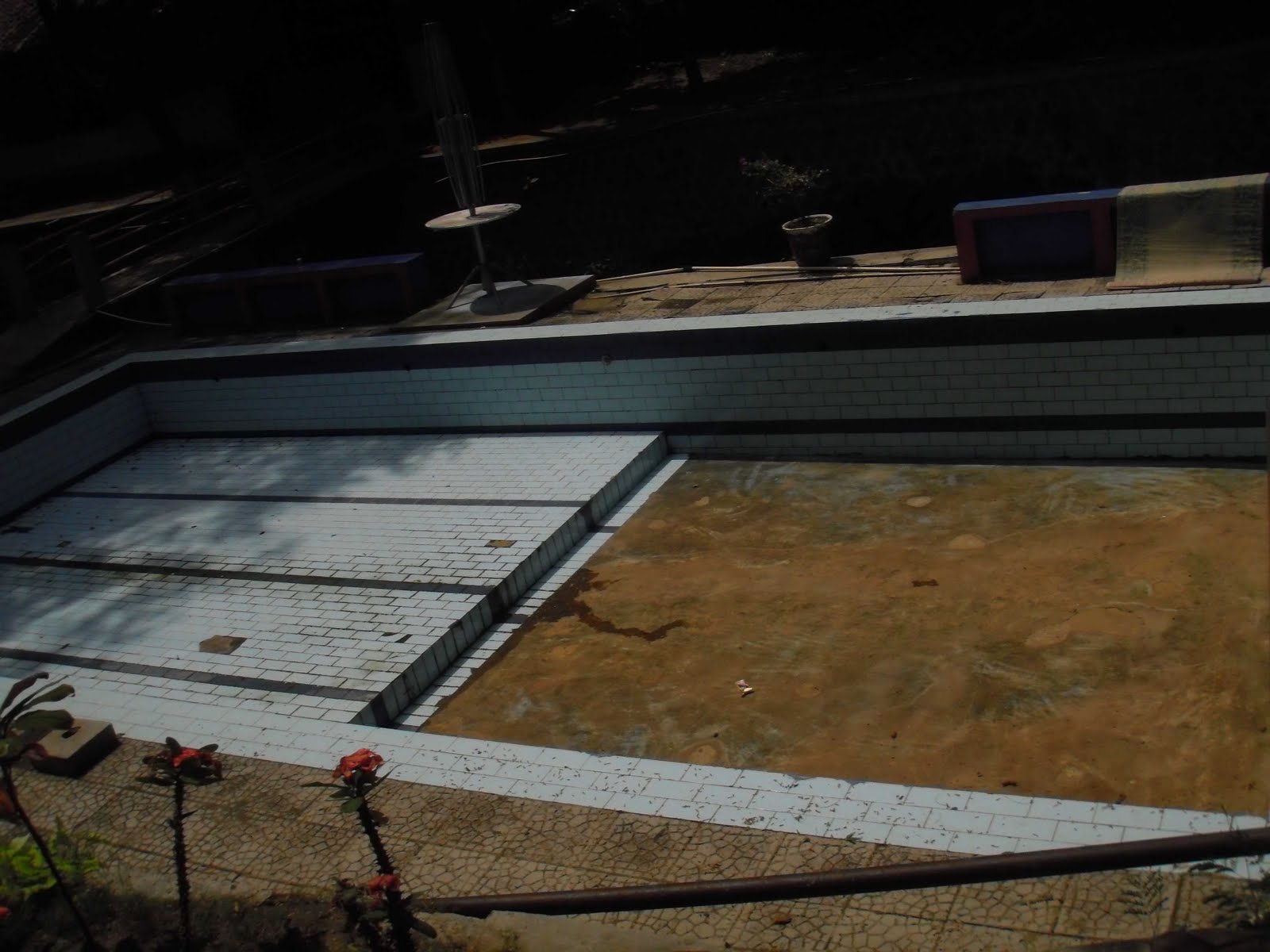
Soaking might have taking place in earlier days in a larger swimming pool, but possibly as this was the drier season, the pool was empty.
Beyond the pool is a cemented enclosure which had to be the source. The small view of it’s interior revealed only a reflection, which has to be attributed to a water surface.
Continuing, thick water pipes lead to a number of bathing cubicles which in contrast to the rest of the area, have been maintained. Inside are a bath tub and enough space to change.
It looks clean, so a soak can be enjoyed, why else come here. After the soak, it’s another 2 hour journey to cover the 50 km back to Solo. In just two hours.
Other sources
The local government website of Sragen regency has extensive info on the Bayanan hot spring recreation zone. Which includes all info on how to get here and photo's from better times. 'Through scientific research was known that hot water and the substance that were contained inside it was suspected came from the touch magma (geothermal) that touched the source very deep ground water and to was felt in the surface as the source of hot water. Hot exact water in his source + 44 0 C, and after until the surface in the bath to + 36 0 C, in accordance with the temperature of the human body, so as to will be felt was glad and comfortable to bath. Investigation that was done by the Balai Penyelidikan Dan Pengembangan Teknologi Kegunungapian Yogyakarta showed the existence of many elements/the chemical compound that was contained in the Bayanan Hot Water Bathing Place including the sulphur (Sulphur)'.
Tourists are to be persuaded by this text. A selection: 'Bayanan hot spa is considered to have many advantages in curing many kinds of diseases, such as f rheumatism, itch, and so an. Many visitors coming to this place have proven that the hot spa in Bayanan is really curable. Besides curing several diseases mentioned above, this hot spa can also decrease cholesterol level in blood, revitalize our body and muscles, relieve the tiredness, and keep us young'.
A video perhaps?
 Getting there: Sragen is closest major town, conveniently found on the main highway from Solo to Surabaya. Train also passes through here. Getting to Bayanan might mean finding some kind of deal with either a small microbus or an ojek (motorcycle). Bayanan is well known, not far from Sambirejo.Soaking experience: The water was hot, but not too hot (see above). The bath was clean. The cubicle was dark.Overall impression: Not really worth all the trouble to get out here. Cheap though.
 Seldom can one expect to find anything remotely describing worldwide soaking experiences, other than a number of websites. Let alone a full blown scientific publication.However Patricia Erfurt-Cooper and Malcolm Cooper (both connected with Ritsumeikan Asia Pacific University, Kyoto, Japan) are most probably the first and are putting down the stakes. Besides initiating soaking as a science, they are drawing on worldwide experiences of soaking, contrasting most current scientific literature on hot springs which never comment on the practices of soaking themselves other than the odd mention of bathing taking place. That said their focus is not solely on hot springs but the overall 'wellness tourism'. And though there are many similarities between soaking in hot springs and taking the waters in spa's, there are also the significant difference of naturalness of the source of water. Especially in Europe and increasingly elders hot springs are offering more 'products' (massage, beauty therapies, etc.) thereby blurring these differences. Specifically the authors provide us with info on the global spa and wellness industry and it's historic roots, from ancient Pakistan to today. Other chapters look at the cultural and religious significance of water (and thus bathing), the geological background of springs, the tourism environment, economics, management, marketing and technology of wellness tourism, as well as the presentation of case studies.Summarized the findings of the study are:
- Springs are often located in active volcanic environments,
- Despite geography hot springs worldwide have religious (and/or traditional) similarities',
- Historically, development of hot springs has waxed and waned. This indicates their continuing significance.
- Multiple use of hot springs for non-bathing purposes,
- Hots springs are often synonymous with curative and therapeutic values. Information on both is lacking,
- Especially in Europe springs have been part of the medical tradition,
- Differences in hot spring use are often determined by local socio-cultural conditions, as well as factors such as access, temperature and development status of the hot spring and
- No culture can claim first use.
It also pinpoints gaps and challenges, some of which concern information supply. Outside of North America and Japan, little information has been compiled (other than this site). Soaking need not be the only use. Increasingly development of hot spring sites include a trend to presenting them as waterparks. Within tourism literature there seems to be lacking researched demand.In no doubt this book does provide extensive insight and manages to compile a backlog of literature references. That said the simple occurrence that this blog was not part of accessed websites despite the wealth of info, shows that there is still heaps of information to be compiled.
The blurring of the text with upcoming wellness tourism (though economic more significant) does not necessarily make this a must read publication for soakers. Yes, there are highly informative pieces but also less interesting chapters.
Wellness tourism as such derives from cultures where taking the hot waters has always been important.Specifically the authors miss considerable information on Southeast Asia and manage to lop in Taiwan as well, while listing the Philippines in the Pacific. Indonesia gets a small paragraph despite it probably being one of the best places to find hot springs in the world. Thailand though does get more coverage, even though the places listed fail to attract specific soaking customers; hot springs in Thailand are used by locals for therapeutic reasons while tourists visit out of curiosity.And though there may be similarities worldwide in soaking, the actual method (and tradition) of soaking is only briefly discussed. Much is made of the risk factor due to contaminating water (due to poor circulation), little of how for instance Japanese maintain absolute hygiene (with Iceland a close second) and the lack of hygienic bathing traditions in many lesser developing nations (for instance Southeast Asia ...). And though significance is given to Roman culture for the spread of ancient bathing traditions and embracing soaking, the role Japan played in developing many of Asia's hot soaks is neglected .Other aspects which I thought might constitute more research are the fact that many of the bathing traditions stem from countries / regions where bathing in warm or hot water are a treat in colder months. How would this tradition translate itself to Southeast Asia, where most soaks are located in hot climates. Does the water loose it's value therapeutic / medical value when cooled? Is heat part of the therapeutic process?Another aspect is the fact that it focuses on water as the corner stone of this aspect of wellness tourism. In the absence of hot water, cultures have used hot air (sauna's, steam baths) for much of the same aspects, combining social life with 'health' aspects. Modern day wellness traditions seem to focus much more on non-social aspects, affording personal exclusivity as another selling point (four, six hands massage). The presentation of case studies fails to back up the literature. The case study for instance includes two pages on what a hot spring in Australia might develop.All-in-all despite the promise, slightly disappointing. A wealth of references and a stimulus for improvement nonetheless.ReferenceErfurt-Cooper, P., Cooper, M. (2009) Health and Wellness Tourism: Spas and Hot Springs. Aspects of Tourism 40. Channel View Publications, Bristol, United Kingdom.Available from Publisher and Amazon.
Copyright 2009 © Soaking in Southeast Asia. All rights reserved.
No reproduction or republication without written permission.
 Batu city, located 25 km west of Malang, East Java is due to the natural surroundings and it’s climate a magnet for Indonesian tourism. (see also Batu's entry on wikitravel) Considering that potatoes and apples grow here, a hot soak is also a worthy pursuit.
 The Air Panas Songgoriti hot spring complex. In front garden, ancient Hindu statue.
 One of the springs. Sand bags protect it from wash outs. Note mandi's on the edge.
 The main building: more happy soakers.