Personal
With the gradual expansion concerning my personal experience on hot springs and the ever growing know-how of hot springs themselves, I have been thinking about how can we add additional original content to the experience concerning natural hot springs soaking, the (bathing) culture involved and the increasing need for conserving the few natural hot springs remaining?
One idea is to make conservation, natural bathing and cultural awareness a recurring theme in these posts. Witness past updates on this blog.
Another idea is to expand to other internet media; with tumblr this is a resolute success, whereas Facebook somehow has missed the bus altogether ...
Another idea I want to give a try, is to seek alliance's between persons who have similar views or are at least passionate about bathing in natural hot water(s).
Through the years I have noticed quite a few persons who present their love for soaking either through business associations, through tourism promotion, through consumer consumption or through internet presentation.
This alliance could take place through actively seeking out these persons by presenting interviews where they can put their views forward or try to understand their thoughts / experiences on soaking in hot spring.
To launch this series of interviews, I have approached the public face of Peninsula Hot Springs (Victoria, Australia), Charles Davidson. Besides being an inspiration and the driving force of Peninsula HS, he has gone out of his way to highlight cultural aspects and conservation of natural hot springs. More recently he put himself forward at the 2013 Global Spa and Wellness Summit where a special forum on global hot springs was held as a means of upgrading our knowledge on soaking in general.

Introducing Charles
With the gradual expansion concerning my personal experience on hot springs and the ever growing know-how of hot springs themselves, I have been thinking about how can we add additional original content to the experience concerning natural hot springs soaking, the (bathing) culture involved and the increasing need for conserving the few natural hot springs remaining?
One idea is to make conservation, natural bathing and cultural awareness a recurring theme in these posts. Witness past updates on this blog.
Another idea is to expand to other internet media; with tumblr this is a resolute success, whereas Facebook somehow has missed the bus altogether ...
Another idea I want to give a try, is to seek alliance's between persons who have similar views or are at least passionate about bathing in natural hot water(s).
Through the years I have noticed quite a few persons who present their love for soaking either through business associations, through tourism promotion, through consumer consumption or through internet presentation.
This alliance could take place through actively seeking out these persons by presenting interviews where they can put their views forward or try to understand their thoughts / experiences on soaking in hot spring.
To launch this series of interviews, I have approached the public face of Peninsula Hot Springs (Victoria, Australia), Charles Davidson. Besides being an inspiration and the driving force of Peninsula HS, he has gone out of his way to highlight cultural aspects and conservation of natural hot springs. More recently he put himself forward at the 2013 Global Spa and Wellness Summit where a special forum on global hot springs was held as a means of upgrading our knowledge on soaking in general.

Introducing Charles
Despite it's size, Australia seems not to be well-endowed with reference to the occurrence of natural hot springs. Certainly if compared to many Asian countries.
With the exception of a few scattered hot springs, Australia is far from a soakers haven.
Well, at least until recently.
Dedicated hot spring followers will have noticed that the internet savvy crowd are mass photo-opting the Peninsula HS (website), located roughly 100 km south of Australia’s second largest city Melbourne.
Dedicated hot spring followers will have noticed that the internet savvy crowd are mass photo-opting the Peninsula HS (website), located roughly 100 km south of Australia’s second largest city Melbourne.
The increasing popularity is due in part to the vision and perseverance of Charles Davidson.
While working and living in Japan during the early nineties of last century, Charles became accustomed with the Japanese love of hot springs with it’s specific bathing culture.
Some years later, by coincidence he came into knowledge about the existence of hot springs buried in shallow rock not so far from his home town of Melbourne. Forming a partnership with his brother Richard and Norm Cleland, it took five years before a bore-hole revealed 54 degrees hot water found at
more than 600m below the current site.
With development starting slowly, it has only been in recent years that visitor numbers to Peninsula HS have swelled.
Rather than focusing bathing activities on a sole water basin, Peninsula HS is a testament to many of our globes styles of hot water bathing practices, which are combined with many well- and lesser-known wellness practices.
With annual growth of 30% during the last year, one can see that the vision has paid back. Peninsula HS is now not only a leader in Australia’s wellness sector, it is also one of Victoria's prominent tourism destinations. But more will be in the offering as plans are under way for their stage three of the Peninsula HS blueprint for development.
Charles, you have experienced many a hot spring in the world, but what would have been your most favorite experience?
"There are many incredible hot springs around the world and selecting one to be my favourite would be like trying to select one of my four children as my favourite - really impossible. So I'll provide three, and provide a brief explanation and a photo of each".
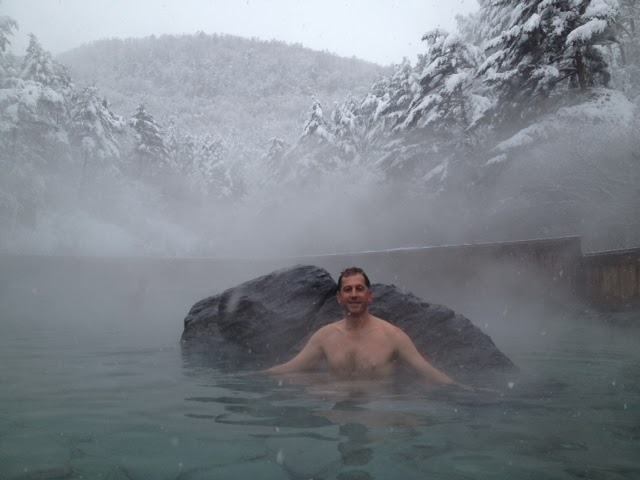
'Sai-no-Kawara hot springs in the town of Kusatau in Japan. This was the first place I enjoyed natural hot springs in March 1992 and was the experience which started my lifelong passion for hot springs bathing. It was in early spring and the open air hot springs looked out over snow covered trees and the surrounding mountains. I has an epiphany in that pool realising that this was the most gentle and relaxing experience. At that moment I decided I wanted to help people relax in the environment and with each other through the connection of thermal waters. I had been seeking a way to bring together global cultural understanding in a harmonious and sustainable way and thermal waters was a natural connector. Photo taken in December 2013'.
D.I.Y.
When one reads the development story of Peninsula HS, it is evidence of persistence and dedication to fulfil in part your dream.
Concerning the development of Peninsula HS how have you been able to pay the development costs without any certainty about the outcome of both the exploration as well as the development?
You have been successful in introducing many of the world's bathing experiences to Peninsula HS, but without the traditions associated. Is this against your philosophy, is it driven by commercialism or do you believe that Australians will be put off by f.i. nudity?


Many hot springs worldwide are falling victim to development. Companies are taking over community run resources and changing these into bland, run of the mill, catering to the rich and famous hot spring facilities where the original community is barred and bathing traditions are based on individual-based mainstream therapies. None more so than in China.
Do you believe mainstreaming hot spring development such as for instance your participation in the aforementioned GSWS '13 will hasten the disappearance of community, natural and often rustic hot springs? Or will it highlight the need to maintain a certain naturality?
Notes
The photo's of Sai-no-Kawara, Mataranka and Khirganga are used courtesy of Charles Davidson.
For more information on Sai-no-Kawara, visit one of the many English language websites f.i. this one. For Mataranka Bitter Springs visit this website. And for Khirganga see a posting on Hot soaks of the Himalaya on Himachal Pradesh.
More recent info on Charles Davidson and Peninsula Hot Springs. Mind you this is just a small selection ... :
[1] Ah Chee, D. (n.d.) Indigenous people's connection with kwatye (water) in the Great Artesian Basin
(Save and exchange .aspx file extension with .pdf)
When one reads the development story of Peninsula HS, it is evidence of persistence and dedication to fulfil in part your dream.
Concerning the development of Peninsula HS how have you been able to pay the development costs without any certainty about the outcome of both the exploration as well as the development?
"I feel very fortunate to have been able to lead the life I have had. Passion, perseverance and determination are a few of the traits that have made Peninsula HS possible.
We started with very little money and a dream to bring the wonderful sensation of hot springs to Australia. We have grown slowly over the past eight years, one bath at a time. The money we receive from each visitor to Peninsula HS is spent on staff, maintenance of the facility, community projects and the continual development of the facility. More than 90% of the profit is re-invested into the business and the evolution of the master plan for the site. It all takes time, so patience is also an important trait".Many of your visits have been to natural occurring hot springs. Can hot springs emanating from bore holes (such as Peninsula HS) be categorized as natural? And irrespective of this, do you believe the future ahead for experiencing hot water bathing is by expanding the number of boreholes?
"Certainly the water that comes from bores is natural and the heat source is also natural so in that sense they are natural. There is, however, a very clear distinction between a free flowing natural hot springs and a bore fed hot springs. I prefer the idea of free flowing hot springs but very often these are only available in remote locations and are very inaccessible.Understood
I think there is a future for both free flowing and bore fed hot springs. Bore fed hot springs enable the relaxation of hot springs to be available to more people. Making sure that our interaction with the environment, and specifically in this instance water resources, is sustainable is essential."
You have been successful in introducing many of the world's bathing experiences to Peninsula HS, but without the traditions associated. Is this against your philosophy, is it driven by commercialism or do you believe that Australians will be put off by f.i. nudity?
"There are many bathing practices all over the world. Depending on the country and the culture of the country the way of enjoying the hot springs varies. There are actually very few countries where bathing naked is practiced. In Germany male and female bathers all bathe naked together, in Japan male and female bathers have segregated naked bathing areas (that is since the Meiji Restoration in 1868 - before then there was no segregation), and apart from that there are a few rare naked bathing venues in U.S.A., China and Europe.
The remainder of the world (Middle East, North and South America, Africa, China, Russia, all around Southeast Asia, etc) wear bathers in hot springs. I believe cultural factors are behind this and not commercial factors.
It is also cultural factors and not commercial factors that were behind the choice to require bathing costumes to be worn in the main bathing experiences at Peninsula HS. We have always wanted to provide bathing experiences in which people of all nations and all ages can enjoy together. One of our company visions is achieving 'International understanding through hot springs'. If we only offered naked bathing we would be alienating most of the cultures of the world.
That being said I personally believe that naked bathing is a much better experience - it feels better. At Peninsula HS we do also offer the opportunity for guests to bathe naked in private indoor and outdoor baths and pools. Guests hire these pools for 30-60 minutes and can choose to bathe with or without a bathing costume. In the future I would also like to offer a Japanese bath house experience in which people can choose to enjoy the traditional Japanese style of bathing. We have many more bathing styles that are planned to be introduced at Peninsula HS. These have been, and continue to be, learned from travels to hot springs all over the globe. Our business is in a constant state of evolution and change".
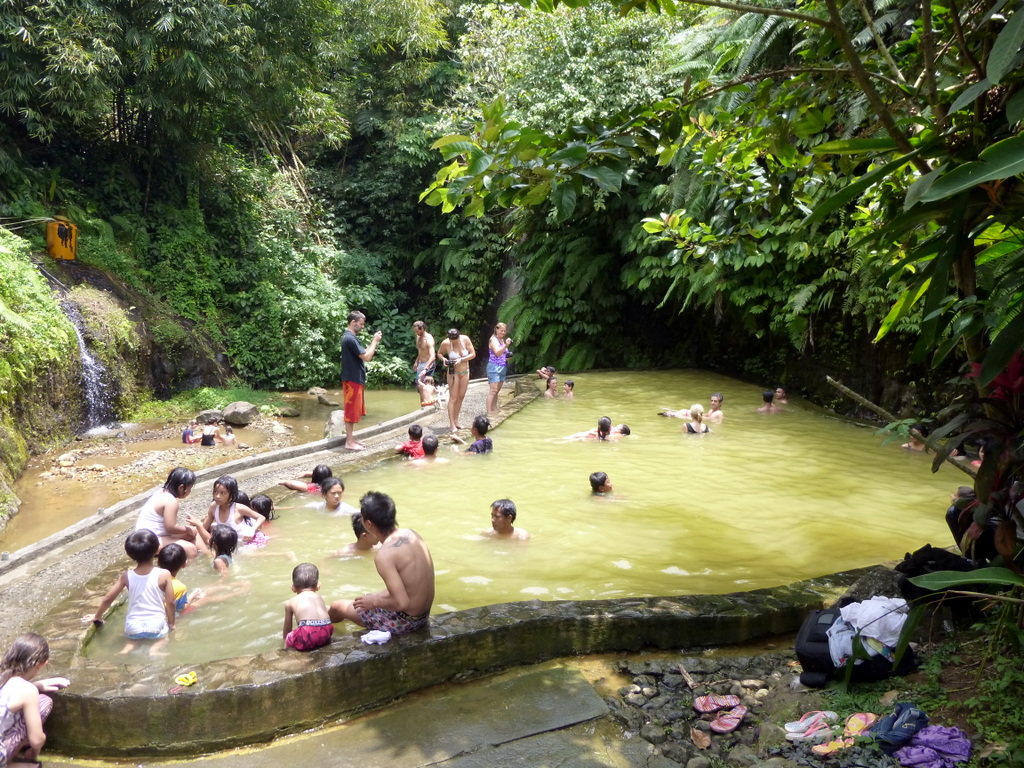
To what degree would you support conservation of the very few natural hot springs left in this world?'Bitter Springs at Mataranka in the Northern Territory in Australia. The Bitter Springs are literally a river of crystal clear hot springs that flow over limestone and are surrounded by palm trees and a tropical oasis in the centre of arid semi-dessert country. Visitors can swim and dive (with snorkels and goggles) in the thermal waters together with fish and turtles. Many birds fly overhead in the tall trees. My children swam in the waters and said, 'this is better than the Great Barrier Reef'! A very big statement indeed. We visited Bitter Springs on a family driving holiday in September 2011 when we drove across Australia from North to South (Darwin to Melbourne)'.
"Sustainability is a key prerequisite for any business and hot springs are definitely no exception. To evolve hot springs into a global industry that offers natural relaxation and wellbeing to many people can only happen if it is done with the highest level of integrity and concern for the environment.Can you report on your active participation with the Global Spa and Wellness 2013 Summit (GSWS '13)? Is this the right venue for putting hot springs on the agenda?
I am currently involved in a 2-3 year research project called 'Global best practice in the hot springs industry'. The original goal of the research was to create a blueprint for the creation of the hot springs industry in Victoria, Australia. The study involves learning from hot springs cultures all over the world how they use hot springs for the health and wellbeing of their customers and communities. Central to the research is the question of sustainability and resource management. Without learning there will be no understanding and without understanding there can be no systems around the conservation of and respect for the natural gift of hot springs. The study is looking at both commercial operations and also at traditional indigenous cultural connections to hot springs. You will also see in the details of the Global Hot Springs Forum [below] that I was suggesting that the global hot springs industry could come together to build hot springs facilities as community projects in developing countries. These would have to be built sustainably using the natural resource and with the highest level of cultural respect and understanding".
"If the hot springs business is to provide a service to the communities they need to be able to operate at a profit. The GSWS is a gathering of people active and interested in health and wellbeing and coming together to help shape the future. The knowledge gained at the conference is shared with the world free of charge.
In the case of the Global Hot Springs Forum held for the first time at the GSWS in Delhi, India in October 2013, it brought together people from the hot springs industry in many countries. There was a panel of hot springs representatives who lead the discussion. Panel members came from Germany, Japan, China, New Zealand and Australia. The individual presentations from the Hot Springs Forum are available on the GSWS'13 website on Day 3 Monday 7th October.
From the minutes of the forum you will see in this document some ideas for the future evolution of the business and how global hot springs are able to work together".
Home & Away'Khirganga hot springs, Himachalpradesh, India. A days hike along goat and sheep trails from the town of Manikaran in the Indian Himalayan mountains this is a natural hot springs paradise. It is only open in the summer months and in winter is deep under snow. There is a shanty backpackers tourism village built below the springs'.
Many hot springs worldwide are falling victim to development. Companies are taking over community run resources and changing these into bland, run of the mill, catering to the rich and famous hot spring facilities where the original community is barred and bathing traditions are based on individual-based mainstream therapies. None more so than in China.
Do you believe mainstreaming hot spring development such as for instance your participation in the aforementioned GSWS '13 will hasten the disappearance of community, natural and often rustic hot springs? Or will it highlight the need to maintain a certain naturality?
"I think it is better to create forums and have discussion on all topics rather than not to have them. There are many issues that need to be addressed and your concern and respect for the maintenance of traditional cultural values and practices is certainly one of them. If discussion does not occur, and particularly at the level of the participants of the GSWS, then there will not be any opportunity to create frameworks around which the industry evolves. Global best practice in the hot springs industry can only be understood if it embraces and involves people from all over the globe".You describe that there are similarities between Peninsula and the aborigine belief being one with the land. Do Aborigines have connotations with (hot) water?
"There is a long and established tradition of Aboriginal connection to the land and water. Hot springs are found in various parts of Australia and Aborigines have had a connection to them for many thousands of years. Probably the best article I have read that explains the relationships of Aborigines with hot springs is by Dean Ah Chee [1].
I will be travelling in April to the desert country of northern South Australia to meet and learn from Dean Ah Chee the author of this article and a park ranger".
I have heard the
bathing world as follows: Asia-natural, Europe-medical,
America's-relaxing. Do you really believe this is so clear cut?
"At the broadest level I think this observation is correct. However the division I use is:Charles, thank you for your participation in this interview. I wish you all the best and hope you continue to highlight the ideas and philosophies put forward above. And of course all the best for the future of Peninsula Hot Spring!
In my presentation at the GSWS Global Hot Springs Forum I changed this by taking out U.S.A. (which offers a combination of Asian and European plus public thermal pools) and adding in 'India - Spiritual'.
- Japan / Asia - natural bathing,
- Europe - medical / health bathing,
- U.S.A. - spa industry (retail product driven commercial motivation)
I recently completed another hot springs research tour in U.S.A. and Canada (in September / October) and can say that the majority of hot springs in U.S.A. are natural bathing style.
There was a strong thermal bathing tradition in U.S.A. a hundred years ago and that largely came from Europe with major influences from the medical / health bathing tradition. The emphasis on medical and health cure caused its downfall as it came head-to-head with the rise of allopathic medicine and the pharmaceutical industry. It became much easier for consumers to take drugs to find answers to their illnesses than travel, often great distances, to spend weeks at hot springs wellness centres.
The reality is that there is a huge divergence in all aspects of global cultures and hot springs is no exception. It is impossible to be clearcut about any categorisation as in most countries one can find all these styles of bathing. These divisions are just generalisations to help develop understanding".
For more information on Sai-no-Kawara, visit one of the many English language websites f.i. this one. For Mataranka Bitter Springs visit this website. And for Khirganga see a posting on Hot soaks of the Himalaya on Himachal Pradesh.
More recent info on Charles Davidson and Peninsula Hot Springs. Mind you this is just a small selection ... :
- Peninsula Hot Springs: Our story so far
- Business Times (Dec. 18, 2013): A life in hot water can be a good thing
- Love the Peninsula: Peninsula Hot Springs
- The Age (June 24, 2005): Brothers keep dream afloat
- Interview with Charles Davidson on Landtalk episode 4 (August 23, 2012)
- Fun Travel TV Show (February 8, 2013): Peninsula Hot Springs: A must do experience
- Peninsula Weekly (August 27, 2012): Brothers spring into education project
[1] Ah Chee, D. (n.d.) Indigenous people's connection with kwatye (water) in the Great Artesian Basin
(Save and exchange .aspx file extension with .pdf)