Monday, 9 November 2009

Updates for October 2009

A few changes on the site itself. I've created a mirror site dedicated especially for Thai soaking sites, aptly named Soaking in Siam, while at the same time I've added another blog site concerning Waterfalls in Southeast Asia. Though a soak is great, sometimes a cool soak can be just as invigorating. What's more, like where I live in Cambodia, there's only the 1 soak so visiting waterfalls makes sense, sort of. I'll leave the reader to decide on that ...

There have also been a couple of smaller changes as well on the site, most notably the linkwithin widget. It has instantly became one of the better referrers. See also the Top Posts. How the ranking works I don't know, but already 6 posts are graded at 10 (out of 10). By the time the whole top 10 is such rated I'll have to ditch this widget, doesn't add much.

News / Features
Roxanne
An interesting post by Roxanne Downer which is to be published in Spafinder titled
'Spa Customs around the World'.
Spafinder mentions its global reach but has only 3 hot spring spa's in Asia (out of 5,000), one of which is in Southeast Asia (
COMO Shambhala, Bali; which actually is not a hot spring spa ...).

Anyway Roxanne's article tackles the most anxiety causing issue, nudity apparently:
'Understandably, being undressed with someone you’ve just met can feel awkward. It certainly doesn’t help that customs regarding nudity at spas vary from country to country'.
If anything most people have problems being naked with people they know...
She then cites an Italian spa marketing manager who explains that it's due to Catholicism that nudity is a no-no in that country. Funny that in catholic France, Spain and Austria there are less qualms. Roxanne fails to guide us through on this the most anxious issue ....

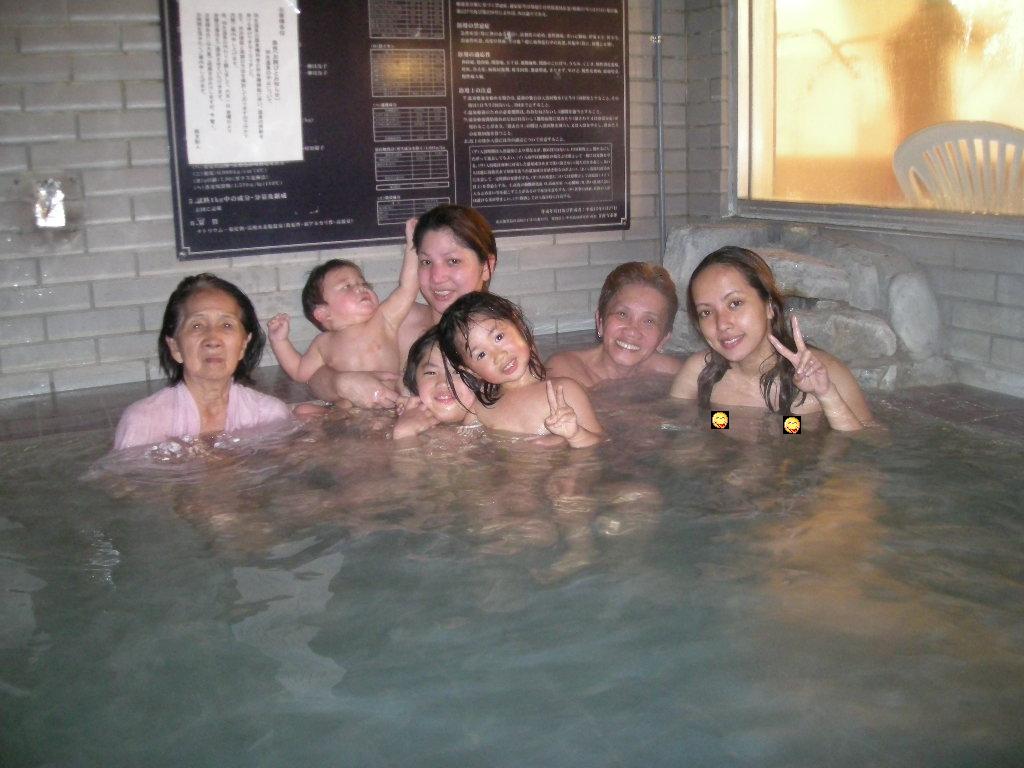
Filipino (and Catholic?) Jhayelle Schluter takes undoubtedly a for Roxanne confusing bath in Japan.

Then feel reassured as:
'take comfort in the knowledge that, in many locales, single-sex treatment areas or hours and same-gender therapists are the norm'.
That's probably the conservative American in her speaking.

She then highlights how soaking in Japan is besides a ritual practice a social one, though again she lacks to mention that nudity is de-rigeur, even co-ed ....

Finally she tackles the American issue of utmost importance, tipping, though again no real guidance ...


Anxiety in China?
More on the aforementioned most anxiety causing subject. And in relation to China where they claim that nakedness is a western undesirability.
A
good piece (from last year) in the China Daily by Raymond Zhou. He states:
'Is public nudity legal in China? I do not know. I have not heard of a law that legitimizes or forbids it, but it certainly goes against China's social mores. The puritanical constraints of Confucianism essentially put these matters off limit for rational debate. ...
Paradoxically, the Chinese society has long put up with social nudity. Someone told me of women in rural places, young and old, who in the old days did not bother to wear tops in the suffocating heat of summer. ...
In a country with more pressing issues to solve, naturism is something that concerns a tiny slice of social life. People who are into it should exercise common sense and refrain from creating a scene; they should visit secluded locations for their activities such as sun-bathing and swimming. While the public should be more open-minded, the gradual pace of social acceptance is the intangible rule that guides such things'.
The father of the nation, Mao, even was partial to a skinny dip:
'Mao took a liking to swimming naked [but not co-ed]'
(page 354,
Mao, a biograhy by Ross Terrill).

Unfortunately Mr. Zhou may have said it all when stressing the lack of conformity in social mores and reality. Take Singapore a largely Confucianism based society:
'A 19-year-old student, who was one of the women participating in a topless car wash, has been expelled from her college ...
The student ... said she had only two months to her graduation'.
Source.
Though I personally view the whole idea of car washing half naked as a particular form of sexual exploitation (and childish), why a woman would get kicked off a school for doing what a male can do without any second thoughts seems obnoxious.


Promoting soaking?
'Guangdong Provincial Tourism Bureau has announced that October 25 will be Guangdong Hot Spring Tourism Day'.
From
China Hospitality News.
Possibly there may be some understanding as to what a hot spring is:
'Guangdong is among the best provinces for hot spring operation, construction and services. It now has more than 300 hot springs that can be developed, 130 have already been developed, and 70 already in operation'.
That's a lot of hot springs.
This list nearly contains 1200 references to hot springs and Guangdong.
Wonder what they mean with 'developed'?


Developed
A possible answer comes from the Philippines.
'Millions of pesos in government funds and taxpayers’ money were spent on an infrastructure project aimed to boost the tourism industry in Tanjay City, Negros Oriental, but it has now turned into a “white elephant”, said incumbent officials of that city. ...
The officials are referring to the Mainit Spring Development project, where an unutilized swimming pool was built sometime in 2005. ....
However, as the project was well underway, it was discovered that the elevation of the swimming pool was way above the hot water source, and for still unclear reasons, the construction of the facility was stopped'.
Blogoshere
Malaysia

  • More Sungai Klah at Netmoirs from a Solemn Rover:
    'Here is some facts about Sungai Klah Hot Springs Park (SKHSP) or Taman Rekreasi Air Panas (TRAP) Sungai Klah. First of all, this place is a must visit especially if you are a local as this place was carefully managed by FELDA, the leading agency spearheading plantations and agro-tourism industry. This place was inaugurated in December 2003 (mentioned above) with the building cost of over RM6 million. SKHSP is reputed to be one of the best hot spring in Malaysia. The hot spring is located 200 ft. above sea level at the foothill of the biggest mountain range in malaysia, the Titiwangsa Range. You pay a tenner per person, and RM7 for senior citizen'. ...
    'We wondered around not much as most stalls and shops were closed. It was Monday and it is such a pity that this kind of place are only lively in the weekends. Good news for xenophobics, if you hate contact and being a crowded place, this place is good for you during the weekdays!'
Thailand
  • Pong Duet by Betty:
    'Pong Dueat is definitely not a world class attraction, but it is a beautiful, little-visited, quiet rest stop on the way to Pai. The hot springs must be a real attraction during the cold months, when mornings are positively chilly in the mountains. Also highly recommended if you want more scenery than concrete to go with your hot spring experience. ...
    As usual, Thai visitors were taking a dip all dressed up and we did not stick out'.
Vietnam
  • A write up on Binh Chau by Sarahelaine, the nation's southern most hot spring. Resort: quite expensive. Rooms: very clean. Hot springs: lovely. Massages: very nice. More on the trip there and back here.
Cambodia
  • Nyo Nyum August/September 2009 Edition of Cambodian Life . Click on photo above for full picture and text of Cambodia's only hot spring.
  • Yet again more info on Kampong Speu's hot spring this time from an updated guide to the province on Cambodia.com:
    'The country’s only hot springs are found in Kampong Speu at Phnom Te village. Known as Te Teuk Pous, it is well off the beaten track and is easy to miss. Its name is derived from the name of its founder Lady Te and Tuek Pos, which is Khmer for boiling water. There has been some development around the springs to create a pool to collect the hot water from the ground but the developer appears to have dropped plans to convert the area into a golf and spa resort [appears refers to leaving the place deserted ...]. Changing rooms, soaking tub and picnic tables have been built but otherwise, there are no other facilities, nor people in attendance The springs are sacred to the Suoy minority tribe that still uses the site for religious ceremonies. To the Suoy, healing spirits reside in the hot springs. Small archaeological finds suggest that Angkor kings would use the springs for their therapeutic properties and the area could have been part of an Angkorera burial site. The belief in the spring’s healing waters still prevail today as the Kampong Speu locals who make their way to Te Teuk Pous believe that it will cure them of afflictions'.
Co-incidence or not, two foto's highlighting the difficulties in dealing with English while visiting a hot spring in Southeast Asia:

Wednesday, 14 October 2009

Southeast Asia's Most Popular Hot Springs

Putting together a list of hot springs and making a top 10 of this or that seems to be a popular thing to do. However quite often these lists add nothing and are based on nothing.

Lifeinthefastlane.ca has put together a list with 12 most astonishing hot springs in the world. The list has no references and seems at random. But not. Most are from North America, 4 from Japan and 3 from Iceland. Forgotten is the South Pacific, Southeast Asia and South America.
World's Top 5 hot springs by
Virtualtourism.com, even selected Sankampaeng, Thailand as it number 5; due to it
hot springs cooking area
(!). Not really remarkable, cooking at hot springs in Southeast Asia is a number one past time.

Then there's a recent list on the 15 hottest springs in the world by sumberair, which surprisingly contains 17 listings. Though hottest seems an objective criteria the list once again seems arbitrary. Temperatures are not used for selection the list seems at random with bias once again towards North America.

I thought that putting a list together of Southeast Asia's most popular hot springs would not be too difficult. I have a hunch, but I used hits from Google search, flickr photo's, Technocrati and tripadvisor.com's Asia forum to arrive at a score for each hot spring. The result:
  1. Poring, Malaysia
  2. Sungai Klah, Malaysia
  3. Ardent, Philippines
  4. Fang, Thailand
  5. Banjar, Indonesia
  6. Maquinit, Philippines
  7. Thap Ba, Vietnam
  8. Pangururan, Indonesia
  9. Rinjani, Indonesia
  10. Tambun, Malaysia
Falling just outside the Top 10 were Asin and Mainit, Philippines and Binh Chau, Vietnam.

Though arrived at through repeatable measurement, it has to be acknowledged that there is considerable bias in the results.
  • English is the main language in some countries and counts especially for Malaysia and Philippines.
  • Income and thus internet use once again counts in favour of Malaysia.
  • Names for hot springs are sometimes fluid, especially in Thai, where one can have many different versions for the same hot spring. In Vietnam and the Philippines this is less the case.
  • Due to changes in ownership, hot springs change name which does not favour a large number of hits. See for instance Toya Bungkah, which was previously known as Kintamani, a much more often used name. And would have made the top 10.
  • Internet is disproportionally skewed towards English. Vietnam sees relatively more non-English speaking tourists.
  • Some hot springs carry easy names referring to larger places, such as Fang or regions. Banjar for instance, would have been third instead of fifth if Lovina (the name for the region) would have been used.
That said, Poring has repeatedly been mentioned on this site already as propably the most popular hot springs site in Southeast Asia, which was also the outcome. Sungai Klah is also well known for being popular. Surprises are Rinjani and Pangururan in Indonesia. Pangururan I have visited myself and it was not busy ...

Now, have I chosen the right method to ascertain popularity?

Wednesday, 7 October 2009

Updates for September 2009

Tinkering
A bit blatantly stated, but tinkering is what they believe will make Ranong, Thailand a
'health and wellness destination'.
Cost 4.9 million THB (just 150.000 USD). What they want to do with the dosh?
'... hire a company to study how to upgrade the province’s best site, Pornrang Hot Springs, in Bangrin sub district'.
The TTR weekly's article shows what's needed free of charge.
'There was a need to provide explanations on how the minerals benefit health and the ambient temperature at each pool. There were eight employees at the springs but none of them could communicate in English. ... To succeed provincial authorities should take a leaf out of the spa resorts’ manual on construction and landscaping. To be successful they need to balancing ambience, user-friendly facilities and quality in a manner that would justify higher entrance fees'.
Why? This well thought article continues to decry developments of hot spring resorts in Thailand.
'The dilemma for hot spring developers is that with every improvement, the natural ambiance is eroded. Often the interpretation of what visitors require from a hot springs results in tacky designs, poor maintenance regimes and ultimately a product that becomes unhygienic and less appealing as its popularity grows. Upkeep and maintenance is a crucial factor that is often overlooked, giving an overall negative impression of the facility. Left in their virgin state, hot springs are usually very appealing to the eye. But as developers move in to build tiled pools, changing rooms and toilet blocks, much of the ambiance of a natural hot spring is lost'.
So though tinkering is what the authors would like to see, is that what the 4.9 million THB will recommend? Too often in Southeast Asia what happens when governors try to attract tourists is as above. Make them less appealing. I hope I can visit this spring before the developers move in.

In the mean time, let's have a look at what it looks like now:
From traveljournals.net. Now why does she have minimal wear and he oversized shorts? Something with his thighs ...? There are more photo's ...

Western thinking revisited
In July, this blog highlighted a press report from China that mentioned that soaking nudey is so western like. In response Soaking in Southeast Asia gave quite a few examples contradicting this.

From
echinacities.com comes this article, originally from ifeng.com:
'Communal and co-ed nude bathing doesn’t only take place in Cancun hot tubs during spring break celebrations. In fact, for several Chinese minorities, nude bathing has long been a part of their traditions. It may not be purifying yourself in the waters of Lake Minnetonka, but here are the best five best places in China for nude bathing; you can leave those bathing suits at home'.
It briefly describes five opportuntities to bath au-naturel complete with pixelated pictures. Do mind though, it's minorities who do this!

I also delved up these pictures which contradict aforementioned press opinion:

The first a hot springs festival (!) posted on a blog by
Fusansan: in 2008
'Every Spring Festival, the Lisu people gather at the Hot Springs by the Nujiang River [Yunnan]. By taking baths and washing off dirt with sacred spring water, people hope for forthcoming auspiciousness'.


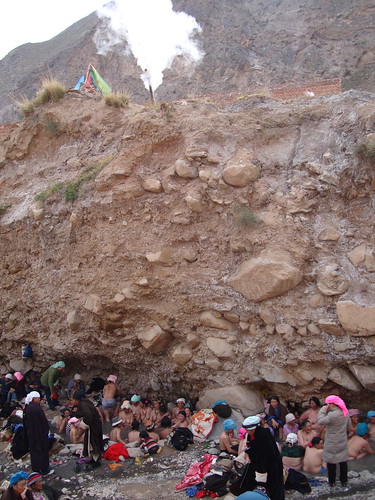
The second from Tibet (Oh, oh. There goes my theory, these are examples from western China....).


"I soaked with the friendly ladies in the hot spring until I became too hot and had to hop out".
By Solemnyeti (2008).

Then, a much older picture (1950) and from Japan and involves no hot soaking, just fishing.

"A successful launch" by Iwase Yoshiyuki.

Odd though, this focus on females ....


In the same vein?
Asia Spa (printed in Singapore) July/August 2009 has an article of south Japans best baths. In the guide to onsen (hot spring) section (not online unfortunately) the author informs Japan's etiquette concerning bathing there:

'First you must be prepared to bathe completely naked, swimsuits are never worn. But Japan's baths are single sex, and in the steam and splash your naked state feels completely inconspicuous.
...
Before you enter either bath you must make sure you are clean.
...
Being spotlessly clean is essential'.
The blog world then
Malaysia

  • Sungai Klah? §oŁЇtǺ®ÿ ®o§ě went there and stayed a nite at the adjacent resort. Apparently the villa's come with private pool:
    '* Jacuzzi - babe not included with booking of villa * This villa does not come with bikini babe. Unless you book the babe along.. You have to bring your own bikini babe. LOL!!! This a picture taken candidly by my mom'.

  • More on Sungai Klah, a blog dedicated to a child who burnt herself, posts written by her mother. The burns came from cups of noodles, not from the hot spring.

  • What does Paku hot spring look like? Going by photo's by Wilson Tie, it's not much, certainly not a soak site ...


  • The Lost World of Tambun is a water based theme park based on a possible ancient Mayan city. It's based around a hot spring. Judging by sixthseal's blog entry the hot spring is the least interesting part of the park.
Indonesia
Thailand

  • The Wiang Pa Pao hot spring in Chiang Rai claims to be the highest hot spring in Thailand. Not clear what they mean, they highest pumped spout or the highest located ...

Singapore
  • A visit to Sembawang, Singapore by MoMo Post.
    'While we were there, an uncle came over & offered his help to ease the blue black on my wife's leg, as she had a really bad fall on Friday. He seems really helpful & the blue black really subsided after 30min of rubbing with the hot spring water. But some part of her skin on the blue black were also being "Rubbed Out" which we didn't notice until later. As we were leaving, we went over to say thanks & to our shock, he asked for a payment of $20 for his service.'
    Accompanied by lots of photo's.
This blog
Added link to Spacious Planet Guide to Japanese Onsen Bath by Anna Mar.
'Can you wear bathing suits at onsen?'
Jimboche's answer:
'Rarely'.
A site with more info in the form of questions and answers as well as some photo's, though all strictly Japan.


I've also expanded the number of hot springs in Vietnam ...

Monday, 31 August 2009

Updates for August 2009

Looking for alternative energy it can occur to tap local hot springs. In the region there are already a number of countries with power plants derived from geothermal heat up and working.
Singapore is now looking into this as well. From the
Strait Times (15 August 2009):
'A hot spring tucked away in Sembawang might just hold the key to Singapore's untapped geothermal power potential, and at least one geologist is going full steam ahead on the idea'.
Co-incidentally, a recent
blog on Sembawang hot spring contained the following message:
'The authority should develop and make it a tourist attraction'.
Yes, why not? But it's not so bad as it is, mind you.
Then more is revealed on a comment to Temasek's finance strategy on
Todayonline:
'A professor of NTU [major uni. of Singapore] is confident that with a $26m investment, he can tap geothermal heat at the Sembawang hot spring or Pulau Ubin to generate electricity for 200,000 homes'.
That's 4 times as many homes as two weeks before! Progress.

The Malaysian state of Sabah is looking into the same subject, reports the Star:
'Deputy Chief Minister Datuk Peter Pang said the idea was to tap hot springs in the Adrassy forest in Tawau [Sabah] to generate some 100MW of electricity'.

But back to real soaking. Much of the soaking is to do with health benefits.
An interesting non-Southeast Asia article titled
'Clays, Muds and Dirt for Anti-aging Beauty'.
Written by Lorne Caplan it looks specifically into claims of anti-aging and mud. She clearly sets out that many skin care products containing mud can't stand up to what they claim. Lathering in mud, adds nothing it appears. Her final advice:
'We do know that therapeutic massage, when given frequently, provides a true stimulation to our immune system and lymphatic system. Or,simply roll around in the mud with your kids and you’ll find your hormones on fire in a good way. Whether you’re in Alaska, Thailand or your backyard'.
This throws the claim in a recent article on Phu Klon hot spring, Mae Hong Son province, Thailand into doubt:
'The results from the laboratory showed that the mineral contents of the mud are good for the skin and blood circulation. There are some minerals that are found in the Dead Sea mud and volcano lava mud'.
Elsewhere in Asia, there are a number of resorts offering a mud bath (see below). Not worth it now? Possibly, but isn't it just fun in the mud?

'Thap Ba mud baths in Nha Trang, Vietnam' (source).
In paradise (Bali?) there are problems with developing hot springs. The article relates to development taking place without proper permits and failure of the projects to materialize. Despite one project promoting alternative healing, it was believed that part of the project was to threaten a local hot spring's water supply.
Elsewhere, a major investment is taking place on north Sulawesi, Indonesia:
'Located in Bitung Hills, this natural 60 m waterfall is an ideal place to enjoy nature and fresh water pools at the base of the falls, just on the Beach next to the Waterfront Hotel is a Hot Spring. The plan is to connect the Hot Spring to the Hotel to develop a Beach-Spa Resort.'
What about the hot spring?


Blogs
Vietnam
  • Thap Ba proved to be nice place to frolic in the mud for traveling Peacecorps duo Carrienica:
    'The whole experience was fun since you're surrounded by more vietnamese tourists than foreigners. I loved seeing how the familes were interacting and how they all had fun playing in the water. I have to say that it was an experience I won't forget'.
    Fun indeed.
Indonesia
  • Want to know what Sari Alter hot spring looks like?
Malaysia
  • Poring, arguably one of Sabah states biggest tourist attractions fails to live up to it's fame. Here another disappointed blogger by the name of perutbesi:
    'I was expecting the natural hot springs like the ones I've experienced in Ipoh! All I saw were pools with warm water. Cis. Just like my own bathroom kinda experience. Cheap thrill!'
  • An extensive blog entry on Selayang hot spring, located not so far from KL. Is a trip there worth it?
    'To be honest with you, in general, Selayang Hot Spring has 'nothing to shout about' ... really. .... And while you are there, you can see all sort of antics and interesting behaviour of some of the bathers. Some of them can be downright funny though...but then again...of course...they have own reasons for behaving in such peculiar manners:).
    eSa had more laughs when reading a signboard:
    'Loosely translated: Please Take Note: To all visitors, kindly adhere to these guidelines>- do not place your feet in the pool- do not wash clothings in the pool- do not wear underwear while bathing!'
    Possibly the funny part is that no one adhere's to it, everyone has that days underwear and upperwear on. Yuck!
Vaneza provided me with this shot of the welcome words to Ardent hot spring on Camiguin, Philippines.
  • In my recent blog entry about visits to soaks in Thailand and Bali, it was mentioned that the springs were discovered / developed by Japanese. According to this site the Gadek spring was developed by the English. Hard to believe.
    'It was believed that local villagers discovered the hot spring in the forest after watching some English soldiers settled around the spring. After the war, visitors from far and wide discovered that the hot spring had strong healing elements unlike many that they had encountered before'.
Thailand
  • Dressing up maybe the norm for locals visiting natural hot springs in Southeast Asia, but surf to this photo of a number of soakers complete with life jackets in knee deep water in Umphang, Tak province!
Philippines
  • A great blog entry on Maquinit:
    'Everything seems right in place, the location of the pool, the mangroves even the scenic view around the area all conspires to make this a very unique place'.
  • To add, Marinduque hot spring on ... Marinduque island! Here a link to a German blog. There are actually two soaks on the island, Mainit and Malbog.

Sunday, 9 August 2009

I Love?


Kanchanaburi
The province of Kanchanaburi is a well trodden piece of Thailands tourist path. Besides historical highlights (as in the Burma railway), it excels in natural highlights. In this, the Erawan waterfall meets most tourists expectations of a beautiful tropical waterfall paradise.

But there is much more nature to be discovered. Many more waterfalls and caves. So it may not be surprising that hiking and rafting are increasingly becoming popular pursuits, especially for the more wealthy middle class Bangkok citizens; Bangkok located not more than 2 hours drive from these delights.


Hin Dat hot spring
As said there are a couple of hot springs, non more well-known than that of Hin Dat (or Hindad / Hindard / Hindat / Hin Dad or formerly known as Kuimang; the name on the tickets though is Hindaad). Not only in Kanchanaburi, but Hin Dat rates as one of the more recognized names in hot springs in Thailand.


Located at a fair distance from Kanchanaburi town it's just a km off the near perfect highway 323 heading west. Judging from the ample space for parking, it surely is part of the main tourist road, even a number of coach parking spaces are available. Parking outside the main gate, a small fee was required to enter, though why nationals only get charged 10 Bt and foreigners four times that amount seems a bit weird; do foreigners get more value for money?

Beyond the gate is another parking area with many stalls around, for drinks, food, tourist nick-knacks, souvenirs and orchids / plants. Tickets get checked before a bridge. From the bridge one has a good overview of the hot spring pools themselves. This being a rainy Sunday afternoon around 3 o'clock, the sides of the two pools are lined with soakers, though not many are immersing themselves. Is the water too hot? Just a meter from the pools is a swift flowing stream; it having rained during the preceding days. The banks of the stream are also lined with people half in the water.

Sunday afternoon: packed soakers.

The soak
Leaving a visit for the air-raid shelters (!) for later, I precede to the changing rooms, which are not well-maintained, but probably serve their purpose. Then down to the showers. Oddly it are mostly visitors who are leaving who are using the showers; clearly cleanliness is not an issue.

Finding a dry spot to put my things down is quite a challenge, but once found it's off to find a spot on the side of the pool to adjust to the water. Of course there is still a place available: right next to the source, which is well over 40C apparently. After a couple of minutes I slide into the hotter of the two pools. After a nice soak, I get out and cool off in the stream.

The bank of the stream has been lined with steps of flagstones and though the river current is strong, it's a great pleasure to enjoy a natural cooling off. By the time I'm ready for a second round, the pools are starting to clear of their visitors, possibly having to return to the big smoke. But without the crowds, the soaks are even more enjoyable. A few more rounds follow and to top off a short massage is required. All 'n all a great soak.


Soaking Thai style.

After wrestling back from swimwear to clothing, I walk around the site that includes a number of private soaking bungalows, a temple and the aforementioned air-raid shelters which remained from the second World War. What better protection would you need when soaking?

Background
As stated above Hin Dat is a well-known soak, why remains a mystery. Possibly it's accessibility together with the beautiful location of springs next to swift running stream.

However most mentions of the hot spring concern tourist web sites mentioning the possibility of soaking.
Some credit the Japanese occupiers (during WW II) with finding and enhancing these springs:
'.. discovered beside a stream of cool water by Japanese troops during WWII and two cement wells were then constructed at the site'.
Both pools are still there. However there is also the following mention:
'This hot spring has a long history and has been with the local villagers for over 150 years'.
It does seem logical that the hot springs were there before the Second world war, why the Japanese get the credit for discovering them is beyond me. Though no doubt they did enhance and popularise them.

But it does seem that not much has changed since. The site has been enhanced with ample parking spaces, a bridge, changing rooms, toilets, ticket vending office and private pools. The latter though don't seem to be too popular, but they are located on the hill overlooking the site, without access to the stream and thus probably provide a less superior experience. They also cost the foreigner a foot or more, upto 1,000 Bt (~$US 30). Pay more, get less.

Other bloggers mention
  • AbsoluteBangkok.com:
    'Well, what else you need when you got large hot water tubs lined with natural stone - and a clean (!) fresh mountain stream two meters away to cool you down again. You could rent private bath tubs, but what would you need narrow walls and a roof for when the sky’s the limit?
    ...
    And don’t trust the name of the nearby Green World Hot Spring & Golf Resort. They have no access to the hot spring water, but talk about repairs and broken pipelines and … screw them.
    All they have is a rotten jacuzzi in the cellar. Go for the real thing at the public bath. The only thing to worry: I always wonder when visiting a public bath in Thailand why you won’t find cleaner toilets than in a Thai public bath. As nobody uses the toilets'.
  • Bluestar guesthouse:
    'the springs are a God send'.
  • caryn:
    'This one is rather simple, yet it attracts numerous tourist'.
  • andydaniels:
    'The springs were really nice, big pools that fit a lot of people and were deep'.
After four: quiet and serene.

Other information
There
is also a Hin Dat hot spring festival, each year in November:
'In the festival, there are booths of agricultural products and tourism exhibition of Amphoe Thong Pha Phum'.
The waters are said to have as a healing property for various ailments such as beriberi and rheumatism [1], holy water that can cure diseases [2] and gout [3].

There are two locations to stay overnight nearby: the above mentioned Green Valley which might be more appealing to golfers and the Phatad Valley Hot Springs resort, which actually is still a couple of kms away and has nothing to do with the hot springs!

Nearby are also the Pha Tad watertfalls, probably a great place for a swim. As it is a national park, entry is a hefty 100 Bt, unfortunately during my visit three was too much water to make a swim possible. This site has more info on Pha Tad which are only located some 10 km from Hin Dat.

Gushing waterfalls of PhaTad.

Furthermore it should be pointed out that the hot spring is open til 22.00, which means that a late nite soak and picnic are available. Always good to know in hot Thailand.

Then just a mention about the name, the official name is Hindad, however by far most internet links refer to it being Hin Dat. Can someone explain?

Getting There: Traveling from Kanchanaburi town, one only needs to continue on the main 323 highway towards the Burmese border. Past the entrance to Sai Yok National park, the well signposted hot springs are just off the main road at km marker 123.

Soaking Experience: The natural surroundings and the possibilty to cool down in the adjacent stream make Hin Dat are great place to soak. Also the possibility to stay until well into the night add to a great way to soak. The pools are deep, though the bottom is uneven.

Overall Impression: Positive. A great place to while away a few hours preferably on the day edges, as midday sees many visitors. The food stalls even have western food and the masseurs work full time, such is their appeal.
But I always have doubts about hygiene. Currently in Thailand you can sanitize you hands at every reception desk, though it's disputable whether the swine flu can be obtained over the counter. However without batting an eyelid, all soakers jump in in their already-worn clothing to soak; somehow missing out on the hygiene lessons. Outside of Southeast Asia though, customs (based on hygiene) determine that rigorous cleansing should take place before soaking ...


A you tube on Hin Dat?

Related Posts with Thumbnails
Copyright 2009 © Soaking in Southeast Asia. All rights reserved.
No reproduction or republication without written permission.