Thursday, 18 July 2013

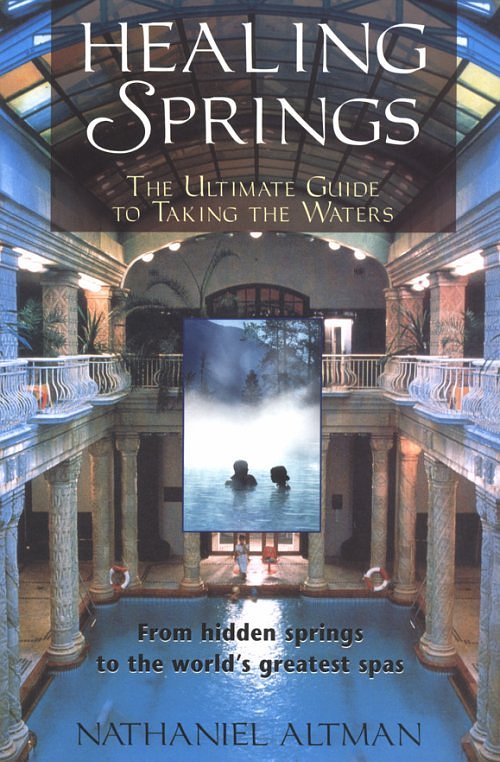
Publications: Healing Springs - The ultimate guide to taking the waters [?]


Non-existent
Soaking literature is far and few between. 

There are indeed many a hot spring guide book, in the US quite a few and in New Zealand as far as I know. Supposedly there will also be quite a few connoisseurs guides in Japanese.

But with instant internet, there's little or no need to publish these guides any more. We can all delve the info required with a swish and pointer or two. All up to date as well as the latest visitor who wishes to diss the place. The photo's are always there, explaining every nook or cranny. And even pre-buying an entrance fee to the fancier resorts becomes apparent. All the pre-visit pleasures.

This does mean that the enthusiast / upcoming soaking expert is depraved of an avenue to exhibit his or her expertise. In print. And who's not being printed does not exist. So goes the old adagium.

But beyond the world of lists and links there is surprisingly little info on what hot springs are and why so. Altman's now slowly dated Healing Springs wishes to link the two worlds and probably back in 2000 that might have worked. But nowadays a book a third filled with alist of potential soaking spots and a small collection of soaking picca's instantly seems out of place. And soakers in Southeast Asia need to note: we are not included! So much for our beloved soaking culture.

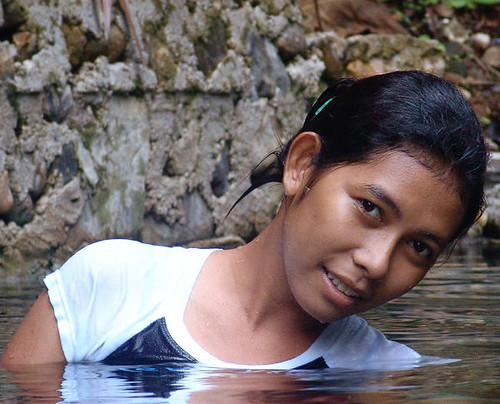
Best efforts to no avail? Krabi, Thailand's Klong Thom hot springs by Cholthicha Pornpan

Lost
But in the other two thirds, Altman has gone out of his way to seek to prove beyond doubt that soaking is indeed a healing process. 
Altman's expertise is in alternative healing (he's an hand analyst) and he seeks to combine natural waters with immediate health benefits. Mineral content is linked to disease remedies while diseases are linked to types of hot springs. It transpires that soaking isn't the only healing aspect, one needs to include drinking and inhaling mineral spring content. Emphasis is awarded to the Euro concept of taking the waters where states have enabled soaking industries to expand and medicalise the hot spring experience itself.
And that is where to me the healing aspect is lost.

Healing and hot springs is as much about inspiring and relaxing rather than solely something to heal. Altman does try though. There is a chapter on the ambiance of soaking. But describing this book as the ultimate? Even in 2000 that wouldn't have covered the content.

Though he admires the Euro soaking states, he's right in emphasizing that soaking nowadays is something we might be interested in; but gone are the days in which states could afford soakers to indulge for weeks on end. Better are the Japanese concept with ample bathing facilities which can afford daily experiences. Already this fits much more in with northern Europe's hang towards sauna. Or the old daily English bath.

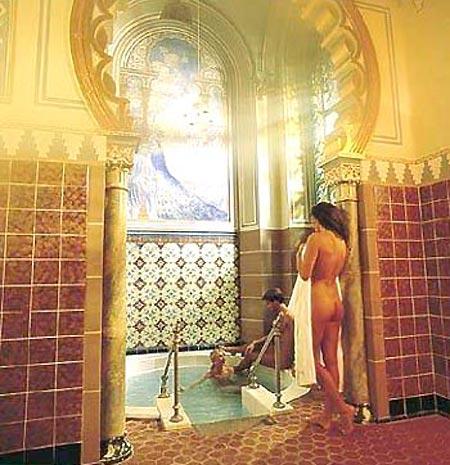
The author raves on about his Bad Wildbad experience, Germany. Unfortunately his own photo's are not available any more. The caption to this photo:
'A swimming fairy tale come true ... The classicist façade of the Graf-Eberhard-Bad (Count Eberhard Pool) looks rather unsophisticated in relation to what it contains. Behind the Florentine sandstone walls you will find oriental bathing splendour that is certainly unique in Europe.
This building, once threatened by decay, was restored with the help of significant financial backing, good planning and artistic effort to its original luxury as a bathing landscape, a dream from 1001 Nights. Today it is a modern temple of health with the refined feeling of the orient.
A grand architectonic effort thus succeeded in creating symbiosis between necessary modern form and an atmosphere of nostalgia. The Moorish Hall, the Princes' Baths and the Great Lords' Bath, where the statue of Venus by the Danish sculptor Bert Thorwaldsen can be seen, and above all the exclusive sauna landscape are part of the wonderful framework for a healthy visit. No resort visitor should miss this attraction: no one leaves without being impressed'.
Other aspects included are a nice historic overview where he notes that hot springs and human interest can be traced back for 600,000 years, but what with the lack of writing skills, use of mineral waters can be traced to Greek and Roman scripts as well as ample evidence in the form of archeological remains.

Altman does add a chapter on the preventive aspects of heated baths (leading to higher states of immunity) which assist in cleansing the body of toxins. We also learn that water pressure leads to increased flows of oxygen-rich blood. There is much more added to the list to the preventive powers of soaks, aspects of negative ions, micro-nutrients. You'll need to read for yourself.

So to sum up is Healing Springs a no buy? Well, I think the book cost me 0.14 cents which is about just above scrap value. The question is the book worth the transport costs? Hmm ...

Healing Springs has 4.8 stars at Amazon (4 reviews), while only 3 stars at good read (2 ratings).

Reference
Altman, N. (2000) Healing Springs - The ultimate guide to taking the waters. Healing Arts Press, Rochester, Vermont, United States of America.

Tuesday, 9 July 2013

Impact

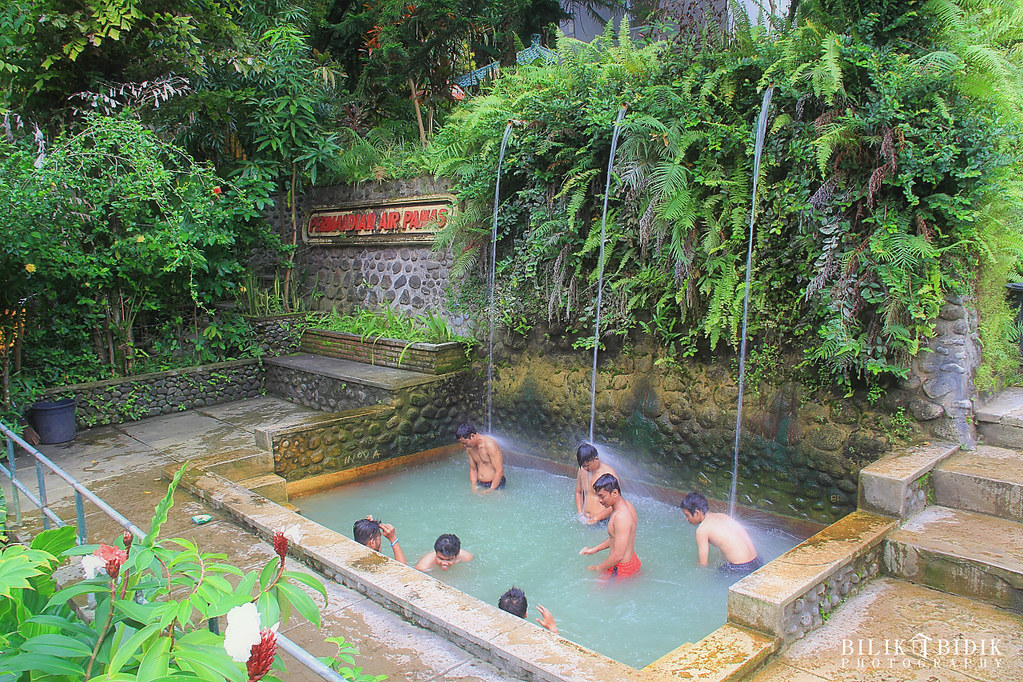
'Water spring bath
Hot water spring at Banjar, Buleleng, Bali'
From the flickr site of I Putu Budi Astawa

To follow
Does anybody recognize that the social side of internet is dumbing down? With the advent of broadband and higher speeds, there's been a shift from text based write ups to mass photo ops.

In this case, do you notice that after all these years there are still only just 8 followers on this blog? that's not much ... The Tumblr site Soaking Spirit on some days welcomes 8 new followers!
I do get it. On Tumblr a follower is just a single click away, whereas if you become a follower on blogger there are a few steps to go through. 
But I simply believe that the intellectual stimulance blog entries offer, simply can't stand up to the instant (in your face) photo visualisation. And yes in some cases one pic can beat many a lengthy blog. But a blog offers more ...

Anyway this leads me to Pininterest. I don't understand Pininterest. I have put up a board of Thai hot springs, but nothing seems to happen. I follow a couple of boards, but again nada: no updates. Doesn't look like anything will happen here ... Can someone explain to me what the existence of Pinterest is meant to be?

And what is happening at Flickr? Are they really trying to drive away their customers? And their visitors?

Hmmm. 

Light headed
The Global Times, China not so long ago warns potential soakers for health concerns (January 20):
'However, even though the hot springs are reputed to have beneficial effects, doctors say the hot springs are not some supernatural elixir and that there are many risks involved in overdoing it, from light-headedness to infertility.

Even for young and healthy people, hot springs have risks that often are not posted.
...
"In Japan, bathing in the hot springs is a very popular and enjoyable thing. But in Japan, the hot springs are a more natural resource. It's underground water with a lot of minerals, such as sulfite," he [Yan Hongbiao, a doctor at the Fuwai Cardiovascular Hospital] said.
In China, there are many fake hot springs and the quality cannot be ensured, he said'.  
Infertility is a remote possibility apparently.

'People soak in the hotspring in Xingtai, north China's Hebei Province, Dec. 13, 2012. 
Local people went to hotspring during snowy days'. 

The ultimate list? Lonely Planet's 1000 ultimate sights of this planet. Under the heading best baths are a few hot springs (Beppu, Dogo (Japan), Hot water beach (New Zealand (been there)), Szechenyi Baths (Hungary) and Blue Lagoon (Iceland)).
These are their ten choices for Best Natural Springs: (1) Rift Valley, Ethiopia; (2) Oymyakon, Siberia, Russia; (3) Deception Island, Antarctica; (4) Waimangu Volcanic Valley, Rotorua, NZ; (5) Grand Prismatic Spring, Yellowstone National Park, USA; (6) Jigokudani Monkey Park, Yamanouchi, Japan; (7) Troll & Jotun Hot Springs, Svalbard, Norway; (8) Pamukkale Terraces, Turkey; (9) Landmannalaugar, Iceland; (10) Blood Pond Hot Spring, Beppu, Japan.
Most hot springs I presume ...

Lonely Planet has another list, this time of Europe's best hot springs (May 17). A couple from Iceland, likewise for Austria, Italy and Hungary. Language barriers mean the need to include the sole Anglo-Saxon soak, aptly named Bath. How they compile this list seems to be besides the point. Who cares, as long as you have a press release every day ...

Nudity is common in northeast Asia hot springs. Equally common are the western (or better said conservative) reactions. Example from Soul to Seoul (11 June) visiting a local Jimbilang (hot spring bath) near Seoraksan National Park:
'People, the scene facing my small tribe when we opened the change room doors will never leave me. I had entered some alternate reality where I was taking part in a Cleopatra-esque era movie Korean style. There were more than ten big (think typical Aussie backyard pool big) rectangle baths spread out before us. There were hot baths, hotter baths and even hotter baths to choose from (temperature readings at the top told you what to expect) along with a walking bath, a mud bath, a cold bath and the outside bath (where, as we discovered, there was no where to hide thanks to the water clarity). Along one side of the enormous cavern were rows and rows of mirrored benches where groups of women sat on small stools facing the mirrors and vigorously scrubbed each other using special gloves and brushes. All totally naked. Despite all the activity - women walking from bath to bath, from bath to scrubbing area and back to bath - there was an unbelievable sense of calm that exuded from all. One might even say it was somewhat liberating and strangely comforting all at once. I would like to report that I soon got used to being this naked but I did not. Oh no, not at all'. 
She didn't relax ...
  
The way ahead? Ciater hot spring , Java, Indonesia. From the instagram page of sayisayyie

Yet again New Zealand leads the way in the wackier (literally) side of soaking. First there is the story of a 9 year old volcano hunter. Or should it be a hot spring hunter and volcano vollower ... (NZ Herald, July 7). 
Then from the same source (July 3) the curious story of a hot spring hoist:
'As the man left the hot pools he was hit over the head.
Some of the couple's belongings were then stolen from their van and their keys were tossed into the hot pools.
After the group left, the pair were able to retrieve their keys and drove to Rotorua Hospital.
The woman was not harmed but the man needed stitches to a cut to his head'.
Poetry from from the region
  • Indonesia
Meanwhile in Bali, Indonesia. Geothermal projects are off the drawing map (Thinkgeoenergy, June 19):
'Pastika [Govenor of the province] said there are still other green sources such as water, solar energy and waves that could be exploited for it. “It may be more expensive but it also has a price,” he said.
The governor said the main reason for his decision is that because mountains, forests, beaches, lakes and estuaries are holy areas'.
Soakers can continue to enjoy Angseri hot spring, Bali, Indonesia. At least for the time-being? From the instagram page of lealbeny
More bad news for Indonesian geothermal powerfans. On Sumatra there is local opposition to a geothermal project, according to thinkgeoenergy (June 6):
'“The villagers, mainly members of the Rajabasa traditional clan residing on the slope of Mount Rajabasa, staged a peaceful rally at Sukaraja dock in Jeti village, Rajabasa, on Wednesday, demanding that PT Supreme Energy cease its exploration.
Beside being detrimental to the environment, the villagers said the geothermal exploration would also damage the social structure of the South Lampung traditional community, especially those living around Mount Rajabasa'.
On Java, near Sumedang, another geothermal project (100+ $US million) is running into problems due to land acquisition (thinkgeoenergy, June 6). Or not?
'“The land acquisition process is hampered due to public concerns about the impact of environmental pollution resulted from the geothermal project,” he [PT Wika Jabar Power Engineering Director Uum Komarudin] said'.
Is a pattern evolving?

 Hot spring near Bogor, Java, Indonesia. From the instagram site of audreytanzil

Indonesia in the meantime is raising feed-in prices for geothermal electricity. The smaller the geothermal plant, the higher the price (Source: thinkgeoenergy, June 12). So maybe they could buy a few wavering villagers ...
  • Malaysia
Banjaran hot springs, Malaysia is very ... umm chic. The yumlist BLOG has a report (June 13). How to describe? Well, the author goes over the edge and picks up on many a detail:
'Earthy hues, natural stone, wood, glass and tropical furnishings transit the outdoor environment to the in. Abundant use of vegetation and running water bring the revitalizing characteristics of nature to the living space, creating both a calming and rejuvenating setting.
The glass windows and doors of the bathroom look over the villa’s most prized feature – an outdoor sunken Jacuzzi with a direct hook-up to the geothermal hot springs. Star filled skies can only be made better with a skinny dip in the bubbling bath allowing the healing properties of the water to do its magic'. 
Note that this all comes with a price ...
  • Philippines
More on the proposed hot spring / geothermal plant on Mindoro island, the Philippines (Southern Luzon Inquirer, June 19):
'The potential is endless!  Power firm Constellation Energy Corp. (CEC) will develop lakeshore areas near its 20-MW geothermal power project into a hot spring and wellness center to showcase the healthy mix of green energy and green tourism in this province'. 
Well, that would be a first for the region. In general there is a disregard for soakers vis-a-vis the techno superiority of geothermal projects. 
Note the Dutch connection ....!
The News of Iceland (July 1) picks up on the Dutch connection (IF Technology) as well (leads to credibility?), as it of course does on the Icelandic comparison.

From the instagram site of buddz_06 Hibok-Hibok hot spring, Camiguin, Philippines:
'The perfect way to cap off the day!. Sarap..emojiemoji Goodnight!'
By the way, Philippines, already one of the global leaders in geothermal energy hopes to up the output by another 75% in the coming 15 years. According to the Manila Standard (July 3).
  • Singapore
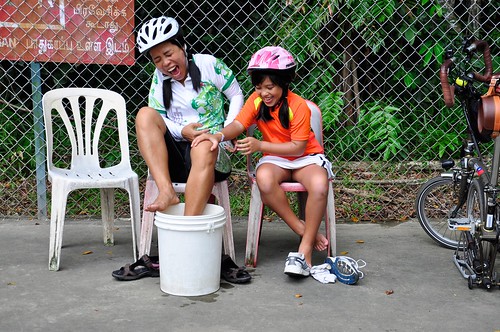
'Yikes hot'
Sembawang hot spring, Singapore. From the blog of smallwheelsbigsmile (June 16).
  • Vietnam
Top 5 most famous hot springs of Vietnam by tripatini (June 25):
1. Kim Boi ('Being immersed in a large mineral water deposit of Kim Boi stream is also not unmemorable for every visitor'.)
2.Bang ('Bang Spring is attractive with its fanciful, poetic scenery'.)
3. Kenh Ga
4. Tay Vienh
5. Dam Rong
No mention of Nha Trang?

Bicol hot spring. From the instagram site of carmelajacinto

Sunday, 2 June 2013

Zeroing on toxic (developments?)

Yeh panes hot spring, Bali, Indonesia. From instagram of cara_elyse:
'Chilling in the hot springs.. Which were kinda lukewarm..'
Toxic rash
Time again I have commented on the lose of natural soaking sites. If it's not (local) government selling out to private interests and thereby locking out local public access (save the privileged few) then there is the often unregulated geothermal power lobby which with many a flowery argument seeks private control over natural process of thermal flows.

Oddly in recent months it's the Philippines which is showing some guidance. 
It had to happen. A good idea gets followed up. What simply stupefies me is that it took so long. The Blue Lagoon Reykjavik, Iceland has earned itself as the national no. 1 tourist attraction. But in essence it's just an overflow of a large geothermal power generation project. What with everybody now plumbing their own geothermal projects and killing off many a local soak, linking the two seems so obvious. 
From thinkgeoenergy.com (22 May 2013): 
'Philippine geothermal developer Constellation Energy Corp. plans the development of lakeshore areas with hot spring and wellness center near its 20 MW geothermal power project in Oriental Mindoro [Montelago]'. 
Let's hope they don't hash the development ...

Then there are those that are questioning the  impact of geothermal power. Sadly despite all the arguments, it's hardly ever highlighted that there could be any negative implications of geothermal power other than a couple of social ones.
The Philippines BusinessMirror (May 21) has an article on opposition to establishing geothermal plant: 
'After two decades, the people of Irosin continue to stand up against advocates of geothermal energy, this time the Department of Energy (DOE) and contractor Summa Kumagai Inc. (SKI), who want to set up a multimillion-dollar geothermal power plant in the town, Dr. Gante [Irosin Coalition Against Geothermal (ICAG) Chairman] said.
...
Gante expressed profound concern over human exposure to hazards entailing geothermal operations.
She said arsenic concentration is high in all geothermal sites, adding the deeper the operation goes down, the higher the concentration.
“Arsenic is converted into other compounds but never destroyed once outside of the soil,” she said. “It contaminates water, including sources of drinking water.”
She said arsenic is highly toxic for the human body. Exposure can cause cancer. It is a Category 1 poison, according to the World Health Organization.
The ICAG chairman said the drilling period is very toxic-laden since at the time, there is not yet reinjection of waste back into the earth.
She said Hiromi Hironaka’s finding in 1993 which reports that residents along the Mantigao and Marbel Rivers had elevated levels of arsenic, hydrogen sulfide and manganese traced from hair samples.
These people experienced headache and stomach upset during the construction of Mount Apo Geothermal Power Plant, she said
...
She dismissed geothermal zero-waste backlog claimed by project proponents, and pointed out that such claim has been refuted by people living close to geothermal plants who are getting sick from toxic emissions.
The ICAG chairman cited skin disease on residents of Barangay Osiao in Bacon district near the BacMan geothermal power plant, saying areas near the Tiwi geothermal plant have signs warning of the hazards of hydrogen-sulfide discharge.
Irosin has a bustling tourism for its hot springs. But geothermal operation may drain local tourism after depleting water in the area, Gante said.
“Our main tourist destinations in Irosin are the hot springs,” she said.
A geothermal plant can also sewer the active tourism in nearby Bulusan, which is retraced by visitors for its choices of cold springs, Gante said' 
Positively, Thinkgeoenergy (May 21) has made a short and correct summary of the article. Though no comment on the issues raised ...

That's the plus side. Now the low side. China is swiftly losing it's wilder soaks and with it goes public access. How about Angsana Tengchong Hot Spring Village in western Yunnan. By Banyan Tree. Spaopportunities (22 May 2013):
'Angsana Hotels and Resorts is set to launch its first hot spring destination retreat 
...  
The resort’s wellness area spans 17,083sq m (183,879sq ft) and is formed of a three-storey indoor Hot Spring Centre and outdoor hot spring area.' 
Basically soaks are available everywhere. Traveldailymedia (16 May) adds:
'Angsana Tengchong Hot Spring Village is the fourth Angsana resort to launch in China, and the second hot spring resort to be announced by Banyan Tree in recent weeks, following the Banyan Tree Chongqing Beibei, which also opens this summer'.
Hot springs and beauty. A recent study suggests that soaking does enhance beauty (we all knew all along): 
'One onsen in particular, named Ryujin (lit. Dragon God), is also known as bijin no yu or “the beautiful women hot spring.” It is hailed as a hot spring for enhancing beauty and the waters are said to smooth and moisturize skin. Despite these claims being repeated for hundreds of years, some may still be skeptical. However, a recent study suggests that the waters of Ryujin Onsen actually have beautifying capabilities'.  
Article originally from NHK News Web (May 24).

Innovation kiwi style: a bike tour of hot springs! 
'Thermal by Bike - Te Ara Ahi offers a 74 km cycling adventure through a thermal wonderland of steaming vents, bubbling mud pools and spectacular geysers'.
News from the region
  • Cambodia
Somebody (Meas Roth) has actually made it to the nations only hot spring of Tei Teuk Pous:
'This is 'Te Teuk Pous' or Hot Spring in Aoral district, Kampong Speu province. It's hard to believe if I don't see by my own eyes the hot water emerging from the ground'.
  • Indonesia
An Indonesian take on our relation with water by Byron Black on the Jakarta Globe (May 7, 2013). 
'Indonesians are basically fastidious people, and even the poor try to wear clean clothing and wash themselves. You can’t imagine the horrid stench of old human sweat and dirt you encounter on a bus in India or in any Arab country; even a crowded Economy-class train or bus here won’t stink like that.
Indonesians are, however, not fundamentally water babies. Travel to Germany or Japan and you’ll be amazed at the devotion to ‘taking the waters’. 
After touching on the habits of both (Japanese love of hot water and Germans love their birthday suits (so should you!))) he concludes: 
'Millions of years ago we emerged from the oceans, to evolve into land creatures. But many of us (including this writer) are still fond of swimming, bathing, splashing and diving'.
Also reminiscing earlier times before modernity hit the region connectlocally on worldnomads has the following story:
'Mount Batur [Bali] smokes silently. Threateningly. It’s the reason we’re here, standing naked in our embarrassment, the natural hot springs are therapeutic, we’re promised.
Okay, how does this work? My friend and I stop and watch for a while.
In one area women dip clothes into hot soapy water, then rinse them in the cold clear lake – an ancient twin tub washer.
Alongside, men and women wash themselves, graduating from the cold lake to ever-hotter pools of steaming, mineral-laden water… and back again.
The women enter the water draped in a sarong. The men are, as men are everywhere, arrogant in their nakedness beneath the water. So it’s ‘kit off’ for men? In we go!
Mount Batur rumbles.
The problem was that we didn’t do enough touching. We should have cupped our ‘bits’ in our hands and kept them out of view while we lowered ourselves into the water.
Instead we’re a couple of big swinging inappropriate white guys!'
  • Malaysia
A hot spring along the East-West highway. Yew Aun:
'A few km ahead was a hot spring and I stopped there as well. What's unique about this hot spring is that the area has natural cold river flowing and hot spring water joining together at one pool. I submerged myself in this pool and the sensation I got was WARMTH, just like 5am after a downpour under your comfortable duvet'.
And inclusive of a warmth (or hot?) photo 

Sungkai felda hot spring, Perak Malaysia. From instagram account of ahmadlatif90
'FELDA Residence hot springs'
  • Philippines
A good photographic blog entry by Iloveeverythingaboutit on a lesser known hot spring on Negros at Palinpinon. Compare notes: 
'It's a very great place to spend time with the families, friends and loved ones. You can enjoy the very peaceful place, the nature, the breathtaking air, the view, relaxation and the hot spring'. 
The evidence: 


Yet again highlighting Puning hot spring. BusinessMirror (June 1) has a long expose:
'Ma. Carmencita Luciano Kim and her group did not waste time after seeing the huge potential of the hot spring and the adventures that go along with it.

In 2008 the Puning Hot Spring and Restaurant officially opened to the public.

There was a struggle between the developers and the Aytas of Inararo and Sapang Bato during the resort’s construction but it ended when the Aytas were assured of livelihood opportunities and the protection of their general welfare.

The hot springs are basically borne out of the eruption of Mount Pinatubo. No one ever thought then at the height of Mount Pinatubo’s wrath that there was opportunity left for Pampanga'.
Now Puning rates as one of the Philippines major hot spring destinations. Owners are quoted as saying that the amount of visitors goes up by 2-30% annually.

Lublob#hOtspring#familybonding#weekend special
 Another Filipino hot spring.
  • Thailand
Other innovation: hot spring yoga! Brought to you by Outdooryoga Chiang Mai. From their Facebook page: 


Apparently no yoga during the actual soaking? See also their homepage.

Not only humans need a soak. From the Bangkok Post (May 29) this article on a black leopard sighting. It quotes the photographer:
'As usual, I'd set up camera traps at a hot spring not far from the ranger station some 50km deep in the interior, accessible only by a dirt road. This natural seep is visited by all the large mammals including tigers, leopards, elephants, gaurs, bantengs, tapirs and sambars as well as many smaller creatures, and provides excellent opportunities for some great animal shots'.
  • Vietnam
The tourist city of Nha Trang has many a waterfall located nearby, some of which have been turned into veritable tourist traps. Yang Bay waterfall is the top-notch tourist trap. Having visited Yang Bay in 2011, I was unable to find the apparent hot spring. From Travelblog.org this on recent developments: 
'Ho Cho hot spring - Yang Bay park: There are two pools for tourists to swim in'.
Vietnam surprise has published it's top 7 most famous hot springs of the nation:
1. Bang Hot Mineral Water Spring in Quang Binh province
2. Kim Boi hot spring in Hoa Binh province
3. Kenh Ga hot spring in Ninh Binh province
4. Tay Vien hot spring in Quang Nam province
5. Binh Chau hot spring in Ba Ria – Vung Tau province
6. Dam Rong hot spring in Lam Dong province
7. Hoi Van hot spring in Binh Dinh province

On the former the jury reads: 
'The most interesting in this spring is that when the sun sets, the air stream from the hot water circuit genealogy fly into space, creating natural picture has nowhere just to make you feel like you are playing with in a certain paradise'.

Sunday, 14 April 2013

Relax

'Swimming in the hot springs on the Rinjani trekking tour ! Lombok - Indonesia'
From webstagram page of gogi29

What's customary? 
A variety of recent articles / blog entries follows, all concerning customs of foreigners vis à vis local customs.

Travelling to foreign countries opens oneself to different experiences. In this piece by CNN (Apr. 10) they discuss the advent of Chinese tourists abroad. Both the expectations of those coming and those offering hospitality are challenged. However when both adapt great experiences may occur.
The same source follows it up with more comments: basically all  tourists which come in hordes irrespective of nationality are hard to handle: 
'Summing up the "just because you've got money doesn't mean I have to respect you" contingent, THEGenuineOLiTWiST wrote: "In general, most mainland Chinese who are 40 or over are suffering from this money= respect syndrome. The younger ones are much better at 'fitting in' with their travel destination's social and cultural norms"'.
So how does one re-act to outlandish social norms? With hot springs? This (young?) lady, from Singapore, while in Japan does go into the onsen. Though she has misgivings:
'Then we unpack and went to the hotspring only me and chenhong went seriously i think between friends it's also a very awkward thing looking at each others boobs and vagina and everyone (locals) were like so open about showing their body.... you know there's those door then you go in is locker room you see in anime?
But in real life the moment you enter the door you see all the naked aunties saggy boobs young kids boobs and many people not blow drying their hair but their vagina hair. FUCKING WEIRD RIGHT.. I took such a long time to undress myself and psycoing myself that this will be my only experience i should just go....'.
From the above citation it can be expected to conclude that this is a the first part of an overall poor experience. It's not, the lady in questions does enjoy the experience. 
It's odd that on the one hand when from Singapore, a society which is possibly one of the most prudish in the world, one has no qualms about at least partaking in the locals' habits however contrite. On the other when abroad, Asians (in general) are very well aware that this is not home ... and adapt ...

This attitude seems to differ from for instance North Americans (Anglo-based), where experiencing traditions not meeting the social norm known, means a no-no to the experience ....
That it is not always the case, illustrates the following experience from i heart rachabees (Mar. 27): 
'When people ask me what was the best thing I did in Japan, I usually mull over the question, my mind wandering to the weekend trip with my friends to Naoshima, the day spent celebrating a small local festival in Himeji, biking the Shimanami Kaido or the big dance festival in Kagoshima. However, when it comes down to a unique, off the beaten path experience, Kita Onsen was possibly the absolute best.
...
I came across Kita Onsen as a photo on tumblr, an atmospheric shot of a woman reclining in steaming waters under the imposing face of a giant tengu demon mask. I was so intrigued that I started researching the mysterious hot springs hotel, discovering it dated back to the 1600s, and, even better, it was relatively affordable for me (at least in comparison to other onsen hotels).
 ...
After they retired for bed, I decided to take advantage of the late hour and go in the mixed onsens without a bathing suit. I crept outside to the big outdoor pool. The wind was absolutely howling and I quickly jumped into the warm water, beautiful and surreal in the dark night. The sky had semi-cleared and there were stars visible and clouds lit white-blue by the half moon were racing across the sky. I swam and swam, as great gusts of wind whirled autumn leaves around me and chilled any inch of me not covered by warm water.
Next I went to the Tengu no Yu, where I sat in the bath and took in my strange surroundings, the enormous masks watching me with their scowls. Then the third floor baths, where I soaked for a bit, listening to the strangled gurgling of the old drains'.
What about differing soaking habits without foreign tourists? An interesting discussion on the Facebook site of the Friends of Cougar (hot spring), Oregon, U.S.A.. Administrator posts this: 
'This weekend at Cougar I interviewed several people and came up with what I think are the reasons many people don't go nude [for which this hot spring is partially known for]: 
The relative importance of each varies with each person.
Common:
1. Vibe. Presence of people in suits relative to people nude.
2. Fear of inferiority. Self conscious about their suit-covered areas.
3. Insensitivity. A disregard for suits causing discomfort for people nude or wanting to be nude.
4. Habit. Long instilled habitual behavior.
Special cases: 
5. Fear of superiority. Fear of being judged too hot and getting too much attention and scrutiny. 
6. Friends. Presence of judgment of friends / family'. 

After much response this evolves to:
'With the help of your suggestions, I've revised my list: 
Common: 
Vibe. Presence of people in suits relative to people nude. 
Body image. Being self conscious about one's suit-covered areas. 
Habit. Long-instilled social programming. 
Insensitivity. A disregard for suits causing social and aesthetic discomfort for people nude or wanting to be nude. 
Special cases: 
Shyness. Fear of getting too much attention and scrutiny. 
Friends. Presence of judgment of friends / family'.
One later response:
'It is so strange that so many clothed people go to cougar. Obviously they are ok with nudity...weird'. 
An interesting discussion on an interesting and thought provoking page. 
  
Other strange tourist habit news. Debat on Sanya, Hainan, China's (only?) nudist beach. China.org (Mar. 25): 
'Many tourists have posted nude photographs while vacationing at Sanya's nudist beach in south China's Hainan Province, giving the Chinese public a vivid imagination of what happens at Sanya, Taiwan newspaper Want Daily reported.
Sanya is a popular tourist destination in China. The so called nudist beach lies on Da Dong Hai (Great East Sea) beach, is only three kilometers from Sanya. It has become increasingly common to see groups of people chatting and playing cards in the nude at the far end of the beach.
There is no sign posted to inform tourists that the area is for nudists, and there have been reports of embarrassing encounters between clothed and nude beach goers.
An internet user called "yilunanfeng" said that the beach used to be frequented by foreigners on vacation, but gradually more and more Chinese tourists took over the nudist beach'.
Solution: 
'"Yilunanfeng" [internet user] advised that the local government should set up a notice to remind people that there is a nude beach here'.
Apparently, some habits are not so outlandish as one would suppose ....

Another example in the customary section. Is Thailand uptight? TTR weekly (Apr. 10) reports that just one third of respondents to a Thai national poll were uncomfortable with perceived relax of dress code during Thai new year celebrations (Songkran): 
'The poll of 1,253 people countrywide reported 36.79% were unhappy and opposed celebrations involving females wearing skimpy or see-through dresses or suggestive dancing'. 
Strange? Just to put this perspective, nearly half of the respondents thought the government should ban the sale of alcohol during Songkran! Priorities or common sense?

More (or less) on the same. One could be surprised (shocked even?) in Malacca, Malaysia:
'"It was a real shock to see someone in the nude like this in conservative Malacca," he said.
Security guard P. Saravanan, 39, said he reprimanded the [French?] woman but she was nonchalant about it.
"She only replied 'I am going naked to save the world. I am a naturist' and she continued walking," he said.
Saravanan said he called the police, who came and took her away'. 
It doesn't mention if she managed to save the world, at the very least it's not worse off. 
One may frown on the police action, but alas, this is very much the same action police would do all over the world: clearly an outlying free-thinking individual, have to stop this in the bud (google naked rambler).
Toya Bungkah, Bali, Indonesia. kailey_styles:
'Just swimming next to a volcano, the usual'.
Apping
Is there a hot springs app? hotspringsfinder.com has an app for the US: a long overview of all (commercial) hot springs and reviews. Chapters of for instance California and Idaho chapters cost $9,99; Oregon is slightly cheaper. The owner (author) Richard:
'Many of my friends tried to dissuade me from publishing a hot springs guide fearing that hordes of iPhone users would descend on their favorite soaking hideaways. Alas, this was the only application that intrigued me enough to actually see methrough allthe hard work. It was the first thing I really wanted on my iPhone, so for better or worse I was hopelessly hooked.
To mitigate the impact, I decided to price the app at $9.99, higher than the usual $0.99 or $1.99, but cheaper than the equivalent paper guide books. I know many iPhone user's won't be happy about this but I felt it was the responsible thing to do, even though it will greatly reduce the project's annual revenue.
Although I don't worry about the commercial springs being overrun, many of the primitive sites are fragile. You can help by becoming a hot spring steward, not just a hot springs consumer. Tread lightly and help pickup after the people who don't understand how precious these magical places are'.
Maybe a future project for this blog?

Geothermal news
Nuclear leaks have forced Marubeni, one of Japan's largest companies, to look at geothermal power. Japan Times (Apr. 4):
'More than 70 percent of respondents in an opinion poll by the Asahi Shimbun in February said Japan should scrap nuclear power, a stance favored by environmentalists who note geothermal energy does the same thing as nuclear with much less risk.
“To import a very complex and difficult technology to boil water in the world’s most seismically active country when there is such vast geothermal potential strikes me as madness,” David Suzuki, a Canadian author, environmentalist and board member of the Japan Renewable Energy Foundation, said in an interview.
...
The projects threaten to revive conflict with hot springs resorts, which are concerned commercial geothermal plants will siphon away the same reserves that they tap. Geothermal developments were largely off-limits before the Great East Japan Earthquake in March 2011 because heat reserves were set aside for the resorts.
“We realize geothermal is one of our energy options,” said Hirokazu Nunoyama, secretary general of the Japan Spa Association. “But there are impacts on the environment. There are cases of hot spring resources running out or thinning, or a drop in water temperatures.”'
The article finishes as follows, not upbeat for the soakers: 
'“Geothermal plants are rapidly increasing in major geothermal countries abroad, and we are the only country that is not moving ahead,” Susumu Tanaka, chairman of the Japan Geothermal Association, said in a statement on the group’s website'.
And though some might view this as positive, the same article on Bloomberg has a less positive headline: 
'Marubeni Targets National Park in Japan for Geothermal'
So whose side are they on?

Meanwhile: 
'Japan’s Ministry of Economy, Trade and Industry (METI) is currently considering 21 geothermal projects as part of its overall renewable energy strategy', 
so reports thinkgeoenergy.

Der Spiegel (Mar. 10) relates about Japan's search for geothermal power generation: 
'Dabei ist das eigentliche Problem ein anderes: Knapp ein Dutzend regionale Stromversorger haben das Land unter sich aufgeteilt. Diese Platzhirsche stemmen sich gegen unerwünschte Neuerungen. "Sie haben kein Interesse an Wettbewerb, und sie arbeiten auch nicht zusammen", sagt Kosuke Kurokawa, Chef des Japan Council for Renewable Energy'. 
I.e. regional power companies are not interested in new potential as this counters their current position / interests.

In Central America companies are eyeing up national parks as well: 
'The President of Costa Rica signs decree that will start a public interest investigation into potential geothermal power development in the National Park of Rincon de la Vieja'.  
Recent
'Various environmental organizations oppose legislation that would open the Rincon de la Vieja National Park in Costa Rica to geothermal development'.
Indonesia is capitalizing on geothermal.
A new geothermal field found near Kolaka, Sulawesi, Indonesia (source). No news as to how one finds a new geothermal field ...
Japanese development aid gets used to develop geothermal power in Indonesia: 
'Japan International Cooperation Agency (JICA) is providing a development loan of $53.4 million to the Tulehu [Ambon] geothermal power project of PLN in Indonesia'. 
A thing of the past:

'Hot-Spring Tulehu, Ambon Island'
From the flickr page of helenanya-simon

Turkey would like to invest in Java, Indonesia's geothermal potential. Invest heavily
'Turkish group Hitay is planning investment of up to $2.5 billion in three projects in Indonesia, at Mount Bromo, Mount Lamongan and Raung, East Java. The estimated potential for all three project is at about 1,100 MW'.
Around the region
  • Malaysia
The aclaimed Travelfish authority has a take on Langkawi island's hot spring Ayer Hangat: 
'Malay-style buildings create a village-like environment on the lush landscaped grounds, with cool and hot water pools. A series of small canals run through the grounds and connect hot spring water collected from two wells with cooler water, offering you temperature variation options. Surprisingly, the hot springs are natural salt water, which seeps up from the shallow tide table. The springs claim to be medicinal, helping improve chronic skin conditions, detoxing and joint pain resulting from injury or gout'.
But are the springs worth a visit / soak?
  • Thailand
Hot spring festivals are catching on (Pattaya Mail, Mar. 22): 
'The province is holding an eight-day festival “Mineral Hot Spring Bathing” from today through March 30 at the health park near Ranong’s municipality office to promote health tourism.
Hot spring bath services, spa treatment, Thai traditional medicines, mineral water and herbal products are available at 30-50 per cent discounts'.
In Thailand an idea has been to renew government legislation of the spa sector (the Nation, Mar. 25): 
'However, the spa scene has been unfortunately partly plagued by a sexual image. If word of mouth by tourists on this issue spreads, the industry will no doubt be hit.
This is one of the troubles for Krod Rojanastien, the new president of the Thai Spa Association. He admits the industry has faced barriers at a time when Thai spas are growing in popularity in the global market.
...
A new law is needed to help shape up and modernise the industry. The industry has been stuck with the Spa Act of 1966, as amended in 2003, to cope with the rapidly-changing industry. It has waited for a decade for the law to be approved by Parliament.
The Spa Act defines a spa like a massage service. This is way out of date.
If the law passes, law enforcement will lead to a big change in the industry. That means spas will be scrutinised in detail as a way to crack down on sex-oriented openings.
Also, those working in the industry will be upgraded professionally with a proof of licence via a training programme designed by the Public Health Ministry. A committee, chaired by the minister, will be set up to check standards regularly to ensure the industry's sustainability'.
Kantang, Trang, Thailand. From webstagram page of harrietwh.
  • Vietnam
An interesting blog entry on Tien Lang hot spring, Hai Phong, Vietnam. The promise: 
'Especially, Tien Lang Hot Spring Tourist Site promises to bring the tourists to a wonderful world with feelings of enjoying, relaxing, and reinforcing health by the staff that are technically philological and major in massaging with a lot of experience'.
More cash
Big companies in hot spring development (Travel Daily, Mar 27): 
'Banyan Tree Hotels & Resorts has signed a new hot spring resort close to the Chinese city of Chongqing.
... 
All rooms feature private hot spring pools. The resort will also feature a large Banyan Tree spa with seven different outdoor and indoor hot spring pools with waters at a constant temperature of 38⁰C, plus nine treatment rooms, a gymnasium and yoga room'.
'Evening hot spring session'
Palawan, Philippines
Related Posts with Thumbnails
Copyright 2009 © Soaking in Southeast Asia. All rights reserved.
No reproduction or republication without written permission.