Saturday, 21 April 2012

Concerning developments (mostly)


The Soaking family of blogs is expanding once more. Achievable or not, a blog focusing in Euro-soakers / soaking possibilities will need to take off, but the first step has been taken: European Natural Soaking Society. Herzlich wilkommen!

Trade-offs
More of the seemingly never ending discussion of geothermal energy generation versus soaking. Thinkgeoenergy.com (8 April) gives it's views of this Japanese debate: 
'It is no news to anyone having been to Japan, that there is a thriving bathing culture in the country and this paired with strong traditions. Bathing in those “onsen”, or hot springs, is very popular.
So it may not be surprising that onsen owners have a strong voice when it comes to concerns about geothermal development. A recent article in The Economist [April 7, original article] touches upon this subject. The reason for concern is simple, onsen owners fear that geothermal development for power generation could dry out the hot aquifers that fuel the hot springs.
But with the tremendous energy demand of the country, following last year’s tsunami and nuclear disaster at Fukushima and the move away from nuclear power, geothermal as a sensible energy choice is now harder to argue'. 
To sway the onsen conservatives the ambassador of Iceland to Japan is drafted in. 
'... he [Icelandic ambassador] points out the example of the “Blue Lagoon” in Iceland, as likely being the biggest onsen in the world. The geothermal field there not only fuels the spa but also a geothermal power and heat plant. .. maybe as a side note one can say that the plant existed first, while the initial “pond” or pool was an environmental accident. Today the Blue Lagoon is Iceland’s largest tourist attraction attracting nearly double the Icelandic population in visitors'. 
This is of course a true point and well worth considering. 

However at the base of the case are small scale hot springs which could loose their waters, while the generation side requires more concerted larger scale efforts. And if then the result is an extensive hot pool pond, will this then suffice local habits? Will for instance traditional naked bathing cultures be thrown overboard in favour of mass marketeering capitalist seeking short term strategies? 
At the heart of the debate should be Japanese naked communication versus modern day perosnalised (and selfish) culture. 

More on this debate, again thinkgeoenergy notes that Bloomberg predicts that 50% of the global finance for geothermal investment will flow to Asia. Let's hope they won't ruin too much ....
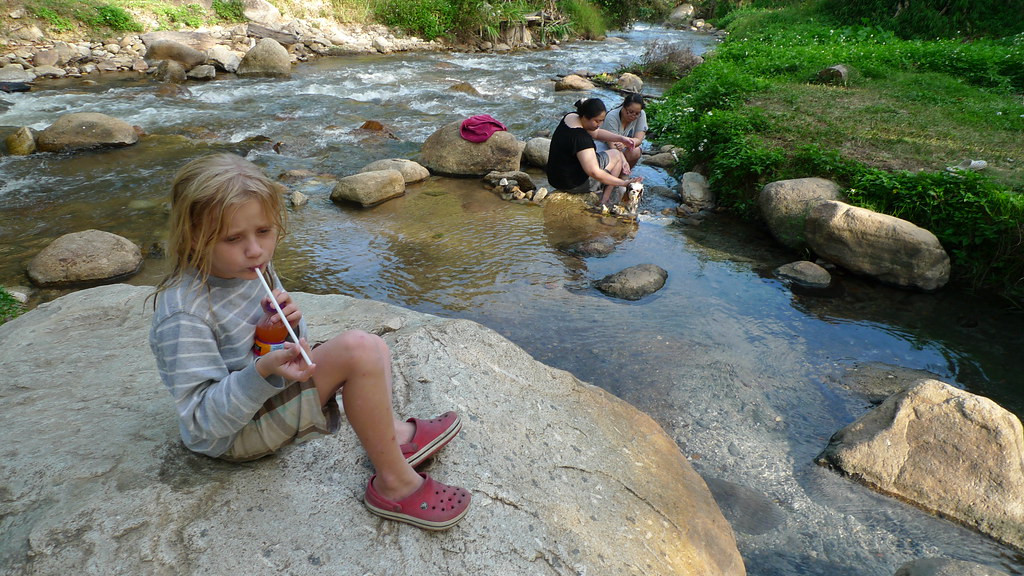
'The hot spring at Chae Son National Park'. 

19th December 2011 By Scorchamac

Regional
A short uploaded video of a newish hot spring near Berastagi, North Sumatra, Indonesia. 

An extensive blog on Selayang hot spring, Malaysia. Conclusion: 
'From my point of view, it is worth paying the entry fee [less than a $US] and get to use the natural hot spring for unlimited time and volume of water (as long as you are happy)! So, do visit there and have fun!'
Vietnam News reports (13 april 2012) that medical tourism needs enhanced promotion. Their readers respond.  Le Van Nhat, Vietnamese from Hanoi: 
'Last year I had a trip to the mountainous province of Son La. I was exhausted after a quite long journey from Ha Noi. Local people recommended that I should go to a natural hot spring at the nearby village to rest and restore my energy.
I decided to go there, dreaming of a relaxing time wallowing in hot water.
But I was totally disappointed.
The water was not hot as I expected and the bathroom was dirty with cobwebs. It seemed that the bathroom had not been cleaned for years. And there was no other tourist except for me.
I do not expect significant development of medical tourism in Viet Nam if things remain unchanged'. 
The dilemma of soaking in Southeast Asia: it's seldom that wild and natural is combined with sanitary. And the expectations of locals of a soaking Disney World. Then again if vexed by cobwebs then maybe one should stay at home.

More bad experiences, this from the Philippines: 
'Today I went to Dauin Hot Spring and Beach Resort, around 2 hours away from our place in Valencia. ... When I arrived, the pool with the hotspring water wasn't filled so they had to fill it up and it took them like the whole day. .... 
The water was ground water .... 
I spent something close to P500 ($12 US) for the afternoon stay, with the "hot spring" only 2-feet deep!'The upside: 'Still, it was a luxury for me as I was able to spend time with myself'. 
!

A mud bath in Nanjing, China, brings some strange customs to the fore. Laura the explorer
'I don’t have many pictures because they had a strict rule about photos.  It’s curious – the Chinese are fairly modest in public, but in private it’s completely different.  The only person wearing a bikini at this place was one of the teachers, and everyone walked around wrapped in a towel.  They don’t want pictures of people in bathing suits.  However, in the change room, people let it all hang out.  I don’t know about the men’s change room, but by now I think I’ve seen more naked Chinese women than naked Canadian women'.
Shanghaiist reports (Mnarch 21) on hot spring developments in Shanghai. No protecting natural soaking sites. No less than around 75$ million will be invested to create 
'... the city's first open-air hot spring resort hotel with a 12,000-square-meter man-made hot spring pool zone'. 
Hmmm, a good development? 

Hot soaks of the Himalaya has highlighted the plight of Gasa Tsachu, Bhutan. The newest development, a road may well be on the cards. 

The outlandish?
New fashions not yet to reach the shores of Southeast Asia: singing. Saunascape reports (13 April): 
'What do a Japanese pop group and a specialized bus in Finland have in common? They’re both all for singing in the sauna!
Rocket News from Japan tells us about OFR48, a new, all-female pop group made up entirely of workers at Ofuros, or urban Japanese bath houses. The OFR in their name even stands for ofuro.
The performances started as a way to make customers feel more willing to approach the staff of the bath houses: An awkward experience because the bath customers are naked. The clothed female workers serve both the men’s and women’s sides of the spa.
The performances began in the bath houses around Tokyo. They were so well received that the group has gone on to perform at larger venues. They plan to release their first single “Our Customers are Naked” in May. Their music video for this performance follows'.
 

After singing, another sort of weird event from Japan. Artist Mariko Sakaguchi manages to take photo's of herself bathing, in her own mobile tub in very unconventional locations, such as in peoples lounge area with the family watching TV, in a meeting room (with employees having a meeting).
Mariko explains
'I am making art works by using photography.
I am trying to cross the sense of private and public, and also now and past by taking bath in old style Japanese bathtub and stepping into photography by myself. You can see I take bath anywhere, It means the place you are seeing my works and also the place you are at now are not off-site.
The place where you are has possibilities to be the scene of my works.
You are not spectator, but party of my work, art.
I want to be a part of art with you all'.
The amusing part is that in every picture you see Mariko bathing you actually end up asking yourself, what are the others in the picture doing?

Final note, another video, this time from Greenland:

Saturday, 4 February 2012

Updating TOPics

Trending topics
Despite first hand reports now to be halted, traffic on this site has tripled in the last 2 months. No indication why though. Thoughts?

Spafinder.com publishes their pitiful attempts to recognize trends for the upcoming year:
  • Focus on feet
  • Icy therapies
  • Coaches (I'm now a soaking coach ...)
  • Online wellness gaming ...
  • Spa food
  • Vibration, sound, music, light and color therapies
  • Glamour
  • The website SpaEvidence.com
  • Spa's becoming family friendly ...
  • Wow spa's, dressed to impress ...
  • Corporate programs
If it weren't for the need to come up with trends every January, what would the real trends be?

A real trend?
While on the subject of new therapies, the
New Zealand Herald gives an in-sight on hot rock therapies.
Ganbanyoku is a hot stone spa popular in Japan, where people spend all day in one - especially during the cold winter months'.
It's origins, states the article, lie in the imitation of the famous soaking Japanese monkeys, who after soaking their time then lie on hot rocks. Saunascape adds that this treatment is becoming very popular with especially young women in Japan.
I myself remember taking a sauna in a small holiday park while on a congress in Germany, nearly 20 years back. After the sauna, we swam in the adjacent pool. Very normal there were the thick stone benches alongside. Under these benches was the central heating system. So, despite the freezing temperatures of the dark night outside we could lie down covered by a towel and regain heat after a long swim, a great experience.

Ganbanyokou doesn't describe whether or not natural stones are needed; in Ranong, Thailand, it was just ordinary cement. The article continues:
'Ganbanyoku is believed to have a detoxification effect similar to low-temperature saunas, and helps to improve the circulatory system and conditions the skin'.
It then describes a 60 minute session at Aucklands Bliss Stone Spa which knocks the visitor back at a rate of 1 $NZ / minute (or 0.8 $US) that while in Ranong where I visited last year the treatment was free!

Growing native Japanese plants in water from hot springs is superior than other water! A research project.

Topsy
Aah, a title tilted to tell?
'10 Cool hot springs areas in Asia'
posted by
hotelclub.com. Three areas are in Japan, two in Taiwan, surprisingly 2 in India (Sikkim and Bakreshwar) and making the list Vietnam (and one of Southeast Asia's premier commercial soaks), Nha Trang.

Vietnam has it's own list,
'Discover the most popular hot springs of Vietnam',
by
indochinapioneer.com. Surprisingly it doesn't list Nha Trang! It does add some interesting info, f.i.
'According to some scientific tests, Kim Boi water resources can reach the required standard for quality; therefore, it proves to be suitable for drinking and bathing'.
More top somethings. Top 12 geysers and hot springs. Asia springs involved are Beppu & Jigokudani (Japan), Valley of Geysers (Kamchatka, Eastern Siberia) and Huanglong (China).Twelve hot springs worth traveling for seems a bit ambiguous. Caption:

'With so many steamy spots to choose from in the world, we’ve narrowed our list down to natural hot, mineral, and geothermal springs in historic, picturesque locations, including two right here in the U.S. Here are some of the prettiest places to jump in and say “ahhh.”'
Including Kusatsu (Japan) and Yambajan (Tibet).

Deep Energy
Well, despite all the hoopla, on Bali geothermal energy seems to be terminated:
'Bali governor Made Mangku Pastika recommended last week that a geothermal power plant proejct in Bedugul is to be stopped and its province to look for an alternative power source, as first exploration didn´t prove to be as successful
He said results from exploration at three sites in Bedugul were not fruitful and had led to the destruction of four hectares of protected forests. “It’s difficult to green-light the continued destruction of what little forests we have left in Bali,” he said.
Pastika said another reason for his recommendation was that the areas in question were regarded as holy sites by Balinese Hindus and contained 30 temples.l ... '.
Elsewhere in Indonesia (Baturaden), permit troubles. Think Geoenergy highlights how the potential of geothermal energy in Indones1a is being hampered by politics. Despite this Pertamina's geothermal arm might go public.

Regional
Thailand

  • A complete photo set by Noporomises23 on San Kamphaeng hot springs, about an hour out of Chiang Mai.


'Hot springs near Phrao [Thailand]'.
By
Andrew Smith.
Vietnam
  • Than Tha (Than Tan) hot spring near Hue, Vietnam, is visited by Hayden:
    'The whole place was dead though except for the workers ... The mineral bath wasnt very warm but the hot springs was actually pretty nice...'.
  • Dak To hot spring, Kontum, Vietnam.
  • Travelfish have a very good entry on Thap ba hot spring:
    'All in all, I would say this was my most relaxing day in the country to date.'.
Indonesia
  • A salt mud volcano? Bledung Kuwu on Java island, Indonesia, according to javaisbeautiful.

News from Burma. Sagar news reports on mud volcanoes erupting and rising temperatures of hot springs after an earthquake.

Laurent Beullac: Toya Bungkah.
A more upscale hot spring resort in Kintamani, Bali, Indonesia? It's not
Toya Devasya


Asia
Who would think that skinny dipping is allowed in South Korea? Malaysian SK Ong reports:
'I had not experienced a hot spring bath but enjoyed it tremendously even though I was not used to wearing my birthday suit in front of strangers'.
Well he then continues:
'I spotted the swimming pool and without further thought, immediately jumped in. Oops, too late. I heard children, men and women splashing and screaming at the other side of the pool. This was a public pool! And I was still in my birthday suit!'
Difficult (and often contradictory), these local customs ....

A link to a video of winter swimming in Khingan Range in China. Icy waters are never a good prospect. Whenever I visit a local sauna, I tend to skip the cold bath, not nice. However the prospect of a hot soak afterwards entices 'swimmers on Thursday [to defy] the severe cold to jump into a pool at a local scenic spot.

Weird?
'Tourists will get discounts on prohibited open spas, house and camp services in Lujiang county, Anhui province. A prohibited open festival is reported to open after this month and will attract many tourists. Local tourism authorities pronounced yesterday that a use discounts will be offering to pull tourists to Lujiang during a festival, People going to a 4th “Hot Springs Benefiting Health” festival jubilee will design to see a indication show, a poem contest, a low-pitched luncheon and a county tour'.
How to get more visitors? By adding a hidden element of secrecy? A hot spring near Guangzhou, China adds pr material with video's of girls with tattoo's smoking while enjoying a soak with lots of bubbles ....

GoCNN has a write up on Tokyo's hot springs. How do we sell the article?
'Hot-spring superstar Beniko Yamada takes the towel off the (extended) city's greatest soaks'.
How can we resist the towel disappearing act? Her superstar status is due to the fact that she has soaked at nearly 4000 hot springs! She even has her own
app.

Globally
Britian admires it's Bath hot springs. Not faraway from these are the Taffs Wells , near Cardiff, which are neglected and ruined. Why, no body seems to have clue. So, according to
BBC now is the time to rejuvenate the site.

It's not often that hot springs from the African continent catch our eye. Tunisia-live.net has it's own article on their nation's soaks, which by the looks of it number slightly more than 10 ...

Thursday, 12 January 2012

The end?

With over 50 original postings and proving to be the premier destination for information on bathing in hot springs in Southeast Asia, it seems the posting below will possibly be the last original posting for the time-being.

Since a couple of months I have relocated to Europe and seem to have less and less time to pursue my own pursuits and passions, let's hope it won't last for that long ...

This site will remain and will constantly be updated, but let's say less regularly than before. Because as the soaking family has expanded way beyond what I had originally intended, keeping the blogs updated and interested will be very challenging. Even now avid follows are hoping I will chase down more natural soaks in Europe. Alas Europe has done it's best to tame nature such that soaking it the real sense can only take place in more remoter parts of the continent. Let's see!

Maybe it's also time to organize soakers and present to the policy makers and the development elite that hot springs are best enjoyed pristine. Considering the amounts of money poured into the geothermal advocacy, a small cash line to proponents of keeping the soaks as they were could lead to win-win situations.

Anyway that's just my thoughts, let's shift our focus to Thailand, to one of the best hot springs I have visited:


The town, néé the province of Ranong, is synonymous with hot springs. However this link is entirely focused on the existence of
Raksawarin hot spring, located not far from downtown Ranong. Developed and overdeveloped, this hot spring is ....

Read more in Soaking in Siam to see whether or not Porn Rang can be rated as one of Southeast Asia's best hot springs!

Saturday, 10 December 2011

Slurpy


The lesser developed
With the differing levels of to-be-expected development concerning hot springs in Thailand, there seems to be no rule, bar one: the more remote, the less developed. But even this rule will have to thrown out of the window.


Chaiya district's (Surat Thani province) distant claim to fame is the Suan Mokkh temple. Established just 50 years ago (or earlier) this forest temple was home to Ajahn Buddhadasa Bhikkhu, one of Thailand's most famous monks (source).

But besides the attraction of the road side temple complex, just a one km walk away is a hot spring; delitefully ...

Read the full entry on Soaking in Siam.

Wednesday, 9 November 2011

Bombs, nuclear bombs, eve, jokes and belief: an update

Soaking in Southeast Asia has added another couple of last hot spring reports, just a few more left ...

A potential terrorist threat?
Meanwhile, it's not often that a hot spring / wellness issue hits the front pages, but Britain's the Sun news(?)paper lead story on the 18th of October concerns the
'virus bombs'
that are fish foot spa's, aka Dr Fish. Luckily the story actually determines that the risks are
'extremely low'.
Energetic discussions
Not only are soakers cautious on geothermal energy development, headlines by bloomberg (September 18, 2008!) suggest that naked bathers are staging protests in Japan! Not a handful, but
'millions of naked bathers'.
However the article does little do substantiate the claim of staging protests and why specifically naked bathers are opposed to geothermal energy (are textilites pro?). The article does once more highlight the difference in interests concerning thermal waters and the lack of possible consequences that geothermal power production may well or not have on other uses.
Better documented is the Guardian's reporting from 2009, though now the soakers are in a lather!
'Geothermal developers insist that power plants and Japan's thousands of spas - or onsen - can happily coexist. But the 7,400 people of Kusatsu, more than 90% of whom depend on the tourist trade for their living, are not convinced. The fear that energy development will rob the town of its precious supply of hot, mineral-rich water has propelled them to the forefront of the anti-geothermal movement'.
A case in hand is just a snippet of very recent news from energybusinessnews.com.au which actually misleads readers in thanking that developing the Innot hot spring into a geothermal plant will create a spa resort, despite Innot hot spring already being a well-visited tourist site (see onsen soaker's review)!
And then back to what this blog is about, the current day. The Daily Telegraph runs a blog (October 28, 2011) on how geothermal energy will be the answer to Japan's nuclear problems.
'Such a measure would invariably face opposition from the powerful “onsen” lobby – but would clearly mark a step in the right direction in terms of Japan finally tapping into the potential of one of its most powerful but overlooked natural resources'.
Surprisingly more than 70 persons comment on the blog.


Another two days earlier none lesser than the
Wall Street Journal (October 26 2011) again looks at the issues at hand, but with reference to Indonesia. Poor regulation are hampering the investment in geothermal energy. And then there is this:
'Some projects have been delayed by local politics. Geothermal start-up Bali Energy, on the resort island of Bali, started exploration close to 15 years ago and received most of the necessary approvals in the 1990s. Its plans to rev up production several years ago hit a bump when some groups expressed concern that tapping geothermal wells would drain a nearby lake. Hindu leaders, meanwhile, worried that meddling with nature’s pressure points could anger the gods'.
And pointing to the Lapindo mess (see below), the Hindu leaders may have a point ...

Finally another threat, mentioned from the Borneo Post (November 1). Melaka's chief minister is eying up the potential of his state's two hot springs for commercialization as spring water. It would even
'generate good income for the people'.
Stuff the soakers?


Risk management

Though geothermal mud usually has medicinal qualities, the
case of Lapindo in Indonesia illustrates how the lack of geological know-how and a gun-ho mentality can have severe adverse consequences.
The human tragedy is yet to be addressed, but the Indonesian government is
reported to be lining up $2 billion as compensation.

Back to nuclear and geothermality.
Revitalizing Fukushima's onsen's is highlighted by the
need to get Hula girls to the front. A past ploy to stand out from the crowd was to use Hula girls to attract customers to the spa town of Iwaki. With the re-opening of the local soaks imminent the Hula girls will need to attract previous customers and somehow let the visitors forget how close they are to Fukushima ...

Claims to fame
The Dead Sea, though not geothermal, has it's own medicinal qualities due to it's high salt content and it's mud. Less well-known are China's own versions of the Dead Sea. Highlighted by a recent posting on
factsaboutchina.com there is Daying in Sichuan (a multi-million $ resort pumping salty waters from 3000m depth; a great success as it is now granted the accolade 'world's most packed swimming pool'!), Yuncheng in Shanxi (or Salt Lake City, apparently a lake with medicinal mud) and Shouguang (Shandong, a 'don't sink lake').

Planet's most incredible and exclusive hot springs
contains a few Asian inclusions (Kamuiwakka, Beppu, Yangbajing, Oymyakon and Betiou) but none from Southeast Asia. Asia's strangest spa therapies lists durian rubdowns and Buddhist massages though why the latter is included is unclear. A list too far? Twenty truly odd relaxation techniques has hot stone therapy (seen in Ranong), cupping and Dr Fish.

And on October 31st Getty Images runs a picture of 14,325 soakers in Chongqing China.


Bloggosphere
Malaysia
  • Another condemnation of Bentong hot spring posted by Leven Woon:
    'The spring has gone to seed; it was filthy and several used condoms could be seen on the ground'.
    He asked the local council why so? As always they deflected responsibility and looked at the bright side:
    '“But beginning last year, the state awarded the management contract to Suria Management Berhad,” he said. He [Bentong Municipal Council urban planning department head, Affandi Razali] added that the company is now surveying the land and will soon clean up and revamp the place. “They will build a resort and a conference room at the place, and start imposing door fares at the gate,” he added'.
    Oddly enough, on the internet just the one link to this company. Now two ...
  • So instead visit another nearby hot spring, like ummmm ..., Selayang. Kenneth says reports that the third well is least hot but the reason for its' under usage is as follows:
    'We were told that people normally urinate in the well while soaking in it. Didn’t feel the need to find out for ourselves, so we avoided that one like the plague'.
    Despite this he manages to have a good experience and makes mentions of the possible positive attributes of this spring. He likes it so much that the next week Kenneth makes another pleasant visit.
'Les pieds dans l eau et le souffre, 45 degres !'
By Tonio et Marion, Dieng, Java Indonesia.

Indonesia
  • Bali soaking goes upmarket with the Ayu Kintamani Hot Spring Private Villa, eight suites (some?) with hot spring jacuzzi's. tripadvisor?
    'The hotel is a joke'.
  • Visiting hot springs can turn deadly. On their way to Ciater a traffic accident killed 4 potential soakers.
  • Despite Indonesia being a densely populated country, there are still hot springs to be discovered. This blog, based on an off-chance of encountering a Sumatran Tiger near Kerinici ends up in a very undiscovered and unnamed hot spring:
    'There I am alone in the jungle with nothing but the sound of running water and the melodious chirping of birds. Something about standing naked in the Sumatran jungle makes one feel a bit like Adam in the garden of paradise. Unfortunately, Eve was nowhere to be found'.
    And no tiger either, a very enjoyable read.
Singapore
  • In Singapore more of the same. Wildshores blogs on a rare plant trek by involves the off-chance of discovering the
    'fabled hot spring'.
    Alas?
    'I managed to reach this series of pools with white stuff on the ground. The water in most of the pools were cold, but in this one, the water was quite warm! I didn't smell any sulphur though. Is this the hot spring that Dr John Yong told me about?'
Thailand
  • Another newish find, Phra Nang Waree Raksa, a private resort near Klong Thom hot spring, Krabi. Bangkok Post (24 September 2009) has a nice write up of a visit there.
Philippine
  • Soaking is healthy science tells us. In Los Baños there is also the belief that the waters can heal.
A final note, though Asia prides itself on hot spring eggs, Italians are reknown for hot spring spaghetti ..
Related Posts with Thumbnails
Copyright 2009 © Soaking in Southeast Asia. All rights reserved.
No reproduction or republication without written permission.